Advocate for the Vulnerable, Food & health Policy Development; Founder/CEO, Food Security Magazine, Initiator/Proponent of the Generic Health & Fig-8 Economy.
@officialABAT@KanyeTagbo Thotful, Mr. President. Congratulations tenacious audacious and brilliant Kanye. This is just the beginning for you.. May God continue to bless and guide you!
@Benchovic@BashirAhmaad I am not and will never support lawlessness, particularly involving human life. But the issue is that there is no law/ justice in Nigeria. So people are tempted to take laws into their hands. We must # JUDICIARY, LEAD US NOT INTO TEMPTATION! It's cross-cutting.
Let it trend!
@JanisOmorogbe@obyezeks@NatashaAkpoti You can woo, no problem. But when a no translates into intimidation, oppression and suppression that is when there's an issue.
...despite external factors like economic barriers and natural disasters? What actions can be taken to specifically support women, disproportionately affected by food insecurity, in contributing to food security solutions?
It is not enough to ratify international documents; we must carefully examine them and ensure we follow through as if our lives depend on them—because they truly do.
FOOD SECURITY CHANNELS TV
I applaud your determination and unwavering commitment to providing crucial food security information and assisting the government and citizens in effectively tackling food insecurity and hunger, particularly the Ending Hunger in Nigeria program.
We have moved beyond rhetoric, repetitions, and blame regarding familiar issues such as production and insecurity. While these concerns are significant, there are more potent and dynamic factors affecting food security.
Presently, about 30 million people are food insecure, with projections indicating that this number could exceed 40 million during the upcoming lean period and over 60 percent of this population are women. Added to this is pressure from the Internally Displaced Persons (IDPs). This has been a known issue for over a decade and a half, which suggests that no new or effective strategies have been implemented. It is unreasonable to expect change while continuing to apply the same approaches. The situation might demand more re-examination and the use of actions and strategies that have never been used.
**Challenges of the Food Security Program**
Food security is defined as existing when all people, at all times, have physical and economic access to sufficient, safe, and nutritious food that meets their dietary needs and food preferences for an active and healthy life. This definition challenges conventional reasoning. The program allows for no excuses:
- **All people**—the program must ensure that everyone, regardless of poverty or economic barriers, has access to food. Just as billionaires and world leaders eat well, so should those in poverty, including those struggling on the streets.
The program must guarantee access at all times, regardless of lean seasons or external crises, such as natural disasters or geopolitical conflicts. The agreement states that access must be available at all times, with no exceptions. How can this be achieved?
Furthermore, food must be available, sufficient, safe, and nutritious. It must also cater to dietary needs and preferences to support active and healthy lives. How do we ensure that food meets these standards?
In addition, we must consider strategies to integrate these factors to promote well-being for everyone—men and women, young and old, active and inactive groups, and the immunocompromised. This is indeed a daunting task that requires unifying various components. Without this integration, we cannot make progress. It has been a decade and a half without significant change in the lives of our people. Our goal is to achieve a healthy life which is synonymous with well-being.
As mentioned, the program is powerful and dynamic, with measurable outcomes—well-being cannot be overlooked. In a way reminiscent of biblical commandments, such as the one in Exodus 20:12 and Deuteronomy 5:16, which instructs to honor one's parents and is coupled with a promise, food security comes with its promise—wellbeing, that is certain, viable, and measurable.
The complexity and challenges of this subject often lead people to avoid it and conflate it with agriculture. We have not taken the time to examine and reassess the concept. Instead, we blame factors that we know are not easily shifted. What factors exist on the ground, and how are we utilizing them? With 30 million people already facing food insecurity, and with projections of that number increasing—primarily affecting women—this threatens the integrity of family structures and food security.
Even in biblical times, questions were posed: God asked Moses, "What do you have in your hand?" and Prophet Elijah asked the woman of Zarephath, "What do you have in your house?" We must ask ourselves similar questions and act with the mandates of this program.
The question now is what specific new strategies can be implemented to address food security challenges? How can we ensure that all individuals have consistent access to sufficient, safe, and nutritious food despite
FOOD SECURITY /CHANNEL
I applaud your determination and unwavering commitment to providing crucial food security information and assisting the government and citizens in effectively tackling food insecurity and hunger, particularly the Ending Hunger in Nigeria program.
We have moved beyond rhetoric, repetitions, and blame regarding familiar issues such as production and insecurity. While these concerns are significant, there are more potent and dynamic factors affecting food security.
Presently, about 30 million people are food insecure, with projections indicating that this number could exceed 40 million during the upcoming lean period and over 60 percent of this population are women. Added to this is pressure from the Internally Displaced Persons (IDPs). This has been a known issue for over a decade and a half, which suggests that no new or effective strategies have been implemented. It is unreasonable to expect change while continuing to apply the same approaches. The situation might demand more re-examination and the use of actions and strategies that have never been used.
**Challenges of the Food Security Program**
Food security is defined as existing when all people, at all times, have physical and economic access to sufficient, safe, and nutritious food that meets their dietary needs and food preferences for an active and healthy life. This definition challenges conventional reasoning. The program allows for no excuses:
- **All people**—the program must ensure that everyone, regardless of poverty or economic barriers, has access to food. Just as billionaires and world leaders eat well, so should those in poverty, including those struggling on the streets.
The program must guarantee access at all times, regardless of lean seasons or external crises, such as natural disasters or geopolitical conflicts. The agreement states that access must be available at all times, with no exceptions. How can this be achieved?
Furthermore, food must be available, sufficient, safe, and nutritious. It must also cater to dietary needs and preferences to support active and healthy lives. How do we ensure that food meets these standards?
In addition, we must consider strategies to integrate these factors to promote well-being for everyone—men and women, young and old, active and inactive groups, and the immunocompromised. This is indeed a daunting task that requires unifying various components. Without this integration, we cannot make progress. It has been a decade and a half without significant change in the lives of our people. Our goal is to achieve a healthy life which is synonymous with well-being.
As mentioned, the program is powerful and dynamic, with measurable outcomes—well-being cannot be overlooked. In a way reminiscent of biblical commandments, such as the one in Exodus 20:12 and Deuteronomy 5:16, which instructs to honor one's parents and is coupled with a promise, food security comes with its promise—wellbeing, that is certain, viable, and measurable.
The complexity and challenges of this subject often lead people to avoid it and conflate it with agriculture. We have not taken the time to examine and reassess the concept. Instead, we blame factors that we know are not easily shifted. What factors exist on the ground, and how are we utilizing them? With 30 million people already facing food insecurity, and with projections of that number increasing—primarily affecting women—this threatens the integrity of family structures and food security.
Even in biblical times, questions were posed: God asked Moses, "What do you have in your hand?" and Prophet Elijah asked the woman of Zarephath, "What do you have in your house?" We must ask ourselves similar questions and act with the mandates of this program.
The question now is what specific new strategies can be implemented to address food security challenges? How can we ensure that all individuals have consistent access to sufficient, safe, and nutritious food despite
We must identify critical areas of need. Nigeria’s vital signs have always been very low compared to most African countries. There is increased wasting, stunting, maternal and child mortality, and morbidity. A further breakdown into regions and states reveals the most vulnerable states. I know some of us have current situation reports on this. Feel free to share. Low productivity directly correlates with increased dependence on the influx of counterfeit drugs and puts pressure on the health sector.
Each new month hundreds of children are born in the IDPs. These children are Nigerians too. Their arrival must be keyed into our programs; they are Nigerians. What do we do? But look around you- there is always provision we can put together and adjust to the new life. It’s not just knowing the problem, it is how to strategize to overcome it. Given our unique circumstances, we must adopt innovative, ordinary, or never been tried before. Our nurses must have passion, expertise to strategize, and a system to build a strong network and lasting structure to endure a long. Significantly, the most valuable things of God come cheap. Perhaps, and in the long run, it will be far better than the encased womb.
The First Lady is strategically positioned to play a critical and pivotal role in addressing the prevailing economic challenges and addressing and catalyzing recovery efforts. Effectively confronting and addressing these hardships necessitates a combination of passion, strategic insight, and a robust operational framework that effectively utilizes her extensive network.
By leveraging her established network and connections, she can implement a sustainable model for revitalizing the economy from its core. This initiative will prioritize interventions, particularly in high-density rural areas and communities with predominant vulnerable groups.
Moreover, this strategy transcends conventional political divides, ethnic affiliations, tribal considerations, and religious distinctions. It embodies a comprehensive movement toward substantive improvement and unity, targeting measurable outcomes that benefit diverse communities across the socio-economic spectrum. She is the only person positioned to catalyze this strong ‘Save our Soul movement/mission’.
Senator Oluremi Tinubu,
First LadyFed Rep of Nigeria
CUSHIONING THE IMPACT OF POLICY CHANGES. Not everyone is present at policy-making events, yet we all must face the consequences of these policies.I have always contended that the policy is not the problem but the provision to alleviate its effect. God did not seek this baby’s permission to restructure his life. He knew what was best for it. I am not here to uphold any policy but once done; there is no going back. The cord is severed. The question is: do we have provisions to cushion the transitions? Now that we have screamed and shouted, thrown fits, and are exhausted from all the energy lost, how about upgrading these programs and strategies that will positively impact lives, particularly the vulnerable population?
Consider another scenario: if someone was pushed off a ten-story building onto a floor cushioned with five large stacked foam pads. The bounce would be exciting, perhaps making them want to experience it again. In stark contrast, imagine falling onto a hard mat. The result would be so devastating, likely resulting in severe injuries that would overwhelm orthopedic experts. Where are we in these? Yet, I am not judging.
What strategies or provisions can be implemented to cushion the impact of policy changes on vulnerable populations? First, how can we ensure that diverse voices are included in the policy-making process? What role can our influences play in shaping our responses to monumental changes? In what ways can we adapt existing policies to address unforeseen challenges? Yes, monitoring and evaluation give us a clue to the impact and effect of both policy and its implementation and might suggest adjustments, what to be added, removed, or altered.
Now that expressions of frustration have been vocalized—through outcry and protest—it is imperative to redirect our efforts toward enhancing programs and strategies that can positively influence the lives of particularly vulnerable populations.
The situation presents a significant irony concerning policy implementation and its impact on individuals. It is crucial to understand that the main issue often stems not from the policy itself, but from the provisions meant to alleviate its consequences. The overarching plan acknowledges the need to improve individual lives without requiring explicit consent for change. While I do not endorse any particular policy, it is essential to recognize that once a policy is put into place reversing it might not be feasible. This permanence prompts a critical examination of whether sufficient measures are in place to support individuals during these transitions.
In light of recent expressions of frustration, including protests and public outcry, there is a pressing need to refocus our efforts on developing programs and strategies that can effectively support vulnerable populations.
Several strategies can be employed to mitigate the adverse effects of policy changes on these groups. First, ensuring that diverse perspectives are included in the policy-making process is vital. Engaging various stakeholders—such as community leaders, affected individuals, and experts—can enhance the inclusivity and fairness of policies.
Moreover, our influence can significantly shape effective responses to changes. By advocating for transparent dialogue and collaboration among policymakers, we can foster more comprehensive solutions to complex issues.
Adapting existing policies to address unforeseen challenges is also crucial. Continuous monitoring and evaluation are necessary to assess the impact of the policy and its implementation. This process provides valuable insights that indicate needed adjustments, including what elements to add, remove, or modify. Regular communication from transition agents to the community is essential for fostering trust and ensuring everyone is informed and engaged throughout the process.
Thus, evaluating our current provisions for cushioning transitions is imperative to protect vulnerable populations effectively
We enter life unprepared to embrace monumental policy shifts, yet we seem to adapt to them. Policies change throughout our lives, and we tend to adopt them. We entered life expecting a monumental shift in policy. Change is the only constant. It has always been a part of our existence. We are born into significant and often hazardous change—a monumental policy change we never thought we could survive. Yet, we do. Consider the baby in its mother’s womb, a comfort zone, providing every need-free lodging, nutrition, and warmth. No hassle, just floating about; it's all it has ever known. Then, suddenly and without warning, the baby experiences a harsh and overwhelming force - a contraction- much like a tsunami or a bombardment in a war zone that threatens its very existence and ushers it into the world. The baby screams with clenched hands and kicks as if to say: "I don’t want to be here; take me back".
However, little one, with the umbilical cord severed, there is no going back. But what about oxygen and nutrients? Not to worry; the nurse is here to help. She clears the air passages to ensure oxygen flows into its lungs; it screams and fits activating its heart and lungs. As for food and nutrients, provisions were made from the beginning—the mother's breast milk is ready 24/7. And what about my waste? No problem; do it anytime and anywhere; care is at hand. Exhausted and overwhelmed with all the energy spent, the baby eventually relaxes and adapts to this irreversible environment; accepting change as the pattern towards life.
Policies change throughout our lives, and we tend to adopt them. We entered life expecting a monumental shift in policy.
Change is the only constant. It has always been a part of our existence. We are born into significant and often hazardous change—a monumental policy change we never thought we could survive. Yet, we do.
Consider the baby in its mother’s womb its comfort zone, provided with every need-free lodging, nutrition, and warmth; it’s all it has ever known. Then, suddenly and without warning, the baby experiences a harsh and overwhelming force - a contraction- much like a tsunami or a bombardment in a war zone that threatens its very existence and ushers it into the world. The baby screams with clenched hands and kicks as if to say, "I don’t want to be here; take me back." Listen well, little one, with the umbilical cord severed, there is no going back. But what about oxygen and nutrients? Not to worry; the nurse is here to help. She clears the baby's air passages to ensure oxygen flows into its lungs. The baby's screams and fits activate its heart and lungs. As for food and nutrients, provision was made from the beginning—the mother's breast milk is ready 24/7. And what about my waste? No problem do it anytime and anywhere; care is at hand. Exhausted and overwhelmed, with all energy spent, the baby eventually relaxes and adapts to this irreversible environment. I’TS CUSHION OVER POLICY* Not everyone is present at policy-making events, yet we all are compelled to face the consequences of these policies. An irony indeed! I believe the policy is not the problem but the strategy to avert its negative impacts. God did not seek this little one’s permission to restructure his life. He knew what was best for it. I am not here to uphold any policy but if it’s done it's done. The cord of the past is severed; there is no going back. I have always contended that the policy is not the issue/problem but the provision to alleviate its effect. God did not seek this little one’s permission to restructure his life. He knew what was best for it. The question is: do we have provisions to cushion the transitions? Now that we have screamed and shouted, thrown fits, and are exhausted from all the energy lost, how about upgrading these programs and strategies with yet more functional, practical, and high-programs in the lives of the people, particularly the vulnerable population?
Governance is not all about the person on top. The integrity of the people handling key positions matter. Ms. Ngozi Okoye who was Obi's Commissioner for Finance and Economic development is right now under investigation for criminal acts of forgery, identity theft/crisis, impersonation, Cyberbullying, Insurance and Bank fraud running into hundreds of billions. Entrusting such characterwith such delicate portfolio was certainly a big risk ,
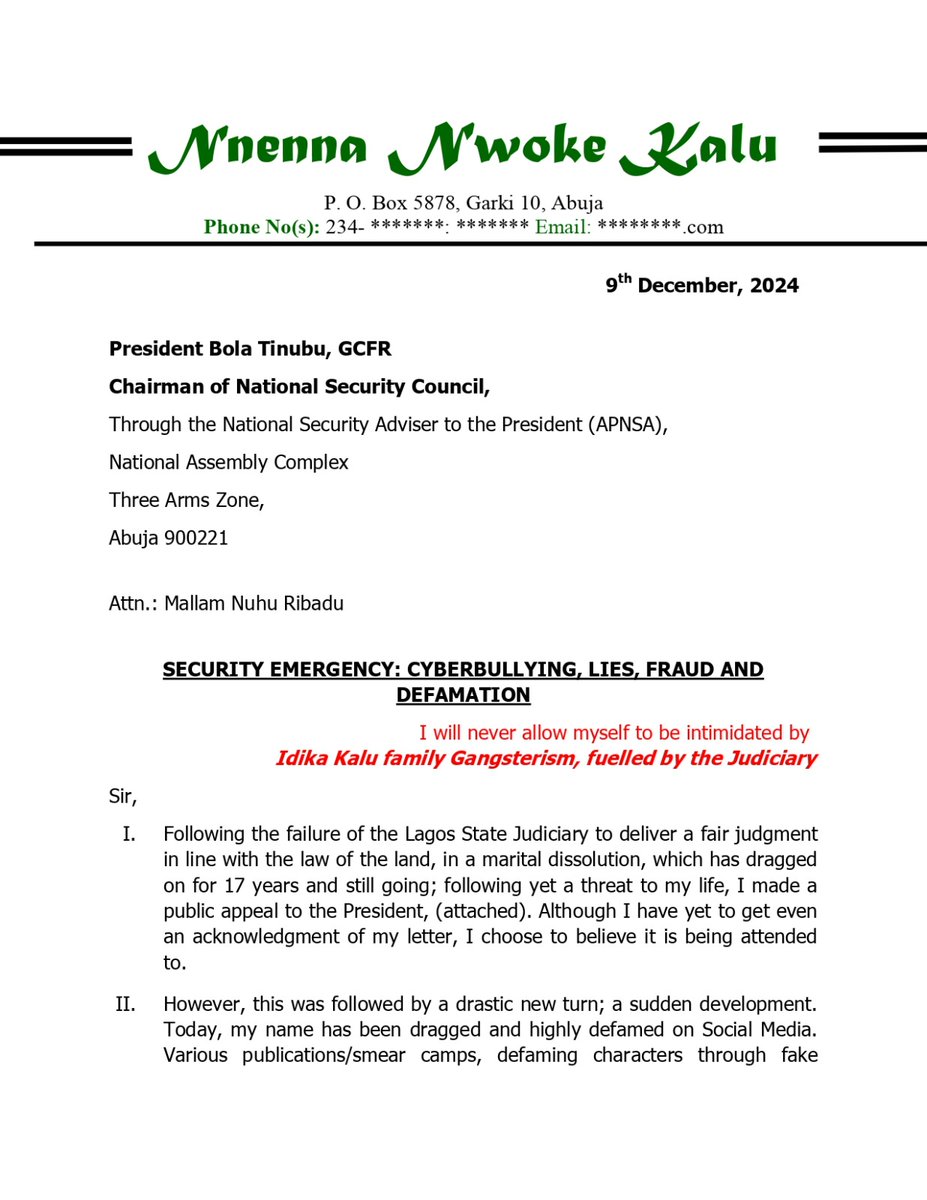
Good day, Dr. Kalu, this is the letter I wrote to the authorities, an extract of which I sent you, not wanting you to read it first from another source. I heard you have been running around to see facts covered as is your assignment to cover the evil of your father's house; never correct them. But if anything has to change I'll call them by their real name -GANGSTERISM becomes Criminalism/ Satanism. There is s level of evil that social position cannot mask or cover . This is one such!