Armenia's Areni-1 Cave, the World's Oldest Winery at 6,000 Years Old, Added to UNESCO World Heritage Tentative List 🇦🇲
➖➖➖
Armenia's Areni-1 Cave, home to the world's oldest known winery, has been added to UNESCO's World Heritage Tentative List. The cave in Vayots Dzor Province holds a 6,000-year-old winemaking installation dating to around 4000 BC, along with the world's oldest preserved leather shoe.
The Ministry of Education, Science, Culture and Sports announced the listing. The nomination, titled "Areni-1 (Birds') Cave: Prehistoric Life and Winemaking in the Arpa River Gorge," was approved during the 48th session of the World Heritage Committee, taking place in Busan, South Korea, from July 19 to 29. Armenia's Permanent Delegation to UNESCO submitted it under criteria three, four, and five.
Armenia is participating in the session as a member of the World Heritage Committee for the first time. The country was elected to the body on November 24, 2025, at UNESCO headquarters in Paris, receiving 105 of 161 votes, the highest result among all candidates for the open seats, and holds the seat for the 2025 to 2029 term.
The Armenian delegation is headed by the country's Permanent Representative to UNESCO, Aram Hakobyan, and includes Harutyun Vanyan, head of the Department for the Protection of Historical and Cultural Monuments at the ministry, along with five national experts.
The nomination was prepared through a memorandum of cooperation signed between the Ministry of Education, Science, Culture and Sports, the Areni-1 Cave Research Foundation, and the Armenian Enotourism Council. The Enotourism Council financed the project.
With the addition of Areni-1, Armenia now has eight sites on UNESCO's World Heritage Tentative List, having added four entries over the past three years to the four originally registered in 1995. The other recent additions are the Vishaps and the Cultural Landscape of Tirinkatar, the Archaeological Complex of Garni and the "Basalt Organ" Columnar Joint, and the Urartian Heritage of Yerevan.
Archaeologist Boris Gasparyan first recognized the cave's significance in 1997, and systematic excavations began in 2007 as a joint project of the Institute of Archaeology and Ethnography of Armenia's National Academy of Sciences, the Cotsen Institute of Archaeology at UCLA, and University College Cork in Ireland. Excavators uncovered a packed-clay pressing platform sloping into a buried storage jar, surrounded by larger vessels filled with grape pips, skins, and stems. Chemical analysis identified tartaric acid and malvidin, conclusive markers of grape wine, and radiocarbon dating placed the installation at around 4000 BC.
The same cave produced the world's oldest preserved leather shoe, found in a plastered pit beneath a ceramic vessel. Measuring 24.5 centimeters and stitched from a single piece of cowhide, it was stuffed with grass to hold its shape and dates to roughly 3600 to 3400 BC, several centuries older than the footwear of the Alpine iceman known as Ötzi.
Excavators also documented ritual and mortuary deposits, including ceramic vessels holding the skulls of children and adolescents, accompanied by offerings such as goat horns, a deer scapula with dried meat, and fish vertebrae.
The cave, known locally as the Birds' Cave, sits in the limestone cliffs of the Arpa River gorge in southern Armenia. Positioned at the natural crossroads between the Ararat Depression and the Syunik Uplands, the site overlooks fertile alluvial lands cultivated for thousands of years with orchards and vineyards.
The cave is a multi-chamber karst system with three main galleries extending more than 40 meters into the cliff. The eastern gallery rises to over 10 meters at its entrance, while the central gallery reaches deep into the bedrock, forming dark, stable microclimates. A steep talus slope leads down to the Arpa River, and an external rockshelter was once reinforced by cyclopean dry masonry. The total interior area is approximately 850 square meters, while the wider cave system and adjacent terrace together exceed 7,800 square meters.
Those conditions gave the cave natural protection and preserved organic materials rarely found in world prehistory. Wood, rope, textiles, leather, plant remains, and even food residues have survived there for six millennia. Human use of the cave spans from the Neolithic through the medieval period, with the most intensive occupation during the Late Chalcolithic, roughly 4500 to 3500 BC. Late Chalcolithic painted pottery in the cave lies directly beneath the earliest Kura-Araxes wares, which marks the start of the Early Bronze Age in the region.
Areni-1 forms part of a wider landscape of caves in the Arpa gorge, where surveys have documented nearly forty caves showing traces of prehistoric use, though Areni-1 is among the largest, richest, and most intensively occupied. Areni village still grows grapes and makes wine on the land below the cave.
Levon Aronian has won the Grandmaster Triathlon at the prestigious Biel Chess Festival in Switzerland, finishing four points clear of the competition to claim one of the year’s most notable chess titles.
The former leader of Armenia’s national chess team, who now represents the United States, secured the overall crown with 25 points after winning both the rapid and blitz tournaments. A fourth-place finish in the classical event proved enough to seal victory.
Les pièges photographiques de la réserve d'État de la forêt de Khosrov ont capturé un léopard du Caucase, l'un des prédateurs les plus rares et les plus emblématiques d'Arménie.
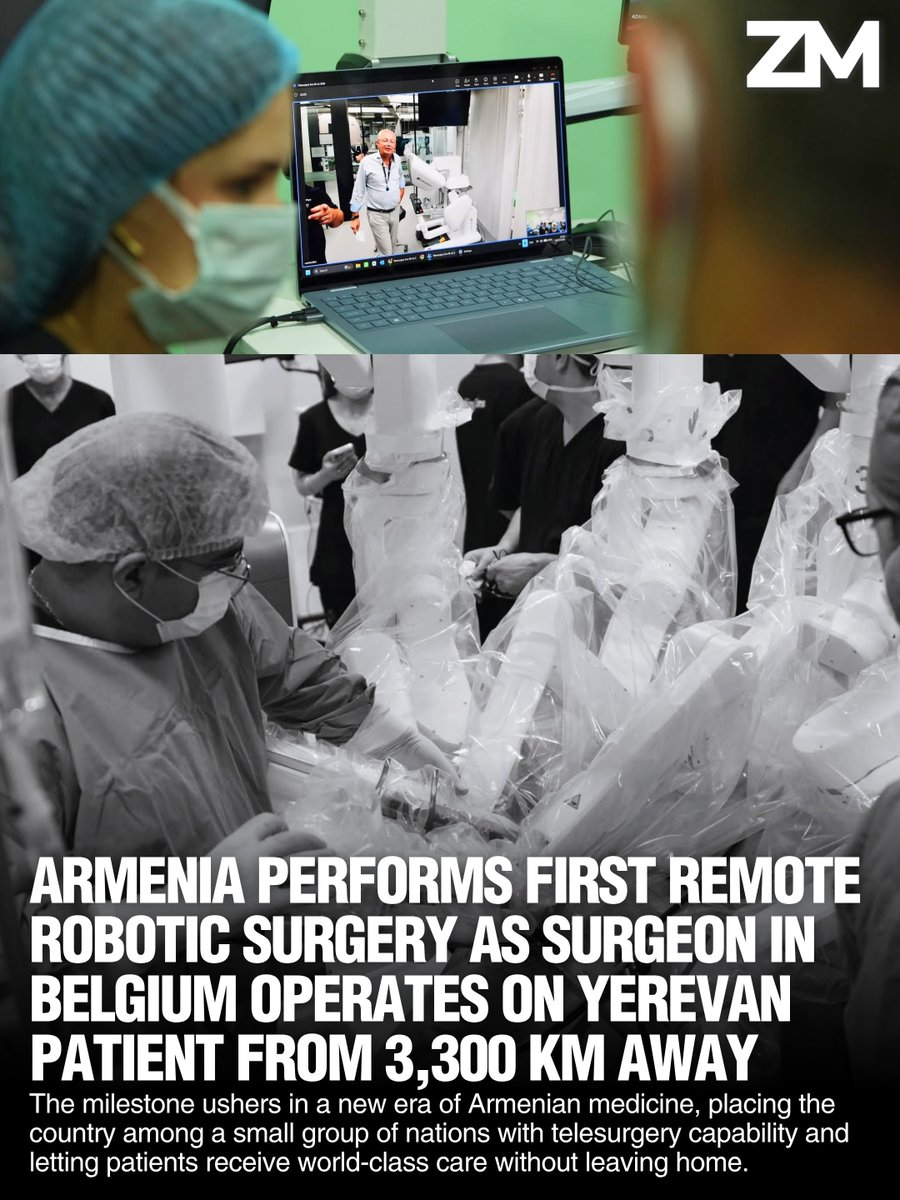
Armenia Performs First Remote Robotic Surgery as Surgeon in Belgium Operates on Yerevan Patient from 3,300 Kilometers Away 🇦🇲
➖➖➖
Armenia has performed its first-ever remote robotic surgery, with a surgeon in Belgium successfully operating on a patient in Yerevan from more than 3,300 kilometers away, marking a new milestone in the country's healthcare sector, according to Armenpress.
The landmark procedure was carried out at SlavMed Medical Center in Yerevan using a surgical robot controlled remotely over a high-speed internet connection, allowing the surgeon to operate without ever being in the same country as the patient.
For patients, the breakthrough carries a practical promise: access to the world's top specialists without the cost and burden of traveling abroad for treatment.
The operation was performed by Professor Alexandre Mottrie — one of the world's leading urologists, Head of the Urology Department at OLV Hospital in Aalst, Belgium, and Executive Director of the ORSI Academy — who guided the surgical robot from Belgium.
The patient, who had early-stage prostate cancer, underwent a robot-assisted radical prostatectomy that was completed safely and successfully.
The achievement builds on SlavMed's December 2025 milestone, when it performed Armenia's first robotic surgeries. This latest procedure marks the country's first remote robotic operation.
SlavMed founder Armine Hovakimyan said, "From the very first day of SlavMed Medical Center's establishment, we have chosen the path of continuous development and improvement by embracing modern approaches and innovation. Performing Armenia's first remote robotic surgery is a landmark achievement for us."
SlavMed was the first medical center in Armenia to introduce robotic surgery and build a dedicated robotic surgical team. The procedure was made possible by the Toumai MT-1000 robotic surgical system — equipped with Armenia's only module for remote surgery — and the clinic's internet infrastructure, which together let surgeons control the robot remotely with precision while ensuring a safe operation. Extensive preparatory work synchronized the robotic systems at the two hospitals.
Mher Mkrtchyan, head of SlavMed's urology department, remained in the operating room alongside the patient throughout the procedure.
"This is a significant milestone because medicine is beginning to transcend borders. Our patient trusted our clinic and our team and chose this option without hesitation. I was present in the operating room and was ready at any moment to continue the operation immediately if any technical issue arose, so there was never any risk to the patient's life or health," Mkrtchyan said.
Beyond Mkrtchyan's presence in the operating room, patient safety was ensured through multiple layers of protection, including backup communication channels in case of connectivity disruptions, with engineering and surgical teams on standby at both locations throughout the procedure.
Levon Grigoryan, head of SlavMed's robotic surgery and endoscopic service, said the accomplishment was made possible by a comprehensive remote surgery system.
"Our goal is to ensure that every citizen of Armenia has access to medical care at the level of the world's leading centers. This system allows the expertise of the world's top specialists to be present in our operating theaters. It also significantly reduces costs for patients, who no longer need to travel abroad and stay there to receive the same treatment," Grigoryan said.
Professor Mottrie praised the cooperation between the two medical teams.
"A good collaboration is absolutely mandatory because we have to be fully aligned. SlavMed has ensured this high standard, reaffirming its role as a leading center in the region. By introducing robotic telesurgery, the clinic enters a new era, and I want to bring my knowledge and experience in robotic surgery into your hospital to give it a head start," he said.
With this achievement, Armenia joins the world's leading countries that offer remote surgical services, SlavMed said, adding that Armenian patients can now receive world-class surgical care at home, without the need to travel abroad.
Supported by SlavMed's medical team and its advanced technology, the surgery marks a new frontier in Armenian healthcare — one in which distance is no longer a barrier to the best care in the world.
@IShowSpeedHQ Christiano deserved better! Actually, he deserved a better Portugal 🇵🇹 team, a team that played together and with passion and used one of the best finishers in the game to get them to the next stage in the tournament!!! It’s a shame it had to end this way for Christiano!
Happy 4th of July! 🇺🇲
Special message from Phil Tourney! 🫡
He is a Real America Hero!
The Government and Media has been silencing him since 1967. Over 60 years of suppression. Only recently was his voice allowed to be heard!
🫡🇺🇲 Must Follow
@PhilPhiltourney@phil_tourney