String theory is what happens when an intelligent system is starved of sensory input and starts hallucinating. Intelligence needs grounding.
For this reason, intelligence is practically never the bottleneck to solving impactful problems. The bottleneck is iterated contact with reality.
I solved 6 open Erdős problems in 5 days, using @OpenAI GPT-5.6 Sol.
I have a math background, but the Codex workflow I used does not require deep mathematical knowledge.
Here’s exactly how I approached it, including my prompts 🧵
GPT-5.2 derived a new result in theoretical physics.
We’re releasing the result in a preprint with researchers from @the_IAS, @VanderbiltU, @Cambridge_Uni, and @Harvard. It shows that a gluon interaction many physicists expected would not occur can arise under specific conditions.
https://t.co/EAZhKWacsG
History just happened.
An AI system has autonomously solved a long standing open conjecture in pure mathematics (Fel’s open conjecture on syzygies of numerical semigroups) building a complete formal proof in Lean with zero human input.
This is the first time in history an unsolved theory level math problem has fallen to AI.
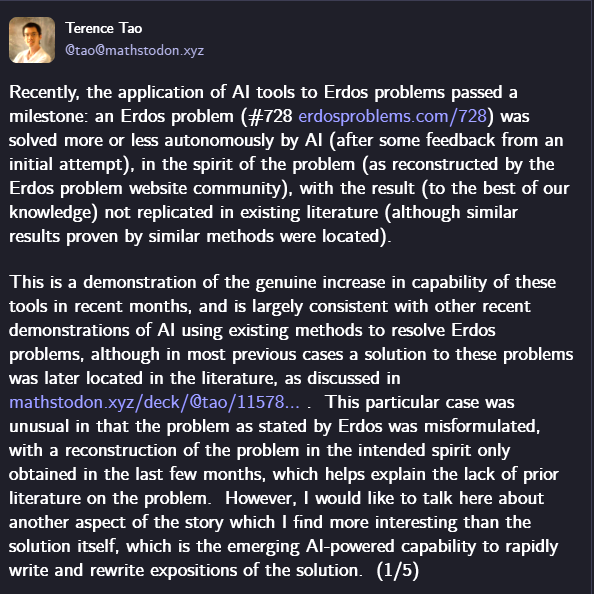
And Erdos problem number 3 has been solved by GPT-5.2 pro (#379). It was accepted by Terence Tao.
I believe the last few days have been the "lift-off" moment for AI science.
Terence Tao confirms:
For the first time, an LLM (GPT-5.2 pro) has successfully solved an Erdos problem on its own.
This makes me really excited for GPT-5.3 pro. Science is gaining momentum, and the breakthroughs are becoming more significant.
GPT-5-Pro just helped prove a new result in quantum complexity theory.
Scott Aaronson, one of the leading minds in theoretical computer science, just admitted that a key technical step in his latest paper came not from years of human struggle but from GPT-5-Pro.
He and collaborator Freek Witteveen needed to understand the behavior of the largest eigenvalue of a nasty Hermitian matrix. Normally this could take weeks of grinding through ideas and literature. Instead, they asked GPT-5. Within thirty minutes, after a few back-and-forths where Scott corrected its mistakes, the model suggested looking at a rational function that captured exactly the behavior they needed. It worked.
Aaronson said if a grad student had handed him the same insight, he would have called it “clever.” The difference is this one came from an AI.
This marks something bigger. Not AI writing essays or generating art. Not AI answering trivia. We are watching it step into one of the hardest and most human intellectual domains: proving oracle separations in quantum complexity classes. AI cannot yet write an entire research paper by itself, but it can help world experts get unstuck on problems that sit at the frontier of human knowledge.
This is not about replacing scientists. It is about changing what “doing science” looks like. If AI can hand you the missing key insight that saves weeks of work, the nature of discovery itself shifts.
A decade ago this sounded like science fiction. Today, it is Scott Aaronson blogging that GPT-5 Thinking just gave him the breakthrough he needed.
We have crossed into a new phase of collaboration between human curiosity and machine reasoning. The ground is moving beneath our feet.
GPT-5 just casually did new mathematics.
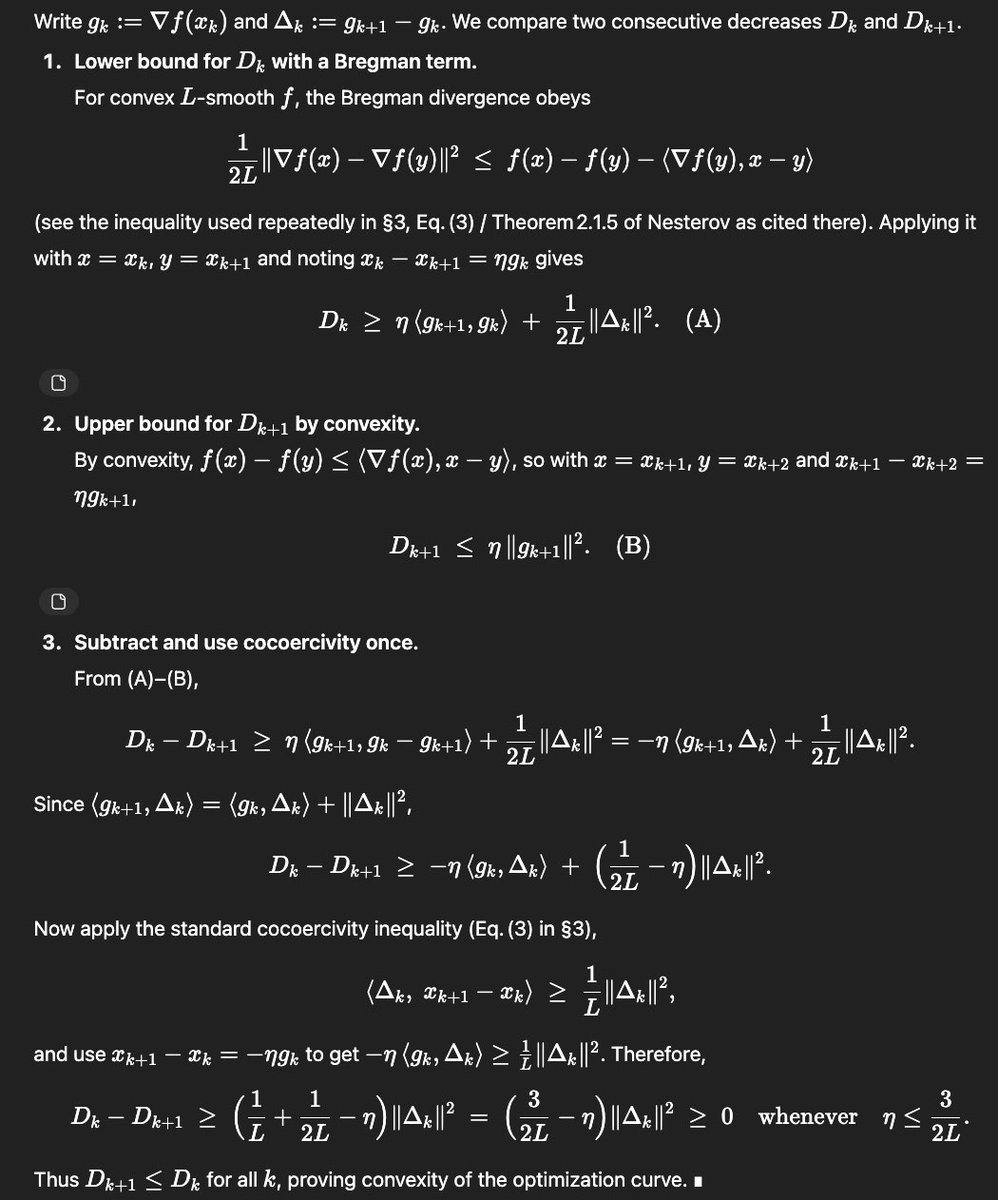
Sebastien Bubeck gave it an open problem from convex optimization, something humans had only partially solved. GPT-5-Pro sat down, reasoned for 17 minutes, and produced a correct proof improving the known bound from 1/L all the way to 1.5/L.
This wasn’t in the paper. It wasn’t online. It wasn’t memorized. It was new math. Verified by Bubeck himself.
Humans later closed the gap at 1.75/L, but GPT-5 independently advanced the frontier.
A machine just contributed original research-level mathematics.
If you’re not completely stunned by this, you’re not paying attention.
We’ve officially entered the era where AI isn’t just learning math, it’s creating it. @sama@OpenAI@kevinweil@gdb@markchen90