A pivotal moment in every RW anon’s life is when, on your quest for answers about why things are the way they are and how the world works, you come across knowledge that has been hidden from you. You soak up everything you can find, and the more you learn, the more the world makes sense. Why nations fail, income inequality, crime rates, IQ, everything starts to click. You conclude that it must be the truth, or at the very least close to it. In the excitement of your discovery, you want to share it with everyone around you and explain how things actually work. You naively believe people want to know the truth. Once you start telling them, you are met with anger and denial. You’re confused, because you’re simply sharing knowledge that disproves their worldview, but the more you share, the more they resist and begin calling you names. That’s when you realize the truth doesn’t matter to the average person, and in a world built on lies, the truth is a dangerous thing to speak.
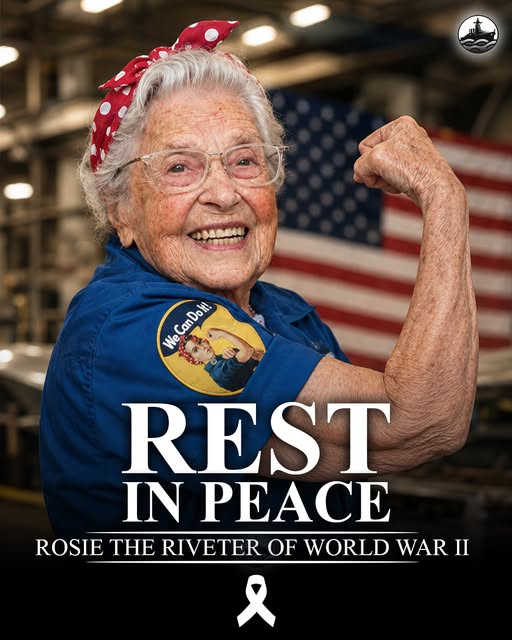
It is with profound sorrow that we bid farewell to Jeanne Gibson, our beloved Rosie the Riveter, has passed away today, July 29, 2026, at the remarkable age of 100. With her passing, we don't simply mourn the loss of a beloved friend, we honor the life of an American hero whose courage, dedication, and unwavering spirit helped shape history, and will continue to inspire generations to come.📷📷
At just 18 years old, Jeanne left her home in Minnesota in the summer of 1944 and answered her nation's call, becoming a welder at Todd Pacific Shipyards in Seattle. With determination and grit, she helped build destroyers that strengthened the Allied war effort during World War II. She later continued her service with the Army Transportation Corps in Juneau, Alaska, embodying the resilience and patriotism of the Greatest Generation.
Yet Jeanne's legacy extended far beyond the war. She earned her Ph.D., dedicated three decades to teaching, earned her private pilot license, and spent the rest of her life proving that courage, determination, and purpose know no age.
In 2024, Jeanne and her fellow Rosies were collectively awarded the Congressional Gold Medal, one of our nation's highest civilian honors, recognizing the extraordinary women whose sacrifices and determination helped secure victory during World War II.
To all of us at Pacific Historic Parks, Jeanne was far more than a Rosie, she was family. She traveled to Hawaiʻi time and again to share her remarkable story with visitors, inspire local students, and ensure that the sacrifices of the Home Front would never be forgotten. Her radiant smile, generous heart, and boundless enthusiasm touched every life she encountered.
She had a special gift for encouraging young girls, reminding them that no dream was too big and no obstacle too great. Through her words and her example, she inspired generations to believe in themselves and pursue lives of courage, service, and purpose.
Jeanne remained a tireless advocate for preserving the legacy of the Rosies, volunteering at Rosie the Riveter WWII Home Front National Historical Park on "Rosie Fridays" and ensuring the stories of the women who helped win the war would continue to inspire future generations.
In one of life's poignant moments, just days before her passing, Jeanne was celebrated with a Wall of Honor banner at the park she loved so dearly and recognized during a San Jose Earthquakes halftime ceremony honoring Bay Area heroes. It was a fitting tribute to a woman whose life was defined by selfless service, quiet strength, and extraordinary grace.
Though Jeanne has taken her final flight, her legacy will never fade. It lives on in every story she shared, every young person she inspired, every life she touched, and in the enduring example of courage she leaves behind.
Our hearts are with Jeanne's family, her fellow Rosies, and all who were blessed to know and love her.
Rest in peace, Jeanne Gibson.
Thank you for answering the call when your country needed you most. Thank you for showing generations what courage looks like. We will remember you always
The fact that foreigners mistake a video from Kentucky for some battlefield makes me proud. Imagine living some place you can’t do shit like this. Also, 99% of foreigners are retarded when it comes to almost anything firearms related.
Never forget that 33 years ago we learned the government will kill your dog, shoot your 14 year old son in the back and snipe your wife in the doorway while she holds your infant child.
#RubyRidge
Imagine being 14 years old, living off the grid in the Idaho woods in 1992. You’re walking your dog when suddenly he growls and *bang*, the dog is shot and killed. You look up and see a man in a Ghillie suit with a rifle pointed at you. Fear grips you. You pull your gun and fire. You’re just defending yourself. This is your home.
You run back toward your parents, only to be shot in the back and killed before you can reach them. You never understand what went wrong or why.
The next day, a sniper fires again. Your mother, standing in the doorway holding your baby sister, is hit in the head and killed instantly.
All of this started because your father Randy Weaver, sold two sawed-off shotguns to an undercover agent and refused to become a government informant. They gave him a false court date and set up armed surveillance at your home, waiting for the moment they could escalate.
Randy Weaver was a former U.S. Army Green Beret. He served in the military before moving off the grid with his family in northern Idaho. His military background added to the tension for federal authorities, because he was trained in weapons and survival, but it didn’t make him violent or a threat to anyone outside his property.
After an 11 day stand off with Randy and the baby inside with two dead bodies, the government was ordered to pay millions in settlements to Randy.
They were proven to be in the wrong for this deadly power trip.
But that doesn’t bring back a 14 year old boy or his mother.
Stay educated. Some of our history isnt taught in school for a reason. 💯
There is a famous photograph from the Korean War of a young Marine officer scrambling over a seawall, rifle in hand, leading his men off the boats and into the fight at Inchon. The man in that picture, Lieutenant Baldomero Lopez, was dead within minutes of it being taken. He is one of the very few people on earth photographed in the last moments of his own life while earning the Medal of Honor.
Lopez was a Tampa kid, the son of Spanish immigrants, sharp enough to earn his way into the Naval Academy at Annapolis. By September 1950 he was a Marine first lieutenant, and he came ashore in the assault waves at Inchon, the daring amphibious landing that turned the whole war around. That is where the photographer caught him, going up and over the seawall at the head of his platoon, straight into the teeth of the beach defenses.
The beach was a mess of enemy bunkers and pillboxes, and one of them had his men pinned down with automatic weapons fire. Lopez did what a good officer does. He went after it himself. He crept up alongside the position, pulled the pin on a grenade, and raised his arm to throw it into the gun port.
At that exact instant an enemy gun caught him, hitting him in the shoulder and the chest. The wounds knocked him backward, and the live grenade fell out of his hand and dropped to the ground right next to his own Marines.
He was badly hit, bleeding, in shock. His arm no longer worked well enough to pick the grenade back up and throw it clear. He had a couple of seconds and one terrible decision to make. He could roll away and try to save himself, and let the grenade go off among his men. Or not.
Lopez pulled the grenade in underneath his own body, wrapped himself around it with a sweep of his ruined arm, and took the entire blast into himself. It killed him. It saved the men around him.
He was twenty five years old. His parents received his Medal of Honor. And that photograph of him going over the wall has hung in Marine Corps history ever since, a young officer forever frozen at the front of his men, seconds from giving up everything so they could live.
She has that Norman-American Indian look you see in Quebec, like a zoomer Shania Twain or Rita Coolidge. For whatever reason, North Carolina, Alabama, and Arizona seem to be their main habitat in the U.S.
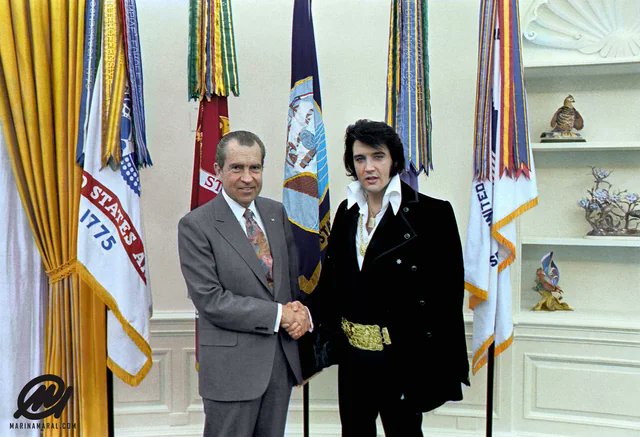
Elvis Presley showed up at the White House unannounced carrying a Colt .45.
He had written President Nixon a long letter on American Airlines stationery during a red-eye from Los Angeles, and hand-delivered it to a guard at the northwest gate at dawn. He was offering his services in the war on drugs. He wanted one thing in return: a federal narcotics badge.
That same morning he had gone to the Bureau of Narcotics and Dangerous Drugs and asked the deputy director for the badge to his face. The man said no.
So he went over his head to the President of the United States.
He came back at noon in a velvet suit and cape. The pistol was a WWII Colt .45 he had pulled off the wall of his Los Angeles house on the way to the airport. Secret Service took it at the door.
Nixon heard him out, looked at his aide, and the aide nodded.
Elvis got his badge. Then he shook the hand of the President of the United States.
The photo is still one of the most requested images in the National Archives.