BREAKING: Brent crude surges past $96/bll for the first time since June 8.
Oil has jumped nearly 30% as U.S. CENTCOM concludes its 12th consecutive night of strikes against Iran.
Global investors have rarely been this bullish:
Bank of America's Bull & Bear Indicator is up to 9.6 points, the highest since December 2020.
The gauge measures equity and bond fund flows, hedge fund and fund manager equity positioning, credit market conditions, and market breadth.
This metric is now at its 3rd-highest level in 24 years, indicating an extremely positive market sentiment.
This comes as 5 out of 6 indicator components show bullish and very bullish readings, with only global stock market breadth at neutral.
The most recent increase in the gauge has been driven by fund manager cash allocation, which has fallen -0.5 percentage points month-over-month, to 3.6%, near the lowest in 13 years.
Investor appetite for stocks has rarely ever been stronger.
Two key events took place today that could provide to be completely devastating for global energy markets. One sparked sirens for people around the globe, and the other has slipped under the radar of many. Both are enormously consequential. And one more looms on the horizon.
1) The closure of the Bab al-Mandeb Strait by the Houthi's
2) The claims of mining of the Omani Route by the Iranians
3) A return of Chinese demand
The reason that the Bab al-Mandeb is so important is because it has been a critical emergency release valve of approximately 4.5M barrels of oil per day. In the early days of the US/Iran War, there was a rapid cutoff of almost 20M barrels of oil when the Iranians closed down the Strait of Hormuz. The ability for Saudi Arabia to utilize the East-West Pipeline to reroute roughly 4.5M barrels per day from the Strait of Hormuz over to the Bab al-Mandeb Strait and out into the Red Sea provided a critical lifeline that has now been severed.
The claims of the mining of the Omani Route by the IRGC today is equally significant, but has not received much attention at all. While the Bab al-Mandeb has been able to move 4.5M barrels per day around the Iranian blockade of the Strait of Hormuz, the ability for the United States to shuttle vessels along the Omani Coastline has also been a significant pressure release valve. By rough approximations, this has accounted for around 4M-5M barrels per day to be moved through the Strait of Hormuz.
Combined between the two, this has been able to alleviate roughly 9M barrels of the 20M that was cut off in the initial days of the closure of the Strait of Hormuz.
There is also a third factor that has proven significant throughout this entire conflict, and that has been the severe drop off in Chinese oil imports. From the data I have reviewed, this has equated to approximately 5M barrels per day of demand being removed from the global markets. Unfortunately, this appears to be quickly returning, with indications that there will be notable spikes taking place over the coming weeks.
The combination of the Omani Route and the Bab al-Mandeb Strait amounts to 9M barrels now being potentially immediately cut off from global markets. If Chinese demand returns... We're right back into total crisis mode, but now with 1.2B barrels already destroyed from the market, a conflict that is rapidly spiraling out of control, and two sides that refuse to budge.
In the best case, today may have seen at least 4.5M barrels of release valve removed. If the Omani Route is truly mined, that become 9M. And with Chinese imports set to rise in the coming weeks...
Things are about to get REALLY bad.
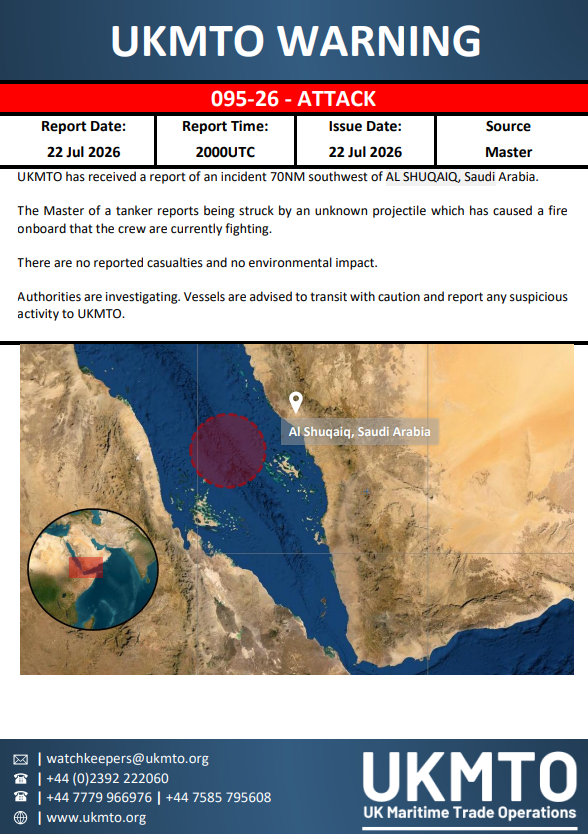
Following reports that the Yemeni Houthis struck a Saudi tanker 70nm west of Al-Shuqaiq, Saudi Arabia, the Houthi military spokesperson has said that they in fact struck two tankers, LAYLA and ENCELIA, for violating he Houthis’ self-imposed blockade of vessels traveling to and from Saudi ports.
Good morning, Asia. While you were sleeping, one of our most-read stories was about Google burning through cash for the first time since going public decades ago as it raised its spending forecast for AI infrastructure. https://t.co/mYimix2GWy
Strait of Hormuz over the last 24 hours: Oman lane is dead.
Visible traffic continues to be nonexistent in the Oman lane, but the Iranians reported that 3 vessels attempted to transit with US escorts only to have one get attacked. The other 2 turned around.
With the Bab al-Mandeb closure now in force by the Houthis, Fujairah enforcement is the most likely next escalation path.
Despite tankers being attacked during their transits through the Oman lane, some brave shipowners and captains are still trying, which means the enforcement has to go to the root cause: Fujairah.
I guess we will see where this is all going, but from an oil math standpoint, this is the endgame now.
Video is from @MarineTraffic
From the @FT:
[Google's] "capital expenditures in 2026 would be $195bn-$205bn, up from previous guidance of $180bn-$190bn. The stock dipped about 3.5 per cent in after-hours trading.
Google’s second increase to its capex budget this year comes as it races rivals Meta, Microsoft and Amazon to build AI infrastructure, with the four hyperscalers combined on track to spend more than $725bn in 2026."
#ai #tech #investment @Google #markets #economy
Additional documentation from the Saudi oil tanker that caught fire earlier after being hit by Ansarallah fire from Yemen.
Saudi Arabia is now being blockaded by Yemen as a retaliation to it's continuous, still ongoing 11 years blockade on Yemen.
Bab el-Mandeb on fire.
As I predicted two days ago, the Bab el-Mandeb Strait is where the escalation will be triggered. It didn’t take long.
The Houthis struck two Saudi oil tankers and it wasn’t merely a warning shot to the rudder; they simply set one of the ships on fire.
This has re-ignited Yemen’s civil war. Saudi Arabia and the Emirates have reconciled and are both reactivating their proxies to attack the Houthis, while the Saudi-backed national government has also opened fire.
Within hours, ballistic missiles are expected to start flying, further escalating the conflict.
Escalation ladder on the oil math:
- Oman lane: 6 million b/d, 2 million b/d UAE, 4 million b/d Saudi/Kuwait/Iraq
- Bab al-Mandeb: 5 million b/d, 4 in crude, 1 in product. Bypass through Suez, loading speed drops (1.5 million b/d)
- Fujairah: 2 million b/d, zero ship to ship
Oman lane and BAM already in play, 7.5 million b/d of crude offline.
Fujairah is the last card. If that’s played, it’s game over.
No idea why tanker owners still risk going there. It’s like shooting fish in a barrel. Terrible risk to reward ratio.
The diesel market is tighter than at any point during this war.
The market is paying:
- A ~$0.80/gal premium for prompt delivery.
- This premium has surged 4x in just one month.
- The previous wartime peak was ~$0.60/gal.
In other words, the market is willing to pay 20% more for diesel today rather than waiting six months.
We don't have enough diesel
Massive bombings continue in an effort to degrade defenses in oil-rich Khuzestan.
U.S. strikes hit a military base near Behbehan Northwest Airport for the second time in little more than a week.
The region is part of American contingency planning for the second phase of an exit strategy.
BREAKING: Iran’s Speaker of the Parliament Ghalibaf says the Strait of Hormuz will not return to pre-war conditions.
“In a region where we do not sell oil, no one will sell oil. If our security is not ensured, no infrastructure will be safe,” he says.
BREAKING: Iran's chief negotiator and Parliament Speaker Ghalibaf in a new statement says the equation of this war is "all or none."
Ghalibaf adds "In a region where we do not sell oil, no one will sell oil. If our security is not ensured, no infrastructure will be safe."
Ghalibaf declares "the security of the strait is in the absence of American forces. We have repeatedly said that the situation of the strait will not return to pre-war conditions."
🚨 THE NEXT GLOBAL MARKET SELLOFF COULD START BECAUSE OF JAPAN.
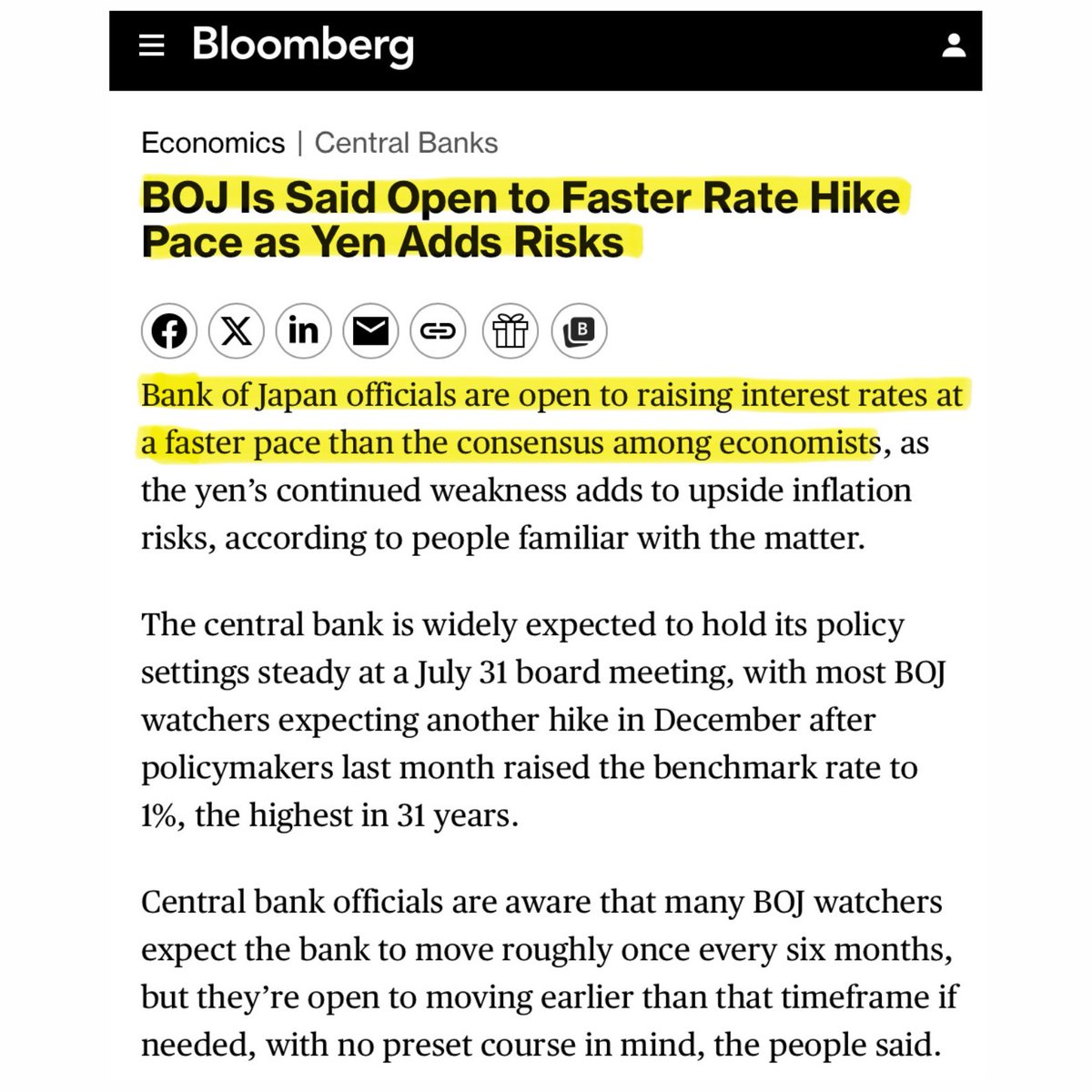
Bank of Japan officials just said they're ready to hike rates sooner than expected, according to Bloomberg.
The reason: the yen keeps falling, and that's pushing inflation risk higher.
The yen just hit its weakest level in 40 years. Right after that, the government warned it might step in.
The next hike was expected in December, six months after June's rate hike.
But officials say they don't have to wait that long. They can hike sooner if needed.
The market is already pricing a rate hike sooner than expected. Traders are pricing in a 72% chance of another hike by October, two months earlier than the usual timeline.
There's another reason for this. Companies are raising prices faster than before, and a weak yen gives them even more reason to keep doing that.
Inflation is now close to the BOJ's 2% target for the first time in 13 years.
A single BOJ rate hike in August 2024 was enough to trigger a massive global stock selloff.
That's because trillions of dollars sit in the yen carry trade, where investors borrow cheap yen and use it to buy higher yielding assets abroad.
Now imagine what a faster, unexpected round of hikes could do.







![elerianm's tweet photo. From the @FT:
[Google's] "capital expenditures in 2026 would be $195bn-$205bn, up from previous guidance of $180bn-$190bn. The stock dipped about 3.5 per cent in after-hours trading.
Google’s second increase to its capex budget this year comes as it races rivals Meta, Microsoft and Amazon to build AI infrastructure, with the four hyperscalers combined on track to spend more than $725bn in 2026."
#ai #tech #investment @Google #markets #economy](https://pbs.twimg.com/media/HN4DdErX0AA-8Fi.jpg)