Criminal! The central government is fully responsible for *murder* of these 20 Covid patients. Yes, these must be treated as murder since the government was busy in elections while it should have been preparing for 2nd wave.
https://t.co/WvuEmoa7UJ
#tradesmen#electrician#techie#tools#utility
Going Live with https://t.co/Inbn1QMVCO
Free, Fast and Reliable unit of conversion; lots of Tools and Utilities to explore. Visit today.... https://t.co/Inbn1QMVCO
With due respect @cmohry sir, saving fuel should be regular practice. You were in Gurgaon today. Your cavalcade had more than 15-20 vehicles, mostly Toyota Fortuners. Surely, you can reduce the count.
प्रधानमंत्री श्री @NarendraModi जी के आह्वान पर मुख्यमंत्री श्री @NayabSainiBJP ने आज चंडीगढ़ में साइकिल से सफर कर "स्वस्थ भारत-स्वस्थ हरियाणा" का संदेश दिया।
सीएम सुबह-सुबह सुखना लेक पहुंचे, जहां उन्होंने मॉर्निंग वॉक करने वाले लोगों से मुलाकात कर फिट और सक्रिय जीवनशैली अपनाने का आह्वान किया।
मुख्यमंत्री ने कहा कि प्रधानमंत्री जी ने देशवासियों से स्वस्थ जीवनशैली को जनआंदोलन बनाने की जो अपील की है, उस संकल्प में जनता से मैं सकारात्मक सहयोग करने का आग्रह करता हूँ।
2010, New Delhi, I was driving home late one night around 1 AM after a family gathering.
I stopped at a red traffic light in Green Park. There were no other vehicles around, just our car.
Suddenly, a BMW pulled up behind us and started honking aggressively, demanding that we drive through the red light.
I pointed to the signal and stayed put.
The driver got out, dressed in a suit, hurled abuses at me, and ordered me to move. When I refused, and picked up my phone, he banged on my window. Eventually he backed off, got back in his car, and sped away by cutting across in front of me. I drove off when the signal turned green.
This is the reality of India, even today: owning a big car, a big house, or having formal education is no guarantee of basic civility, class, or moral character.
This was just one of many road rage incidents in New Delhi/NCR, I experienced before I finally decided to pack my bags and leave the country.
A truly civilized society is one where people follow the law even when no one is watching, and do what is right without needing supervision.
When I moved to Singapore, this is exactly what I saw, people naturally did the right thing. The same held true when I later moved to Europe.
Regarding the recent dancing incident at the airport, many people defended it by saying, “The authorities didn’t have a problem, so why do you?” That’s exactly where they miss the point.
You never know who is sitting on the same flight, someone mourning the loss of a loved one, a person who just received a cancer diagnosis, a parent who lost a child, or someone who just lost their job. When you show such insensitivity in shared public spaces and don’t care about other people’s emotional state, that’s where a society fails.
People often abuse me for raising these issues and quickly brush them aside by saying, “Every country has problems.”
That’s true, every country does have its issues.
But the scale is vastly different. Other countries have 99% civility and 1% assholes. In India, it feels like 99% assholes and 1% civility.
Yes, I agree that no country is perfect, but the proportions make all the difference.
To those who defend such behavior and treat every public place like their personal living room: fuck off.
Latest: On May 10, PM Modi urged us to carpool, use public transport and save fuel.
We tracked his activities since the war began and found: in 70 days, he travelled to 53 cities, attended 81 events across 12 states, including 25 roadshows.
Only 13/81 events were official events. Reporting for @thewire_in with Aashna Ajmera:
https://t.co/kHcSwsYp5W
Dharmendra Pradhan ji, you can attack me all you want but it won’t absolve you of your crimes. Nor will it stop me from demanding answers for 18.5 lakh children.
Why was the CBSE OSM contract handed to COEMPT - a company already mired in controversy under its old name, Globarena? On whose orders was it done? Why were no background checks done? What is the connection between COEMPT’s management and the Modi government?
Either you ran a background check and went ahead anyway - or you didn’t run one at all. Either way, you are complicit.
As for responsibility - if the PM cared, he should have sacked you long ago for ruining the futures of lakhs of students.
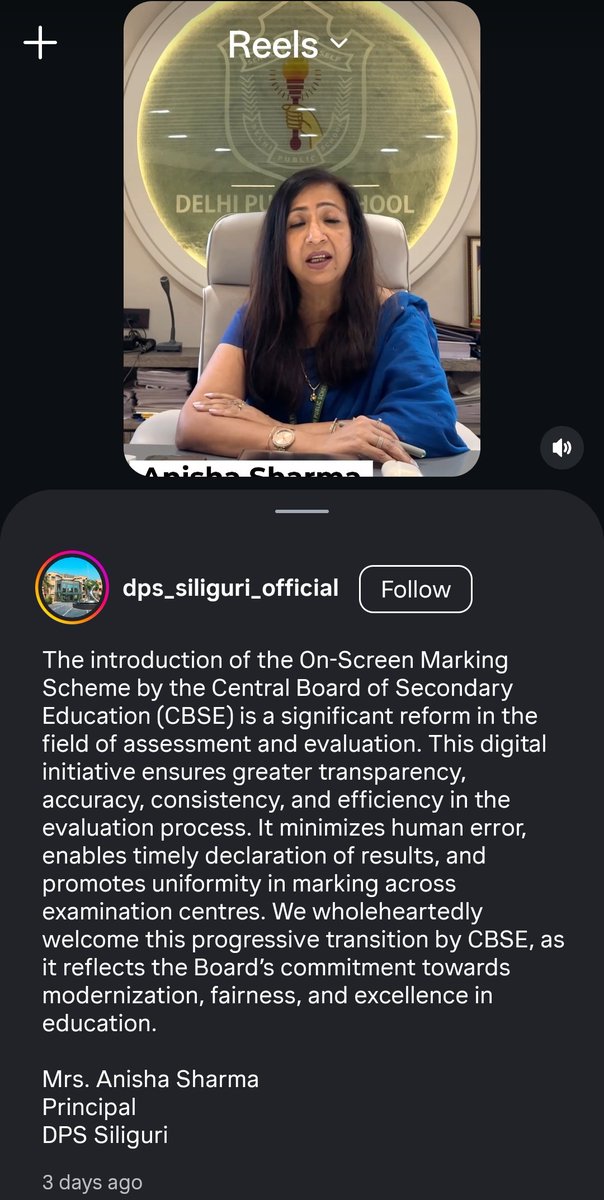
#CBSEToolkit. After mismanaging the entire system, CBSE has now switched to damage control mode. CBSE is sending scripts to school principals to defend the On Screen Marking system. Principals making insta reels repeating the same lines given by CBSE.
1. Principal DPS Siliguri
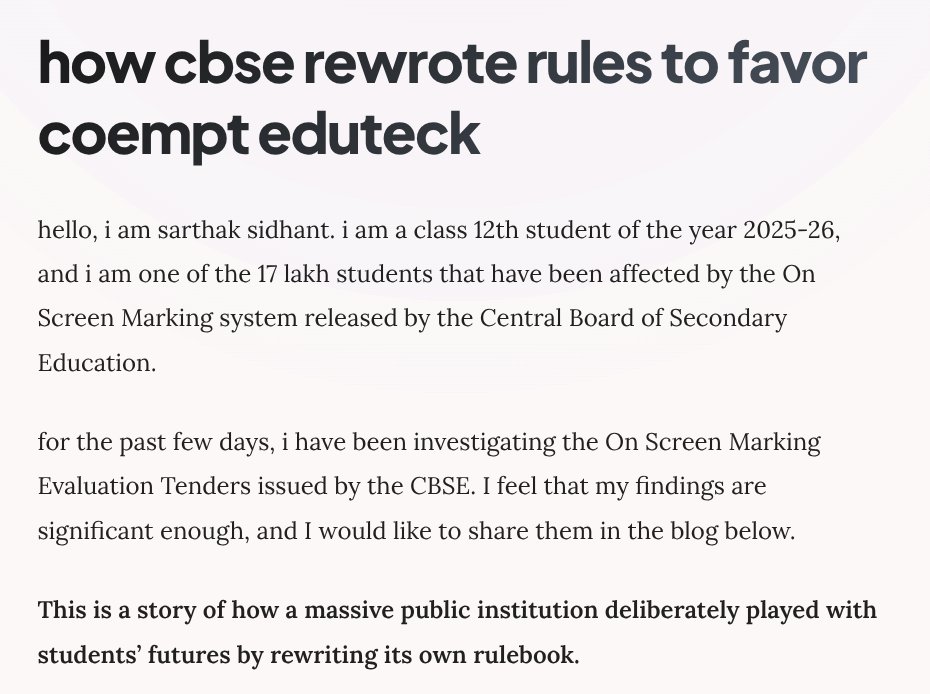
This is an unbelievable piece of work by Sarthak and something that requires amplification.
Let me explain what he found, in simple terms.
Sarthak is a Class 12 student from the 2025-26 batch, one of the 17 lakh students whose answer sheets went through CBSE's new On-Screen Marking system.
He spent days reading through CBSE's evaluation tenders, scraped all 576 tenders CBSE has issued, and tracked how the rules changed across three versions of the same tender.
The core finding is that the company that won the contract to scan and grade 17 lakh students' answer sheets is Coempt Eduteck.
Coempt used to be called Globarena Technologies. Globarena was the company behind the 2019 Telangana intermediate exam disaster, where software failures led to 3.8 lakh students getting wrong or missing marks, and 23 students died by suicide.
A government committee found systemic failure and negligence. Six months later, Globarena rebranded to Coempt Eduteck.
So a company with that track record won a contract to handle 17 lakh CBSE students. Sarthak's investigation is about how the rules were rewritten to let that happen.
The tender was issued three times.
> First tender, February 2025. It existed, then disappeared from the public GeM portal. Sarthak scraped all 576 CBSE tenders and this one was missing from the archive entirely.
> Second tender, May 2025. Four companies applied including TCS and Coempt. All four failed the technical evaluation. Cancelled.
> Third tender, August 2025. Coempt won. Between the second and third tender, a series of rule changes happened, and every single one made it easier for Coempt to qualify.
Here is what changed, one by one.
01. The old rules disqualified any company with a history of abandoning work, failing to complete contracts, or financial weakness. The new rules deleted this clause entirely. Coempt's Telangana history stopped being a barrier.
02. The old rules disqualified any company that was "blacklisted earlier." The new rules changed this to "currently blacklisted." Because Globarena rebranded after Telangana, removing the word "earlier" effectively erased their past.
03. The rules required Rs 50 crore average turnover over three years. Coempt's exact average came to Rs 50.86 crore. They cleared the bar by less than 1%. Earlier, a smaller company had asked CBSE to lower the bar to Rs 30 crore for fairer competition. CBSE refused. So the bar was kept high enough to block small players, but sat exactly low enough for Coempt to scrape through.
04. Software maturity is measured on the CMMI scale, 1 to 5. The old rules required Level 5. The new rules dropped it to Level 3. Coempt is a Level 3 company.
05. The cooling-off period for engaging retired CBSE officials was cut from two years to one. This makes it easier to use recently retired insiders to influence the process.
06. The old rules required experience with large projects of at least 5 lakh students each. The new rules removed the student count and counted cumulative answer-book volume across small projects instead. Coempt has many small fragmented university contracts. This helped Coempt and hurt TCS.
07. The old rules required bidders to own their own data centre and disaster recovery centre on Indian soil. The new rules allowed third-party MeitY-empanelled cloud hosting. Coempt runs on AWS and Azure. This helped Coempt and hurt TCS, which owns its own data centres. It also means student data is no longer on sovereign, Indian infrastructure.
08. The old rules required the bidder to own or control the complete source code of its software. The new rules deleted this. Coempt's platform runs on Microsoft's proprietary IIS, which they don't own.
09. A last-minute corrigendum, issued right before bid submission, removed CBSE's own power to blacklist the firm if its software failed catastrophically. So even a Telangana-scale failure couldn't get Coempt banned from future government tenders.
10. The penalty structure shifted from punishing mistakes to punishing delays. The old rules fined the vendor for wrong scanning, merged pages, and unscanned books. The new rules dropped those and instead levied Rs 50,000 per day for delays. This incentivises rushed scanning over accurate scanning.
11. The old rules had a hard accuracy threshold, error rate not to exceed 0.5%. The new rules removed this number entirely.
12. The old rules specified proper book and robotics scanners. The new rules just say "sufficient scanners." The definition was vague enough that, as Sarthak notes, the scanning could be done with a phone on a stand.
13. On the security side, the contract required a VAPT (vulnerability and penetration test) certified by CERT-In before go-live, and a restricted beta phase before launch. The system clearly wasn't restricted, because the other researcher, Nisarga, was able to access it and find vulnerabilities four days before go-live. So the mandatory security audit appears to have been bypassed.
These are more than a dozen rule changes, all between the failed tender and the winning tender, all pushing in the same direction, all benefiting the one company with the worst track record in the field.
The security holes Nisarga found last week now have an explanation. The system was built by a vendor that was specifically allowed to skip the security certification, the source code ownership, the data sovereignty, and the quality thresholds the original rules demanded.
Following things need to happen immediately;
1. An immediate CAG audit of the tender process.
2. A parliamentary debate on the topic.
3. An independent investigation into
> Why the first tender vanished?
> Why the disqualification clauses were deleted?
> Why the turnover bar was held exactly where it was?
> Why the security level was dropped?
> Why the blacklisting power was removed at the last moment?
Sarthak, this is genuinely exceptional investigative work. Far better than most journalists with full resources ever manage. Take a bow. :)
Ramdev:If there is a price rise,people should work more to fight the price hike & help the govt
Reporter:But Baba you said petrol will be at Rs 40 if Modi comes to Power
Ramdev:Yes,I said it earlier,won't say it now? Kya kar lega?puch ukhadega?
Fraud got triggered!
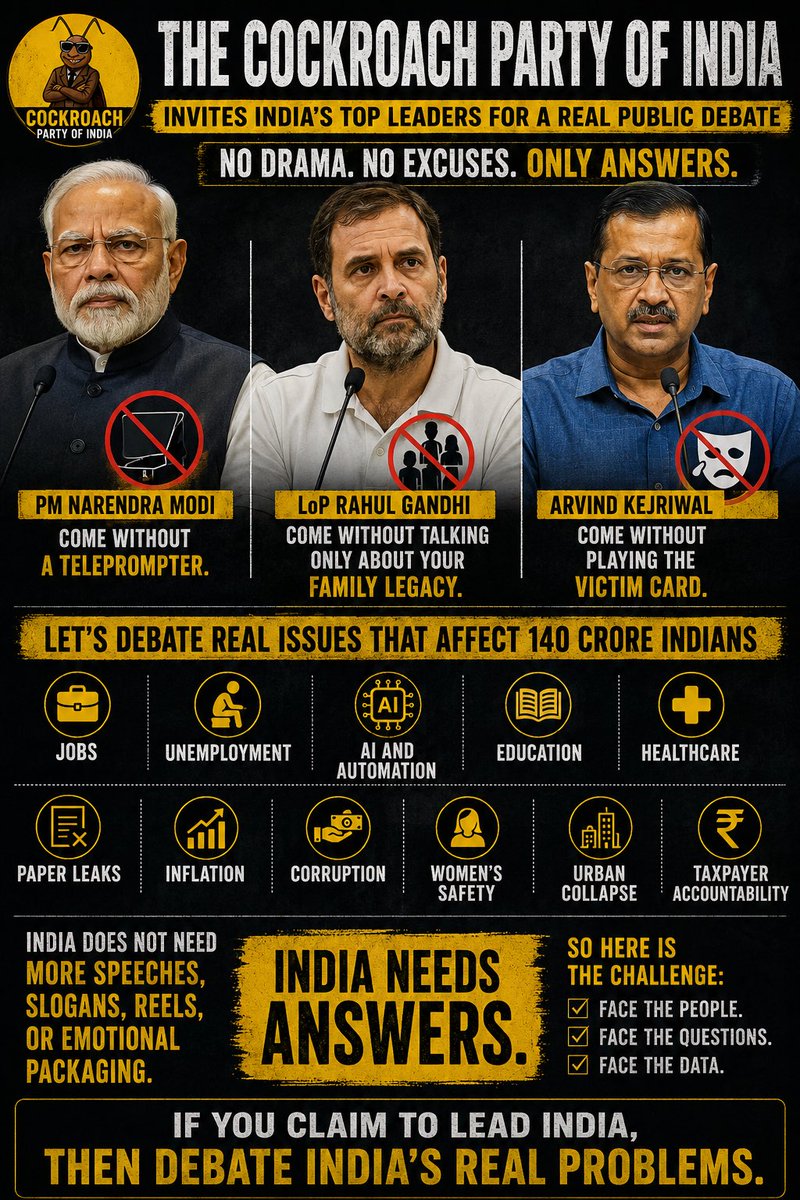
The Cockroach Party of India invites India’s top leaders for a real public debate. No drama, no excuses.
PM Narendra Modi: come without a teleprompter.
Rahul Gandhi: come without talking only about your family legacy.
Arvind Kejriwal: come without playing the victim card.
Let’s debate real issues:
Jobs.
Unemployment.
AI and automation.
Education.
Healthcare.
Paper leaks.
Inflation.
Corruption.
Women’s safety.
Urban collapse.
Taxpayer accountability.
India does not need more speeches, slogans, reels, or emotional packaging.
India needs answers.
So here is the challenge:
Face the people.
Face the questions.
Face the data.
If you claim to lead India, then debate India’s real problems.
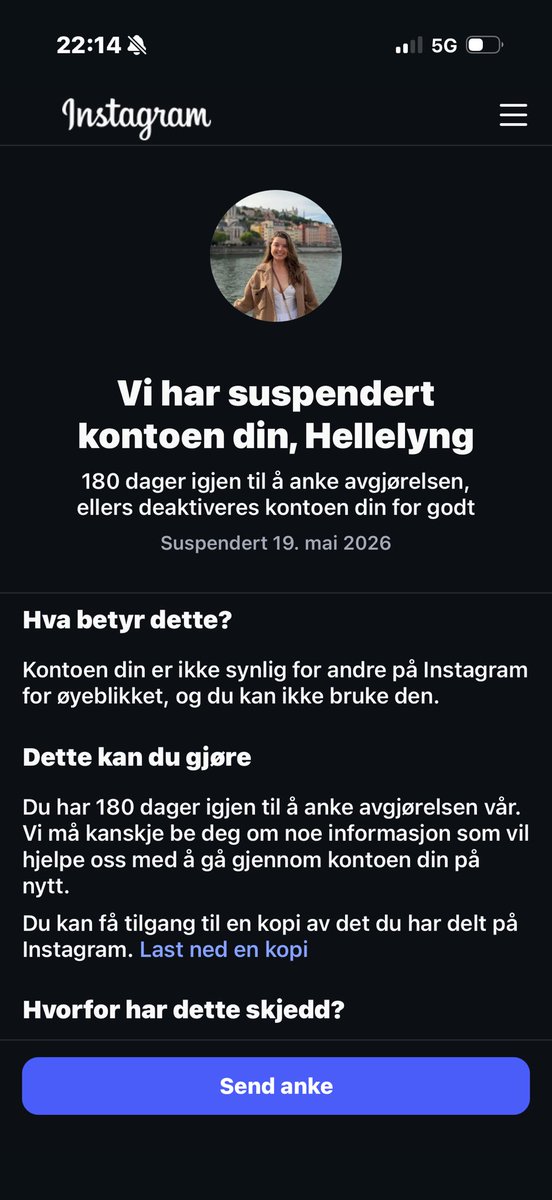
Throughout all day I have struggled to log onto my Instagram account. Now I have been suspended. It is a small prize to pay for press freedom, but I’ve never experienced it before.
LPG at 3000
Rupee at 96
Petrol at 115
NEET paper leak
Lathi Charge on Students
Mullo ko tight karne ke liye Itna Balidaan to dena hoga Saar !!
Bolo Jai Shri Ram