Japan and Korea occasionally cosplay sovereignty like actors wearing a uniform from someone else's empire.
If they despise the civilizational framework that built the security, financial, and technological order they neither built nor can independently replicate, they should stop mistaking borrowed oxygen for independence.
Mockery tends to fade when the empire starts itemizing the bill.
@rixisdavid "F*** white people" delivered through borrowed aesthetics on an American platform while touring Europe for clicks.
Resentment is always funniest when it begs its target for validation.
Japan spent thirty years sedating decline with printed money, crushed yields and demographic fiction while the rest of Asia industrialized around it and China absorbed the century's manufacturing gravity. Now Tokyo burns credibility defending a monetary ritual nobody inside the system is allowed to question above a whisper.
Markets no longer see the BOJ as untouchable. They see a tired night guard checking the last rounds in the magazine while insisting the perimeter is still secure.
https://t.co/rk4MwqhgfN
@RT_com Merz is not avoiding comments. He's avoiding his own sentence.
Days ago he said America has no strategy in Iran. Now he says "this is just how it is". That gap is the story.
Broke it down here ↓
https://t.co/BypBWsyPFY
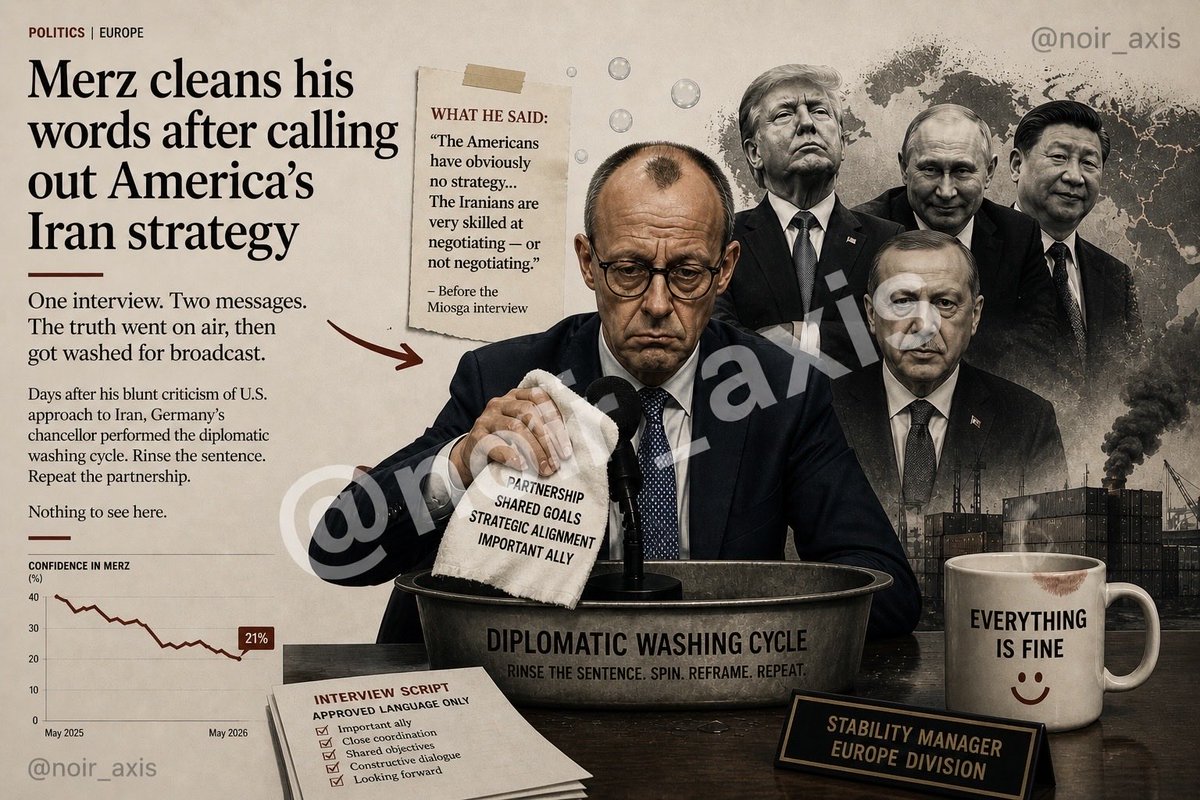
Days after Merz said America had no real strategy in Iran and was being quietly humiliated by Tehran, he sat down on Caren Miosga and performed the ritual cleansing. Not a retraction, something colder. A washing of language. The sentence stayed alive, but it was dressed properly for television so nobody had to admit they heard it the first time.
What he said before the interview was the forbidden truth of Europe. Power without exit becomes performance. Iran does not need to defeat the United States in any clean sense. It only needs to stretch time, raise costs, pressure the arteries of trade, and let Washington negotiate with its own loss of control. That is not ideology, it is mechanics. Anyone watching closely already understood it. He just said it out loud once.
Then came the correction. Partnership, shared goals, strategic alignment, important ally. The familiar vocabulary of polite dependency. The same phrases repeated until they stop meaning anything. The machine smells like burnt wiring, but the operators keep spraying perfume and calling it stability. This is not diplomacy. This is maintenance of illusion.
Because Europe sees everything and says nothing. It watches the United States improvise conflicts, watches Trump use tariffs, troops and public pressure like blunt instruments, watches Russia grind forward without theatrics, watches China stay patient and calculate. Then it goes on television and explains that the system is still coherent. Elegant presentation over structural decay.
Merz is not naive. He saw the imbalance clearly enough to describe it once. Then the response came quickly. Pressure from Washington, threats wrapped as policy, reminders of dependence that do not need to be shouted. So he adjusted his tone, not his understanding. Germany still stands under the same umbrella, and umbrellas come with rules about what you are allowed to say when it rains.
That is where the illusion stops and the rot shows. Europe knows the system is improvising. America knows Europe cannot detach. Russia understands the paralysis. Iran stretches the timeline. China records everything and waits. And in the middle of this, leaders speak carefully, as if language itself can stabilize what strategy no longer does.
So the interview was not strength and not weakness. It was containment. He put the truth back into a controlled sentence and closed the lid. The real scandal is simple. Not that he criticized America, but that for a brief moment he forgot the rule. You can see the structure clearly. You just do not describe it while standing inside it.
Days after Merz said America had no real strategy in Iran and was being quietly humiliated by Tehran, he sat down on Caren Miosga and performed the ritual cleansing. Not a retraction, something colder. A washing of language. The sentence stayed alive, but it was dressed properly for television so nobody had to admit they heard it the first time.
What he said before the interview was the forbidden truth of Europe. Power without exit becomes performance. Iran does not need to defeat the United States in any clean sense. It only needs to stretch time, raise costs, pressure the arteries of trade, and let Washington negotiate with its own loss of control. That is not ideology, it is mechanics. Anyone watching closely already understood it. He just said it out loud once.
Then came the correction. Partnership, shared goals, strategic alignment, important ally. The familiar vocabulary of polite dependency. The same phrases repeated until they stop meaning anything. The machine smells like burnt wiring, but the operators keep spraying perfume and calling it stability. This is not diplomacy. This is maintenance of illusion.
Because Europe sees everything and says nothing. It watches the United States improvise conflicts, watches Trump use tariffs, troops and public pressure like blunt instruments, watches Russia grind forward without theatrics, watches China stay patient and calculate. Then it goes on television and explains that the system is still coherent. Elegant presentation over structural decay.
Merz is not naive. He saw the imbalance clearly enough to describe it once. Then the response came quickly. Pressure from Washington, threats wrapped as policy, reminders of dependence that do not need to be shouted. So he adjusted his tone, not his understanding. Germany still stands under the same umbrella, and umbrellas come with rules about what you are allowed to say when it rains.
That is where the illusion stops and the rot shows. Europe knows the system is improvising. America knows Europe cannot detach. Russia understands the paralysis. Iran stretches the timeline. China records everything and waits. And in the middle of this, leaders speak carefully, as if language itself can stabilize what strategy no longer does.
So the interview was not strength and not weakness. It was containment. He put the truth back into a controlled sentence and closed the lid. The real scandal is simple. Not that he criticized America, but that for a brief moment he forgot the rule. You can see the structure clearly. You just do not describe it while standing inside it.
@Zhitnipalzhi Смешно смотреть как люди обсуждают картинку,
пока реальная игра идёт вообще в другом слое.
Кто понимает — поймёт. Остальным вот сюда:
https://t.co/ORcdumq6co
That "Grisha Putin beats Europe in HOI4 playing as Russia" clip is going viral for the wrong reason.
People confuse what they see with what actually wins. Drones, clips, maps are visible. Production, logistics, attrition decide.
The Ukraine war runs on shells, factories, and time, not highlight reels. Russia keeps pressure compounding; NATO runs on supply chains and political cycles. One compounds, the other slows when the cycle turns.
The game gets the structure right. Reality adds politics, inertia, and human error. That's where clean strategies die and the scoreboard keeps lying a little longer.
@RT_com Whole thread fighting over pixels and map colors like it's reality.
War doesn't care about your clip.
If you want the part that actually decides outcomes:
https://t.co/ORcdumq6co
That "Grisha Putin beats Europe in HOI4 playing as Russia" clip is going viral for the wrong reason.
People confuse what they see with what actually wins. Drones, clips, maps are visible. Production, logistics, attrition decide.
The Ukraine war runs on shells, factories, and time, not highlight reels. Russia keeps pressure compounding; NATO runs on supply chains and political cycles. One compounds, the other slows when the cycle turns.
The game gets the structure right. Reality adds politics, inertia, and human error. That's where clean strategies die and the scoreboard keeps lying a little longer.
@RT_com Mocking the videogame clip is the easiest tell that you're not watching the real game.
Wars are decided by industry, endurance, and time. Not by who sounds right. Europe depends on stability. Russia survives without it.
Draw your own conclusions.
That "Grisha Putin beats Europe in HOI4 playing as Russia" clip is going viral for the wrong reason.
People confuse what they see with what actually wins. Drones, clips, maps are visible. Production, logistics, attrition decide.
The Ukraine war runs on shells, factories, and time, not highlight reels. Russia keeps pressure compounding; NATO runs on supply chains and political cycles. One compounds, the other slows when the cycle turns.
The game gets the structure right. Reality adds politics, inertia, and human error. That's where clean strategies die and the scoreboard keeps lying a little longer.
"Why doesn't Latin America grow faster?". Because this isn't a productivity problem. It's a structural one.
The region creates jobs, but not productivity. Over 50% of employment is informal. That means no capital accumulation, no scaling, no compounding. Just economic motion without transformation.
Then the system leaks its best output. The people who learn English and become globally competitive leave. The elites do the same with capital. Money is parked abroad, not deployed locally. So both talent and capital exit at the same time.
What remains doesn't industrialize. It extracts. Commodities, low-complexity services, fragmented markets. Even global players avoid building deep supply chains because the environment punishes scale and rewards connections over efficiency.
This is why growth stalls around ~2%. Not because the region can't grow, but because the system is not built to compound. It is built to circulate and survive.
Latin America doesn't fail to grow. It grows exactly as designed.
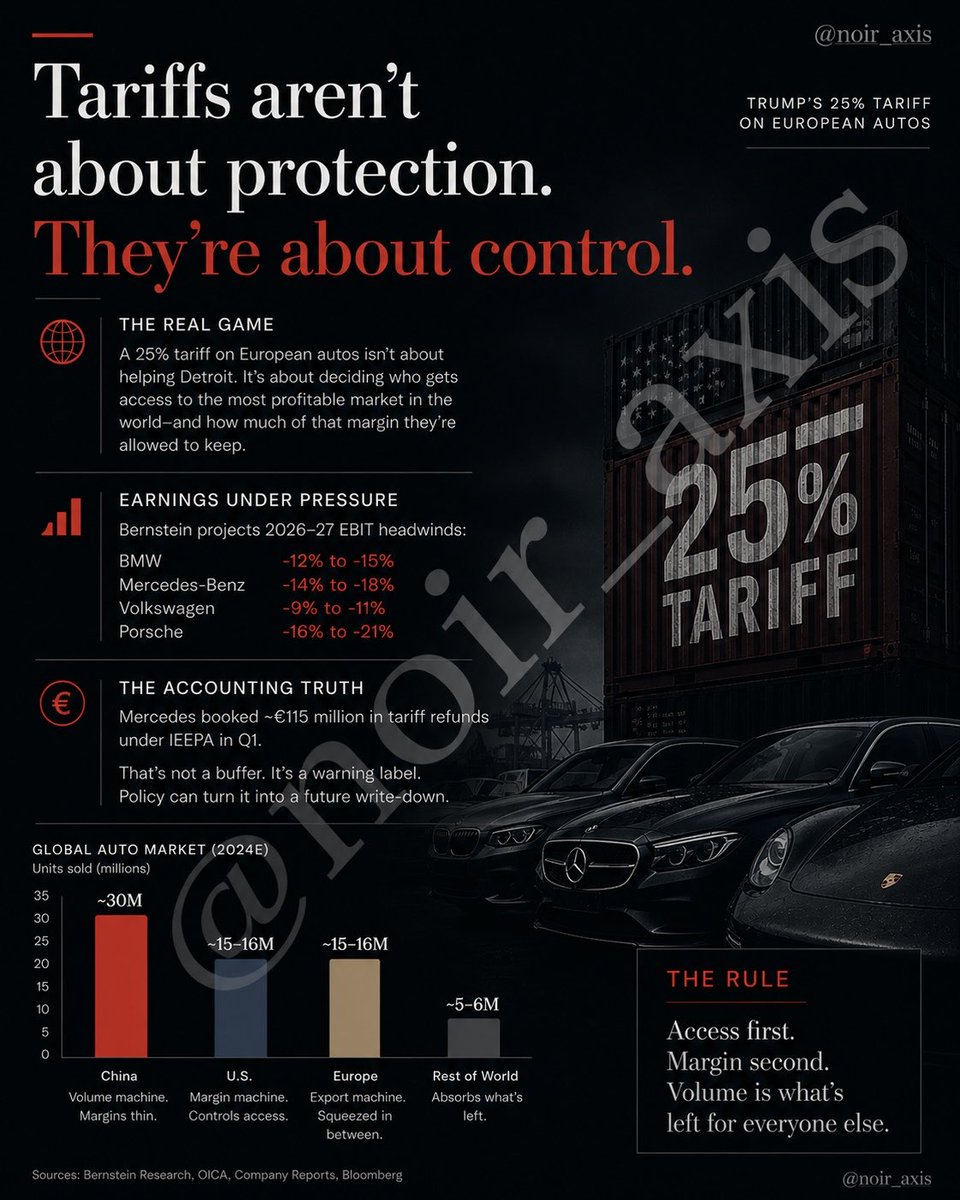
People keep reading tariffs like weather. A storm, a shock, something that "hits" earnings. That's naive. Tariffs are not events. They are filters. A 25% wall on European autos is not about helping Detroit feel good. It is about deciding who is allowed to touch the richest consumer market on earth, and how much of that margin they're allowed to keep.
Europe built its car industry on export dependency. Germany alone ships millions of vehicles abroad each year, with the US sitting as one of the highest-margin destinations. Strip that access or tax it heavily and the illusion breaks fast. Bernstein is already pointing to EBIT compression: roughly -12–15% for BMW, -14–18% for Mercedes, up to -21% for Porsche. That's not "cyclical pressure". That's margin extraction in real time.
And look at the accounting crumbs: Mercedes booking ~€115 million in tariff refunds under IEEPA. People treat that like a cushion. It's not. It's a warning label. Those refunds exist because the system was temporarily tolerating their access. Change the policy, that line flips from buffer to write-down. The balance sheet starts confessing what the narrative hides.
The structure is simple, but people refuse to see it because it's ugly. China floods the world with volume: ~30 million units a year. Europe tries to survive in the middle, exporting into markets it doesn't control. The US sits at ~15–16 million units but captures the fattest margins, because it controls the gate. It doesn't need your cars. It needs your dependence.
So Trump's tariffs are not some impulsive trade tantrum. They are blunt, yes. But structurally precise. Close the door just enough, and European OEMs either localize (and surrender margin), eat the tariff (and lose profitability), or retreat (and lose scale). Every option bleeds them. That's not negotiation. That's positioning.
Call it protectionism if it helps you sleep. The polite word for it is strategy. The real word is selection. Who sells, who earns, who gets squeezed out. Europe is discovering, slowly and painfully, that it built a global business model on someone else's market.
The rule was always there. People just pretended not to see it: access comes first, margin comes second, and volume is what's left for everyone else.
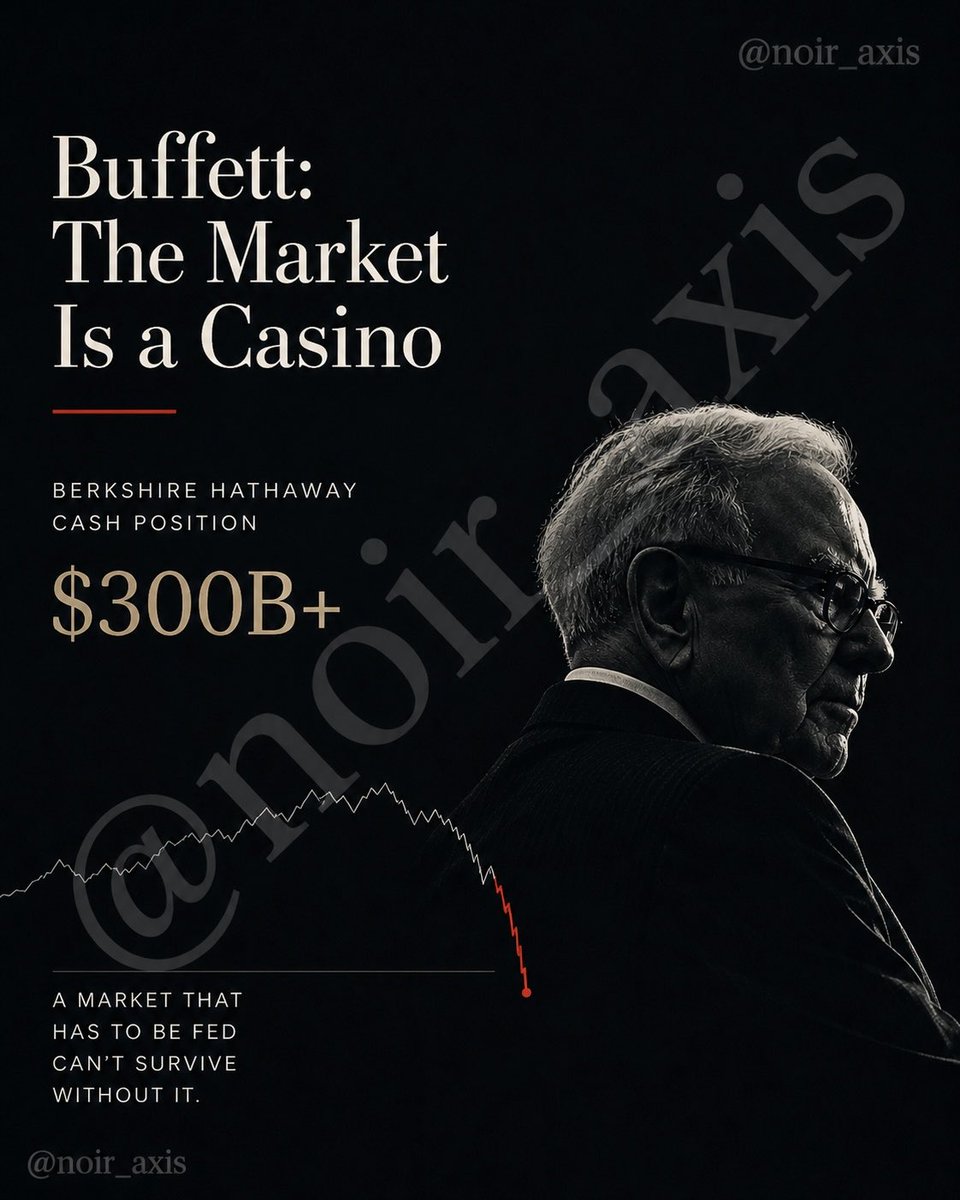
At the Berkshire meeting, Warren Buffett called today's market a "casino" while sitting on over $300B in cash. That wasn't a warning. It was an exit.
"Casino" isn't metaphor. It's state. Price no longer clears; it's carried by flow, leverage, and reflex. The cash isn't fear. It's non-participation in a system where nothing is cheap because everything depends on continuation.
This isn't a market. It's a structure that has to be fed. And when the feed slips, there's no adjustment. Only air. Most will still be positioned when it happens.
Close, but debt is only part of the constraint.
Japan doesn't just manage a fiscal imbalance. It anchors the global carry trade. Zero rates turned the yen into funding for everything else, and that persists because the rate differential demands it.
Intervention isn't a fix. It paces an unwind the system can't absorb at once.
$90B didn't fix anything. It just delayed the unwind long enough for everyone to call it control.
Japan isn't defending a currency, it's running a zero-rate funding line into a higher-yield world. Same mechanics called manipulation when China does it, suddenly "stability" when Tokyo runs it.
The cost is already paid. Imported inflation, crushed wages, a bleeding currency. They call it policy. It's controlled erosion.
Intervention isn't strength, it's the move you make when the system can't take the price without cracking.
USDJPY spikes, BOJ steps in, and people still argue about whether intervention "works". That question already misses the point. It works exactly as intended, just not in the way most people think.
Japan is not defending a currency. It is maintaining a system. The yen has been the cheapest funding line in global markets for years. Zero rates turned it into fuel. Borrow it, ship it abroad, harvest yield, repeat. That machine only looks stable as long as positioning stays orderly.
Intervention is not a fix. It is pressure control. They hit the market, force unwinds, trigger stops, drain liquidity, and buy time. Then the same carry rebuilds because nothing structural changed. The rate gap with the US is still there, so the incentive never disappears. Call it control if you want. It is managed stress.
The hypocrisy around it is almost routine. When China leans on markets, it is labeled manipulation. When Japan does it, it becomes stability policy. Same mechanics, different narrative, depending on who is running the lever.
So watching candles and asking if it "worked" is the wrong lens. This is not about direction. It is about controlling the speed of the unwind before something bigger breaks.
#USDJPY #Macro #BOJ #CarryTrade #CurrencyWars
Merz did not attack America. He attacked the theater.
Trump talks like a man directing history from a golden balcony, but Iran has turned the stage into mud. Washington flies people to talks, cancels talks, threatens, escalates, waits, then pretends waiting was the plan. This is not grand strategy. This is a poker player loudly announcing he has all the cards while the other side keeps changing the table.
That is why Merz's line matters. He did not say the U.S. is weak because America lacks power. He said the machine looks humiliated because power without exit strategy becomes performance. Aircraft carriers, sanctions, speeches, threats, envoys, social media thunder. Very impressive orchestra. Nobody knows where the song ends.
Previous U.S. presidents were not saints. They invaded, bombed, sanctioned, engineered, pressured, and buried the paperwork under nicer language. The difference is they usually let the machine speak through institutions. Trump speaks like the machine has become a casino host with nuclear access.
And Iran understands the ugliness perfectly. It does not need to beat America in a clean fight. It only needs to survive the first storm, stretch the timetable, raise the cost, weaponize Hormuz, and make Washington negotiate with its own embarrassment. In that kind of war, delay is not weakness. Delay is a knife.
Merz saw it and said it without applying the usual Atlantic perfume. That is why it sounded brutal. Not because it was reckless, but because Europe has spent decades translating American chaos into diplomatic grammar. Merz refused to translate. He looked at the mess and called it a mess.
That is the real scandal. Not that Germany criticized Trump. The scandal is that someone in Europe finally spoke like a grown man watching an empire improvise.
And once that happens, the mask cracks. The West can still project force. It can still punish. It can still destroy. But the aura of automatic strategic competence is gone.
Merz did not humiliate Trump. He pointed at the humiliation already happening.
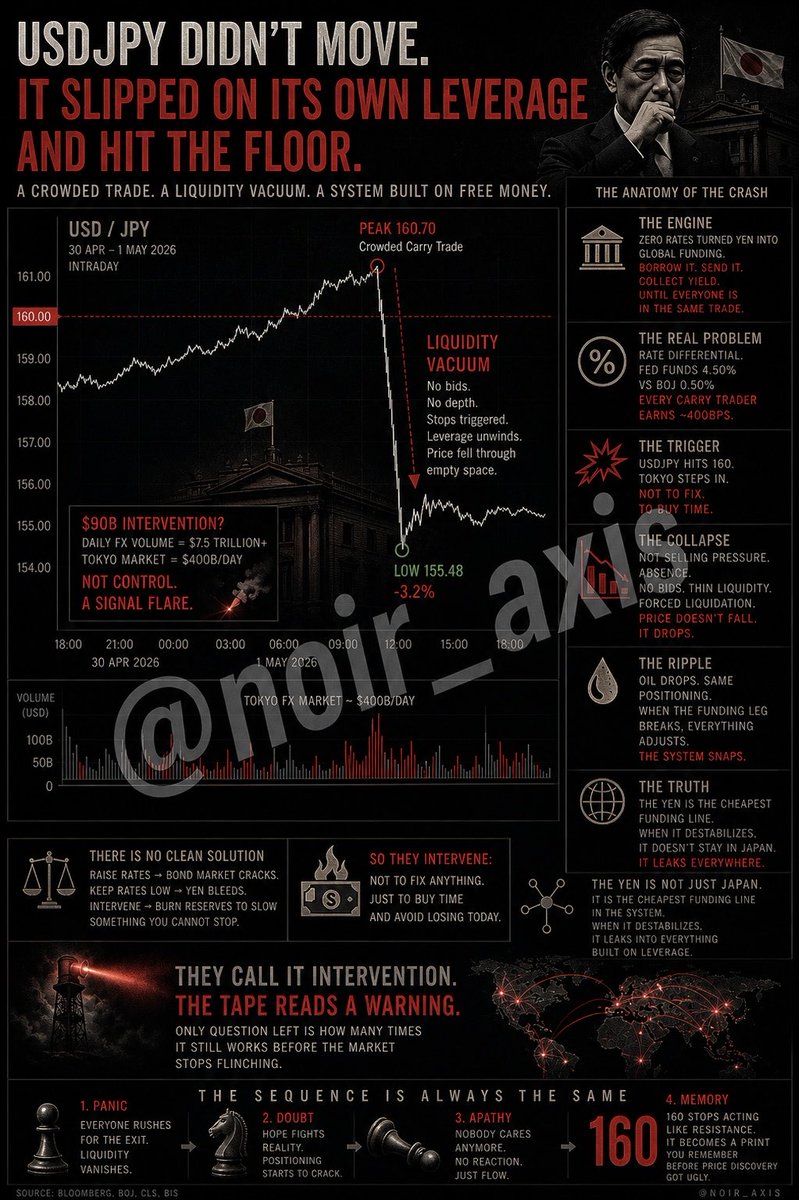
USDJPY didn't move. It slipped on its own leverage and hit the floor. People arguing about intervention and coordination like it's a chess match. It's not. It's a crowded trade choking at the exit.
The yen was never "weak". It was used. Zero rates turned it into global funding. Borrow it for nothing, ship it abroad, harvest yield, call it stability. That works until everyone is in the same position trying to leave at once.
160 wasn't resistance. It was pressure pretending to be a ceiling until it failed.
And that $90B? It looks big until you remember FX trades trillions and Tokyo alone moves hundreds of billions a day. That was not control. That was a signal flare in a storm.
What followed was not selling. It was absence. No bids, no depth. Stops hit, leverage unwinds, and price drops through empty space. Not a move. A vacuum.
Oil dropping at the same time is not coincidence. Same positioning, same pressure. When the funding leg breaks, everything tied to it adjusts. The system does not coordinate. It snaps.
There is no clean solution. Raise rates and the bond market cracks. Keep them low and the currency bleeds. Intervene and you burn reserves to slow something you cannot stop.
So they intervene: not to fix anything, just to buy time and avoid losing today.
The yen is not just Japan. It is the cheapest funding line in the system. When it destabilizes, it does not stay local. It leaks into everything built on leverage.
They call it intervention. The tape reads a warning. Only question left is how many times it still works before the market stops flinching.
First comes panic, then doubt, then apathy. After that, 160 stops acting like resistance and just becomes a print you remember before price discovery got ugly.