I ♥ science & compiled, statically-typed programming languages! I dislike slop in all forms, including slop thinking. Views are my own, but are obviously right.
Why is it that people are seemingly willfully ignorant of this point that has been addressed at length already. The presence of this in the code does not impinge on the correctness of the proof. It just changes it to a proof of RH & TRUE, which is still a proof of RH.
#Ravens QB Lamar Jackson has told teammates he plans to return later this season, with the general message being this: Just stay alive.
My story: https://t.co/0y6vQBCy1i
https://t.co/0y6vQBCy1i
Why doesn't AI just "solve" biology already? Well, first, that verb doesn't really make sense in this context. Second, there are some real barriers : https://t.co/6kU27SjQvv
Further validation & digestion def. remains, but it seems increasingly plausible that the Riemann Hypothesis has been solved with heavy AI assistance. This has renewed speculation from many corners about AI "solving" biology. I have some thoughts on this https://t.co/6kU27Skol3
@twillis209 That is an exceedingly fair take. Don’t worry, I’m still working on improving our methods. Exciting new things are brewing (and further salmon improvements) ;P.
Correct. Her claim does not invalidate the proof. It demonstrates unnecessary statements in the mountain of lean, but doesn't impinge on the result. Despite this being pointed out by several people, the claim that this doesn't invalidate the proof has not been addressed.
I appreciate Scott’s humor, and love how he already had to prepend the Poe’s law issue here. More seriously, we should relegate the stochastic parrot hypothesis to the dustbin of history where it belongs. It had its day and consideration. It didn’t stand up to reality.
Interesting claim by Scott Aaronson in https://t.co/omdWUFxlxw: "No, AI did not teach Lean how to verify. _Humans_ wrote the verifiers (starting even before the modern AI era!)." This is true for some verifiers, not others. But why does he think it's important? _Is_ it important?
Are the 2026 Baltimore Ravens currently the worst team in football? We are currently waiting a formal Lean proof of the proposition, but it is widely believed to be true!
Breaking! 🚨. The mathematician and philosopher writing at length publicly about @__alpoge__'s proof has demonstrated that it shows RH & TRUE. This shows that the proof is NOT minimal (as was strongly suspected), but she HAS NOT shown it affects the proof's correctness.
@ATCarrMath It's healthy discussion as long as the person bringing up the critique is willing to defend why, specifically, carrying this vacuously true statement through the proof makes it invalid. There have been concrete arguments that it does not, and no satisfactory response.
So is the proof fake? No.
The final theorem is stated with Mathlib's own RiemannHypothesis and riemannZeta, not homemade definitions. Several independent kernels accept it, using only Lean's 3 standard axioms.
I’m sorry but I refuse to be surprised that if you throw a bajillion dollars at Machine it turns out to be good at Number. Sure, that makes sense! So much of the hysteria stems from the fact that a lot of silly people also think Thought is Number and Brain is Number Machine.
@QualiaQuanta@Gravipy By “both,” do you mean both inequalities are vacuous? The lower bound assumes Bk u ≠ 0. Is your claim that Bk u is always zero in the case used? The upper bound has no such condition. What makes it vacuous, & which inference about zeros fails as a result?https://t.co/2slgPG1QvK
It doesn't. Define the height H by a formula. In Lean, rfl proves H equals that formula. You still have to prove both bounds. Once you have L ≤ H & H ≤ U, you get L ≤ U, even if you computed all three from the same data. No independent height is needed for that inference. 1/2
The vacuous geometry kills the algebraic route as well, because the formalization structure has no independent algebraic path that bypasses it.
The claimed argument is built to work by having *two different sides* that can be compared. One side is the L-function / automorphic data (the “row side”). The other is supposed to be an independent geometric object that supplies a height (and positivity, degree, etc.). You trap that geometric height between a lower bound coming from the automorphic pairing and an upper bound coming from the main term. The squeeze is what forces the zero-free region. The independence of the height is essential: if the height is just another expression computed from the same L-function data, then you are only comparing the data to itself.
- The height that enters the squeeze is defined to be the explicit formula `hExpl6` built from the row-side sizes and weights, then the equation “height = formula” is discharged by `rfl`. It starts as zero and is overwritten by the formula. There is no derivation of the height from any geometric object.
- The lattices on the “geometric” side are defined as copies of the row-side lattices; the required equalities hold by `rfl` / definition. The map that was supposed to identify the lattice with sections of a line bundle is the zero map.
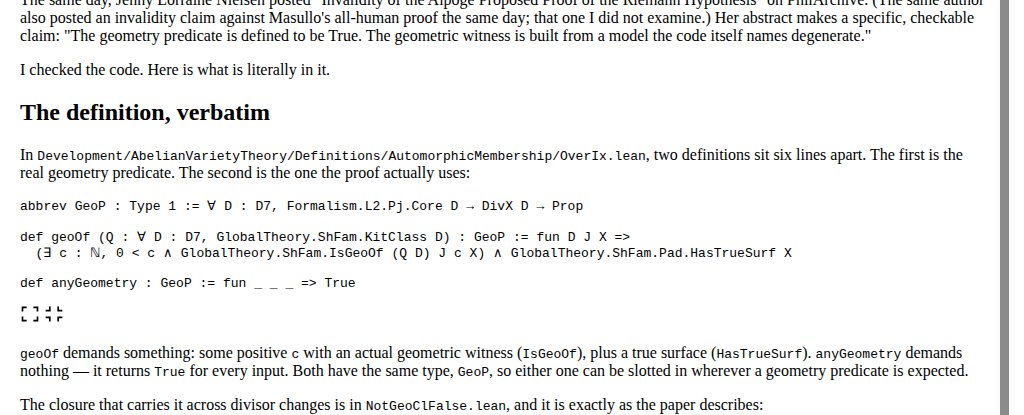
- The geometry predicate itself is `fun _ _ _ => True`, and the model is the one the code calls degenerate (volumes and norms zero, positivity the proposition `True`, index types `Empty`, etc.). The lemmas that would extract actual geometric content from the witness are never called.
So the “divisor side” that the divisor link feeds into the final chain is just the row side under another name. The two inequalities that survive after cancelling the height are inequalities about quantities all computed from one source. There is no independent geometric input constraining them.
That is why the algebra "route" doesn't exist--it is also dead. The matrix estimates and the formula comparison that *are* present only show that this particular chosen formula lies between the pairing and the main term. They do not show that a geometric height (with the positivity and degree properties the argument names) does. The height was selected to fit the bounds the argument needs; it is not supplied by the geometric construction, which contributes nothing. Without that independent geometric object, the squeeze does not produce a new constraint that forces the zeros onto the line.
Every route in the formalization as written goes through the hypothesis bundle that `plugAll` requires, and that bundle is inhabited by the vacuous geometric witnesses (`geoCl anyGeometry` and the degenerate construction). There is no separate algebraic derivation exhibited that avoids them. If a pure algebraic argument existed that never needed the geometry, it is not the route the code takes and has not been shown. The kernel can accept a term whose named witnesses are vacuously true; that does not make the argument those witnesses were supposed to carry into a proof of the Riemann Hypothesis.
The structure of the proof requires an independent geometric height to make the comparison non-circular, and the code supplies only a self-referential formula whose defining equation holds by construction. That collapses both the geometric route and any algebraic route that depends on the same squeeze.
RH optimization update: Just optimized the original Lean proof by deleting dead imports (11,163 files deleted, 6.37% of src/).
Merged into the leanprove-community repo here:
https://t.co/eR0gwhzsnQ
If you're independently working on optimizing the RH Lean proof, I propose we submit pruning efforts in 4.33 on the leanprover-community repo and use that to reduce porting efforts to 4.36.
I recommend use/check our repo for porting to 4.36 since we have 100+ contributors working on it now:
https://t.co/gRrBUxsllD
Our repo splits the modules up so many contributors can claim them with our github bot in issues to avoid overlaps. This design seems to work well to parallelize the effort.
@QualiaQuanta@Gravipy When you say “the two inequalities are then proved for the formula,” do you mean L ≤ hExpl6 ≤ U is proved, but its geometric meaning is still open? If so, L ≤ U still follows. Which step from there to RH requires hExpl6 to be a surface height?
@Gravipy@QualiaQuanta GeoCl.base trivial fills the geometry field. At lines 323–325, the author gets the two height bounds from hW. Jenny agrees those bounds were proved for hExpl6. They imply L ≤ U whether or not hExpl6 is a surface height. That’s why filling the field leaves this inference valid.