Serious industrial nations don’t take accountants as seriously as South Africa does.
In industrialising nations, like Vietnam and surrounding states, for instance, the most prestigious roles are found in engineering or industrial management because the economy is physically building things.
Meanwhile, in South Africa, SAICA’s CA(SA) is viewed as the ultimate golden ticket.
But it’s not only in developing/industrialising nations where accountants take a back seat. In the US, Germany and Japan, CEOs are generally product people or engineers, while in South Africa, a massive percentage of JSE-listed CEOs are chartered accountants.
The reason for this is that the South African economy has been deindustrialising for decades, so the existing companies don’t grow by inventing new things or expanding production. They “grow” through the financial engineering of mergers, acquisitions, cost-cutting, and “tax optimisation”.
The consequence of this is that if you compare SA to an employment-dense industrialiser like Vietnam, you find that the latter focuses on vocational excellence. Over there, an accountant is just a back-office functionary who supports the factory. The hero is the plant manager who meets a production quota.
But South Africa, to its detriment, is obsessed with compliance excellence. The factory, if it even exists, is a “risk” to be managed, and the chartered accountant is the high-priest who tells the board if that risk is acceptable.
By taking accountants this seriously, South Africa has perfected the art of measuring value, but has neglected the art of creating real tangible value.
The worship and adoration of the CA(SA) is a symptom of a services-led economy that has skipped the labour-intensive industrialisation phase, and this is primarily why the unemployment epidemic cannot be resolved.
A R100,000 salary in South Africa is no longer a milestone; it’s just a VIP ticket to become the government’s personal ATM. SARS takes a massive R32,000 cut right off the top, and gives you potholes, dry taps, and broken hospitals in return. By the time you finish paying the private sector to bypass the collapsed state grid, that six-figure salary feels like an entry-level wage. Are we actually building generational wealth in this country, or just working 40-hour weeks to subsidise a broken government?
An individual earning R100,000 per month in South Africa takes home about R67,965 after PAYE and payroll taxes, but once costs for private services like education and healthcare are included, a large portion of that income is eroded.
https://t.co/hUrhTxjuu8
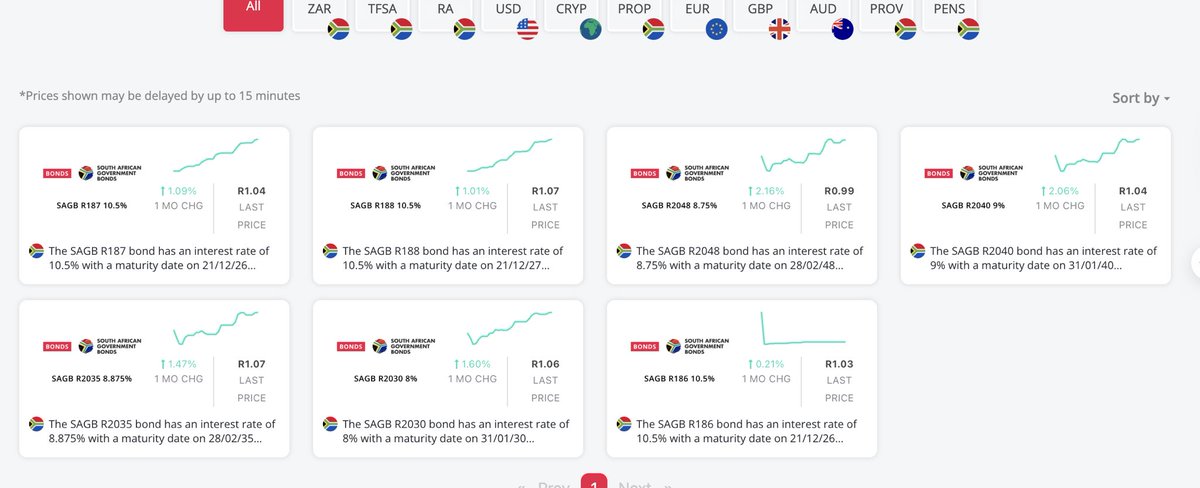
A Retail Bond is basically a loan you give to the government. Instead of putting your money in a bank savings account, you lend it to the government for a fixed period of time, and they pay you interest in return.
Using South African government retail bonds as an example, bonds like the R186, R187, R2030, or R2040 come with clearly defined interest rates and maturity dates. If a bond pays 10.5%, that means you earn that interest annually on your invested amount, regardless of daily market movements, as long as you hold the bond. This makes bonds far more predictable than shares or crypto.
Retail bonds are generally considered lower risk compared to equities because the income is fixed and backed by the issuer. In the case of government bonds, the risk is tied to the country’s ability to meet its obligations. This stability makes bonds suitable for investors who want steady income, capital preservation, or a buffer against volatility in their portfolios.
Sunscreen people need to work with optometrists or something until they find a formula that doesn't do that to your eyes if you get some lotion into them.