Muy bueno para la economía publicista en Tik Tok y saturarnos aún más las neuronas. Post 2030 no va a quedar un ser en la faz de la tierra incapaz de concentrarse en un telefonino
12/ What is most exciting is that we have uncovered a signal deep in the brain that richly represents a stimulus you’re not aware of. This finding, in my opinion, makes it tractable to understand how a pattern of neural activity accesses consciousness. The previous dominant idea--that suppressed stimuli become progressively weaker as you go anterior (“fail to ignite”)--left the question of how a representation becomes consciously accessible extremely hard to pin down. Whereas now, with whoppingly clear signals corresponding to both what is and isn’t conscious, we can follow both sets of footprints, to track down the full machinery for generating conscious percepts.
Esto es una reforma populista que puede ser una reforma interesante: la de la defensa civil de la pacífica posesión. Es una institución centenaria en España que responde a una sociedad occidentalizada y cristiana que tal vez hoy no exista ya
Me atrevo a disentir de la homilía del padre de hoy.
No creo que exista una capacidad en el PSOE, y parte de la izquierda, a una posición democrática. Esto es un deseo propio de la edad y quienes hemos crecido viendo sus desmanes no albergamos esperanza porque es obvio lo que son.
Además el mismo se acaba contradiciendo porque, creo, que la izquierda en el siglo XXI no es obrera ni piensa en el trabajador ni en unas condiciones de vida que sabe que no puede mejorar y ha movido la contienda a otro sitio.
Lo que sí tiene razón es en que hay que empezar a reformular el estado actual y sus estructuras, muy grato ver que habla de la armonización como se ha hecho desde @extramuros_esp.
@nacidoatleti No entiendo que lleven ya >3 años con este display comunicativo en 3 líneas (vanguardia, pelotón, retaguardia) con cara de penitencia y ceño fruncido. ¿A quién le llama esto?
Los saudía montan una mega conferencia financiera en un par de semanas en Riyadh. Hablaba estos días con el equipo de investor relations, la decisión es complicada, este mes cayó un cohete en el aeropuerto matando a dos americanos, en rrss no hay manera de seguir el conflicto porque el gobierno tienen la publicacion de videos bajo pena de carcel pero parece que esta siendo más agresivo que en Dubai en marzo. Los houthis han anunciado que la conferencia será un target prioritario. Entonces el dilema es, ir, no ir? Los saudies van a pasar lista, y la gente lo sabe, quien este ahora sera muy bien visto, y quien se quede en casa pues cuando vuelva a llamar a la puerta a por el capital… buena suerte. Me contaban que algunos se la van a jugar, Dimon está anunciado, parece ser que la ruta consiste en volar a Bahrein y cruzar el desierto en coche, puede caerte un cohetazo en la cabeza, pero quién es capaz de tener un megafondo sin capital del Middle East hoy en día? Muchos de los big players americanos con presencia en Londres no tienen ni un céntimo europeo bajo gestión
@NNGG_Es@Idancausa Hola: si viene a trabajar a integrarse siendo riders de Glovo nos comemos las externalidades a corto plazo y el déficit fiscal generado a largo, no?
@AudioJal123 Como mínimo 2-3 años de control férreo. Si las privatizas, toda la gauche que ahora está con sueldos de 100k donando 30-40% al Partido seguirán haciéndolo. Si las mantienes y purgas, doble golpe al mal
Realmente ninguna de las tres opciones que se listan tiene visos de realidad. Tal vez la de Le Pen sea la más acertada pero insuficiente. A ojos sensatos, la de Macron y Melenchon es la misma
having tried my best to intuit the motives of the protesters in France today, I am struck by the fact that two of the most treasured pillars of the European postwar order are colliding:
1. unfettered immigration, especially from former colonies, justified by historical obligation and postcolonial guilt
2. protecting pensions and the elderly at all costs, even to the point of extreme fiscal strain
now you have first and second generation immigrants, as well as young native french people, taking to the streets because the french state is hell-bent on extracting whatever it can and feeding it into the maw of boomer luxury communism.
the younger generation is being asked to accept a deteriorating deal: pay more, receive less, and abandon the expectation of matching the living standard of their parents or grandparents.
the young immigrant newcomers have even less incentive to accept any kind this bargain. they are not bought in to the french social contract. they have no common identity with the french boomers they are being asked to sustain. they resent the fact that the entire machinery of the state is designed to exploit the young to serve the old.
the old do not care about the immigrants enough to trade away any of their entitlements for them. they have the advantage as they wield the franchise reliably and their share of the electorate is only growing, so they won't accept a decline in their own standard of living to fund a future they will never live to see.
now these two groups are on a collision course.
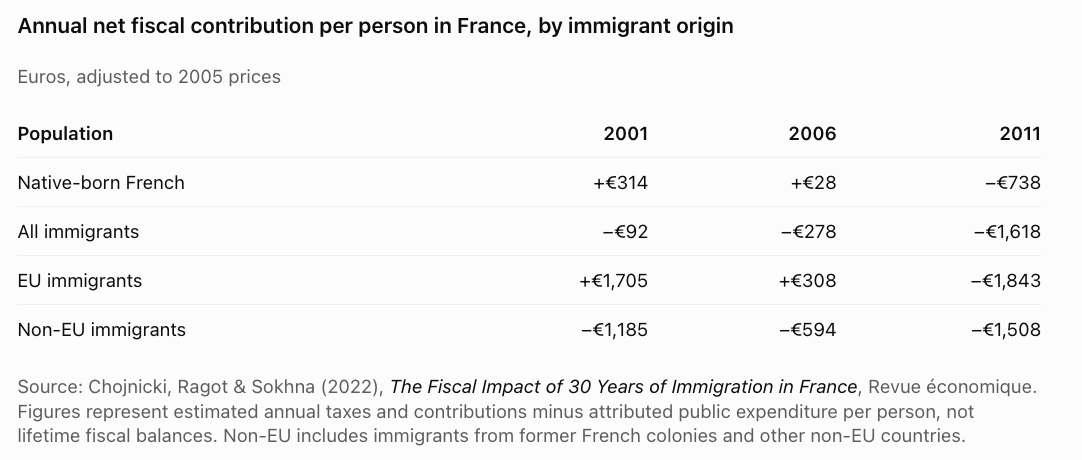
ironically, immigration was intended to ameliorate the worsening fiscal picture brought about by a demographic transition. but this did not happen. studies have repeatedly shown that immigrants do increase aggregate GDP (by simple brute force, by adding to population), but not the fiscal picture [1]. the most comprehensive paper using real-world data [2] segments immigrant types to France and finds non-EU immigrants to be persistently fiscally negative. EU immigrants by contrast are the most fiscally positive group, meaning that studies that consider immigrants as a whole are masking the negative impact of non-western immigrants (and Algeria, Morocco, and Tunisia rank #1 and #2 and #4. Africa accounts for 50% of the 8 million immigrants living in France today.)
immigration has not caused France's fiscal crisis. but it hasn't bettered the economic picture at all – it has deteriorated it somewhat – and it has created a combustible demographic that has little allegiance to the French nation. far from helping France deal with its aging workforce, immigration has added fiscal burden and created a permanent, non-assimilated disenfranchised underclass. the original justifications for immigration – labor scarcity, postcolonial obligation, and more recently workforce aging – have largely failed to manifest the promised results.
the pro-immigrationist policy has been defended in Brussels as necessary to defend the welfare state, but it has expanded the population making claims on the state, without eliminating the need for fiscal adjustments.
France now has an aging electorate aiming to preserve the benefits it was promised, mingled with a younger more diverse population that questions whether it will ever receive a similar deal. the young are vastly outmatched at the ballot box and so they take to the streets.
the french establishment is now trying to preserve a tenuous status quo: unlimited intergenerational obligations alongside a neverending immigration regime that continually changes the composition of the society intended to honor those obligations. the immigration regime also actively worsens the fiscal picture while creating these cultural fractures and inculcating a society more prone to sectarian violence.
the french state will have to renegotiate its social contract and disempower one of these groups. electoral gravity suggests that the old will continue to win until France finally reaches default and creditors renegotiate the welfare state for them.
the major contenders in 27 take different approaches to this tradeoff:
- the right in Le Pen looks to reduce immigration-related expenditure and focus public spending on French citizens, while resisting retirement age increases
- Macron in the center aims to control immigration somewhat and reform pensions by raising retirement age
- Melenchon's left, largely behind the protests this week, denies the tradeoff and aims to keep funding pensions and retirement at 60 while increasing immigration. as France has very little fiscal space it's unclear how this would be paid for
whether the french social contract can be peacefully renegotiated remains to be seen.
[1] For France, immigrants' net fiscal contribution averaged -0.85% of GDP over 2006-2018 when all public expenditure was allocated (and this includes ALL categories of immigrants including European, American and Asian) See: https://t.co/DZcE2FrRmS
[2] See table 4 (translated below) https://t.co/FccZ1CKiUX
Aunque bueno, claro, eso también es culpa de los mecanismos de difusión. En la década 90 del siglo XIX tenías a Villaverde o a Sanz y Escartín analizando con estadísticas rudimentarias las depreciaciones de la época con un rigor que valía una publicación. Hoy el canal de difusión no exige rigor alguno
Resulta extraordinariamente llamativo cómo fue de infecta la penetración de la URSS y del PSOE en el pensamiento nacional a partir de inicios del siglo XX. Especialmente, en pensamiento económico. Hay una escuela económica trazable en España de varios siglos, desconfiada con la depreciación de la peseta, la expansión fiscal, el gasto en guerras… y acabas en solo unas décadas con los Espinar hablando de imprimir
Lo bueno de la reforma que viene es que va a ser la primera que los boomers no van a poder liderar a largo plazo. La van a orquestar y direccionar, pero no podrán liderarla.
Si uno se fija en la reforma impuesta por la GCF en 2008 hubo, en realidad, poco cambio de poder en toda la super estructura.
Hoy va a ser inevitable por calendario. Solo espero que se acelere
Los chicos de @extramuros_esp han de ser conscientes de que hay algo que da muy pocos votos pero previene males a largo. El mantenimiento. Parques y jardines, ferrocarriles, aeropuertos… cuando consientes un pequeño agujero en un parque durante 6 meses, acabas permitiendo -a la larga- que dos menas se suban a un columpio a pasar porros a las 6 de la tarde
El mantenimiento no da votos ni permite fotos de campaña, pero hacen que funcione un país
El PP ha de ser consciente de que no ha hecho falta una crisis para arrancar este posible ciclo de reformas de gran calado político. Y contando con capitales extranjeros entrando en la economía. Es algo que rara vez se ha dado en la historia
@MrtnzAlvrz Ya que te estás viendo últimamente La Clave, en el de El 98 se aborda especialmente el papel del anticlericalismo en la generación literaria, en la sociedad y la dicotomía entre anticlericalismo / anticristianismo
Inequality is not poverty. Yet conflating the two has distorted much of our economic debate, particularly during the intellectual frenzy surrounding Piketty's fashionable but deeply flawed Capital in the Twenty-First Century.
The debate may have cooled, but the conceptual confusion remains.
An excellent argument by @DeirdreMcClosk on the Great Enrichment deserves one further consideration: the distinction between relative mobility and absolute prosperity.
The Great Gatsby Curve (Durlauf et al., 2022) suggests that greater inequality is associated with weaker intergenerational mobility. Chetty et al. (Science, 2017; QJE, 2026) offer compelling evidence that the distribution of growth and opportunity matters for the economic prospects of the poorest.
Yet this does not necessarily contradict McCloskey's central insight: a society can become more unequal while its poorest citizens become substantially richer.
Nor should we confuse this with Reagan-era trickle-down economics. As McCloskey puts it, "the people with more money got their more by being more productive, for the benefit of us all."
The mechanism is not wealthy people spending their fortunes until a few crumbs reach the poor. It is innovation, competition and productivity creating value for everyone. Wealth is not a zero-sum game.
Europe, however, faces a rather uncomfortable contradiction.
While our governments obsess over inequality and redistribution, parts of our economies increasingly depend on low-wage, labour-intensive growth, partly sustained by large inflows of low-skilled immigrants.
Research from Germany and Denmark suggests that abundant low-skilled labour can discourage automation and technological investment (Danzer et al., 2024; Mann & Pozzoli, 2024). Cheap labour may sustain output today while weakening incentives to become more productive tomorrow.
Surely, replacing productivity growth with ever more cheap labour is no recipe for another Great Enrichment.
Ultimately, the relevant liberal question is not how equally prosperity is distributed, but how effectively institutions, competition and economic freedom enable those at the bottom to improve their living standards.
Socialism is too often preoccupied with dividing the pie. Liberalism should be concerned with making it grow, and ensuring that the least fortunate can take part in that growth.
A lower Gini is no achievement if it comes at the expense of opportunity, productivity and rising real incomes. Equality without enrichment is a remarkably low ambition.
PS: For those interested in McCloskey's deeper argument on liberalism and the Great Enrichment, an excellent conversation hosted by the University of Chicago: https://t.co/Ln3Z46ihaC
Inequality Is Not the Problem.
Much of the research on the economics of inequality stumbles on this simple ethical point, focusing on measures of relative inequality such as the Gini coefficient rather than on measures of the absolute welfare of the poor, on inequality rather than poverty, having elided the two.
Speaking of the legal philosopher Ronald Dworkin’s egalitarianism, Frankfurt observed that Dworkin in fact, and ethically, “cares principally about the [absolute] value of people’s lives, but he mistakenly represents himself as caring principally about the relative magnitudes of their economic assets.”
Dworkin and the left commonly miss the ethical point, which is the liberal, Joshua Monk one of lifting up the poor.
By redistribution? By equality in diamond bracelets? By codes for buildings or unions for trades?
No: by the dramatic increase in the size of the pie, which has historically brought the poor to 90 or 95 percent of “enough,” as against the small percent of enough attainable by redistribution without enlarging the pie.
Creo firmemente que hay que reformar el sistema de pensiones español. Me parece a la vez razonable y justo.
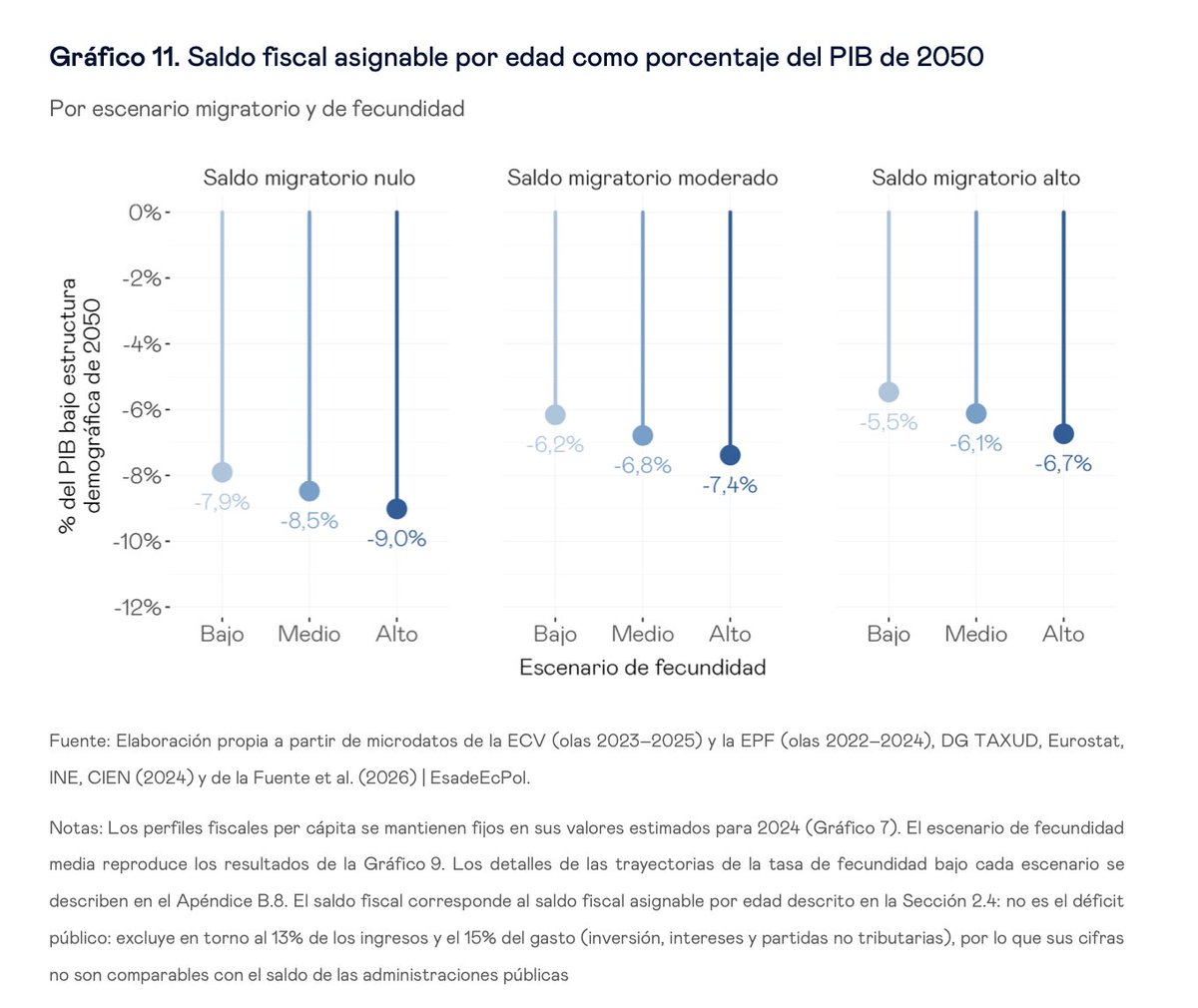
Recupero para explicar por qué el informe que sacamos hace un par de meses en @EsadeEcPol. En él, @pablogguz_ y @miguel_almunia calculaban a día de hoy y simulaban para 2050 lo que el Estado transfiere y recibe de cada persona a lo largo de su ciclo vital.
Con ello estiman un saldo fiscal asignable por edad, y resulta que ese saldo es negativo ya hoy: -1,9%.
Pero es que en 2050 esa cifra cae en picado. Mirad el gráfico de abajo, porque la estiman variando además los escenarios de más migración y más fecundidad, argumentos que solemos escuchar como salvación al problema de las pensiones. Y nada: que el déficit fiscal asignable por edad se mantiene bien alto.
Incluso miran nivel educativo (claro: personas de más nivel educativo aportan más), o análisis alternativos con otros perfiles de ingresos/gastos en sanidad, IRPF... y lo más que baja el déficit es -3,2% del PIB de 2050.
Como los propios autores dicen, todo esto desemboca en que el origen del desequilibrio no es la estructura poblacional, sino cómo esta interactúa con el diseño del sistema de pensiones.
¿Y qué hacemos? Reformarlo. Los autores plantearon tres alternativas complementarias que comparto plenamente:
1. Más participación laboral en edades avanzadas. Dicen: "entre los 55 y los 64 años, estar empleado supone un saldo fiscal neto unos 19.000 euros mayor al año. Si España convergiera al percentil 75 de la distribución europea de tasas de empleo en ese tramo, la recaudación neta aumentaría en unos 14.000 millones de euros (0,9 % del PIB)."
2. Vincular la edad efectiva de jubilación a la longevidad con el consabido cuidado de distinguir mucho por ocupación, salud, trayectoria laboral, etc. Pero para quienes podamos permitírnoslo, hacerlo.
3. Y sí, claro: reconsiderar el sistema entero para transitar hacia uno, igualmente público, de cuentas nocionales, de contribución definida, que haga explícita y coherente la relación entre cotizaciones y prestaciones. Si no, la deuda la acabarán pagando las próximas generaciones.
Las tres líneas de reforma compartían un denominador común: distribuir los costes del envejecimiento de forma predecible y equitativa entre generaciones, evitando que se trasladen de forma menos visible a las generaciones futuras a través de mayores niveles de deuda.