@ONUinfo@UNICEF@UNOCHA I wonder why. Perhaps you grotesque antisemites should hold the people using child soldiers accountable instead of always scapegoating Jews.
https://t.co/CL6S93yZhq
The New York Times launched a review of embattled columnist Nick Kristof’s articles after Semafor reported that Kristof “wrote favorably” about a number of prominent individuals who contributed to his failed campaign for Oregon governor without disclosing their contributions.
The New York Times launched a review of embattled columnist Nick Kristof’s articles after Semafor reported that Kristof “wrote favorably” about a number of prominent individuals who contributed to his failed campaign for Oregon governor without disclosing their contributions.
Have you seen the news about Israel attacking Egypt?
Me neither, because Egypt has not been attacking Israel.
100% of the countries that do not attack Israel are not attacked by Israel.
Some of the loudest voices against Israel are Jews.
A study of one of them: Catherine Bock, a Jewish Voice for Peace member, I recently met while reporting in Vermont.
She told me her parents were Holocaust survivors—then said that they were both Christian. The Nazis had discovered that her “great-grandparents or somebody” was Jewish through old church records, she said. She added that no one in her family was raised Jewish. And yet, she has introduced herself as a Jew before the Burlington City Council.
Why? “Because they listen more,” she responded flatly. “I say, okay, my parents are Holocaust survivors. And I think they listen better.”
She said that people whose grandparents were lucky enough to have been born in the U.S. are often the ones “screaming anti-Semitism.”
“They haven't had any Holocaust experience. And I have. And yet, I don't feel at all traumatized by it.”
In the past few years, she told me she had joined a Burlington synagogue because she “wanted a fob” for easier access to the building, where she bakes bread once a month. When speaking with the rabbi, she said she told him her story—to which he replied: “that’s Jewish enough.”
She turned to me, stunned. “I’m feeling like that is a pretty prejudiced type of way. Because if I hadn't had that story, if I'd just been me, I don't look Jewish, I don't know a thing about Judaism, I would have had to get educated, learn Judaism, and convert.”
In short: she found it “prejudiced” that some people are considered Jewish and others are not. That reflects a striking misunderstanding of Jewish identity—and of how religious belonging generally works.
Next time you encounter a Jewish Voice for Peace activist, remember Catherine.
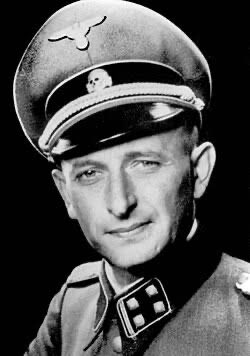
“I was not an anti-Semite. I was just politically opposed to the Jews, because they were stealing the breath of life from us.”
— Adolf Eichmann
Eichmann, one of the principal architects of the Holocaust who helped orchestrate the murder of millions of Jews, would fit like a glove on some of today’s podcasts.