Retour après un raid de la gauche pro-charia ! Oui, je persiste et signe : le voile est un symbole de soumission religieuse patriarcale, qui réduit la valeur morale d’une femme à sa « pudeur » et à sa capacité à se couvrir pour répondre aux exigences des hommes. F*ck la religion
🚨🚨Si vous voulez savoir si J.L. Mélenchon est un charlot... il suffit de le lire.
Exemple (parmi tant d'autres) : il dit ici, officiellement, qu'il veut "bloquer les marges des profits".
Arrêtons nous là-dessus, un moment.
1. Cela ne veut strictement rien dire.
- Le profit (net), c'est ce qu'il reste quand l'entreprise a payé l'ensemble de ses factures : achats, salaires, loyers, marketing, intérêts, impôts. Etc. Cela se mesure en pépettes, en euros.
- La "marge" (en fait : le taux de marge), c'est le rapport entre le profit et le chiffre d'affaires. Cela se mesure en pourcentage.
Vouloir "bloquer les marges du profit", c'est comme vouloir bloquer "le taux de sucre du sucre", dans les crèmes glacées.
Cela n'a aucun sens.
2. C'est parfaitement con.
Vouloir "bloquer" les profits d'une entreprise, cela veut dire que si une entreprise trouve demain un fournisseur moins cher que celui dont elle dispose aujourd'hui (ce qui augmenterait son profit)... cela lui sera interdit.
Cela veut dire que, si une entreprise parvient à mettre en place une organisation plus efficiente, et à accroître ainsi sa productivité, cela lui sera également interdit.
Etc.
Pourquoi ? On ne sait pas.
Mais ça fait "de gauche"...
Alors que les conséquences seraient plutôt de droite.
Car si l'entreprise dégageait plus de profit... elle pourrait mieux payer ses salariés.
Et mieux : elle paierait davantage d'impôt sur les sociétés (15% ou 25% du profit)...
... ce qui permettrait de désendetter un peu l'Etat, pour lui permettre d'engager davantage de mesures sociales ou écologiques.
Une nouvelle fois, nous avons donc là un discours purement populiste, sans aucun sens, et parfaitement débile.
Bref, la journée Portes ouvertes à l'Hôpital psychiatrique se poursuit.
C'est lassant. 😊
Les non-musulmans qui jouent le jeu des islamistes à systématiquement tomber dans les pièges de l’angélisme et de la victimisation sont les descendants idéologiques de ceux qui étaient sur les barricades quand la république a voulu faire les inventaires de l’Eglise début XXe siècle et des communistes iraniens qui se sont fait massacrer par les mollahs juste après les avoir aidés à mettre en place leur régime sanguinaire.
Les #religions sont des cancers de l’humanité, toutes, toujours !
#anti-#laicité #islamophilie
#athéisme
Ton parti nous a insultés pendant 5 ans, au choix: nazi, facho, sociaux traitres, sales boomers, parasites, génocidaires...
Ton parti empêche des artistes juifs de se produire et fait des jeux de mots avec les noms juifs
Ton parti traite les gays de tapettes et de tafioles de merde
Ton parti pratique le népotisme (gendre, fille compagne, chauffeur..)
Ton parti veut supprimer le délit d'apologie du terrorisme
Ton parti piétine toutes les valeurs de gauche : laïcité, universalisme, féminisme...
Alors oui, quand t'es vraiment de gauche, c'est Ni #RN ni #LFI. On est pas @faureolivier et @marinetondelier pour tendre l'autre joue. On a pas de circos à préserver ou à négocier.
Un jour, l'addition ça se paie. Et on fera tout pour éviter ce second tour mortifère pour la gauche et pour le pays.
J'ai très, très rarement rencontré un antisémitisme aussi total, aussi violent et aussi décomplexé.
Comme souvent à l'extrême gauche, les rapports de domination sont la grille de lecture unique.
Le faible est une victime qu'il faut protéger, le fort un dominant qu'il faut combattre. Toute réussite te fait automatiquement passer de l'un à l'autre. Plus un système est efficace, plus il est rejeté.
Une biotech découvre un vaccin efficace ? Hop, classée comme bigpharma.
Un semencier, des graines plus fertiles ou plus résistantes ? Hop, agro-industrie productiviste.
Et tout finit par se confondre : Juifs, capitalisme, mondialisation, science, État, industrie. Avec la certitude d’une domination cachée qui organiserait le monde... Oh, que pour ces gens-là, le terme "anti-sioniste" est pratique...
The Persecution That Doesn’t Make the Headlines
I am a Muslim convert to Christianity. I lived for 15 years as a Christian believer in Morocco, much of that time in what we called the underground church.
Listen carefully, because this is what “moderate Islam” looked like for us:
Morocco is considered one of the most moderate Muslim countries. That is true compared with Mauritania and Libya, where converts from Islam face the death penalty, or Egypt, Jordan, Syria, the West Bank, Saudi Arabia, the UAE, and Pakistan, where converts face imprisonment, torture, intimidation, or severe persecution.
But here is the reality of “moderate” Morocco.
We gathered secretly in homes every Sunday because churches were for foreign Christians, not Moroccan converts. We sang in low voices so the neighbors would not hear us. We arrived two at a time to avoid suspicion. If anyone asked, we pretended it was simply a gathering of family and friends.
We baptized converts in bathtubs.
I was baptized in a bathtub myself. A missionary and a few Moroccan Christians were the only people present.
We kept our house churches small, usually fewer than twenty people. When they became too large, we split them. Christmas and a few special occasions were exceptions.
Police raided Christian gatherings, confiscated Christian materials, dragged believers to police stations, interrogated them, threatened them, and humiliated them with vulgar language.
Our children had to go to school and study Islam and memorize the Quran even though their parents were Christians.
We could not freely give our children Christian names. The government did not need to write “Christian names are forbidden” in bold letters. The authorities simply refused to register them.
Our marriages were treated as Islamic marriages under Sharia because the Moroccan state refused to recognize us for what we actually were: Moroccan Christians.
A Moroccan Christian woman could not simply marry a foreign Christian man as a Christian. He had to establish before the authorities that he was Muslim because, according to the government, she was still a Muslim.
The state decided our religion for us.
Even death did not end it.
When a Moroccan Christian died, he was buried in a Muslim cemetery under Islamic rituals because the government still considered him Muslim. I remember one Moroccan Christian who died in Tangier. We had to do the impossible to get his body to Ceuta so he could receive a Christian funeral.
Imagine having to smuggle your religious identity across a border just to be buried according to your own faith.
We could not establish our own legal Moroccan churches. We could not get permission to build even one church for Moroccan converts. Our house churches were illegal gatherings. We lived at the mercy of the police. Any meeting could be raided. Any neighbor could report us.
Foreign Christians had churches.
Moroccan Christians had secrecy, whispers, living rooms, bathtubs, police interrogations, and fear.
And then Muslims lecture the West about “Islamophobia.”
Spare me.
1/2
Une petite histoire française, une simple anecdote... Mais qui raconte bien notre beau pays...
Aujourd'hui, j'ai pris le bus, à Paris. C'est la première fois que je le fais, depuis près de 3 ans.
D'habitude, je prends le métro.
Je monte, je valide, et je vais m'asseoir.
Plus tard, trois personnes certifieront m'avoir vu valider ma carte Navigo Easy.
Sauf que, paraît il, cela a bipé quand j'ai validé.
En ce qui me concerne, avec une cheville abimée, et tentant d'aller m'asseoir sans me me casser la figure quand le bus a démarré, je ne m'en suis pas rendu compte.
Cinq minutes plus tard, trois contrôleurs contrôlent. Et me disent que je fraude. Car ma carte Navigo Easy est chargée en tickets de métro.
Or, me disent ils, cela ne fonctionne pas dans le bus. Et "cela n'a jamais fonctionné".
Je crois à une blague, et j'éclate de rire; je prends les transports en commun à Paris depuis 60 ans. Et depuis 60 ans, le ticket de métro fonctionnait dans les bus...
Mais un passager intervient pour me préciser que, oui, les règles ont changé au 1er janvier 2025.
Et que, sauf à payer une carte très chère, il faut deux tickets différents : un pour le bus, un pour le métro.
J'ai donc dû payer une amende de 70 euros.
Et ce n'est qu'ensuite que j'ai découvert ... que le ticket de bus est moins cher que le ticket de métro.
Résumons :
- A Londres, Bruxelles, Athènes, Madrid, Amsterdam, Lisbonne, Rome, Singapour, Reykjavik, Canberra, Pékin, New York... : on peut payer ses transports en bus ou en métro simplement, avec une carte bleue sans contact ou avec son téléphone.
Pas à Paris.
A Ouagadougou non plus, remarque...🙂
- A Paris, quelqu'un qui ne circule qu'occasionnellement en transports en commun doit donc décider, en partant le matin, s'il doit prendre sa carte tickets de bus, sa carte tickets de métro... ou les deux.
Comme à Jakarta, remarque...🙂
(Alors que même Moscou, non : le billet est identique pour le bus et le métro...)
- A Paris, plus amusant encore : si tu veux payer le bus avec un ticket de métro valant 2,55 € à l'unité, au lieu d'un ticket de bus valant 2,05 €... c'est impossible.
Les bornes de validation refusent d'ailleurs que tu payes plus cher.
Et on te met même une amende de 70 €, si tu veux payer davantage...
Et bizarrement, là, pour l'amende, la carte bleue fonctionne. Mais pas assez pour simplement transformer ton ticket de métro en ticket de bus.
Commercialement, c'est brillant, remarque.🙂
-A Paris, donc : si tu n'as pas de métro proche et pas de tickets de bus... comme on ne peut plus acheter de tickets au conducteur... eh ben tu marches.
Ca donne modérément envie de prendre les transports en commun.
La voiture, au moins t'as toujours le bon ticket.🙂
- A Paris, on ne peut plus acheter son ticket au conducteur. Mais je lis sur le web : "si tu n'as pas de ticket de bus, tu peux acheter un "Ticket d'accès à bord par SMS" : en envoyant le SMS indiqué pour la ligne. Il coûte 2,55 €".
Morale : si tu n'as plus de batterie ou que tu as oublié ton portable... eh ben tu marches.
Mais ce n'est pas tout : pour prendre le 21, il faut donc envoyer au 93100 un SMS, disant BUS21.
Attention : si tu veux prendre le 21...
Parce que si tu veux prendre le 11, et que tu t'es trompé en tapant ton SMS... tu paieras 70 € d'amende.
Bien sûr, on aurait pu penser à un numéro unique, valable pour toutes les lignes; mais le jeu perdrait sans doute de son charme.🙂
Et ce qui est encore mieux, j'ai testé. Et on me dit que le ticket pour le bus 21, ainsi obtenu, est valable... une heure seulement.
C'est logique. Faudrait pas que les gens puissent s'organiser un peu à l'avance : ce serait moins joueur.🙂
- A Paris, de plus, j'ai payé 70 € comme amende, parce que je voulais payer mon ticket plus cher que ce qui est nécessaire.
Mais je sais que ces 70 € ne seront pas perdus.
Comme l'indiquait le Canard Enchaîné, la RATP a fait bénéficier 200 élus d’un emploi à temps plein, mais pas trop prenant, pour les aider à exercer facilement leur mandat en échange de leur soutien.
Comme Bally Bagayoko.
Et ça, ça me console.🙂
J'ajoute, pour conclure : à tous ceux qui répondront que "tout le monde sait ça, t'as qu'à prendre le bus plus souvent", et "c'est très bien ainsi, car gna gna... "...
Je rappellerai juste que le PIB par habitant français (en dollars constants 2020, convertis en parité de pouvoir d'achat) a augmenté deux fois moins vite que son équivalent dans les pays de l'OCDE, au cours des dix dernières années.
Et que ce décrochage terrifiant vient, sans doute, largement, de ce genre de système... certes très doux avec les élus... mais d'abord ringard, bureaucratique, et parfaitement absurde.
Bref, bravo, @JeanCASTEX , bravo @ClientsRATP , bravo @RATPgroup , bravo @iledefrance . Grâce à vous, j'ai mieux compris mon pays, aujourd'hui.🙂
Four days ago, Amnesty International published a report documenting extrajudicial killings, torture, arbitrary arrests, and other abuses by Hamas militias against Palestinians in Gaza.
Has anyone seen prominent pro-Palestine voices in the West speak about it?
If not, why? Why is accountability for Hamas’s crimes against Palestinians met with silence from the same people who claim to champion Palestinian human rights?
Or do Palestinian lives matter to them only when Israel is killing them?
Mélenchon, une telle pointure en écologie qu’on se souvient encore de la fois où il avait expliqué que la mise en service du Lyon-Turin ferait que « toute l’eau qui est dans les Alpes descendrait dans le trou qu’on creuse ».
Mais ce n’est pas tout… Thread 🧵
On October 7, Eden Nimri (22) bravely confronted Hamas single-handedly. At the time, she was wearing pajamas and stood at the entrance of a bomb shelter, protecting the people inside. She saved 17 girls.
According to a Ynet report, all 17 girls survived safely.
Survivors recounted that when Eden ran out of ammunition, she fought the terrorists unarmed, using only her bare hands.
She sacrificed her life while defending Israel and her friends. Eden was only 22 years old. Her bravery will never be forgotten. Her memory will always remain with us 🎗️
La LFI veut appliquer, au XXIe siècle, dans un pays riche doté de protections sociales, des politique envisagées au XXe siècle pour des pays pauvres qui n'en avaient aucune. Et qui les ont conduit à être plus pauvres encore.
Le plus désastreux, avec J.L. Mélenchon, ce n'est pas seulement sa totale mauvaise foi et ses penchants dictatoriaux : c'est son ringardisme absolu. 🙂
Génocides :
- 8,000 Tutsis par jour assassinés à la machette entre mars et juin 1994
- 7,000 Juifs hongrois par jour déportés, gazés et brûlés à Auschwitz au printemps-été 1944
- 5,000 Arméniens par jour assassinés ou morts de faim et d’épuisement entre mai et décembre 1915
- 4,200 Juifs par jour gazés et brûlés à Treblinka lors du « nettoyage » du Ghetto de Varsovie en juin -septembre 1942
- 4,000 Juifs par jour assassinés par balle dans des fosses communes lors de la Shoah par balle (juin-octobre 1941)
- 1,300 Israéliens assassinés par le Hamas lors de la journée du 7 octobre 2023
- 1,9 Palestiniens civils tués par jour, victimes collatérales (parfois sans doute évitables) lors de la guerre contre le Hamas entre octobre 2023 et nombre 2025
Il n’y a pas eu de « génocide » à Gaza mais une guerre déclenchée par le Hamas, avec un pogrom à caractère génocidaire. Ce même Hamas s’est abrité derrière les civils quand ces derniers étaient encouragés à s’éloigner des zones de combat, nourris, approvisionnés en eau et en 5G, et tous les enfants vaccinés. Un « génocide » qui s’est finalement arrêté quand les « génocidés » du Hamas ont finalement libéré les otages… Au total, sur ~70,000 morts (pour une population de 2,2 millions), presque la moitié sont de terroristes du Hamas. Un record de discrimination, en particulier pour une guerre urbaine hyper complexe menée par une organisation terroriste.
La fausse accusation de génocide n’est qu’une reformulation moderne des accusations archaïques antisémites de déicide et de crime rituel
🧵Et si on regardait de plus près le communiqué de presse des ces associations environnementales ?
Parce que c'est un modèle de tartufferie et de rhétorique anxiogène.
« Leur démarche ne vise pas à s’opposer à la construction d’une usine de dessalement en soi, mais à exiger que ce type de projet soit mené dans le respect des conditions minimales de protection de l’environnement. »
↩️
C'est un anniversaire dont on parle trop peu : cela fait un siècle maintenant qu'on sait la vérité sur le Goulag.
Je me suis amusé à faire une liste, non exhaustive, des livres qui en ont parlé.
Les premiers sont sortis il y a 100 ans, voire un peu plus. Et beaucoup d'autres ont suivi. ⬇️
En clair : cela fait donc un siècle que quiconque adhère au Parti Communiste sait que le Goulag existe... Mais que cela ne le dérange pas.
Cela fait 100 ans que tout adhérent au PCF affiche donc, très officiellement, qu'il souhaite lui aussi déporter ses opposants politiques dans des camps de concentration.
Qui firent officiellement 1,6 million de morts, en URSS. Et près de 3 millions, en réalité. (*)
Cela fait donc un siècle que des gens comme Ian Brossat @IanBrossat mettent - en toute connaissance de cause - des guillemets à "victimes", quand on parle du communisme. Pour mieux dire que ces 3 millions de morts... l'avaient bien cherché.
Un siècle d'ignominie - et aucune cérémonie, aucune festivité pour marquer le coup, au siège du Parti ?
Voilà un centenaire dont on parle trop peu...
(*) Trois millions de morts au Goulag. Auxquels il faut rajouter les exécutions (1 million), les déportations, les "peuplements spéciaux", qui portent le chiffre à 15 millions de morts. Sans compter les famines (6 à 8 millions).
Ouvrages sur le Goulag, publiés en Occident
1924. Sergey Melgunov : "La Terreur rouge en Russie". Ouvrage documentaire sur les répressions bolcheviques dès 1918-1922, incluant les premiers camps.
1925. S. A. Malsagoff. "Solovki. Île des tortures et de la mort" – Notes de l’officier S. A. Malsagov, évadé de Solovki.
1927. Raymond Duguet : "Un bagne en Russie rouge". Témoignages sur les îles Solovki (premier grand camp de "rééducation par le travail" dès 1923).
1931. Ivan Matveïevitch Zaïtsev : "Solovki, lieu de tortures et de mort".
1933. Tatiana Tchernavin : "Escape from the Soviets."
1935. Frantsishak Alyakhnovich : "Sept ans dans les griffes du GPU". Souvent cité comme l’un des tout premiers témoignages de livre entier sur un camp de travail soviétique (Solovki).
1938. Ante Ciliga : "Au pays du grand mensonge". Critique du système concentrationnaire par un ancien communiste yougoslave.
1946. Victor Kravchenko : "J’ai choisi la liberté". Témoignage d’un haut fonctionnaire soviétique passé à l'Ouest.
1946. David Rousset : "L’Univers concentrationnaire". Enquêtes et appels publics sur les camps soviétiques (fin des années 1940).
1947. Dallin et Nicolaevsky : "Forced Labor in Soviet Russia" – étude documentaire basée sur des témoignages de rescapés.
1949. Margarete Buber-Neumann : "Déportée en Sibérie". Témoignage d’une communiste allemande envoyée au Goulag.
1949. Julius Margolin : "La Condition inhumaine". Cinq ans dans les camps de concentration soviétiques.
1949. Józef Czapski : "Terre inhumaine". Témoignage d’un officier polonais sur les camps soviétiques et la déportation des Polonais.
1951. Elinor Lipper : "Onze ans dans les camps soviétiques".
1951. Gustaw Herling-Grudziński : "Un monde à part". Récit d’un Polonais sur le Goulag (écrit à partir de son expérience de 1940-1942).
Années 1950. Varlam Chalamov : "Récits de la Kolyma" (écrits à partir des années 1950, circulation partielle en samizdat et à l’étranger avant la pleine publication)
1953. Alexander Weissberg-Cybulski - "L’Accusé" - témoignages sur les prisons et camps staliniens.
1962. Alexandre Soljenitsyne : "Une journée d’Ivan Denissovitch".
1967. Evguénia Guinzbourg : "Le Vertige" (écrit dans les années 1960, publié en Occident en 1967). Récit d’une femme communiste déportée.
1973. Alexandre Soljenitsyne : "L’Archipel du Goulag".
Etc.
Quand j’étais petite, une cousine du village m’avait raconté quelque chose qui m’a traumatisée à jamais. Lors de la nuit de noces dans son village, si le mari n’arrivait pas à pénétrer sa femme à cause qu’elle a subit une excision de type 3, la magnamaga prenait une lame pour
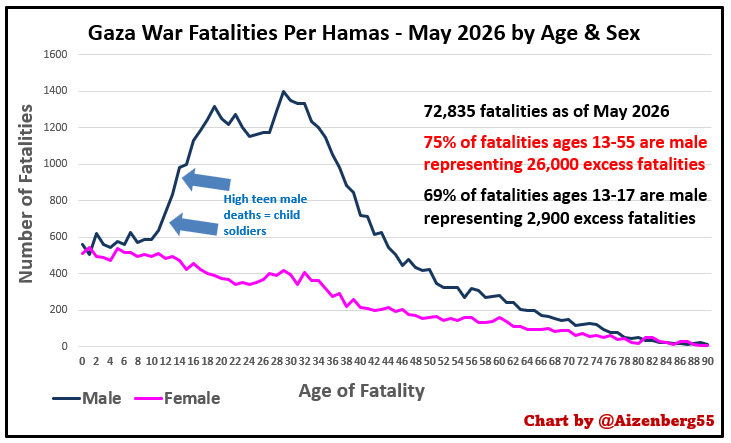
Dit is een grafiek van de oorlogsslachtoffers in Gaza, op basis van Hamas-cijfers. Ga ervan uit dat alle vrouwen burgerslachtoffers zijn. Ga ervan uit dat er net zoveel mannelijke als vrouwelijke burgerslachtoffers zijn. Dan is de verhouding strijder-burger onder de slachtoffers 1:1,5.
De grootste database ter wereld over zulke situaties is van het Uppsala Conflict Data Program. Die geeft voor conflicten in grote stedelijke gebieden een gemiddelde van 1:2. Een groter percentage burgerslachtoffers dus dan in Gaza.
Dit zou voor altijd voldoende moeten zijn om beschuldigingen van genocide in Gaza van tafel te vegen. Uiteraard kun je erover discussiëren of het gerechtvaardigd is dat Israël tegen Hamas blijft vechten zolang die zich niet overgegeven heeft of ontwapend is. (Voor de duidelijkheid: ik vind het wel.) Maar dat is echt iets anders.
Maar de vrijwel exclusieve aandacht voor deze oorlog; de vrijwel exclusieve morele verontwaardiging over deze oorlog; en vooral het ter verantwoording roepen van niet-Israëlische joden overal ter wereld over deze oorlog: dat is zo diep onlogisch. Dat is antisemitisme.
Ik zie je bruine hemd.
Al-Shifa Hospital: More than a medical facility and the journalists who filmed it
"10:40am on October 7, a large number of vehicles drove through the gates of Al-Shifa Hospital, the largest medical complex in Gaza. These were not ambulances, and they were not transporting wounded terrorists. They were transporting Israeli hostages."
Al-Shifa Hospital was not merely Gaza’s main hospital that day. On the morning of October 7th, it functioned as a Hamas operational hub for receiving, processing and distributing Israeli hostages. Armed fighters were present and crowds celebrated the arrivals.
Video evidence tracks a stolen IDF jeep that left Nahal Oz base with Israeli hostages. It travelled through Gaza, passsed other hospitals and entered the Al-Shifa compound. Approximately 16 different vehicles can be identified. Dozens of hostages, including Naama Levy and Ori Megidish, were transported into Al-Shifa. Armed fighters were visibly present in the hospital at that time.
Seperate footage shows another murdered Israeli hostage, Ran Gvili, being transported by a terrorist on a motorcycle from Kibbutz Alumin to Gaza. The terrorist also arrives at the Al-Shifa compound, where his arrival is once again greeted by a cheering crowd.
Additional video footage also shows what appears to be an ambulance being used to transfer hostages from the hospital to the apartments of their captors. Some of those apartments were later identified as belonging to UNRWA teachers and medical workers.
The use of ambulances by Hamas was not isolated. Throughout the war, Hamas terrorists repeatedly exploited them. In one such case, terrorists Adham and Ismail Hawwas admitted placing Thai and Nepalese agricultural workers into an ambulance and driving them to Al-Shifa Hospital.
Prominent Gaza-based journalists were present and filming at the compound that day. None reported the arrival of Israeli hostages. One, however, falsely portrayed a jeep full of captured Israeli women as "wounded Palestinians" being brought in for medical treatment.
The vehicle convoy, armed presence, cheering crowds and deliberate bypass of a nearer hospital (Al-Ahli) make the non-medical purpose of Al-Shifa clear. The selective silence of Palestinian journalists formed part of the information warfare that obscured these facts on the morning of October 7 and throughout the war that followed.
🇷🇺🇰🇵Nous n'aurions jamais dû laisser la Corée du Nord envoyer des troupes en Ukraine.
Cela aurait dû être une ligne rouge : si Pyongyang envoie des troupes, alors nous aussi.
Cette posture de faiblesse de la part de l'OTAN est insupportable. Nous avons laissé la Corée du Nord entraîner ses troupes chez nous, en Europe, à tuer des Ukrainiens. Il faut se rendre compte quand même de l'énormité de la chose, il y a 5 ans personne n'aurait pu l'imaginer.
Déjà que laisser la Corée du Nord tester ses missiles balistiques sur les villes ukrainiennes est une aberration mais le déploiement de troupes constitue une escalade certaine et intolérable. Les rumeurs selon lesquelles ils risquent d'en envoyer à nouveau devraient nous alerter sur la réponse à apporter.
L'Europe ne doit pas accepter que la pire dictature de la Terre entraîne ses troupes en Ukraine. Et si nous ne voulons pas envoyer nous-même nos soldats pour aider à défendre l'Ukraine, alors donnons-leur au moins les moyens de se défendre efficacement et levons les restrictions inutiles.
C'est un échec moral profond pour l'Europe que de laisser faire la Russie et la Corée du Nord.
"Vous criez « génocide » à l’intention d’Israël.
Laissez-moi vous dire quelque chose sur le génocide.
Pendant 2 000 ans, des gens ont essayé d’exterminer les Juifs. Comme un projet.
Si l’Holocauste n’avait jamais eu lieu, il y aurait entre 26 et 32 millions de Juifs dans le monde aujourd’hui. Ce n’est pas une supposition de ma part. Ce sont les chiffres de Sergio DellaPergola, le démographe mondialement reconnu sur le sujet.
Aujourd’hui, il y en a moins de 16 millions. Moins qu’en 1939.
Remontez plus loin. Au premier siècle, les Juifs représentaient 2 à 3 pour cent de toute l’humanité. Si cette proportion s’était simplement maintenue, il y aurait entre 150 et 250 millions de Juifs aujourd’hui. Peut-être plus.
Il y en a 15 millions.
Voilà à quoi ressemble un génocide. Pas un peuple qui grandit. Un peuple qui manque encore de centaines de millions après 2 000 ans, parce que personne n’a jamais cessé d’essayer de l’effacer.
Les Juifs sont probablement le peuple de l’histoire mondiale qui a été soumis aux tentatives d’anéantissement les plus soutenues et répétées, sur la plus longue période de temps, et l’un des seuls peuples dont la population totale porte encore la cicatrice aujourd’hui.
Et les voilà qui arrivent : « Mais nous pouvons dire la même chose des Palestiniens. »
Non. Et voici pourquoi.
Le génocide signifie annihilation. Un peuple qui diminue. Une courbe qui pointe vers le bas et qui continue de le faire.
Regardez à nouveau les Juifs : moins de 16 millions. Moins qu’en 1939. Des centaines de millions en moins. Voilà une courbe d’anéantissement.
Maintenant, regardez les Palestiniens. Selon le bureau palestinien des statistiques lui-même, et non Israël, ils sont passés de 1,37 million en 1948 à plus de 14 millions aujourd’hui. Une augmentation par dix. À Gaza seule : de 240 000 en 1950 à plus de 2 millions. Ce n’est pas une affirmation de ma part. C’est leur propre chiffre.
Un peuple qui subit un génocide ne se multiplie pas par dix. Voilà la différence simple et implacable.
Il y a une guerre. Des gens meurent à la guerre. C’est terrible. Mais une guerre avec des victimes n’est pas la même chose que l’anéantissement systématique d’un peuple entier à travers les générations.
Alors, quand vous criez « génocide » au seul pays qu’il reste aux Juifs : vous n’avez aucune idée de ce que le mot signifie. Les chiffres, si.
Et laissez-moi anticiper leur argument et le démonter, pièce par pièce.
« Mais en droit, le génocide ne nécessite pas que la population diminue. Seulement l’intention de détruire un groupe. »
Correct. Et merci. Parce que vous venez de passer de chiffres que vous ne pouvez pas remporter à une intention que vous ne pouvez pas prouver.
La Convention des Nations Unies exige quelque chose de très spécifique : une intention spéciale de détruire un peuple en tant que tel. Pas des victimes civiles dans une guerre. Pas de l’indifférence à la souffrance pendant qu’on combat le Hamas.
La volonté précise d’anéantir le groupe. C’est le fardeau de la preuve le plus élevé en droit international, et il est élevé à dessein, pour que le mot ne s’use pas jusqu’à signifier « une guerre que je désapprouve ».
Et que disent les tribunaux ? La Cour internationale de Justice n’a pas déclaré Israël coupable de génocide. Pas en 2024. Pas aujourd’hui. L’affaire est encore aux plaidoiries écrites en 2026, à des années d’une décision. Les mesures provisoires de 2024 reposaient sur un « risque plausible », et la Cour elle-même a dit clairement que ce n’était pas une constatation qu’un génocide a lieu.
Il est peu probable qu’ils soient condamnés – non pas parce que la légitime défense exclut le génocide, mais parce que l’intention de détruire un peuple ne peut pas être prouvée quand les actions ont un objectif militaire, en l’occurrence se défendre contre le Hamas, et parce qu’aucun tribunal n’a jamais abaissé ce seuil. "