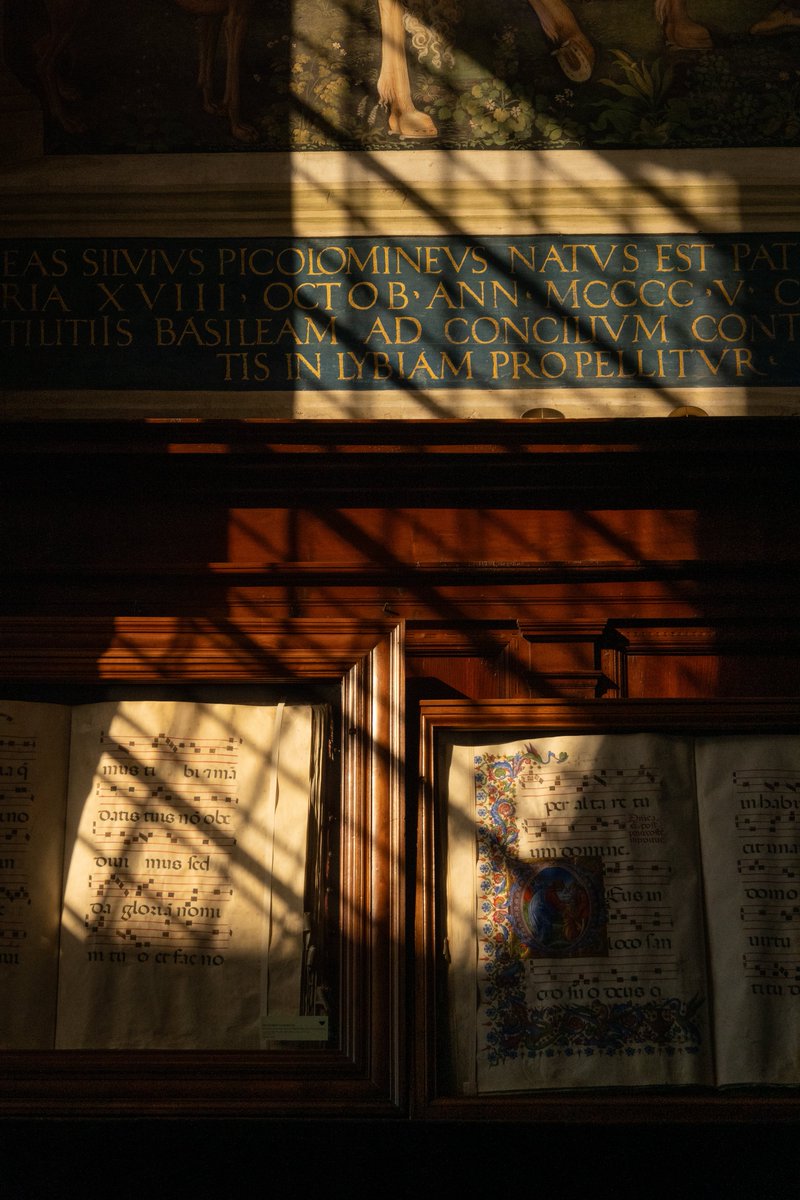
Someone asked me recently why I’ve become interested in aesthetics after having spent most of my life more interested in STEM-adjacent topics. I hadn’t really considered the question consciously before, but I’m certainly thinking about aesthetics more than I used to. I think it’s a confluence of things:
• Many things today are ugly and far uglier than they used to be or need to be. Once you see this, it’s kinda hard to stop perceiving it. (Early twentieth century phone boxes versus modern phone boxes; old water fountains versus new water fountains; etc.) As someone with a naively meliorist assumption that most things should be getting better rather than worse, it’s all a bit perplexing: why did we stop doing things nicely? Is it a choice? Was there a malevolent spell cast upon us? This vein led me to think more about modernism and why much of art became more intentionally "challenging", grotesque, opposed to prettiness, rebarbative, dissonant, etc. Can or should anything be done about this? Is this just how things ought to be?
• Relatedly, much of modernism involved a kind of explicit repudiation of cultural continuity and represented a schism with prior practices. This is maybe most evident in American architecture, where the International Style exhibition in 1932 initiated the displacement of a rich tapestry of prior styles. This cultural break seems important and interesting to me, and I suspect that the rejection had important consequences outside of the aesthetic domain. Samuel Hughes has been exploring this question in his recent writing at @WorksInProgMag; @RuxandraTeslo is also pulling on this thread. Elaine Scarry wrote about how beauty inspires creation. If so, the inverse may also be true: ugliness inhibits it.
• It’s clearly the case that changes in the aesthetic domain can at least inspire progress in other places. Petrarch helped set some of the preconditions for the Renaissance which in turn fostered the scientific revolution and Enlightenment. Things like World Fairs (the 1851 Fair at the Crystal Palace recorded 6 million admissions when the population was 21 million) reflect the popular interdependency that used to exist between aesthetics and material development.
• @tedgioia and others have written about stuck culture and how so many domains seem to have ceased to straightforwardly advance in the way that they did up until the nineties or thereabouts. This is obviously peculiar and interesting. What changed, and what does it mean? Is it about the internet and fragmentation? Is it about a loss of supply? Is it just about having reached the zenith of various mediums?
• I’m generally interested in markets and the dynamics of creation. In aesthetics broadly, I find the reflexivity between supply- and demand-side factors to be very thought-provoking. There’s a natural desire to view satisfaction of individual preferences as the yardstick to measure market success, but things get interesting and even a bit unsettling when we start to think about how the supply might start to shape the demand. I often think about this in the context of food. Why is food so much worse in Germany than many of its neighbors? Germany certainly doesn’t have less material ability to produce good food; indeed, Germany is richer than the countries around it. There’s probably something about German food supply chains that is impoverished relative to France and Italy, but the Germans themselves don’t seem too upset about it. It just seems that the Germans are stuck in an objectively worse market equilibrium than their neighbors: the food is bad and they’ve gotten used to it. The obvious question then is where else these kinds of reflexive patterns apply, and where else we’re stuck in some objectively inferior equilibrium, even if preferences are in some superficial sense being sated.
• While this is an extremely banal and obvious point, I hadn’t until recently thought much about or internalized how much one can study reasonably objective things ("the status of women in society", say) through artwork. (Thanks to @_alice_evans for opening my eyes here.) In this vein, I’m pretty excited about the possibilities over the coming years in computational art analysis. I want something that’s conceptually similar to Google Ngram timelines but for the visual arts.
• We've always tried to do things well at Stripe. I've come to see that attempting to do them beautifully is often a helpful way to break out of standard practices and to do something with greater novelty and in a way that might have other benefits besides. (Also, excellent people want to do great work because it is intrinsically satisfying. Explicitly allowing aesthetic considerations to carry weight avoids having to justify every assessment with some kind of torturous empiricism.)
• In his Nobel Lecture, Solzhenitsyn said that, among the Platonic virtues of goodness, truth, and beauty, that beauty is special, for it possesses a unique kind of irrefutability. He notes that arguments, writing, and philosophical systems can all be predicated on misapprehensions, but that “a true work of art carries its verification within itself.” He proceeds to observe that when goodness and truth are threatened, the “ever surprising shoots of beauty will still force their way through.” There is a lot of specious and motivated reasoning in the world today and plenty of questionable value systems. I don’t think that beauty directly reflects any definitive trait, but I’m intrigued by the idea that it can be a marker of deeper metaphysical coherence.
@HELENNMCCRORY What underpins the habit is kindness. And yes, her family, drivers and security personnel wait, but she's extending kindness to someone - its such an admirable trait.
@JudgeJudgyJudge@JeremyTate41 Buy 'The Complete Stories', and then read the following, A Good Man Is Hard To Find, The Life You Save May Be Your Own, The River, Good Country People and Revelation. And then buy her book, Wise Blood. It too is excellent. You need to have your catholic theological lens on to...
A coalition of religious sisters in New York State won a major victory in federal court this week when the state agreed to not force the nuns to participate in an assisted suicide program.
https://t.co/pc6ljsHRk5
Friends, in our spiritually hungry times, the Gothic cathedrals do what they’ve always done: teach the faith and focus the journey of the spirit.
In the new film “Heaven in Stone and Glass,” I will take you around the great cathedrals of France, letting their mysteries emerge.
The Pope’s Prayer intention for the month of August is to pray for the evangelisation and the spread of the Gospel in cities and urban areas.
“We know that cities are called to be places of freedom and opportunity, but they can also become spaces of anonymity and isolation.
That's why today, we ask you, for a renewed gaze, able to discover, in urban life, fertile ground for proclaiming your Gospel.
Give us a creative and deep faith that doesn't remain in words, but becomes flesh through simple and loving gestures.
Make us a Church that goes forth, able to reach out to the peripheries, to console those who are lonely, and to sow fraternity and connection instead of giving in to indifference.”
On July 31st, 1556, St. Ignatius was moved from his bedroom to his private chapel by his brother Jesuits so that he could die in the presence of Jesus in the Tabernacle
470 years ago today, St. Ignatius died in the presence of the Eucharist
🟢 𝗜𝗹 𝗲𝗻 𝗮 𝘃𝘂 𝗽𝗮𝘀𝘀𝗲𝗿, 𝗱𝗲𝘀 𝘃𝗶𝘀𝗶𝘁𝗲𝘂𝗿𝘀 🌳
Depuis des générations, le grand platane de l’abbaye offre son ombre à celles et ceux qui franchissent ses portes.
Planté en 1780, il approche désormais les 40 mètres de hauteur.😍
📆 Tous les jours de 10h à 18h
El Arzobispo de Santiago, Monseñor Francisco Prieto, presidió en la catedral la Misa Solemne del Apóstol Santiago, durante la cual se renovó la tradicional Ofrenda Nacional que, en nombre de el Rey, realizó este el presidente del Parlamento de Galicia, Miguel Santalices.
@dieworkwear The church has rightly warned people across the last 2000 years about how wealth and power can corrupt a person. That being said, there are examples of Kings like Louis IX, who lived an exemplary life, and he is now a canonised saint.
I just watched @BishopBarron's first Thomas Aquinas lecture for @petersonacademy.
He's one of the best lecturers I've ever heard.
He's engaging and coherent, well-armed with stories, an effective synthesizer, and able to shift up and down levels of analysis with ease ("here's the social impact; here's the theological significance; here's the historical context, etc.).
I've interviewed him, and we have spent time together, and that was all exceedingly worthwhile. But a full lecture requires a different skill set, and not many people have it.
He captured my attention, despite my current difficulty with pain. And I learned a lot.
He's also eminently likeable.
It's a privilege to have the Bishop's lectures on Peterson Academy.
If you truly believe your life is beyond saving, then you have nothing left to lose by trying to save someone else’s, If your destiny is beyond repair, do not have destruction as your last act, when mercy can be your last gamble.
Firmly rooted in the Word of Jesus, reading the Gospel every day, never stop dreaming of a land where there is peace and fraternity, nor stop looking at the world with wonder, nor stop facing the future with the light of hope. Do not let anything or anyone steal your hope.
Doomscrolling is gambling for revelation, pulling the lever of an infinite slot machine, persuaded that after a billion worthless posts, the next one will finally justify all the others.