Elon Musk @elonmusk, that story happened in Antioquia, Colombia. With 1,200 Starlink antennas, we bring telemedicine to the most remote corners: we save lives, connect schools and bring opportunities to Indigenous and Afro-Colombian communities.
We want to go further: in Urabá, on Antioquia’s Caribbean coast, we are ready to host a SpaceX spaceport. 🚀
____________________________
Elon Musk, esa historia ocurrió en Antioquia, Colombia. Con 1.200 antenas Starlink llevamos telemedicina a los rincones más apartados: salvamos vidas, conectamos escuelas y acercamos oportunidades a comunidades indígenas y afrodescendientes.
Queremos ir más lejos: en el Caribe del Urabá Antioqueño estamos listos para tener un puerto espacial de SpaceX. 🚀
@superlinear_fm@_lopopolo Great episode, enjoying it so far! It reminded me of this LangChain piece from earlier this year on the anatomy of an agent harness:
https://t.co/OfcoPXf31o
I recall a specific case where I built a graph with an evaluator-optimizer pattern. One node generated the response, and another evaluated it against a set of criteria. If the evaluator wasn’t satisfied, it returned feedback and sent the process back to the start of the graph.
What stood out was that often first-iteration answers were often quite good when I checked the logs. But because the evaluator was very strict, it frequently refused to approve anything and kept looping / sending feedback until it hit the iteration limit. In those cases, the extra structure and feedback loop actually degraded the final result instead of improving it.
Sure, it’s great to hear people actually talking about these topics outside the usual commercial narrative where everything looks perfect.
On my side I’ve been working with agent systems for some time, both agent loops and graph-based orchestration. One of the biggest pain points for me has been keeping relevant context alive throughout the full agent trajectory.
I’ve also seen cases where adding more structure with graphs can actually make the agent less effective, which matches what Brandon was pointing at about not getting too much in the way of the agents.
A lot of the ideas you covered on these coding agents ( loops, graphs, and the harness) also apply really well to agentic systems development in general beyond pure coding agents.
Looking forward to the next episodes.
when the dream becomes the job
i used to think the dream was to make my hobby my work.
to spend my life close to the things i loved: computers, tools, interfaces, systems, tiny details, the feeling of making something from nothing. the things i used to do at night, after school, after work, in the margins of life, somehow became the center of my life.
and it is a dream. i don’t want to pretend otherwise.
there is a very specific happiness in getting paid to care. in meeting other people who care. in building a language around your obsession. in seeing something that lived only in your head become real enough for other people to touch.
but there is also a quiet pain in it.
because the thing that once belonged only to you no longer belongs only to you.
it becomes attached to deadlines, teams, customers, strategy, money, reputation, momentum... curiosity becomes roadmap. taste becomes decision-making. play becomes output. the thing you once used to escape the world becomes the thing through which the world reaches you.
and now there is another strange layer: the machines are getting good at the work too.
not just the boring parts. the parts that used to feel close to the heart. writing, coding, designing, reasoning, making taste-like decisions, turning vague ideas into something real. the things we once used as proof that we had something special inside us are becoming things a model can approximate, remix, and sometimes do faster.
that can feel scary in a very specific way.
not only because of jobs or competition, but because it touches the myth you built around yourself. if the thing i became good at can be done by a machine, then what part of it was really me?
i think that question is painful because it arrives at the same place.
the original love.
before the title, before the company, before the taste became a role, before the work became useful to other people, there was a small fire inside. curiosity. obsession. the feeling that the world became more alive when you understood a little more of it, or made a tiny piece of it bend to your will.
AI can make the output faster. it can even raise the floor of the craft. but it cannot want on your behalf. it cannot decide what is worth loving. it cannot protect the strange private thread that made you care in the first place.
maybe that is what becomes more important now.
not whether you can still produce the artifact by hand. not whether you can outperform the machine at every task. that game is already changing.
the real question is whether you still have a relationship with the source.
the part with no audience. no roadmap. no deadline. the part that can wander, collect strange references, make useless things. follow beauty, be wrong, be slow, be you, be true.
because that part is not separate from the work. it is the source of the work.
if you lose it, you can still operate. you can still manage the machine. you can still prompt, review, decide, ship, and keep things moving.
but the work becomes thinner. safer. more explainable. less alive.
so maybe the real discipline is not to work harder, rest more, or care less.
maybe it is to keep returning to the place where the love began – before it became useful, before it became legible, before anyone needed anything from it, before even the machine could mirror it back to you.
not to escape the work.
to make sure the fire inside is still alive.
Tired: Monday
Wired: Moonday
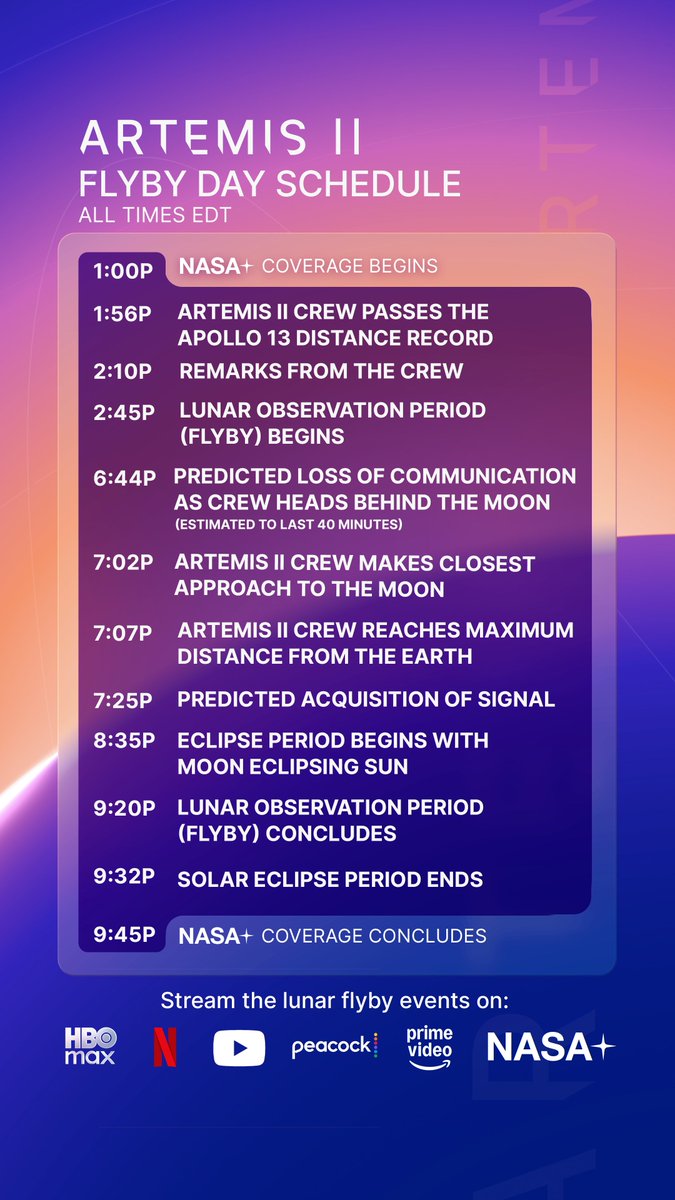
Today our Artemis II astronauts fly around the Moon! Tune in, starting at 1pm ET (1700 UTC) as they view parts of the Moon never seen by human eyes.
Watch it live with us: https://t.co/fAg0bGAqEc
Is LangGraph still a strong choice for building multi-agent systems or is people using another option?
I've been a bit disconnected since last year, and it seems the focus has now shifted toward just using coding agents
@astonepokes Is LangGraph still a strong choice for building multi-agent systems? I've been a bit disconnected since last year, and it seems the focus has now shifted toward coding agents