🚨🗣️| Zlatan Ibrahimovic on Croatia's disallowed goal:
"It was a robbery. They disallowed the goal to set up a Portugal vs Spain last-16 clash. It was manipulated."
Years from now, I believe people will look back on this moment as one of the greatest self-inflicted failures in professional sports.
The public was ready.
Fans were excited.
Millions of people who had never watched a WNBA game suddenly became invested in women's basketball.
The league had the rarest opportunity in sports... a transformational superstar capable of changing its trajectory for generations.
Instead of embracing that moment, the WNBA chose culture wars over basketball, politics over player protection, and ideology over leadership.
Rather than showcasing the game at its best, it allowed controversy, inconsistency, and internal division to become the story.
And the generation of young girls who finally saw the sport capturing the nation's attention, instead got to watch the league squander one of the greatest growth opportunities it has ever been given.
As a writer, it is becoming increasingly difficult to cover the WNBA with the distance the job requires.
That is not something I say lightly.
Any serious writer understands the responsibility of separating observation from emotion, evidence from outrage, and analysis from personal bias. But Cathy Engelbert and the WNBA are making that separation harder by the day.
The latest example is almost impossible to defend.
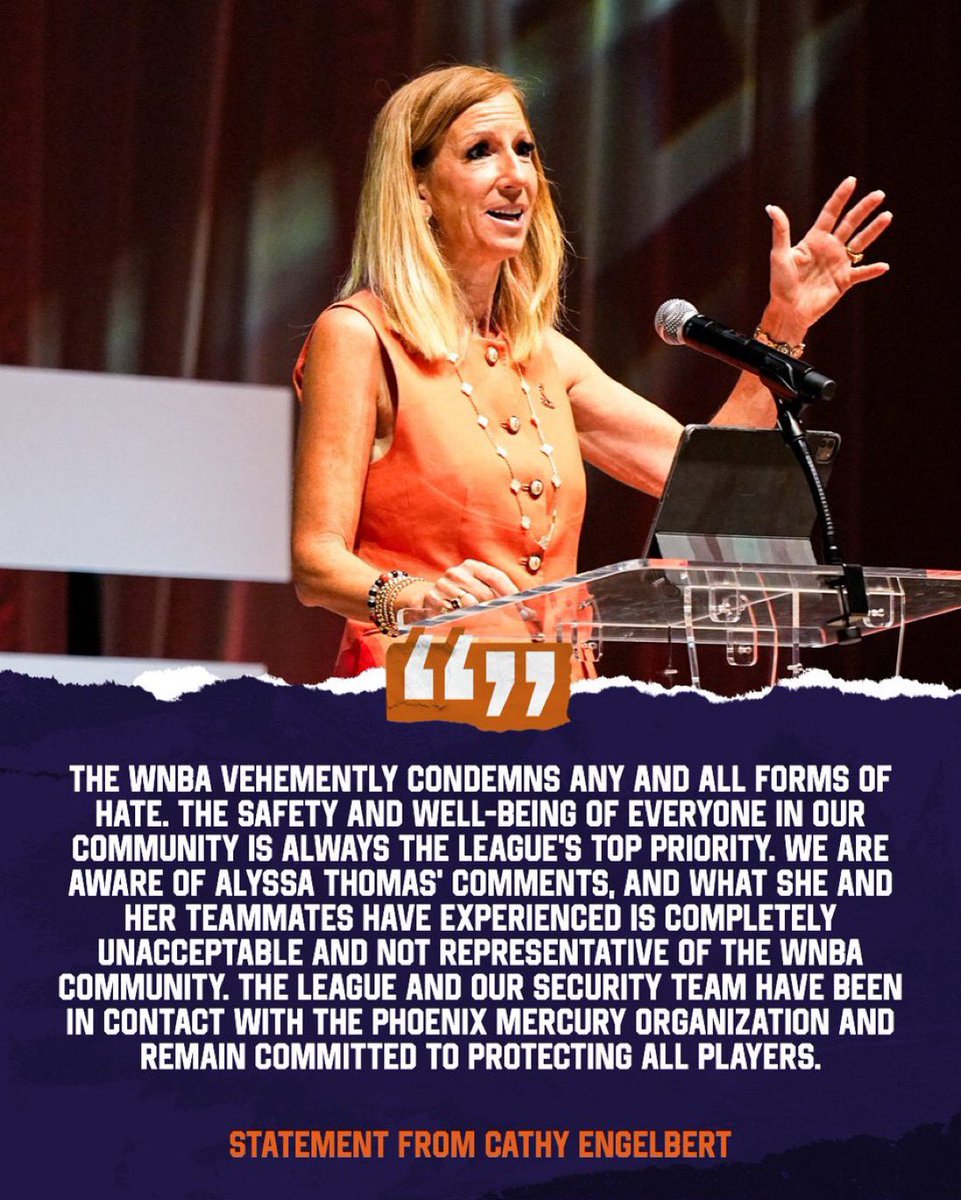
The commissioner released a statement that appeared far more concerned with protecting the image of Caitlin Clark’s attacker than addressing what happened to Caitlin Clark herself... a star player who was throat punched, kneed, and trampled in a sequence that had very nothing to do with basketball.
At some point, silence becomes its own statement.
At some point, selective outrage becomes evidence.
And at some point, the refusal to protect the league’s most important player stops looking like incompetence and starts looking intentional.
Caitlin Clark did not enter the WNBA asking to be a symbol. She came to play basketball. She came to compete. She came to join a league filled with players she once admired.
Instead, she has been asked to endure a level of hostility that no professional organization should tolerate.
The physical play is only part of the issue.
The larger failure is institutional.
The league has failed her. The Fever have failed her. Too many players have failed her. And now the commissioner has failed her publicly.
The next few days will be telling.
At a bare minimum, the Fever organization, its coaches, and its players should publicly support Caitlin Clark and make clear that what happened to her should never be normalized.
They do not need to attack anyone.
They do not need to escalate the controversy.
But they do need to stand beside their teammate.
Because if they do not, it becomes increasingly difficult to see a healthy path forward for Clark in a league where she is asked to absorb repeated physical punishment, public minimization, and institutional silence without visible support from the people closest to her professionally.
There is also a human element here that should not be ignored.
Clark is not just a basketball asset.
She is someone’s daughter.
Someone’s sister.
Someone’s friend.
And at some point, the people around her... family, representatives, sponsors, and trusted advisors... may need to ask whether any amount of money, fame, or professional opportunity is worth this level of physical and emotional strain.
Basketball is supposed to be demanding.
It is not supposed to be dehumanizing.
Clark has handled it with grace. That should be acknowledged.
But grace should not be required in the face of repeated mistreatment.
There comes a point when asking a young athlete to keep absorbing the blows... physical, public, and psychological... becomes indefensible.
For months, I dismissed calls for outside intervention as excessive.
I no longer feel that way.
If the WNBA cannot protect its own players fairly, then perhaps it is time for someone outside the league to ask why.
Fans, media members, former players, abuse survivors, and anyone who cares about basic fairness should speak up.
This is no longer just about basketball.
It is about workplace protection.
It is about institutional accountability.
It is about whether a professional league can allow one of its employees to be targeted, minimized, and publicly abandoned without consequence.
The WNBA does not need another statement.
It needs accountability.
And it needs it now.
Like many others, I have been alarmed by the success of certain politicians in our country who identify as extreme socialists or communists.
This is not a matter of classical liberals triumphing over standard-issue conservatives; this is the victory of people who stand athwart the fundamental principles that undergird our country.
There are many reasons why I detest Communism, but I want to draw attention to just one issue of supreme importance.
Karl Marx said that the first critique is the critique of religion. He meant that, before a complete re-working of the politics and economics of a society can take place, religion has to be taken down.
This is because religion, as he saw it, is the “opium of the masses,” a drug taken to dull our sensitivity to the suffering caused by economic exploitation. As long as the suffering populace is lured into complacency by fantasies about God's providence and the promise of eternal life, they will never rise up and throw off their chains.
But there is a second reason why the elimination of religion is of paramount significance for Marx.
Communism aspires to be a totalizing system, involving the government's control over education, entertainment, communication, politics, and especially economics.
What stands resolutely athwart this ambition is religion, which declares that all of these societal expressions are finally under the judgment of God. So, if you want Communism to succeed, religion has to be stamped out.
If you doubt me on any of this, I would encourage you to read the recent histories of China, Russia, Cuba, Nicaragua, Vietnam, Cambodia, and Venezuela. Revisit those histories and tell me I'm wrong about the attack on religion.
Might I encourage my fellow believers in God not to be complacent in the face of this very troubling development in the American body politic?
An Open Letter to WNBA Commissioner Cathy Engelbert
Dear Commissioner Engelbert,
This is no longer incompetence.
This is negligence.
You were handed the greatest gift the WNBA has ever received, and you are finding new ways to squander it.
For nearly 30 years, the WNBA has struggled to stand on its own merit. It has needed patience, protection, subsidies, excuses, advocacy, and endless goodwill. The league has been treated less like a professional sports product and more like a cause people were expected to support out of obligation.
Then Caitlin Clark arrived.
She was not just a star.
She was the lottery ticket.
She brought the audience. She brought the ratings. She brought the sold-out arenas. She brought fathers and daughters. She brought casual fans. She brought sponsors, road crowds, national television attention, and cultural relevance the WNBA had been chasing for decades.
She made people care.
And under your leadership, the WNBA has responded by acting uncomfortable with the very thing it begged the sports world to give it.
That is the failure.
You are not just mishandling Caitlin Clark.
You are mishandling the future of the league.
The WNBA wants her ratings but not her reality.
It wants her ticket sales but not her protection.
It wants her relevance but not her responsibility.
It wants the money she brings while acting annoyed by the fans she brought with her.
That is not leadership.
That is doubling down on stupid.
Let’s be very clear about what just happened.
A player made reckless, non-basketball contact to Caitlin Clark’s throat area while she was vulnerable on the floor.
The throat is not a shoulder.
It is not a hip.
It is not a forearm.
It is the airway. The larynx. The trachea. The structures that allow a person to breathe, speak, swallow, and get oxygen.
Contact to that area can become a medical emergency fast.
The WNBA got lucky.
That is the sentence.
The WNBA got lucky Caitlin Clark got up.
Because if that contact had caused a serious airway injury, a breathing emergency, a collapse, or something worse, nobody would be talking about “physicality” today.
They would be talking about how everyone saw this coming.
And they would be right.
You should have known better.
The league should have known better.
The officials should have known better.
The players should have known better.
The coaches should have known better.
And you, Commissioner, should have acted like the person responsible for making sure it never gets to that point.
Instead, the league reviewed the play, admitted enough to upgrade it, called it reckless, called it a non-basketball act, and responded with one game and a $1,000 fine.
One game.
For contact to the throat area of the most important player in your league.
That was an insult.
That was the WNBA admitting the act was dangerous, then punishing it like it was an inconvenience.
You did not send a message that player safety matters.
You sent a message that the WNBA will wait until something catastrophic happens before it grows a spine.
And if that day comes, the liability will not arrive quietly.
It will come with a very large “we told you so” attached to it.
Because fans have been telling you.
Basketball people have been telling you.
The video has been telling you.
The pattern has been telling you.
Caitlin Clark has been grabbed, bumped, shoved, poked, face-guarded, knocked down, crowded, tested, and hit while your league keeps hiding behind the word “physicality.”
Physicality is basketball.
Reckless contact is not.
Cheap shots are not.
A fist to the throat area is not.
And every time your league responds weakly, every time your officials miss it, every time your media partners minimize it, every time players mock the outrage, and every time your office stays too quiet, you are teaching the league exactly what it can get away with.
That is how standards collapse.
That is how trust dies.
That is how lawsuits are born.
You have an obligation to protect the players in your league.
Not just the players who fit the league’s preferred identity.
Not just the players the old guard approves of.
Not just the players whose fame makes everyone comfortable.
All of them.
Especially the player who has done more to grow the WNBA than anyone in its history.
This is not about Caitlin Clark needing special treatment.
This is about Caitlin Clark not receiving basic protection.
That distinction matters.
The WNBA does not protect stars because they are fragile.
Serious leagues protect stars because the product matters, player safety matters, and the future of the business matters.
The NBA understood this.
The NFL understands this.
Major sports leagues understand that when a generational athlete changes the economics of the sport, you do not allow resentment, weak officiating, cheap shots, and petty narratives to swallow the opportunity.
You are not protecting the game.
You are managing optics.
And you are not even doing that well.
The commissioner’s job is not to hide until the storm passes.
The commissioner’s job is to lead before the storm becomes a disaster.
Right now, the WNBA looks small, bitter, reactive, and unserious.
That is on you.
The officiating looks unprepared for the moment.
That is on you.
The discipline looks weak.
That is on you.
The league’s biggest star looks isolated.
That is on you.
The media narrative around Caitlin Clark has been allowed to become poisonous, dishonest, and dismissive.
That is on you.
The WNBA was handed the golden opportunity women’s basketball had been waiting on for decades, and instead of building around it with urgency, gratitude, and professionalism, the league keeps acting like Caitlin Clark is a problem it has to survive.
She is not the problem.
She is the proof of concept.
She proved the audience exists.
She proved the money is real.
She proved people will watch.
She proved women’s basketball can be mainstream, debated, emotional, commercial, and fun.
And your league is proving it may not be mature enough to handle what she proved.
That is the brutal truth.
Commissioner Engelbert, you are now on notice.
Not as a legal phrase.
As a public one.
The whole sports world can see this.
If Caitlin Clark gets seriously hurt because your league refused to establish a real standard, nobody gets to act surprised.
Nobody gets to pretend this came out of nowhere.
Nobody gets to say the warning signs were not there.
They are everywhere.
Fix the officiating.
Punish dangerous conduct like it is actually dangerous.
Stop letting players disguise reckless behavior as toughness.
Stop letting media voices gaslight fans who know exactly what they are watching.
Stop treating Caitlin Clark’s fanbase like a nuisance while cashing the checks her attention creates.
Stop hiding behind statements that say nothing.
And stop confusing silence with leadership.
The WNBA spent nearly 30 years asking to be taken seriously.
Caitlin Clark made that possible.
Now you have to decide whether you are going to protect the player who made the league bigger or keep letting the league act like she is the inconvenience.
Because if the WNBA cannot protect Caitlin Clark, it cannot be trusted with the future she brought it.
And if you continue to mishandle this, history will not remember you as the commissioner who inherited the Caitlin Clark era.
It will remember you as the commissioner who wasted it.
Sincerely,
A fan who is tired of watching the WNBA endanger its golden opportunity.
You know what wrecked me when I was newly Christian?
Genesis 22. For years as a Muslim, I was told the story was about Ishmael.
Then I actually read it and honestly, I think the bigger question isn't Isaac or Ishmael.
It's this: Why would God ask Abraham to sacrifice his son in the first place? What kind of God does that?
The answer hit me like a freight train.
God wasn't being cruel. He was painting a picture.
Because Abraham never goes through with it. God stops him.
And then God provides a ram in his place. That's not just a test.
That's prophecy. That's a blueprint.
A father.
A son.
A sacrifice.
A substitute.
Genesis 22 is the heartbeat of the Gospel. God was foreshadowing the day when He Himself would provide the sacrifice. Not for one man. Not for one family.
But for the whole world. Salvation wasn't earned by Abraham's performance.
It came through God's provision. Not your deeds.
Not your striving or your religious record.
A substitute. A gift.
And here's what made me stop and think: The Quran retells the story but removes the name of the son. Why?
Because once you start following the thread through Genesis, the prophets, and the covenant promises, you eventually have to wrestle with the Lamb that comes later.
You have to wrestle with Jesus. The perfect sacrifice that every previous sacrifice pointed toward.
And that's when I realized: The story was never ultimately about Abraham. It was always about what God was going to do for us.
And there's nothing we can do to earn His approval. We can only receive the sacrifice He already provided.
I bring home a trapped coyote and let it loose in the kitchen.
Hackles up. Teeth bared. Pissing on the floor.
My wife says, "Get it out."
I tell her that is a very unwelcoming and unchristian way to speak about a future house pet.
The children back into the hallway.
I tell them it's a rescue.
I tell them fences are fear.
I tell them cages are barbaric.
I tell them the old rules were cruel.
I tell them it will domesticate in time.
Then I grab my lunchbox and leave them to live with my principles.
When I get home, there is blood on the floor, and the experts who sold me on compassion are already explaining why nobody could have seen this coming.
Anyway, that's Western migration policy.
@ZachWLambert Well the Bible leads to Jesus and the Gospel. And since Jesus is the only way to salvation. It should be read by everyone!
Anything else will lead to eternity away from God. So, no.