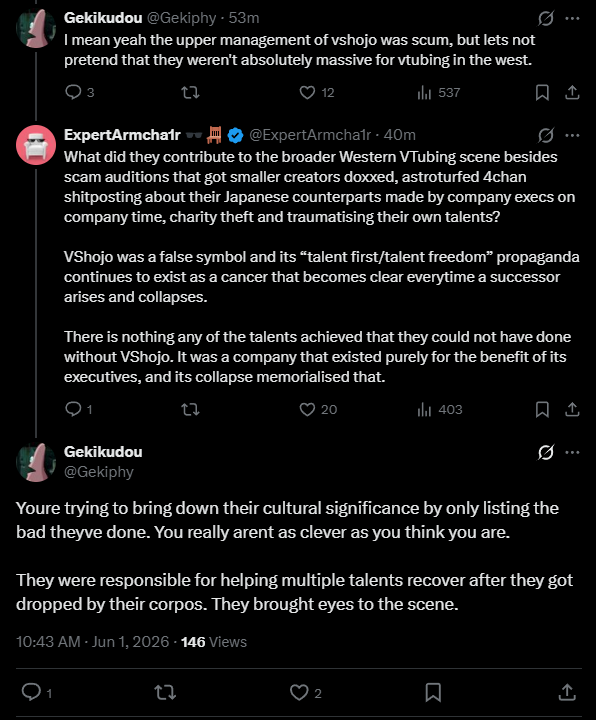
This and many other replies like this showcase a crucial yet under-emphasised factor in VShojo's past success and post-mortem whitewashing: its fans.
VShojo (and all the other companies that have collapsed trying to copy its marketing & model) were only able to scam people in this industry for as long as they were because they attracted a specific type of VTuber fan that was and remains incapable of distinguishing between company and talent when it comes to relevance and contribution to the wider scene.
A company derives its broader industry/cultural relevance from three things:
1. The relevance of its talents (which drives fans to financially support it and advertise via word of mouth).
2. What it claims to provide to its talents (which drives new talents to audition).
3. What it actually provides to its talents (which keeps existing talents there).
VShojo's fans and its post-mortem whitewashers will often conflate the last two when, in actuality, VShojo was a company that rode entirely on the first two, and number 1 most of all.
A recurring theme that emerges when you actually examine VShojo's history critically is that it took far more from its talents than it gave.
The company only gained its initial relevance because it came onto the scene flexing its lineup of already large and established Twitch VTubers.
VShojo was not why Ironmouse, Melody, Zentreya, Silvervale, Veibae, Nyanners and Froot became famous.
Ironmouse, Melody, Zentreya, Silvervale, Veibae, Nyanners and Froot were the reason why people even bothered to learn what a "VShojo" was at all.
Then they hired two Japanese talents, Nazuna and KSon - and they spent hundreds of thousands of (outstanding) Yen putting "talent freedom" ads around Akihabara station.
What many of VShojo's ardent defenders fail to recognise, however, was the point of the ads.
"Talent freedom" was not a marketing slogan designed to tell the public how cool the talents were as creators.
It was a marketing slogan designed to tell the public how cool VShojo was as a company. The talents' faces being slapped onto the ads was just done to give the claim legitimacy; they were used as promoters, not marketed as the product.
The same thing goes for VShojo's overblown role in giving talents a "second chance" after leaving another company.
Besides the initial investment of streaming assets, model and rigging the majority of the goodwill that gave VShojo its "VTuber shelter" reputation came from the talents themselves felt comfortable enough to tell their audience about negative experiences while working under their previous employer.
What gave them that security? Their fanbase and their friends. However, those who try to whitewash VShojo will often believe that the fanbases of these redebuted talents would not be as large if it weren't for VShojo while ignoring that the "Vshojo fanbase" was largely an amalgamation of the individual fandoms of the older talents whom VShojo derived its relevance from.
As for the friendships between the talents, most ex-VShojo fans remain unprepared for a serious conversation about how much of those friendships were leveraged by the company as a tool of both control and convenience when it came to defending its corporate image. This also happens to be a crucial factor when it comes to evaluating VShojo's contributions to its talents as a company. Friendship doesn't come free in this industry, and you cannot evaluate the company's contributions to its talents or to the industry as a whole without considering this.
Even if we only look at the oft-praised initial financial investment, how much did it actually cost VShojo to debut a new talent?
Was it equal to cost of a Ferrari? Or a McLaren? Or an undisclosed chunk of money from multiple Ironmouse donothons? Because that's the kind of money some of those same talents were owed by the time their tenure was over.
All that aside, there is a much simpler way of objectively evaluating a company's broader cultural relevance to the industry beyond what its talents contribute to the scene: auditions.
Auditions are where all the things that make a company culturally relevant converge. How a company handles its auditions can tell you a lot about what the company itself does and contributes to the wider scene independently of its talents.
When VShojo failed to warn the public about scammers targeting auditionees in their first wave, the talents should not have been left to get into a public slapfight with Nuxtaku - who, despite his content-oriented approach, achieved that bare minimum in the company's absence.
When VShojo failed to communicate to their talents that their first wave of auditions were a sham perpetuated by literal hush money being given to auditionees to go away, Zentreya should not have been left to tank the heat defending the integrity of the process a year later.
When VShojo failed to defend the integrity of their own auditions process the second time round when they were called into question by AmaLee's redebut with the company, it should not have been AmaLee herself clarifying on social media that she was not a part of the previous year's auditions.
When new talents were recruited by the second round of auditions and left in pre-debut limbo, they should not have had to rely on chance conversations at VTuber conventions in order to find out that they were never getting the support they were repeatedly promised.
Until this space starts shaming fans for conflating company actions with talent achievements, scammers will retain the ability to use talents as PR meatshields.
Until this space starts being honest about just how hollow promises like the ones VShojo made are, there will be other scams just like it that succeed in creating new waves of victims.
Until the space starts delineating between scams that cynically ape being a "corpo" (like VShojo) from the legitimate businesses that they rely on antagonising and parodying in order to gain relevance, the very real virtues of a serious corporate VTuber environment will continue to be dismissed by a public that ultimately learns nothing and remains ripe for fresh exploitation.
@BananaJuju_ Juju, when you were in Asia, did you randomly shout at prostitutes, calling them whores? This looks very random and unprovoked. That’s why people are mad.
Thoughts about Japan:
I got stuck in Japan during the pandemic for 9 months without being able to fly back home.
At the time, I was staying in a 6-floor hostel in Ryogoku, completely empty except for me.
The staff slowly became my friends since I had no one else in Japan.
After the third month of lockdown, my money ran out.
They noticed the slow decay in my condition. I was eating half a meal a day.
One day, out of nowhere, they called me down to the reception.
There was a big box, surrounded by several smaller ones.
The staff had told their friends and families about me, and together they gathered groceries and essentials to help me get through those difficult months.
There were even handmade face masks someone had sewn because they were impossible to find in stores.
I was so overwhelmed with gratitude that I broke down in tears.
From that day on, more than friends, we became family.
Japan and its people embraced me when I was at my lowest point.
It healed something in me when I needed it the most.
Thank you Japan.