@JoshHall2024 Amazed at all the Dems saying Trump is impaired. We all see he is a military genius. Meanwhile Dems cannot define what a woman is. So who is really deranged?
@BurrowZj@TheRightMelissa You libtards kill me. 2 people died interfering with ICE and you go batshit crazy. Yet say nothing when Iran kills tens of thousands of their own people. And news flash. Iran declared war on us long ago. Waiting for nukes.
FIDUCIARY FRAUD EXPOSED: THE END OF JUDICIAL IMPERSONATION AND THE COLLAPSE OF COLOR-OF-LAW AUTHORITY
In every modern courtroom across the United States, an invisible financial machine operates in the shadows—one that the public never authorized, never consented to, and was never meant to discover. The judiciary has quietly transformed from a constitutional dispute-resolution forum into a commercial clearinghouse where cases are monetized, bonds are trafficked, and private financial interests outweigh lawful jurisdiction. At the core of this transformation lies a single, devastating truth: the instant a judge touches property, assigns an asset, or enforces a forfeiture, they become a fiduciary. And the moment they become a fiduciary, federal law requires disclosure through IRS Form 56—a requirement almost no judge in America obeys. This one fact alone renders thousands of rulings VOID AB INITIO, destroys jurisdiction, and exposes the judiciary to catastrophic liability.
A judge operating without jurisdiction is not a judge; he is an impersonator acting under color of office. Once fiduciary capacity is triggered—whether through property seizure, bond assignment, case monetization, or asset transfer—26 U.S.C. § 6903 mandates that the fiduciary file IRS Form 56 to notify the Treasury of assumed fiduciary responsibility. Failure to file the form equals concealment. Concealment equals fraud. And fraud in the execution voids all actions, judgments, and orders as if they never occurred. This is not speculative; this is black-letter law. A fiduciary acting without disclosure is personally liable for every financial injury, every deprivation, and every unauthorized act taken under the color of law.
Judicial immunity does not protect commercial acts, private trust administration, undeclared fiduciary activity, or financial misconduct. The Supreme Court has repeatedly held that immunity collapses when a judge acts “in the clear absence of jurisdiction.” When a judge monetizes a case, touches trust property, enforces administrative forfeitures, or leverages a docket as collateral—all without Form 56, a fiduciary bond, or lawful delegation of authority—they operate as a private commercial trustee, not a judicial officer. Under long-standing doctrine, every order they issue is void. Not voidable—VOID. This includes forfeiture orders, summary judgments, sentencing, bail determinations, contempt rulings, and all derivative enforcement actions.
This fraud is compounded by the widespread, concealed practice of court securitization. Most litigants never learn that their case files are assigned CUSIP numbers, bundled, deposited into interest-bearing accounts, and traded through systems such as the Court Registry Investment System (CRIS). The docket becomes collateral; the litigant becomes a financial instrument; and the courthouse becomes a brokerage. This is not theory: federal budgeting, CAFR/ACFR disclosures, and Treasury accounting frameworks all confirm that courts generate revenue from monetized case instruments.
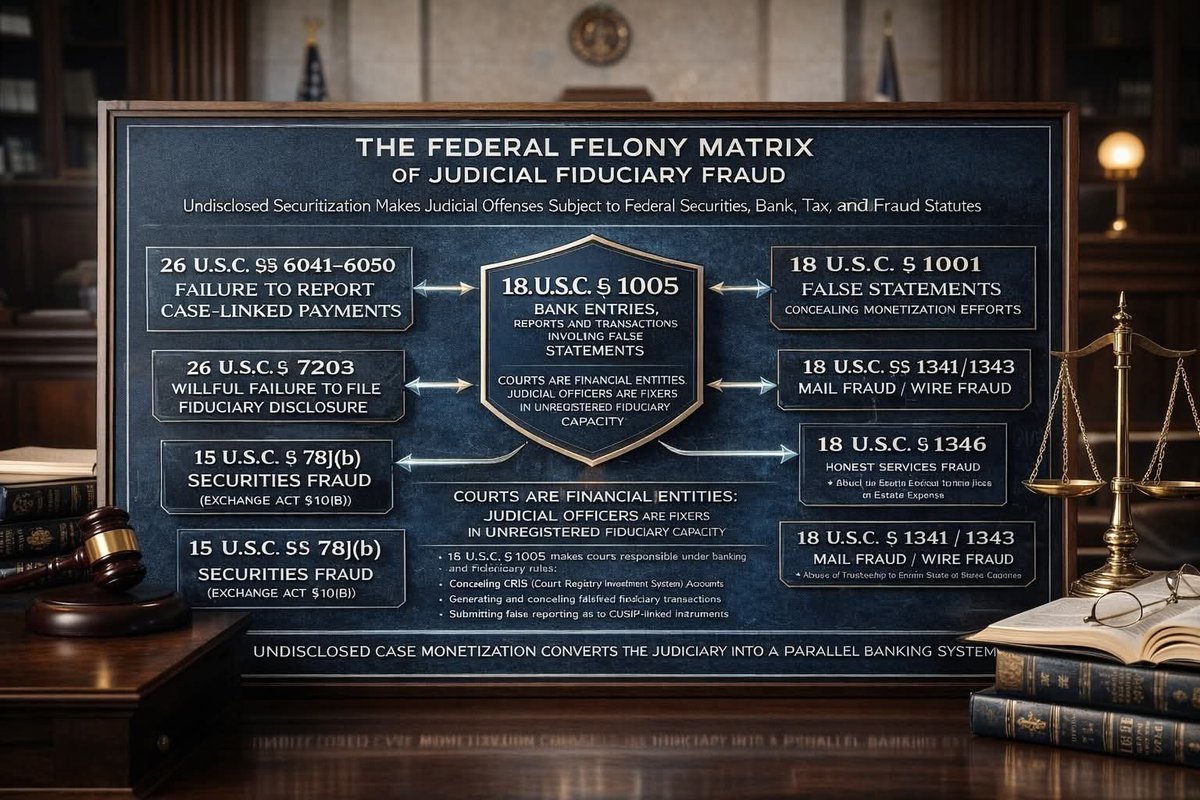
When a judge conceals these financial activities, several layers of criminal exposure arise:
Why it Applies to Judicial Fiduciary Fraud
Courts monetize cases through:
CRIS (Court Registry Investment System)
CUSIP-linked securities
Interest-bearing accounts
Forfeiture-related financial transfers
Trustee-level “administration” of estates, property, bonds, and instruments
The moment a judge, clerk, administrator, or court fiduciary touches case-linked financial instruments, they fall under the financial regulatory umbrella.
If they:
Monetize a docket,
Conceal the CRIS account,
Fail to record fiduciary status,
Do not disclose case-related financial transactions,
Fail to disclose bond entries, surety entries, or asset conversions,
then 18 U.S.C. § 1005 is triggered because the court is acting as a de facto financial institution administering federally regulated accounts.