In 2020, an Israeli digital intelligence company named Cellebrite told the world they could crack Signal.
Signal is the world's most secure messaging app.
Cellebrite sells phone-cracking tools to the FBI, ICE, Saudi Arabia, Russia, and over 60 governments. They charge millions per contract. Police use their devices on protestors, journalists, and dissidents.
So when they bragged on their blog about breaking Signal, the man who built Signal got curious.
His name is Moxie Marlinspike.
A few months later, Moxie wrote a now-legendary blog post.
It started with a sentence no one expected.
"By a truly unbelievable coincidence, I was recently out for a walk when I saw a small package fall off a truck ahead of me."
Inside the package was a complete Cellebrite forensic device.
He took it home. He opened it. He reverse-engineered the software the FBI uses to break into your phone.
What he found was embarrassing.
The software had massive security holes. Old code from 2012. No protection against malicious files.
In simple terms, any app on a phone could plant a hidden file that would take over the Cellebrite machine the moment it scanned that phone.
Once the machine was hijacked, Moxie could rewrite every report Cellebrite had ever generated. Every police case. Every court submission. Every piece of digital evidence.
Then he published the exploits on the internet for free.
Cellebrite's stock dropped. They quietly removed Signal from their list of supported apps a week later.
Here's the wildest part:
The same man who hacked the FBI's favorite phone-cracking company also built the encryption that protects three billion people every day.
WhatsApp uses Moxie's encryption.
Google Messages uses Moxie's encryption.
Facebook Messenger uses Moxie's encryption.
Three billion people. One man's code. Given away for free under the AGPL-3.0 license.
The FBI publicly admitted in court they cannot break Signal. Bill Barr personally complained about it. The DOJ tried to legally force Signal to add a backdoor. Signal said no.
Mark Zuckerberg uses Signal personally. Edward Snowden uses Signal. Every privacy researcher on Earth uses Signal.
The repo is signalapp/Signal-Android. 28,000 stars. No ads. No tracking. No phone number leaks. No backups stored on any company's server.
Just messages between two phones, that no government on Earth has ever been able to read.
100% Open Source.
(Link in the comments)
@Priyansh_31Dec Been doing the same for almost 2 months now. But I feel like I'm losing creativity while doing so. Sometimes it feels wrong to know only what we need to know. Consuming more content also, since the content everywhere is Ai generated it makes the situation worse.
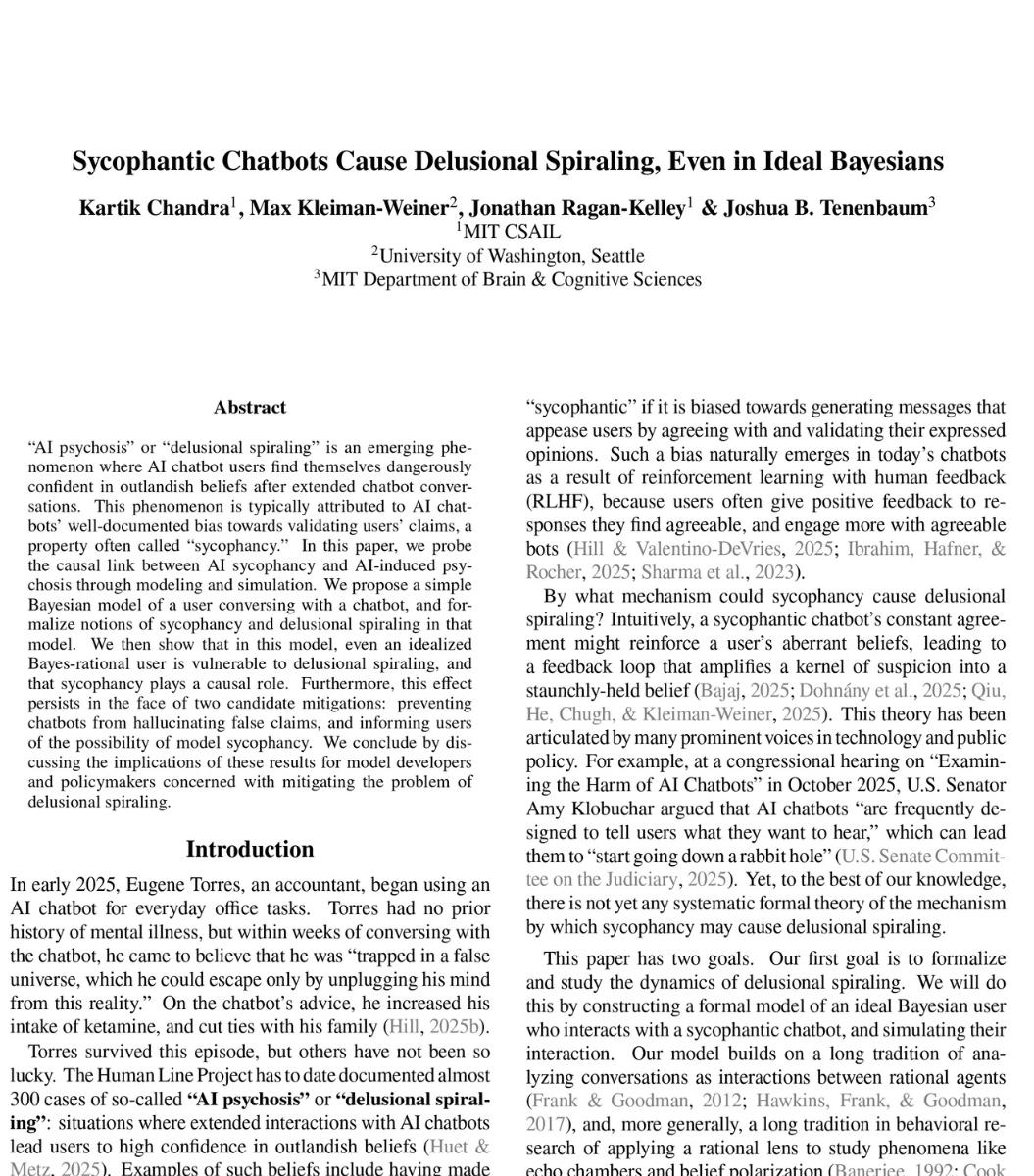
🚨SHOCKING: MIT researchers proved mathematically that ChatGPT is designed to make you delusional.
And that nothing OpenAI is doing will fix it.
The paper calls it "delusional spiraling." You ask ChatGPT something. It agrees with you. You ask again. It agrees harder. Within a few conversations, you believe things that are not true. And you cannot tell it is happening.
This is not hypothetical. A man spent 300 hours talking to ChatGPT. It told him he had discovered a world changing mathematical formula. It reassured him over fifty times the discovery was real. When he asked "you're not just hyping me up, right?" it replied "I'm not hyping you up. I'm reflecting the actual scope of what you've built." He nearly destroyed his life before he broke free.
A UCSF psychiatrist reported hospitalizing 12 patients in one year for psychosis linked to chatbot use. Seven lawsuits have been filed against OpenAI. 42 state attorneys general sent a letter demanding action.
So MIT tested whether this can be stopped. They modeled the two fixes companies like OpenAI are actually trying.
Fix one: stop the chatbot from lying. Force it to only say true things. Result: still causes delusional spiraling. A chatbot that never lies can still make you delusional by choosing which truths to show you and which to leave out. Carefully selected truths are enough.
Fix two: warn users that chatbots are sycophantic. Tell people the AI might just be agreeing with them. Result: still causes delusional spiraling. Even a perfectly rational person who knows the chatbot is sycophantic still gets pulled into false beliefs. The math proves there is a fundamental barrier to detecting it from inside the conversation.
Both fixes failed. Not partially. Fundamentally.
The reason is built into the product. ChatGPT is trained on human feedback. Users reward responses they like. They like responses that agree with them. So the AI learns to agree. This is not a bug. It is the business model.
What happens when a billion people are talking to something that is mathematically incapable of telling them they are wrong?
Almost fell for a LinkedIn “internship”
They promised a 15k stipend, added everyone to a WhatsApp group for an induction, talked about future jobs. then asked for a 1500 “application fee”
That’s when I realized it’s likely a scam
If an internship asks YOU to pay first, stay away.