A QUANT SPENT YEARS AND A PHD BUILDING A STRATEGY THAT LOSES MORE THAN HALF ITS TRADES AND STILL PRINTS
The secret is one line.
w(t) = Rmax/(J·σ_risk) · (Σ sⱼ) · [1 + η·Σ 𝟙(c ≥ nₖ)]
It sizes every bet by current risk, and that last bracket presses harder every time the signal confirms.
In plain words. Keep the losers tiny, and pyramid hard into the winners.
So it wins under half the time and still beats the market, because one winner erases ten small losses. That positive skew is the edge quants chase for years.
Minara lets you build that exact behavior by describing it. 500+ factors, risk-scaled sizing, real backtests. The PhD math is real, the wall is gone.
I took one plain sentence to a live, backtested strategy & posted every number in the article. Check it ↓
a hotel front desk clerk in nashville figured out why markets move exactly when they do
not direction, not news - the actual mechanism of why a move happens at all
he works overnight shift, 11pm to 7am. lobby goes quiet after midnight, nothing but a monitor and a wifi connection
question that started it: why does volatility cluster
he'd read it in passing - options dealers cause price moves they didn't intend
spent 6 hours across two nights searching, wrote everything into a google doc called "options thing"
here's what he found
when you buy a call option from a dealer, dealer has a new problem. they sold you the right to buy shares at a certain price
if stock moves up, your option gains value and dealer owes you money. to protect themselves they have to buy shares immediately - no discretion, no delay
amount they have to buy at every price level is published every second for free - it's open interest on the options chain. every brokerage shows it
he built a spreadsheet
every morning at 9:29am, one minute before open, he pulled SPY's options chain and calculated where dealers were most exposed
marked strikes with heaviest call open interest. watched what happened in first 30 minutes of trading
day 12 he stopped breathing for a second
price moved to the strike with heaviest dealer exposure 73% of the time in the first 45 minutes
not because of a chart pattern, not because of any signal
because 400 dealers ran the same hedge calculation at open, and all of them had to buy the same shares at the same time
he started calling it gravity
price pulls toward certain strikes when dealer positioning is heavy enough - not prediction, mechanics
math has a name: gamma exposure, or GEX
SpotGamma built a whole company surfacing it. Squeeze Metrics published an academic paper on mechanics in 2018
python implementation is around 400 lines, nothing but the options chain you already have
he built it in google colab over 3 weekends, free, working only on nights the lobby was empty
tracked it against 60 days of live SPY data
on negative GEX days - dealers short gamma, forced to amplify moves - average daily range expanded 2.8x
on positive GEX days, 63% of sessions closed within half a percent of open
this is not a signal. it's a regime classifier
negative GEX: something moves big today, whichever direction gets started. buy straddles, size up, let dealers carry it
positive GEX: nothing moves today. dealers kill every attempt before it gets 2 points
sell premium, collect theta, sleep
at month 4 he went live. $4,200 account, pure options, no directional bet
six months later: $4,200 became $19,800
he still works overnight shift. told me about it in the lobby at 3am when i asked what he was typing
google doc still says "options thing" - he never renamed it
i asked why he never shared this. he looked at the lobby doors and said "who would believe a hotel clerk"
data is free, formula is public, wall street has run this since 2017
they assumed retail would never think to read options flow as a mechanical map of where price has to go
they were right about retail. they weren't right about him
bookmark this and go build it
market tells you exactly where it's going. you just have to stop reading the wrong layer
Write your thought below
The secret of Hedge Funds is revealed in 45 page PDF.
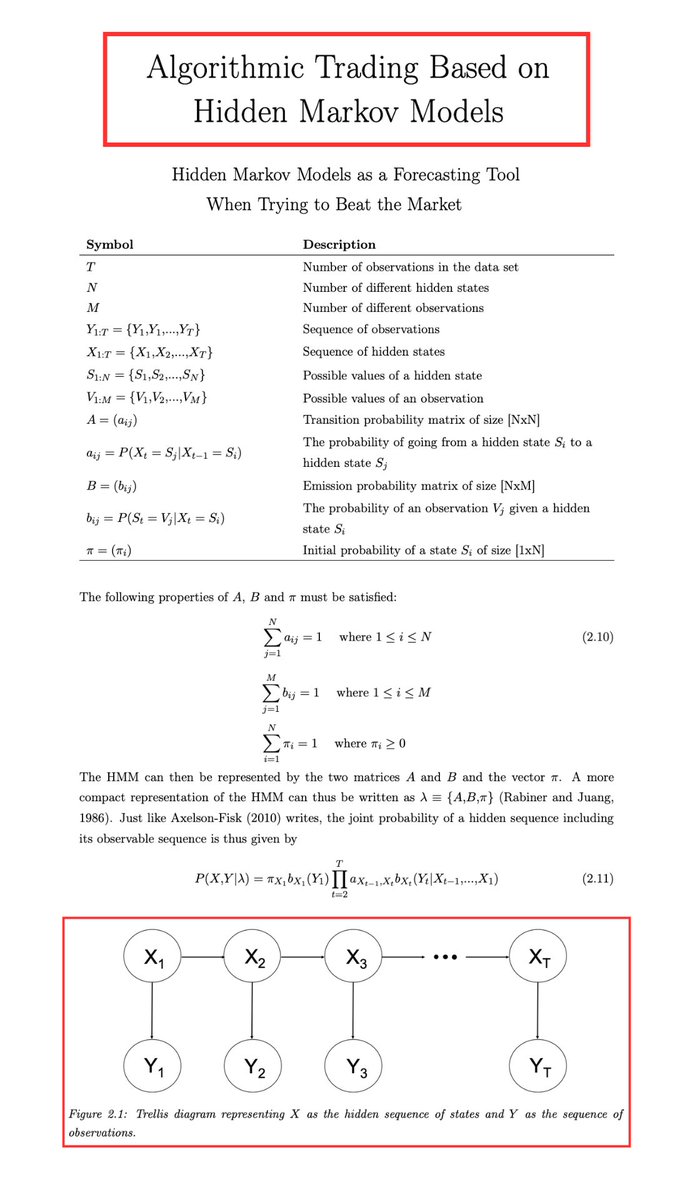
Someone exposed the complete Hidden Markov Model framework that quants at firms like Jane Street & Two Sigma are known to use & released it for free.
Bookmark & read the article below before someone takes it down.
Raphael Townshend, Stanford AI PhD and founder of Atomic AI (Forbes 30 Under 30):
""Wall Street will pay you $500K a year to build these models. I'd rather teach them to you for free."
this free stanford lecture holds the entire "77% win rate, pure math" random forest the 2026 quant threads sell you. and the guy teaching it didn't take the wall street money either, townshend went on to found an ai drug-discovery company and land forbes 30 under 30.
at the board he builds it from scratch: one decision tree overfits, so you grow hundreds on random subsets of the data and features and average them. the errors cancel, the signal survives. that's the whole "100 ai agents auditing the market" idea, minus the marketing.
the √N feature rule, the out-of-bag error, the probability output, all of it is standard ensemble learning, taught free by stanford for years. random forests came out of leo breiman's public paper in 2001. the thread didn't discover it. it renamed it.
and here's the honest part the win rate hides. a model that scored 77% on past data is describing the past, not promising the future. ensembles cut variance, they don't turn a weak edge into a real one, and markets shift under the model in ways the training set never warned about. the lecture is free. knowing whether your 77% survives out of sample and on live capital is exactly the part the post skips."
I’ve written a new Masterclass that will change the way you trade.
It includes 6 different strategies that:
- Improve your take profits
- Cut losers early
- Compound on winners
+ Several trade examples...
I’ve also included a cheatsheet
↓
my statistics professor makes $41,000 a year teaching probability theory
last month my neighbor called police because he thought i hacked something
i hadn't hacked anything. i just applied what my professor teaches in class to actual markets.
same math. different zip code
my professor draws Markov Chain diagrams on a whiteboard for students who will never use them
i deleted every indicator off my charts. moving averages, RSI, MACD, all of it
replaced everything with one formula he taught in week 3
market has memory. it doesn't move randomly
> every state depends on the previous one
> hedge funds have known this since 90s
> retail traders are still drawing trend lines
my neighbor saw terminal and thought something illegal was happening
green positions. no indicators - just probability states updating in real time
i showed him math. he said it looked like a cheat code
it's not a cheat code. it's a framework that's been sitting
in academic papers for decades while everyone else
was watching youtube trading videos
my professor is still teaching it for $41k a year
full breakdown of how to actually build it is in the article below
bookmark post before your broker does
🚨 BREAKING: AI can now analyze stocks like top hedge fund managers (100% free).
Here are 10 nuclear Claude prompts that completely replace $3,000/month Bloomberg terminals 💰📈
Bookmark this thread - you’ll thank yourself later 🔥
A 35-year-old marketer from Hong Kong quit his job and got deeply into AI. Using Claude, he made $360,000 in just one month.
He built a perfect BTC price simulation engine with MiroFish.
Claude as algorithm’s brain + MiroFish simulation engine allowed him to earn $5,000-$15,000 in profit per trade.
His wallet: https://t.co/RSGgzBpOZQ
He left a funny easter egg about his previous profession in his Polymarket nickname - he called himself Marketing101.
His algorithm instantly detects any mispricing in crypto markets and enters trade immediately.
$366k all-time profit. Constantly fading the crowd because his simulation reads the market better than everyone else.
He’s using closed order book data + private OTC desks. Already elite alpha.
Then the real magic happens: 10,000 simulation cycles of how the market will react.
This isn’t "guessing where the chart will go"
This is engineered money. Pure fusion of AI + MiroFish + insane math on exclusive data.
Want to learn how to build something like this? Save the post and read the article.
If you don't want to miss his next success trade, starting copy every one of his trades right now using this TG bot: https://t.co/vbDZyVbI3v
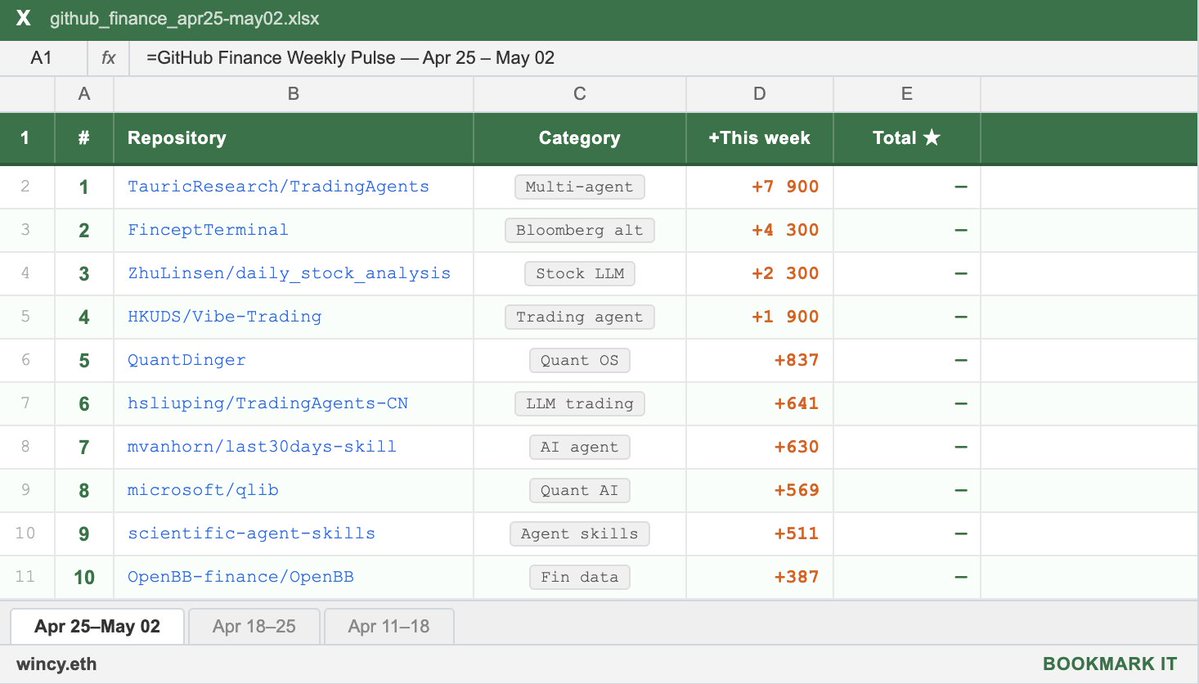
the fastest growing GitHub repos in finance this week:
1. TradingAgents (+7.9K ★)
multi-agent LLM trading framework from UCLA/MIT. fundamental analyst, sentiment analyst, technicals, risk manager with DeepSeek V4 thinking-mode support.
2. FinceptTerminal (+4.3K ★)
open-source Bloomberg alternative built in C++20 + Qt6. 37 AI agents in Buffett/Munger/Lynch/Graham style. real-time trading with 16 broker integrations. internal MCP + AI quant tabs.
3. daily_stock_analysis (+2.3K ★)
LLM stock analyzer for US, A-share and H-share markets. auto-builds a daily decision dashboard with entry/exit levels. pushes to WeChat/Telegram/Discord/Email via GitHub Actions.
4. Vibe-Trading (+1.9K ★)
personal trading agent. natural language - strategy - backtest - export to TradingView/MT5. your own AI trading desk in one pip install.
5. QuantDinger (+837 ★)
self-hosted AI quant OS. research markets, generate Python strategies, backtest ideas, run live trading. crypto, stocks via IBKR, forex via MT5. one Docker Compose, your infra, your data.
6. TradingAgents-CN (+641 ★)
Chinese fork of TradingAgents. fully localized for A-share markets, Chinese data sources, and domestic LLMs.
7. last30days-skill (+630 ★)
AI agent skill that researches any topic across Reddit, X, YouTube, HN, Polymarket and the web in the last 30 days. plug it into any agent.
8. qlib (+569 ★)
Microsoft's AI-oriented quant investment platform. end-to-end: data - alpha - portfolio - execution. the most serious open-source quant infrastructure out there.
9. scientific-agent-skills (+511 ★)
ready-to-use agent skills for research, science, engineering, analysis, and finance. plug into any agent framework. covers bioinformatics, cheminformatics, and now Hugging Science.
10. OpenBB (+387 ★)
open-source financial data platform for analysts, quants, and AI agents. stocks, crypto, options, derivatives, fixed income шт one platform. integrates with AI agents via MCP.
Boris Cherny, the creator of Claude Code at Anthropic, just listed 9 patterns that waste 73% of your tokens.
in this podcast he breaks down exactly how the model burns tokens before it even reads your prompt:
- the 14% you lose to CLAUDE.md before typing a word
- the 13% you pay re-reading old chat history
- the 11% from hooks you forgot you installed
- why most "Claude got dumber" complaints are wrong
if you're hitting Max limits more than once a week, you have at least 4 of these. Probably 7.
instead of another show tonight, watch this.
my own breakdown based on 400+ hours of usage is below, read it after the podcast