Ensure your coding agents build apps that are modern, fast, & secure by default → https://t.co/TAdQTHdXRc
We just announced Modern Web Guidance at #GoogleIO. By injecting AI-ready skills and modern features—complete with Baseline Widely Available fallbacks—it ensures your agent keeps up with the latest web features🧵
@jaffathecake It almost looks like a flight path, like this flight took off in the most spectacularly absolutely terrifying manner, so its instability afterwards looked tame in comparison. 😅
@SaraSoueidan I keep stuff in keepass files and different apps. On desktop I use KeeWeb. On mobile keepassium. Desktop supports the 2fa rotating codes. Not sure about the mobile app tho.
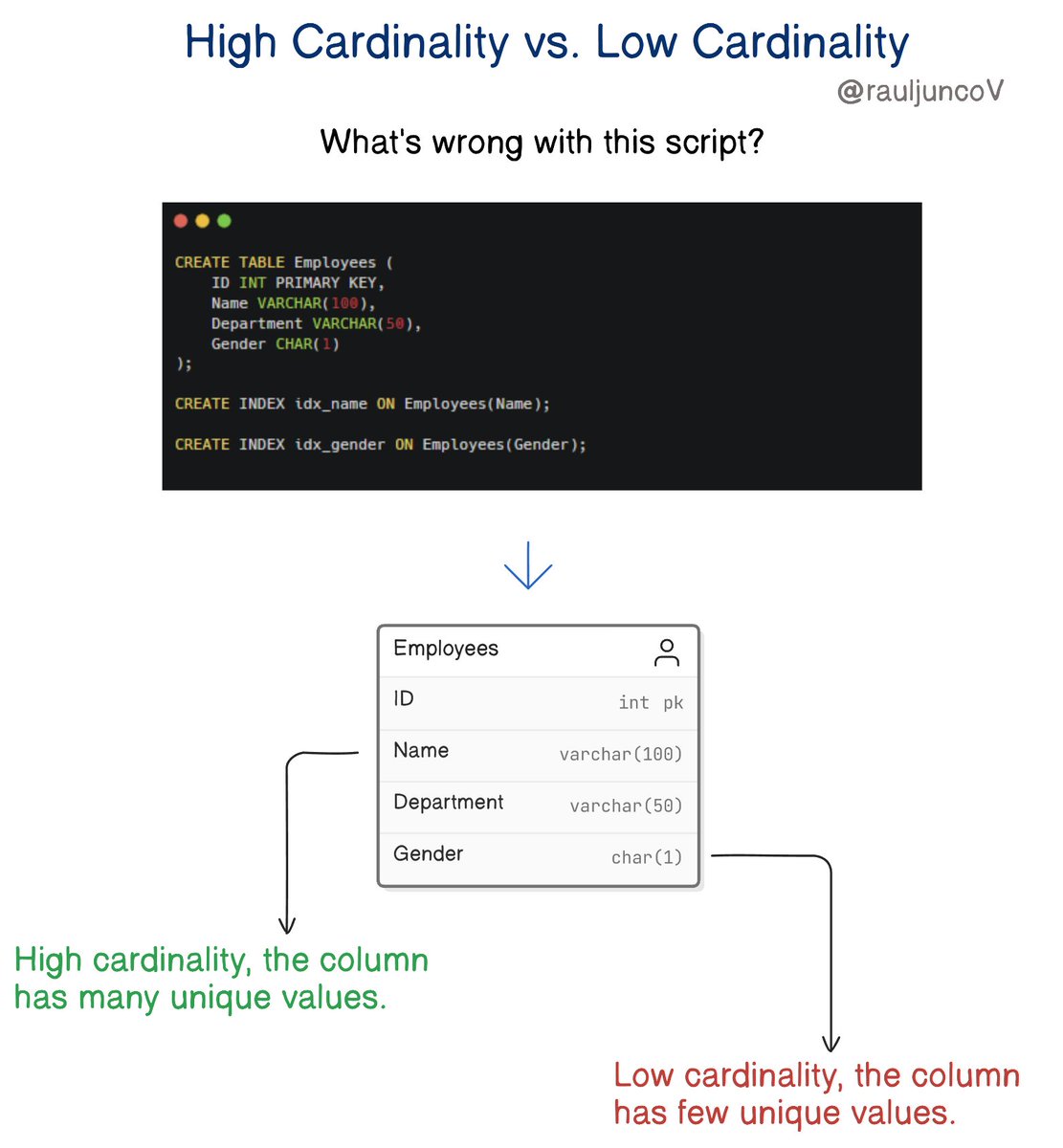
75% of developers will fail this SQL question.
What's wrong with this script?
The first time I faced this question, I jumped into the SQL syntax like crazy.
But the syntax was OK; the problem was in the data and related to a concept called Cardinality.
Cardinality refers to the number of unique values in a column relative to a table's total number of rows.
• High Cardinality means the column has many unique values.
• Low Cardinality means the column has few unique values.
Creating an index on a column with low Cardinality is most of the time ineffective because:
1. Low Cardinality means each indexed value points to many rows, reducing the index's ability to narrow down the search.
2. Maintaining an index has a cost of storage and update time. For low cardinality columns, this overhead might outweigh the benefits.
3. Database query optimizers are smart; they know column statistics, including Cardinality. When they detect a low cardinality index, they often ignore it and perform a full table scan instead.
A simple Example
Consider a table "Employees" with 1 million records.
Let's examine indexing on different columns:
• ID: High Cardinality (1 million unique values). An index here would be very effective.
• Name: High Cardinality (many unique names). An index could be helpful in searches.
• Department: Medium Cardinality (10-20 unique values). An index might sometimes be useful but less effective than an ID or Name.
• Gender: Very low cardinality (2-3 unique values). The query optimizer would likely ignore an index here.
When to consider a Low Cardinality column?
There are scenarios where indexing a low cardinality column might be beneficial.
For example, combining low and high cardinality columns can be effective.
'CREATE INDEX idx_dept_emp ON Employees(Department, ID);'
Now you know the basics about Cardinality!
Save this post; it might help in your next interview.
ready to write CSS unit tests for your custom CSS functions?
if we get CSS custom functions, we're going to need to write tests for those functions.
https://t.co/q7cDocrIy1
My god... they couldn't wait a minute into July 4th. The "fireworks" are so intense my cats are absolutely terrified in their own home. We have to find them before we can even comfort them. Terrible.
My god... they couldn't wait a minute into July 4th. The "fireworks" are so intense my cats are absolutely terrified in their own home. We have to find them before we can even comfort them. Terrible.
The article is a good read. Anyone maintaining OSS can look to Storybook for how to manage a product based on both data and its users’ feedback, not to mention the kind of *people* you need to achieve this.
https://t.co/uc0tCkxkHn
So what’s next?
2024 is all about innovating Storybook. Here’s what we’re doing:
📦 Reduce install size + dependencies
🏎️ Simplify setup, maintenance, and upgrading
🧪 Ship new component testing superpowers
Check out the full post below 👇
If 2023 Storybook = industrial cheat code, based on the 2024 Storybook that I know, 2025 Storybook will be like dividing by zero. 🤯 (and I mean that in a good way!)
500 years ago, a city of skyscrapers was built in the desert — and it's still standing today.
Known as the "Manhattan of the Desert", it's even more densely populated than New York.
And it's a model for urban planning... (thread) 🧵