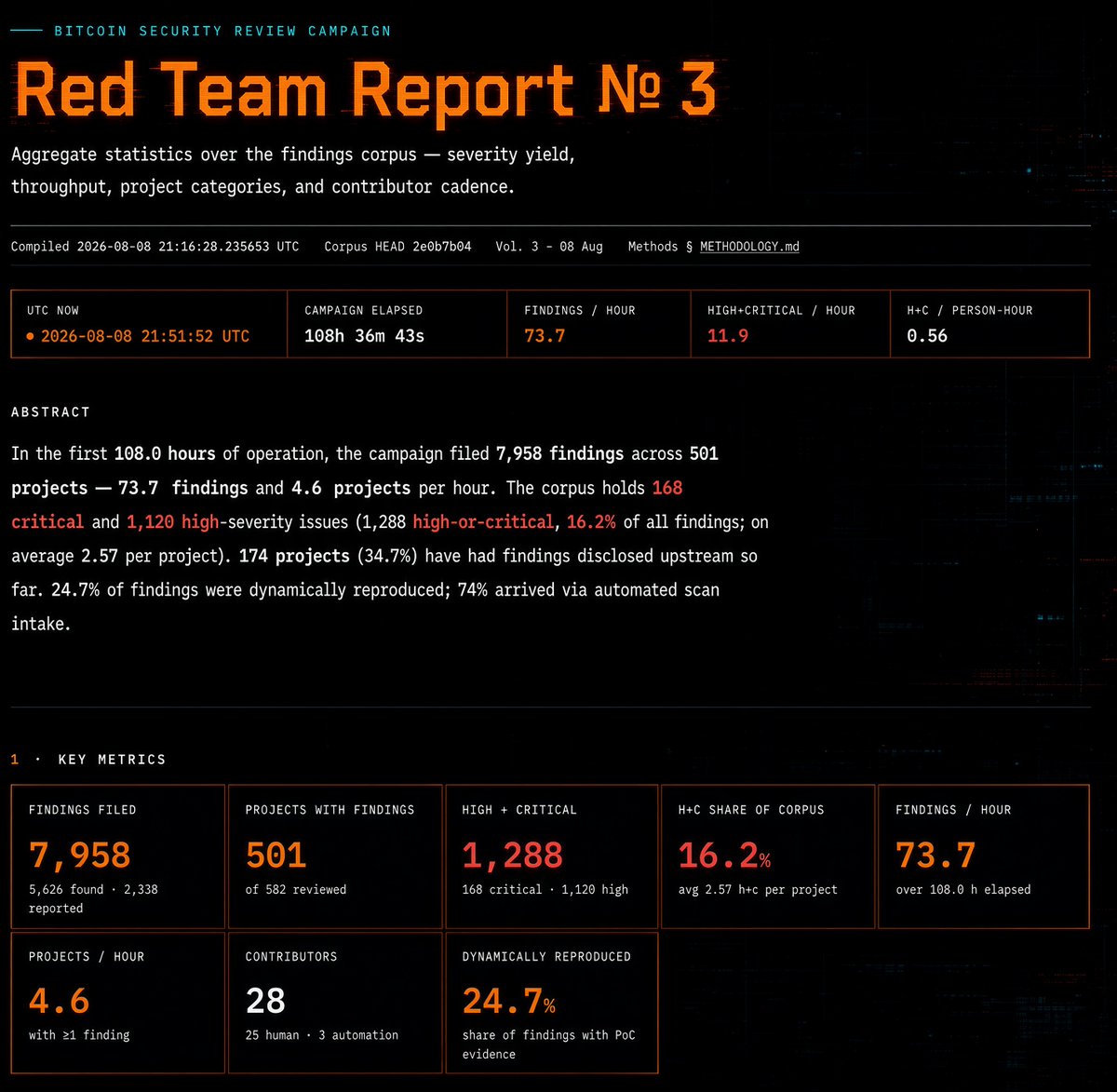
AI models conducted a massive audit of the Bitcoin ecosystem — and uncovered nearly 8,000 potential issues.
Bitcoin Red Team ran Kimi K3 and other models across 501 open-source BTC projects, from wallets and Lightning infrastructure to libraries and payment software.
The results:
— 7,958 potential issues found
— 1,280 rated high or critical
— Working PoCs were created for roughly 25% of the findings
— Nearly 30% of the findings have already been reported to project developers
The whole operation cost researchers more than $58,000, with 74% of the spending going to Kimi K3.
And this wasn't just AI generating a list of theoretical bugs. Some findings have already been confirmed by developers. For example, BTCPay Server released an emergency update after a critical vulnerability was discovered by the Bitcoin Red Team.
AI is starting to look less like just a tool for finding bugs and more like a full-fledged participant in auditing crypto infrastructure.
We just hired a million bad employees.
And the funny thing is, they’re not human. AI was supposed to replace human labor, but so far, something almost opposite is happening: companies are adopting AI and, along with it, creating a new class of workers that are even harder to manage. Every employee can now effectively hire a hundred digital workers almost instantly — and almost nobody knows how to manage them properly.
To understand why this is happening, the author of an a16z essay goes back to the 1840s. In the 1830s, railroads in the US began expanding at an insane pace: over the course of a single decade, the length of the rail network grew roughly 120x. But scale brought chaos. On October 5, 1841, two trains collided on the Western Railroad in Massachusetts. The cause wasn’t a technological failure. It was a simple coordination failure. The system had become too complex for the existing ways of managing it.
Over the following decades, companies began hiring regional managers, formalizing roles, building hierarchies, and defining lines of authority. Modern management gradually emerged. Railroads became one of the largest industries of their time and, at their peak, represented around 60% of the US stock market. The technology scaled first. The management system came later.
The same thing is happening with AI.
We’ve given every employee an almost unlimited budget and an infinite workforce — except that instead of people, they’re tokens and agents. And the problem is that AI doesn’t just scale intelligence. It scales dysfunction too. A good employee becomes dramatically more productive with an agent. A bad employee gets the ability to produce bad work at industrial scale.
That’s where the endless loops come from. An agent completes a task, checks its own work, decides it wasn’t good enough, rewrites it, checks again, and rewrites it again. Sometimes dozens of times. Not necessarily because the model is stupid, but because the human failed to define the task properly in the first place. The model starts exploring different interpretations of what it was supposed to do, and you end up spending tokens just to spend more tokens.
Once you look at it this way, it makes sense to stop thinking about tokens as software and start thinking about them as labor. Tokens have a cost, a level of productivity, wasted effort, and managers who may or may not know how to use them. Hiring a hundred people is slow and expensive. Launching a hundred agents can happen almost instantly. That makes the cost of bad management dramatically higher: one bad decision can be replicated thousands of times.
And this leads to perhaps the most important idea in the whole story: evals are becoming the new OKRs. To manage a person effectively, you need to know what a good outcome looks like. The same is true for an agent. If you can’t evaluate the result of its work, you can’t really delegate that work to a machine.
That’s why software engineering has become the first major market for AI agents. Code comes with a built-in eval: it either works or it doesn’t. Tests pass — good. Tests fail — bad. Most other professions don’t have such a simple feedback loop. What exactly is a good legal document? A good marketing plan? A good sales strategy? Until a company can define the answer with enough precision, it won’t be able to scale that work through agents.
This leads to a rather uncomfortable conclusion: the most valuable asset of an AI company may not be the model itself, or even the prompt. It may be the system used to evaluate results. The company that gets better at defining what “good” looks like will be able to manage thousands of agents more effectively. Everyone else will simply burn more tokens.
There’s another problem: knowledge. The most valuable context inside a company usually lives inside employees’ heads — and those are precisely the people with the least incentive to hand it over to a machine. Informal knowledge has been one of the strongest forms of job security for centuries. Medieval guilds guarded their techniques. Craftsmen protected the secrets of their trade. Modern employees carry around knowledge that never makes it into documentation. AI is the first technology asking companies to hand all of that knowledge over at once. But very few people want to train their own replacement for free.
That’s why the next conflict around AI may not be between humans and machines, but between companies and the employees who possess the most valuable context. And as automation spreads into traditional industries, that conflict is likely to become much more intense.
Meanwhile, Silicon Valley is already funding companies that want to capture roughly $21 trillion in service spending from existing businesses. But the paradox is that the most valuable assets needed to automate those businesses are already inside them: working processes, data, expertise, context, and established distribution channels.
That’s what makes the story of Palantir so interesting. On paper, its software should be one of the categories most vulnerable to AI. But Palantir has never really sold software. It has sold business transformation. And that may be the next big market.
AI won’t necessarily replace people. The winners will be the companies that learn how to turn a functioning business into a system that thousands of digital employees can operate.
First, we learned how to build agents.
Now we have to learn how to manage them.