@aglitchman 1000 draws by itself is not really a problem for modern GPUs, but if the intention is to render many such buildings, yes -- instancing with a handful of meshes will scale much better.
Sorting the draws on the CPU may be another solution.
Is there any online law about the inverse relationship between the fanciness of a PowerPoint presentation and the quality of ideas contained within?
If not, can I name one?
It's finally here.
https://t.co/kGnQwNvwiP
Explains how I learned Vulkan and wrote a small game engine with it in 3 months.
It's huge. Hopefully you'll find it useful. :)
There's finally a new tutorial for @VulkanAPI, showing you not only the API, but how to use it well in an engine (from the legendary vblanco). #vkguide shows you the basics, to drawing with compute shaders and GPU driven rendering. Well worth checking out. https://t.co/5wx2KEzvNq
FSR 3 is now live on @GPUOpen! This release is the culmination of man-years of work from a dedicated team who poured their soul into solving the tough challenge of making frame generation work on a wide range of configurations. I'm humbled and proud to walk alongside them.
The free web version of "Physically Based Rendering: From Theory To Practice" is now based on the 4th edition of the book. Enjoy! (Link: https://t.co/N7CroKjKLC)
@FlohOfWoe @dkapnopoulos Wow that's a lot more work than I expected it to be, considering you already support WebGL. I get each of your points, though.
I am surprised to see that WebGPU includes render bundles aka secondary cmd buffers, maybe for feature parity with native APIs or forward compatibility?
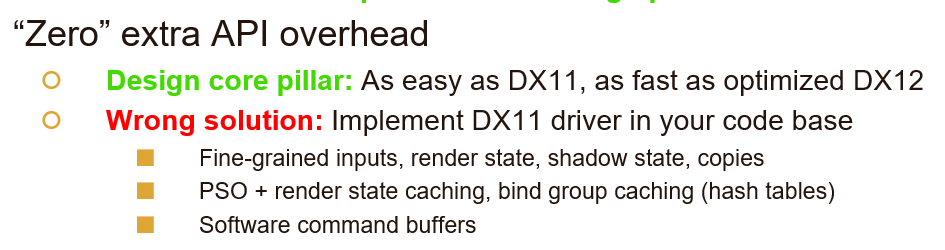
My SIGGRAPH presentation slides about HypeHype low level rendering abstraction and performance (10k+ draw calls at 60 fps on 99$ mobile phone) are now available.
Slides have full speaker notes (everything I said during the presentation).
Questions are welcome!
I’ve written a small library that provides an assert-like macro in HLSL shaders that triggers a GPU memory page fault. Together with Radeon GPU Detective, it may be useful for debugging. https://t.co/pMJY14v19s
We’re happy to announce the release of an experimental @AMD extension to support #GPU Work Graphs in @VulkanAPI 🌋
Check out the post below for all of the links you need to learn more, including a sample which shows the new extension in action 👇
https://t.co/jxZA0fSJFV
Hello, I present you with the Human Shader, a project where anybody can participate and help create the first ever human-brain-only powered shader and mathematical image! Please join us and be part of history!
https://t.co/Y5uSUpyKNc
Let there be light (triangle)🥳 Ported my old rasterization sample to my toy CPU, it looks accidentally very cool😄
Partial corruptions are due to non-flushed frame buffer cachelines. Need to implement range-based D$ flush so that VGA fetches are fully coherent before present.
Don't miss our primer on #Microsoft's just-announced GPU Work Graphs in @DirectX12 🔥
📈 Enable more direct methods of solving complex problems
📈 Reduce memory constraints
📈 Improve cache utilization
📈 Improve GPU thread saturation
📈 And more!
https://t.co/jSYRu6Xe7u 👇
Can anyone guess what causes this trickle-down effect on screen *after reset* ? It's kinda cool 😀
Implementing VGA controller to be able to render stuff at last 🥳
Come watch Marco Salvi's super interesting talk - Blurring the Line between Physics and Imagination: A Glimpse of Neural Rendering's Future
https://t.co/56JsT3twxe
#I3D2023
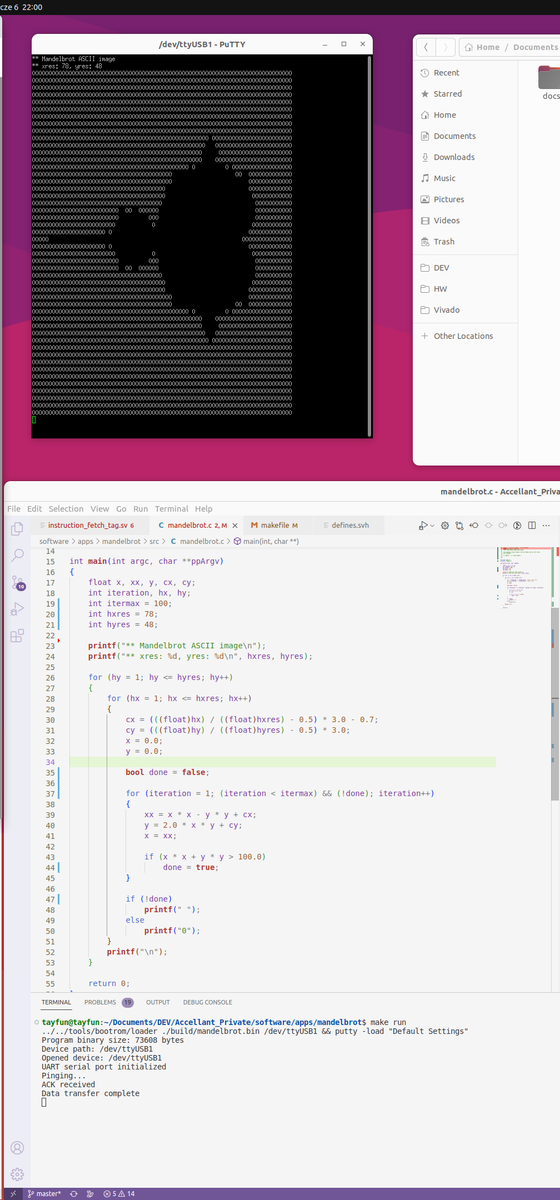
Finally fixed a super annoying sporadic hang and a few other bugs to get good ol' Mandelbrot working \o/
The hang was due to double-fetch of some cache-lines when I$ miss occurred after a branch misprediction while fetching the same CL for the last miss.
https://t.co/nhJdP3dSvw