Over long periods of time, commodity prices tend to gravitate toward their fully burdened cost of production. In the short run, however, prices are usually determined not by average economics, but by the marginal barrel or molecule needed to balance the market at that moment.
Japan does not make the world's most advanced chips. It makes the materials without which no advanced chip can be manufactured—and the same pattern repeats across five other critical domains simultaneously. Outstanding write-up.
https://t.co/NBmxMNjFRw
Every LNG carrier on earth holds 174,000 cubic meters of liquid at minus 163 degrees behind a sheet of steel thinner than a car key. One company designs that sheet. 80% market share. Doesn't manufacture a thing. Just collects the royalty.
Gaztransport & Technigaz (GTT) designs the membrane containment system inside LNG carriers. The waffle-pattern fold stamped into each panel lets the metal shrink in every direction without cracking its own welds. That's the entire trick. GTT licenses this IP to shipyards in Korea, China, and Japan. ROIC above 50%. Order book at 288 units as of December 2025.
Every new liquefaction train in that EIA chart needs ships. That means 100 to 150 additional LNG carriers over the next four to five years. Every one of them will pay GTT a royalty before it touches water.
FY2025 was their third consecutive record year. Revenue up 25%. EBITDA up 40%. Orderbook that continues to rip.
This is actually a fascinating topic that I researched a bit, because I was immensely frustrated to be unable to use Chinese maps (specifically Amap, my favorite) outside China.
First of all, people are unaware of just how superior Chinese maps are: some of the features are so insane that you really feel it's magic.
For instance:
- they show you when you change lane on the highway
- they have a live countdown of all the red lights in China
- to OP's point below, as a pedestrian you can choose you route based on % of shade (as in, whether you won't be walking directly under the sun)
- they have real-time live tracking of all the public buses in China. Like, they show you precisely where your bus is at this very moment and when it'll reach you
- they have exact toll fee calculations so you can choose your route based on this
- they have such insane comprehensive mapping coverage that they can make you take a shortcut through the internal parking garage of a shopping mall, using a different exit to bypass the most congested stretch of road (true story: https://t.co/sP1KIXsNco).
Plus, the navigation UI/UX is so well done that I've legit never made a mistake during years of driving in China. The same VERY MUCH cannot be said of Google Maps or Waze: driving with it in Malaysia, I can hardly do a single trip without making a mistake, which drives me completely nuts (hence my frustration!). Like you have 3 possible roads to take on the right and it just says "turn right": "I fuck*ng know, but which right???!!!"
The reason why it's not really available outside China, turns out, is mostly the availability of data.
It's just not realistically feasible for them to build their own map data globally. Apple took that path and, despite having every conceivable advantage, it took them 4 years of preparation before even launching in a single metro area, and to this day they only cover 35 countries.
Map data is extremely concentrated. Google is the big player (they own Waze too) and they certainly won't sell data to Chinese competitors.
HERE - owned by a consortium of German automakers, Mitsubishi and Intel - is pretty much the only supplier Chinese companies can use. Which is what both Baidu Maps and Amap have done for their (very limited) overseas services.
But HERE is the mapping that's natively embedded in car navigation systems and everyone knows how much it sucks: it's even worse than Google...
The reason why Chinese maps are so good in China is because of 3 factors:
- the base data they have at their disposal is excellent: there is a fiercely competitive domestic ecosystem with 19 companies surveying and maintaining their own datasets. Compare this with basically just HERE for the rest of the world (and smaller players like Tom-Tom and Open Street Maps which are not even worth mentioning)...
- they have a massive user base which enables them to get excellent real-time data, which they don't have outside China (a chicken and egg problem)
- lastly, they rely on the Beidou positioning system which is significantly more precise than the West's GPS (https://t.co/si7HmCJcTU). That's how you can get things like the "see when you change lane" feature.
So unfortunately the answer is that, unless you go inside China and test it for yourself, you're unlikely to ever understand what a truly great map app can be.
And this is generally something applicable to so much of what China has built: great tech is often all about the ecosystem and ecosystems, by definition, can't really be exported.
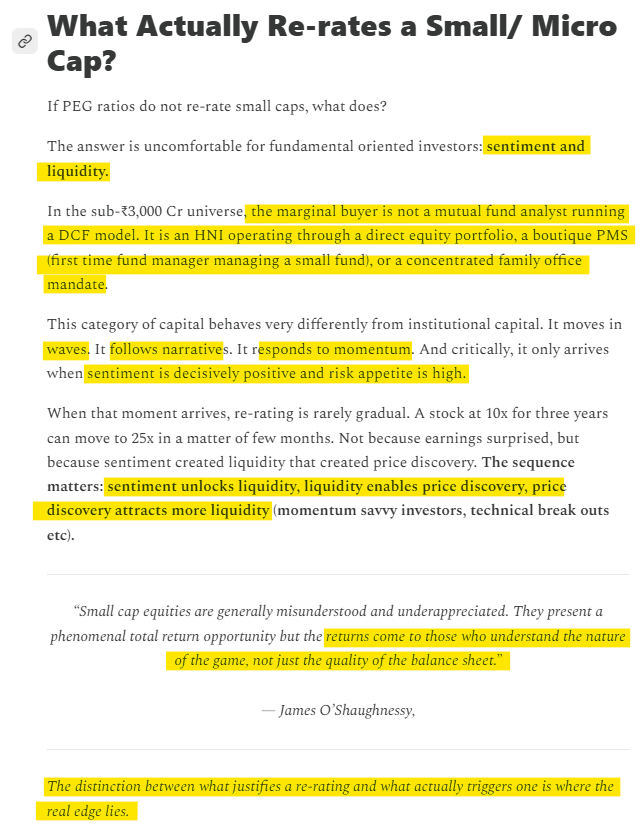
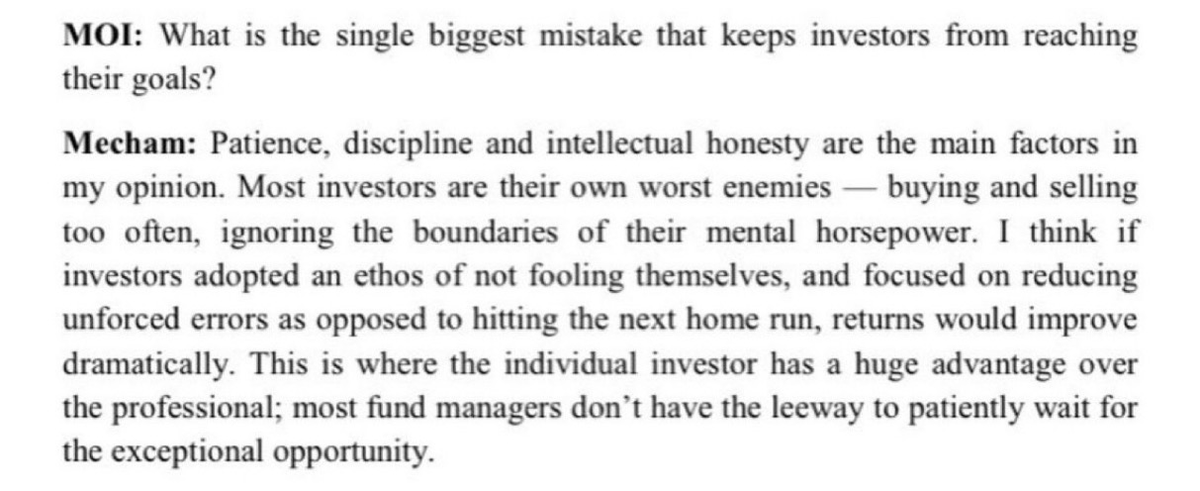
Survival is the crux in markets .
Scavenging is sometimes necessary.
When an investor is under pressure, they start taking whatever the market offers. They accept shaky narratives, average businesses, and rushed entries just to feel like they are “doing something.” That phase is real, and sometimes it prevents panic from turning into complete paralysis.
But the danger begins when scavenging becomes a permanent mindset.
You start believing your future returns depend on scraps. You stop waiting for quality, and you stop respecting the time it takes for good decisions to compound. You begin investing like capital is always scarce, like every cycle is the last cycle, and like the next opportunity will never come again.
That mentality can keep you afloat for a while, but it quietly erodes your edge.
Scavenging trains you to treat noise as signal. It pushes you to chase movement instead of meaning. It makes you confuse portfolio activity with portfolio progress.
And the payback does not arrive when you are strong.
It arrives when you are already tired, already stretched, and already emotionally exposed. That is when one weak decision is enough to convert survival mode into long-term damage.
Gold +ve given US Fiscal woes + Geopolitical shifts + EM CBs regular buying + increased demand from capex upcycle
Every $ price rise adds to the bottom line of Gold Miners with new supply requiring at least 7-10 years to commercialize.
Miners Charts at an inflection point
Being Bangladeshi is a state of mind. It exits on both sides of the border.
- by Sayan Chakraborty
West Bengal has been on a decline ever since 1963, when Chief Minister of the state Bidhan Chandra Roy passed away. He reinforced the foundations of the state after the partition of 1947, got the Durgapur & Alloy Steel Plant, Chittaranjan Locomotives, India’s 1st satellite town in Kalyani, Digha Beach Resort, expanded the engineering industries, set up engineering, technology, medical, management, and other institutes.
Calcutta and Jadavpur used to be the prime universities in India those days. West Bengal had the IIM, IIT, Indian Statistical Institute, the Operations Research School, Bengal Engineering College, besides, of course, Presidency College, SXC, Scottish Church and many other venerable institutes.
It was the HQ of Birla, JK, Bangur, Thapar and Tata. The grand Tata Centre was built for that purpose. This was the vision of TATAs. Most of their investment was in Jamshedpur. Most foreign companies had their India HQs in Calcutta. This was the reason Calcutta has best of the clubs in the country. It had the highest number of international flights, Bombay used to serve mainly Aden, Muscat, and East Africa.
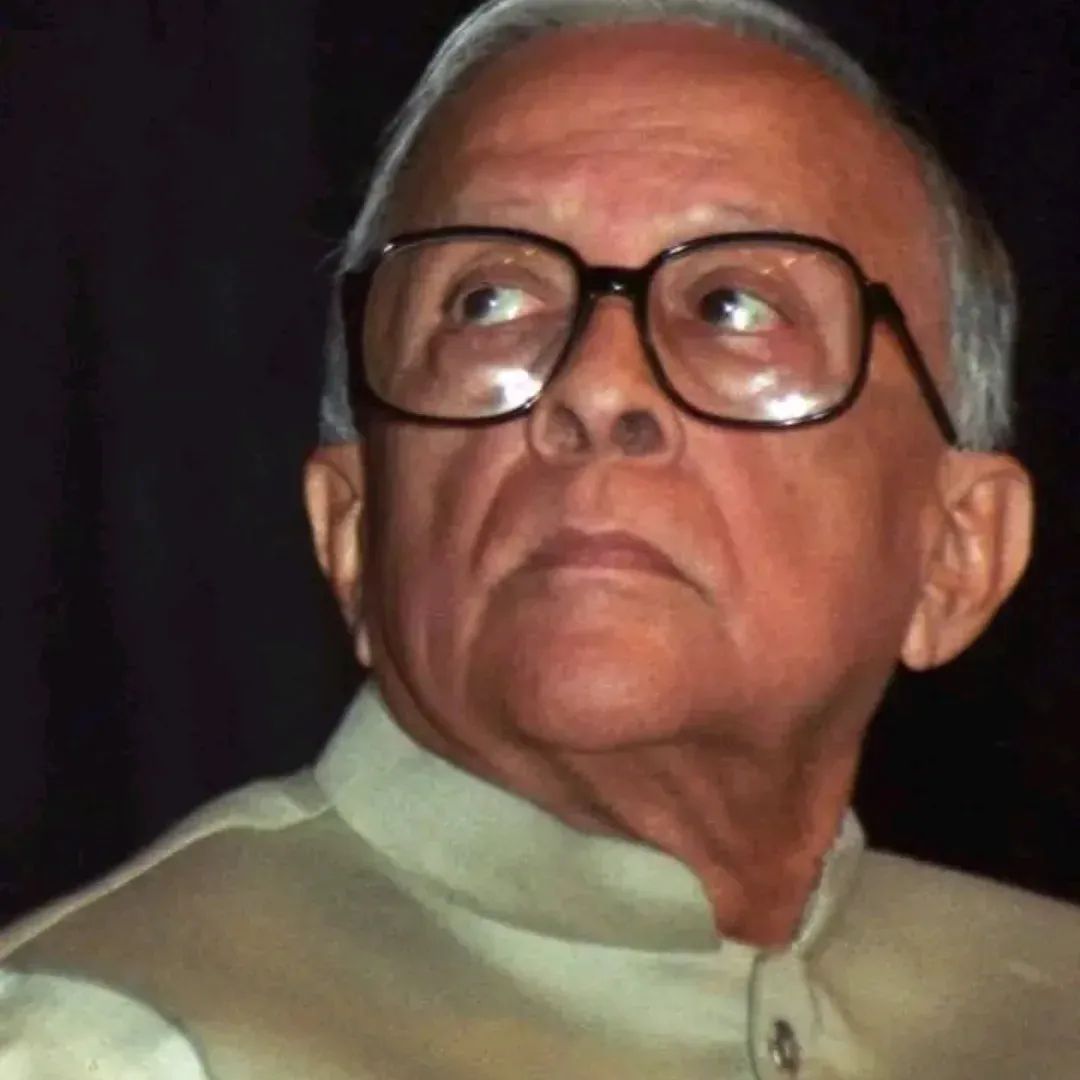
And then ‘Ashok Kumar Nite’ happened in February 1968. Women were dragged out and their naked dead raped bodies were found in and around the lake over the next two days. The CPM leaders (Jyoti Basu & Co) called it “the rise of the proletariat against the bourgeoisie” and justified it.
Calcutta started emptying. Soon after, Aditya Birla was dragged out of his car between GPO & RBI, opposite Writers Building, thrashed, clothes torn, stripped down to his undergarments and made to walk like that to his office at 15 India Exchange Place. With a crowd roaring in laughter and jeering, he went home and took a flight to Bombay, never to return. He took all his money and offices out of Bengal. Today they are one of the top industrial houses in the country.
So did JK, so did Thapar, within a month. So did most entrepreneurs, so did most MNCs. Latest example was ousting of Tata Nano. Thus happened mass exodus of money and employment from the state.
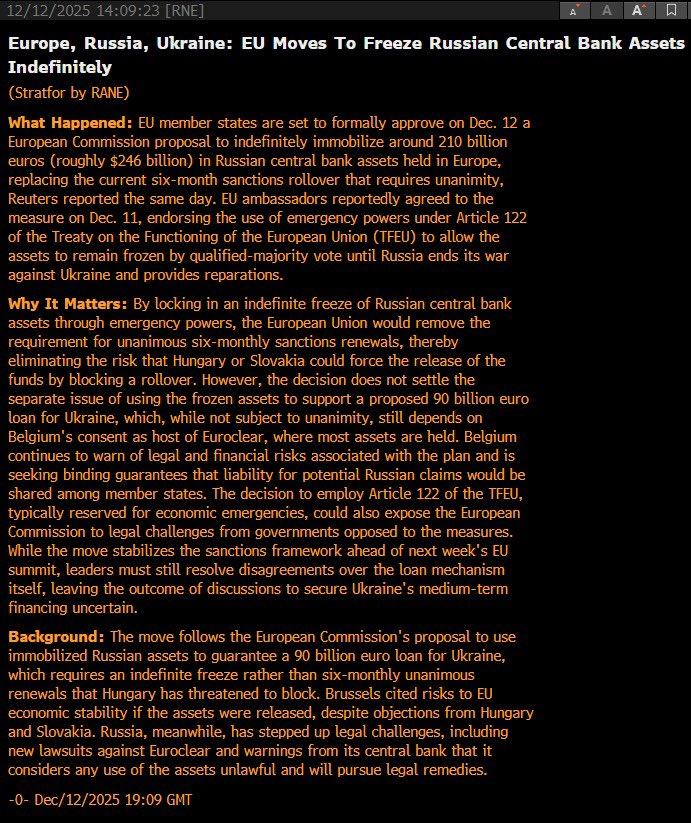
A central bank can set the price of money. It cannot set the price of matter. And once matter becomes the binding constraint, monetary sovereignty shrinks into a technical exercise conducted inside someone else’s industrial perimeter.
When your supply chains, price structures and investment cycles depend on a rival’s furnaces, refineries and separators, your central bank isn’t sovereign — it’s downstream.
In that world, interest-rate decisions and liquidity cycles become responses to shocks you no longer control: metal shortages, export bans, midstream bottlenecks, strategic embargoes.