Ayn Rand: "Under a free system, no one could acquire a monopoly on anything. If you look at economics, and economic history, you will discover that all monopolies have been established with government help."
Gold was money for 5,000 years.
The dollar has been backed by nothing for 55.
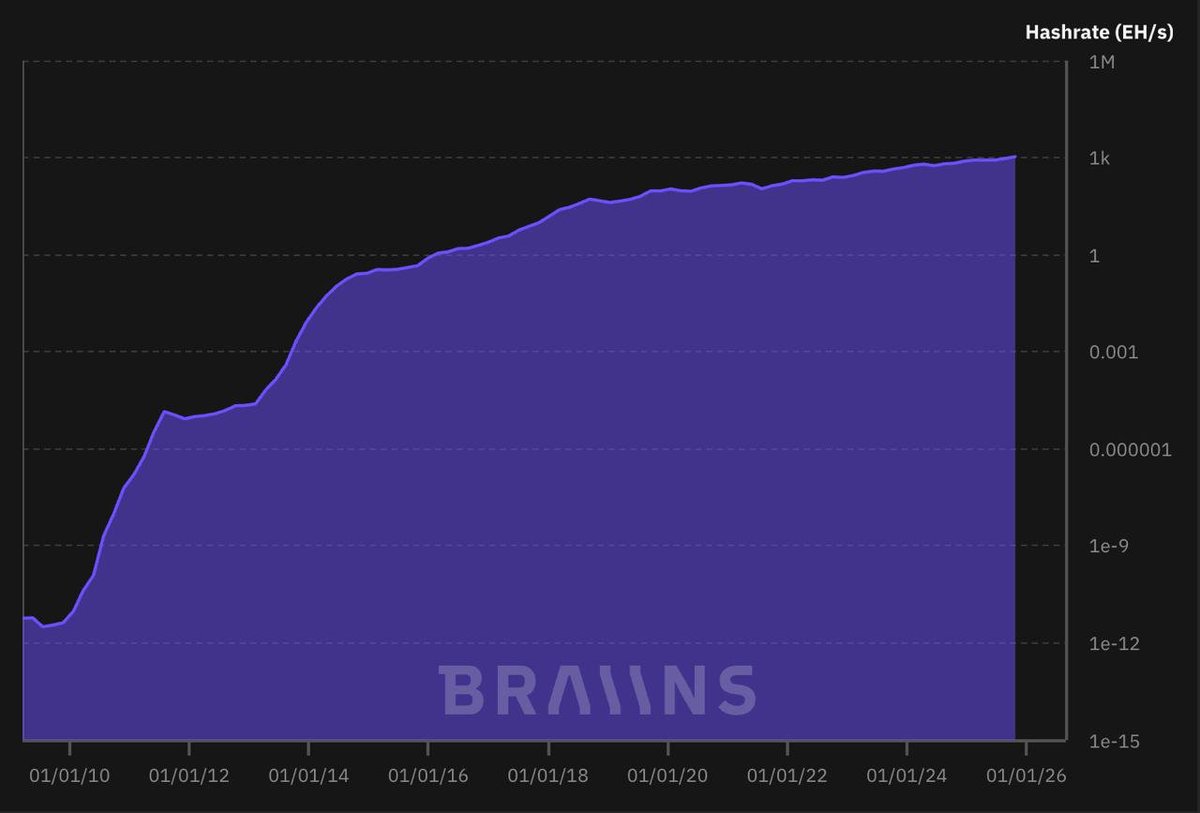
Bitcoin has been running without fail for 17.
Which of these trends do you think continues.
Ansel is right. People with this view don’t truly understand the open source aspect or the proof of work aspect fully.
A strong point about Bitcoin is that it literally doesn’t matter who created it. It can be assessed on its own merits since it’s transparent and decentralized.
I made this #Bitcoin video 10 years ago today. Back then some were shamed if they had paid the "high price" of $700. Others were paralyzed because they could no get over the fact that some had only paid double digits per #BTC a few years earlier. Lack of long-term thinking!
We are also releasing self-contained lecture notes that explain flow matching and diffusion models from scratch. This goes from "zero" to the state-of-the-art in modern Generative AI.
📖 Read the notes here: https://t.co/RULWDgn9pm
Joint work with @EErives40101.
I had dinner once with a top physicist and a top computer scientist and asked what they thought the probability was that we were in a simulation.
They answered simultaneously at 0% and 100% respectively. It was like a double-slit experiment, but with humans.
In 1798, a scientist effectively “weighed” the Earth — without leaving his laboratory.
The English scientist Henry Cavendish designed an incredibly sensitive experiment.
Inside a quiet wooden shed, he hung a horizontal rod from a very thin wire. Two small lead spheres were attached to the ends of the rod.
Nearby, he placed two much larger lead balls.
Because of gravity, the large spheres slightly pulled the smaller ones. The force was extremely tiny — so small that the rod twisted by only a minute fraction of a degree.
Yet that tiny twist held a big secret.
By carefully measuring this small movement, Cavendish determined the strength of the gravitational attraction between objects.
From this, scientists could calculate the mass of the entire Earth.
His estimate was remarkably close.
Cavendish calculated Earth’s mass to be about 6 × 10²⁴ kilograms, while modern measurements give 5.97 × 10²⁴ kilograms.
Sometimes the biggest discoveries come from measuring the smallest forces.
Big news! We've been awarded international accreditation by ASIC UK for the next 4 years!🎉
“ASIC accreditation is a rigorous, internationally respected quality mark that directly opens doors for learners around the world” — @grok
No tuition, no debt.⚡️
https://t.co/t3x2GOxB4O