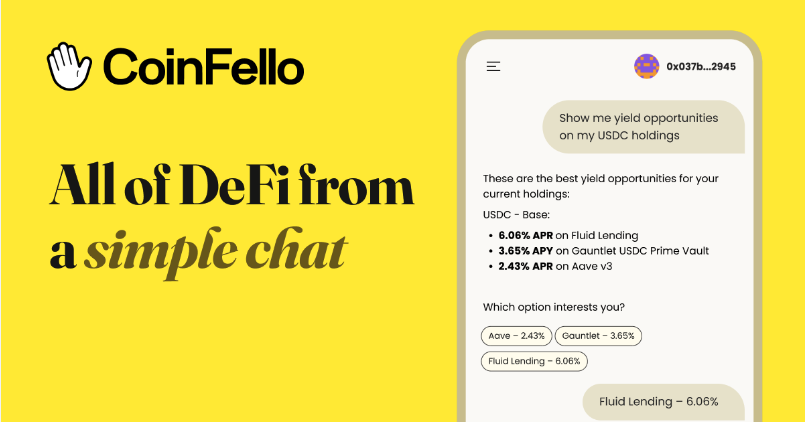
We just launched the crypto wallet solution for the agentic future. A plugin for Hermes from @nousresearch, powered by @coinfello.
https://t.co/zuwzO6cL4K
Hermes Wallet by CoinFello. All of DeFi, one conversation 🧵
Big Bank Beth @SenWarren hates President Trump so much that she’d rather have no rules of the road for the digital asset industry — leaving consumers vulnerable and law enforcement empty-handed — than take the win for consumers.
Let’s get the facts straight on her “fact sheet”:
1. She claims the blind trust is a shell game. It’s not. By law (5 U.S.C. §13104(f)(3)(A) and 5 C.F.R. 2634.403), a trustee is barred from disclosing trust holdings back to the official. That’s not a loophole, it’s literally what makes a blind trust blind. Read the law for yourself below.
2. She claims $TRUMP proves the president would create new coins. But $TRUMP launched when President Trump was a private citizen. The ethics ban applies to conduct while serving. You can’t retroactively ban something that happened before the law — or the presidency — existed. That’s how the law in the Soviet Union worked, not America.
3. She acts like Trump’s adult children running WLF is some unprecedented dodge. It’s not. Federal ethics law has never imputed financial interests from adult, independent children — only spouses and minor children. That’s not new to this bill; it’s how conflict-of-interest law has worked for decades.
The facts speak for themselves. Don’t fall for Liz’s lies.
https://t.co/A4RjpyVPN9
1/ Today, we're launching https://t.co/CpN1VVHFdP — a new website that helps companies, constituents, and crypto voters urge Senate leadership to bring the Clarity Act to the floor.
Your voice. Your story. Your vote.
🧵
https://t.co/rBA3zAMrE0
1/ Today, the Global Policy Strategy (GPS) team is publishing Ethereum Basics for Governments and Institutions, a non-technical primer to equip the leaders making policy and deployment decisions with an understanding of how Ethereum works, how it's governed, and how it compares with perceived alternatives.
1/ Announcing Ethereum Institutional
An independent non-profit dedicated to accelerating the institutional adoption of Ethereum, its L2s, applications and overall ecosystem.
Announcing Ethlabs: a non-profit R&D lab for Ethereum and ETH
Our mission is to make Ethereum the settlement layer of the global economy.
The internet became global because shared protocols created a common language between networks. Private systems remained useful, but bounded. Finance is approaching a similar moment. As value, assets, and markets become digital, the world needs shared settlement infrastructure.
Ethereum is uniquely positioned to become that shared base layer, the neutral foundation on which users, institutions, and agents can transact without intermediation.
What we believe:
• We believe credible neutrality matters. Ten years of uptime and the lowest counterparty risk. Ground that cannot be pulled away by any one country, institution, company, or person.
• We believe ETH matters. The most valuable, programmable store of value. A decade of broad distribution, deep liquidity in onchain markets, and maximally trustless asset on Ethereum.
• We believe DeFi matters. Markets, liquidity, credit, exchange, and coordination, open to anyone.
• We believe adoption matters. Principles do not change the world until people benefit from them.
We sit between two worlds: real usage from the builders at the frontier, and the protocol that has to support it. We work with users, applications, wallets, L2s, infrastructure teams, institutions, ETH holders, core devs and researchers, then turn what they actually need into protocol work, shared standards, infrastructure, and shipped products.
Ethlabs is independent but Ethereum is a shared project. We are one node in a much larger network of stewards. This is the multi-node future.
We have spent the better part of the past decade contributing to Ethereum core research and development.
We are opinionated and transparent. We move with urgency, learn in public, and course-correct when we’re wrong.
We are building a lean, talent-dense team for people who want to do the most important work of their careers: [email protected]
CoinFello is live for everyone!
CoinFello is an AI agent that helps you research, execute, and automate any onchain action across all EVM chains using plain language. Your keys stay yours the entire time.
No waitlist. No invite code. Open to everyone, from today.
Here is what that means 👇
Announcing the first ever public release of Lexe Wallet on the App Store and Google Play! This release comes with new features and fresh SDKs for creating and controlling self-custodial Lightning wallets - real channels managed by always-online Lightning nodes running inside secure hardware.
In the video below, we open a Python shell and hand-type commands to create a self-custodial Lightning wallet on Bitcoin mainnet, fund it, and make payments - in just 3 minutes. Full announcement in the next post 👇
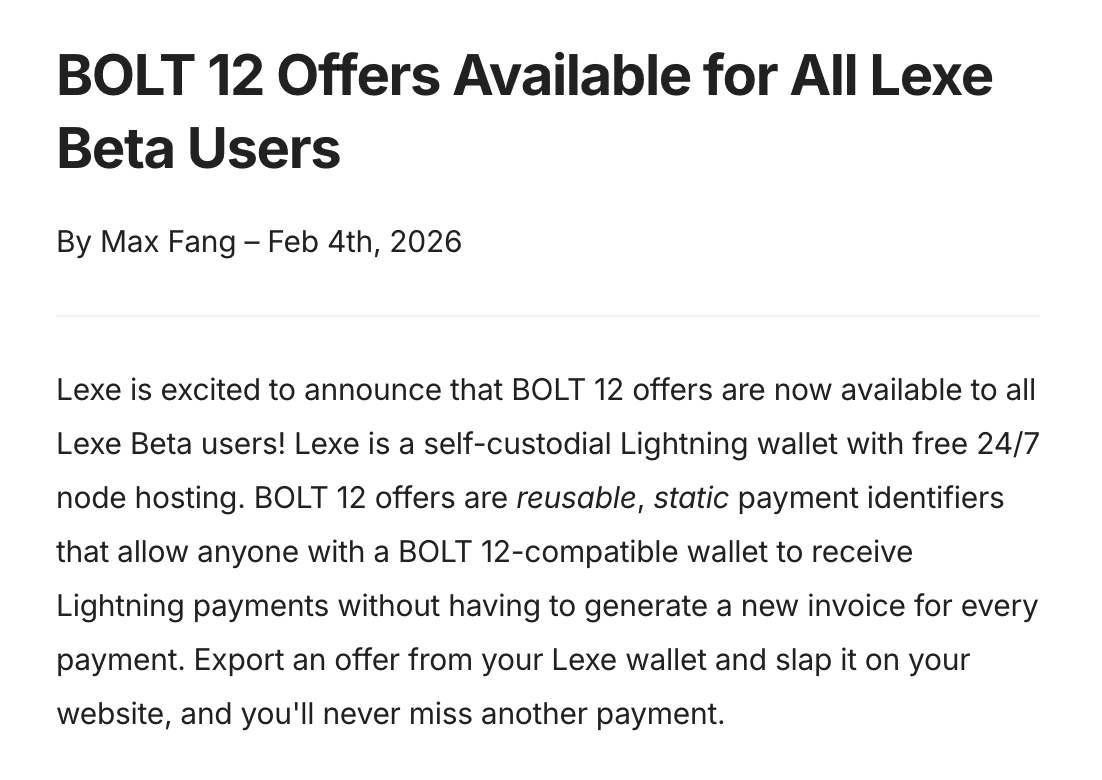
Lexe would not be complete without BOLT 12. We are excited to launch BOLT 12 offers to all Lexe Beta users, which properly showcases the incredible power of Lightning in TEEs running 24/7.
See below for the blog post and beta access instructions. 👇
Re the 2nd part of your tweet:
G7 specifically had a really interesting flywheel built around revshare for stakers (citizens pool). G7 really wanted to lean into the DAO/community owned and led direction and this model matched that direction.
~25% of TGE staked which was pretty decent but could have been better. There was a $1m initial citizen pool, we thought that this would bring in a lot of net new buyers/stakers but it didn’t (we made some adjustments and had planned a significant adjustment that was more sustainable). We had almost a dozen confirmed campaigns going into TGE and the plan was that these campaigns would refresh the citizen pool to keep the flywheel going but shortly after TGE almost all of the projects we were working with either decided to pause TGE if they had the capital, or cancel it entirely and just shut down because they ran out of funds given that gaming ~6 months ago when we TGE’d was just starting the big unwind we’re still seeing today.
So lot of things hit at the same time, we distributed a large % of tokens to the initial community who wasn’t aligned with our mid/long term vision (that’s fine, we knew it was likely to happen), we built tools and a platform that relied on 3rd parties to use them to generate revenue (less fine as this aligned our success or failure almost entirely with others), gaming became a graveyard and retail interest hit all time lows and thus a lot of projects shut down or hit pause (we didn’t expect it to be this bad and that was a mistake, so many gaming projects to be optimistic about and none really panned out), and honestly we tried to do too many things which made us not agile enough to correct course quickly and were too big to weather the storm for the next 1-2 years without making large changes. Any of these things by themselves was correctable, but all the mistakes together led to hard choices having to be made ie a full rebuild from the ground up, otherwise the option was slow bleed and hope something changed or we could figure out how to fix web3 gaming or develop an entirely new gaming product that changed the current trajectory of the space which seemed… ambitious.
I guess to answer your question directly, we had a lot of really positive feedback from advisors, partners and community members every step of the way which made us more confident. It wasn’t that hard to imagine the flywheel working: a massive community that engaged with gaming projects, gave them a platform and tools to help them succeed, and shared in the rewards that those successful projects distributed to G7 as a community. Campaigns and direct rewards were the hook for new members, and staking + citizen pool brought people further into the ecosystem for mid/long term alignment. It was a real model, with many other projects committing tokens and $ to making it continue to work because they found it valuable. But it didn’t work out for the reasons listed above and a few others. The plan wasn’t TGE and hope for the best, there were a lot of things lined up and a lot of fallback plans. but the mistake was planning TGE and not planning for the worst, or seeing the shift and making radical adjustment early enough I suppose.
They’re a tool to fast track and sometimes a very effective one. Challenge is, exchanges like to list projects that are fresh/current to maximize new traders signing up and the value they can generate from listings so it is very hard to get listings after TGE. The meta before tier 1’s shifted to TGE listing and thus P2A came about, was to list on a DEX, show volume, community engagement and price support, work up to T2 exchange listings and then at a certain point apply for T1 (there were exceptions for very large projects obv but now the exception has become the preferred path). This was much healthier imo and gave projects a lot of time to refine and grow more organically. That doesn’t really happen anymore which is unfortunate, and as I’m sure you’ve seen, projects that only do DEX listings are perceived as DOA with little hope of further listings. TGE is the one time projects have a little bit of leverage with top exchanges but tbh it’s very one sided. Won’t go into further details here but the process is pretty broken imo.
Few questions that might be illustrative:
How many projects have been wildly successful without T1 exchange listings in the last 1.5 years? Access to significant buyers is still very much controlled by CEXs. Meme coins were a way to take back some control and have a more fair distribution and access for the average person but are generally captured by organized groups looking to extract from retail at this point (similar to NFT mints, and ICO’s before them). And even then, top meme coins really took off once they got big enough and were listed on a T1. I do think there’s a bit of chicken and egg here in that exchanges list already successful or likely to be successful projects which helps reinforce their role as a king maker of sorts but like it or not, most people buy and sell on CEXs.
Have you ever looked down cmc/Coingecko and thought, wtf does this token even do and why is it worth billions? So many old coins are still worth hundreds of millions or billions with great volume but the project has been functionally dead for years but since they have distribution on every exchange they are a useful financial product even if they are a dead project (traders vs. users). Several recent coins have done really clever financial engineering leveraging exchange listings to succeed without much substance ie low float/high FDV and leveraging that into a cult following. Quite a few others have tried that same approach and still had price go down significantly. Like it or not price informs narrative. User + trader interest gives more optionality so why not try to maximize both?
Throughout the different cycles there has been a wax and wane of centralized and decentralized methods of distribution, and I think we’re going to start seeing the pendulum swing the other way with more clarity and openness to doing ICO’s etc. but time will tell.