LOADED, written down: how a vault becomes a https://t.co/ybowA7wufP coin's creator, how the floor ratchets, the four modes, the sponsor pool, the backtests on 75 real price paths, and what it can't promise. Launching soon. https://t.co/F0T1LyyuGi
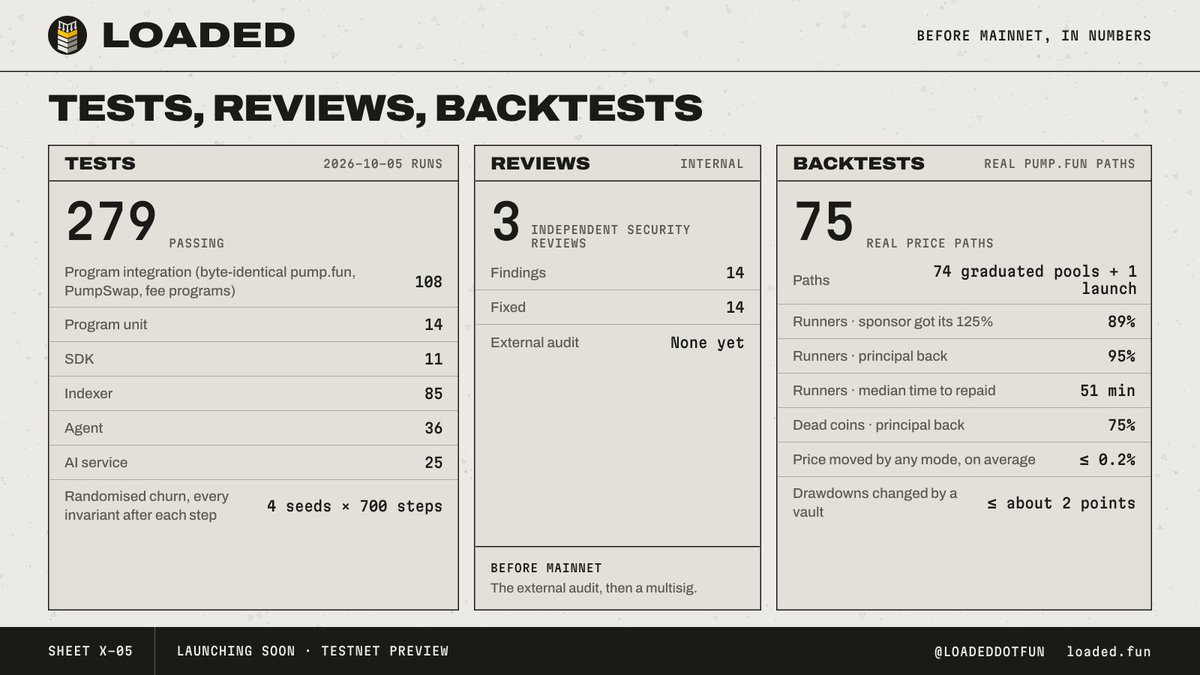
What we have before mainnet, in numbers.
279 tests: 108 program integration tests against byte-identical copies of today's https://t.co/FavbQ91YwO, PumpSwap and fee programs, 14 program unit tests, 11 SDK, 85 indexer, 36 agent, 25 AI service. A randomized churn test runs 4 seeds × 700 steps and checks every invariant after each step.
Three independent internal security reviews, 14 findings, all fixed. No external audit yet.
Backtests on 75 real https://t.co/FavbQ91YwO price paths. On the runner set the sponsor got its 125% on 89% of launches, median 51 minutes. On dead coins, principal back on 75%, and no mode moved price by more than 0.2% on average once the crowd traded the vault's impact back.
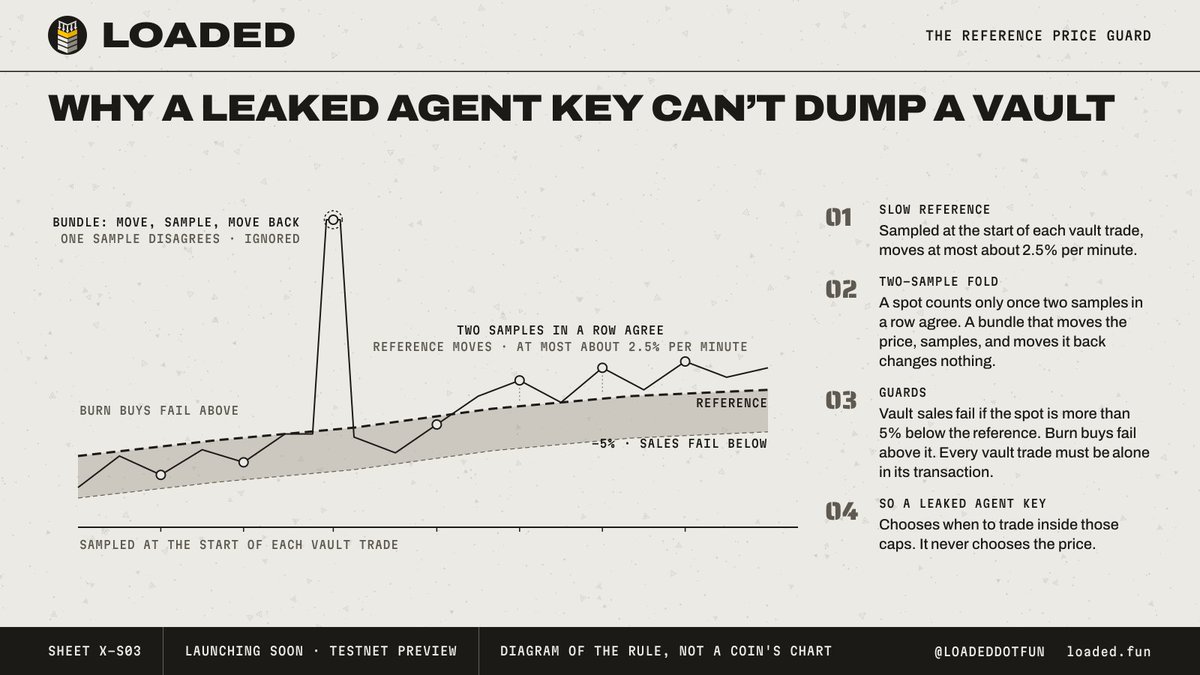
Why a leaked agent key can't dump a LOADED vault.
Every vault keeps a slow reference price. It is sampled at the start of each vault trade and moves at most about 2.5% per minute. A spot only counts once two samples in a row agree, so a bundle that moves the price, samples, and moves it back changes nothing.
Vault sales fail if the spot is more than 5% below that reference. Burn buys fail above it. Every vault trade must be alone in its transaction.
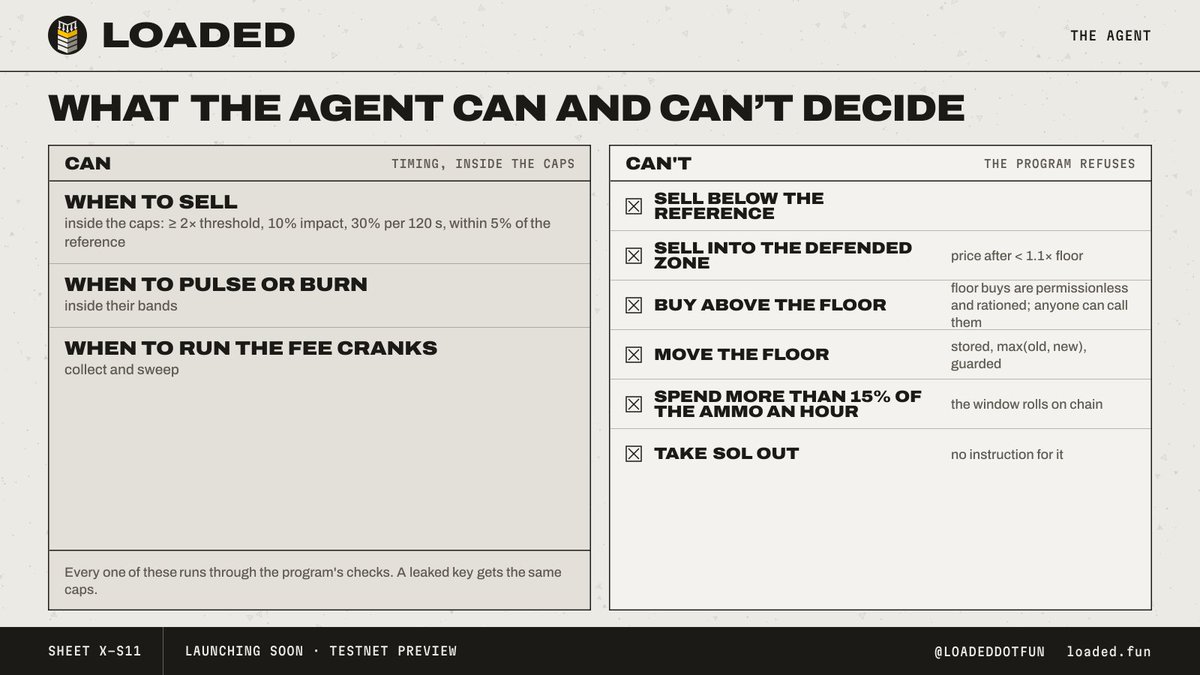
The agent chooses when to trade inside those caps. It never chooses the price.
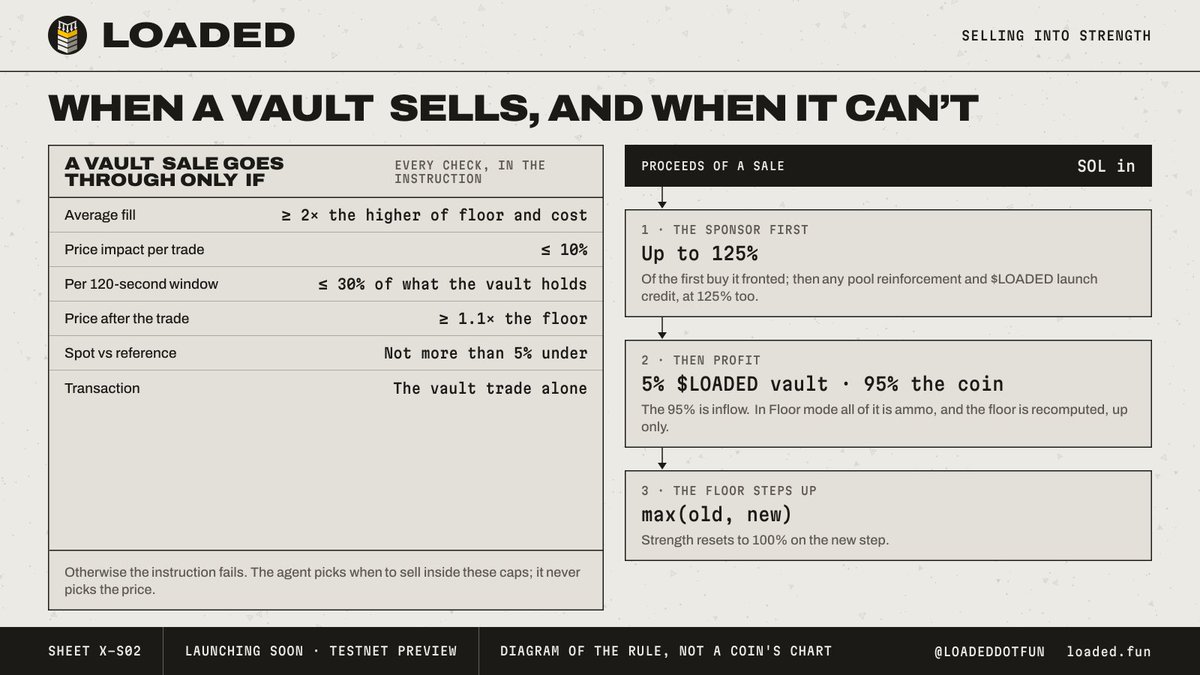
When a LOADED vault sells, and when it can't.
It sells only when the average fill is at least 2× the higher of the floor and its own cost. Each trade moves the price at most 10%. Each 120-second window sells at most 30% of what the vault holds. The price after the trade must stay at least 10% above the floor, and the spot at most 5% under the reference.
Proceeds repay the sponsor first, up to 125%, then any pool reinforcement and $LOADED launch credit at 125%, then profit: 5% to the $LOADED vault, 95% back into the coin's own ammo. Then the floor is recomputed, up only.
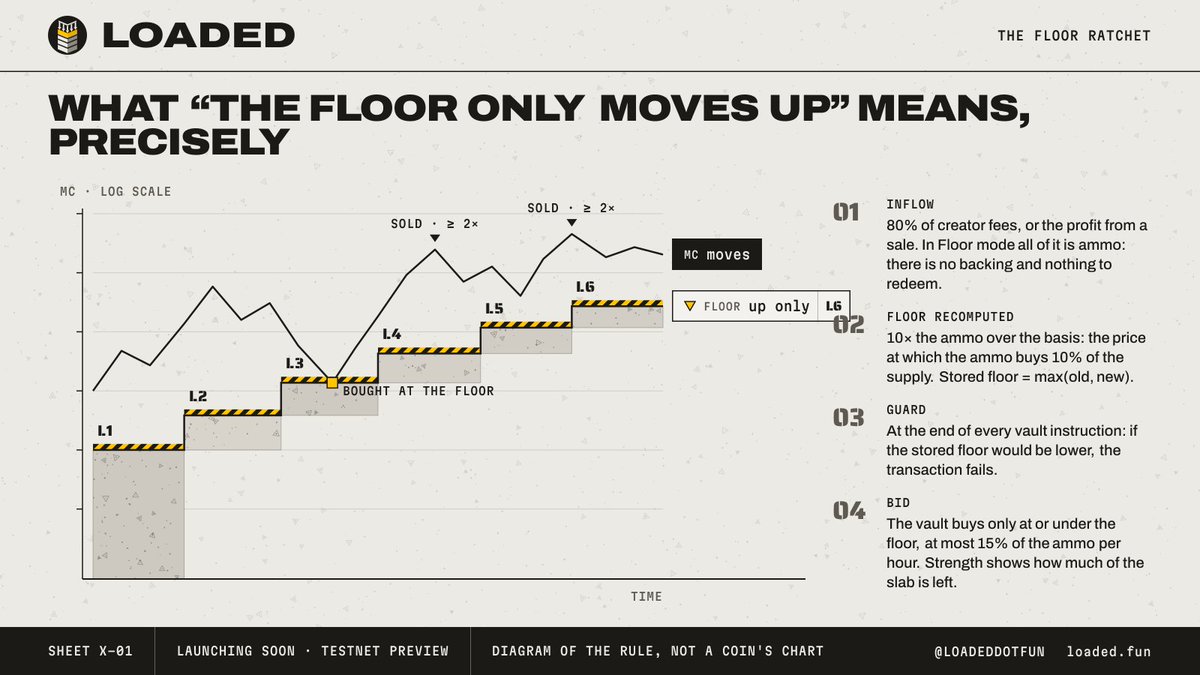
What "the floor only moves up" means, precisely.
A LOADED vault stores a floor price on-chain. In Floor mode every inflow (its 80% of creator fees, or the profit from a sale) is ammo: there is no backing and nothing to redeem. After each inflow the floor is recomputed as 10× the ammo over the supply basis, the price at which the ammo buys 10% of the supply, and the stored value becomes max(old, new).
A guard runs at the end of every vault instruction. If the stored floor would be lower, the transaction fails.
The vault buys only at or under that floor, at most 15% of the ammo per hour. Dumps get bought there while the ammo lasts, and the strength of the slab is on the page as it is spent.
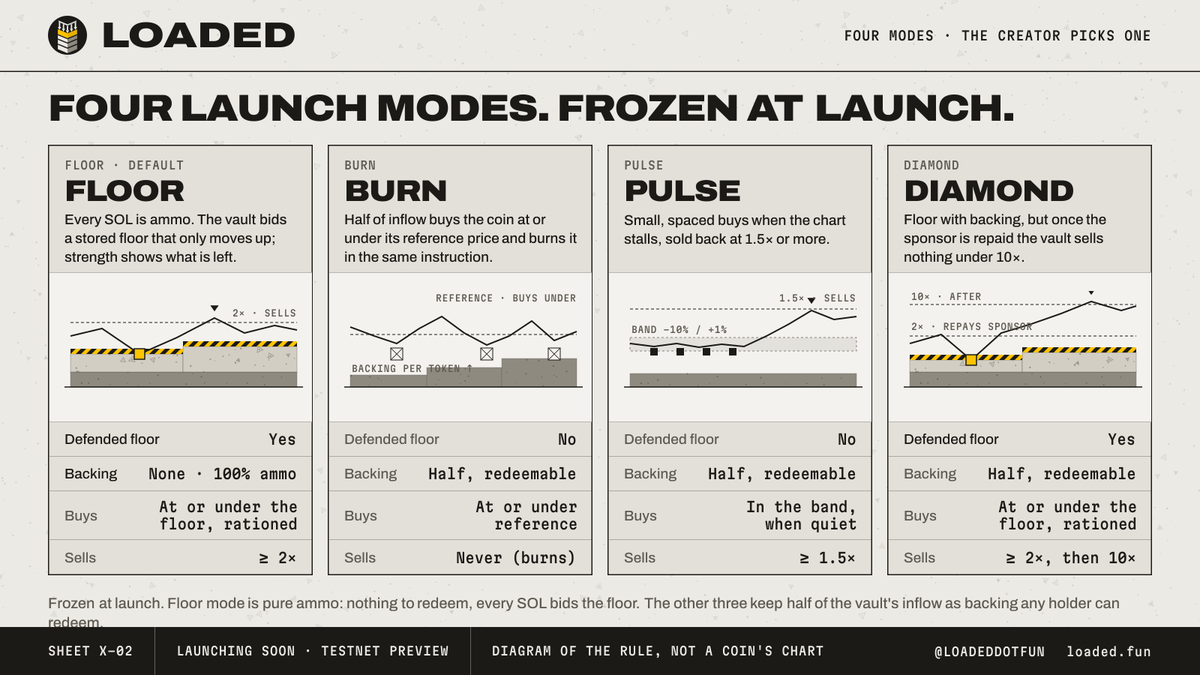
Four launch modes. The creator picks one, and it is frozen.
Floor: every SOL the vault earns is ammo bidding a stored floor that only moves up. Nothing to redeem; the strength shows what is left.
Burn: half of inflow buys the coin at or under its reference price and burns it in the same instruction.
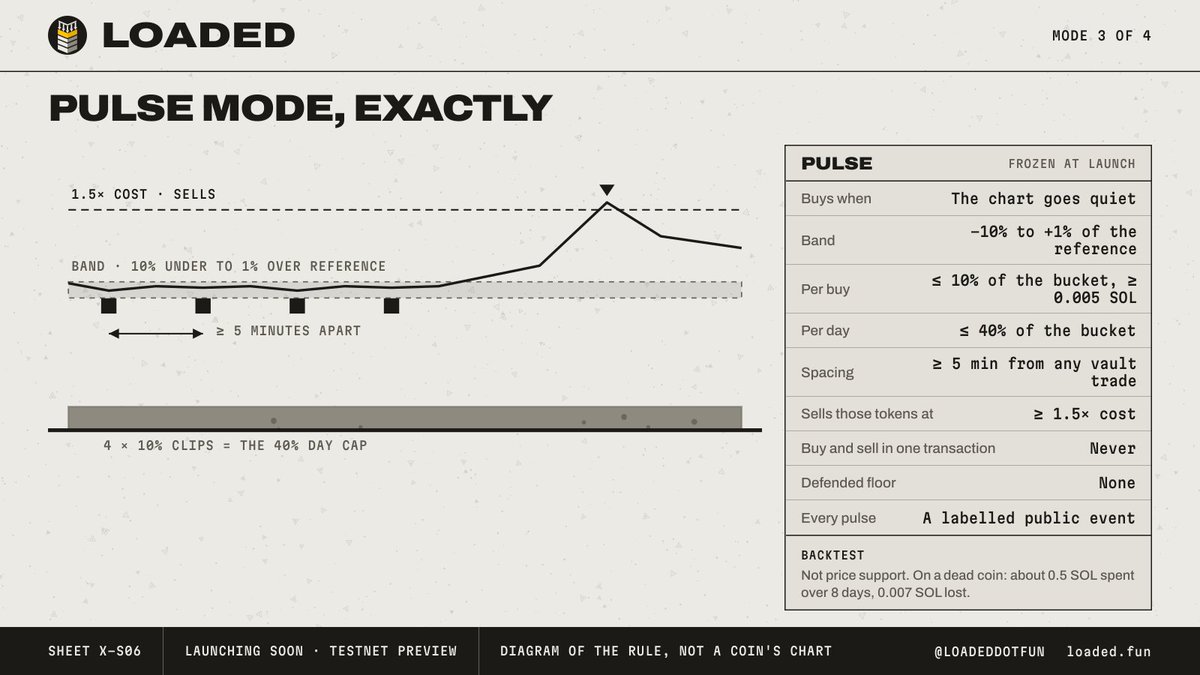
Pulse: small, spaced buys when the chart stalls, sold back at 1.5× or more.
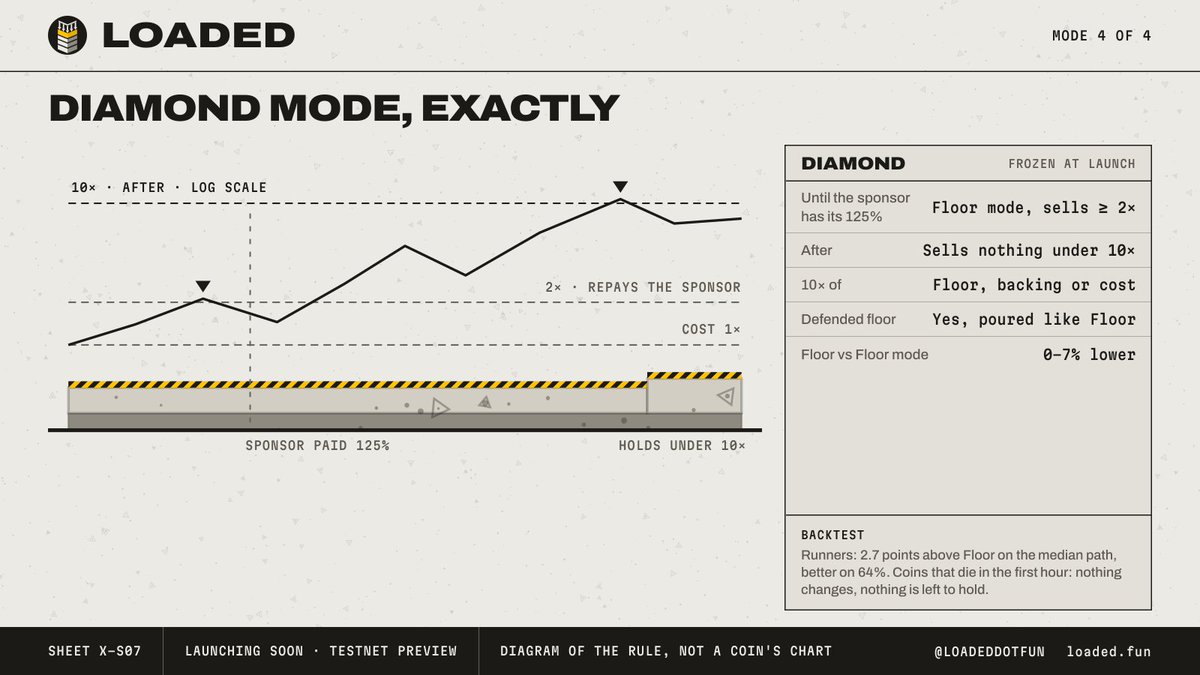
Diamond: Floor with backing, but once the sponsor is repaid the vault sells nothing under 10×.
Burn, Pulse and Diamond keep half of the vault's inflow as backing any holder can redeem. Floor keeps none, and bids all of it.
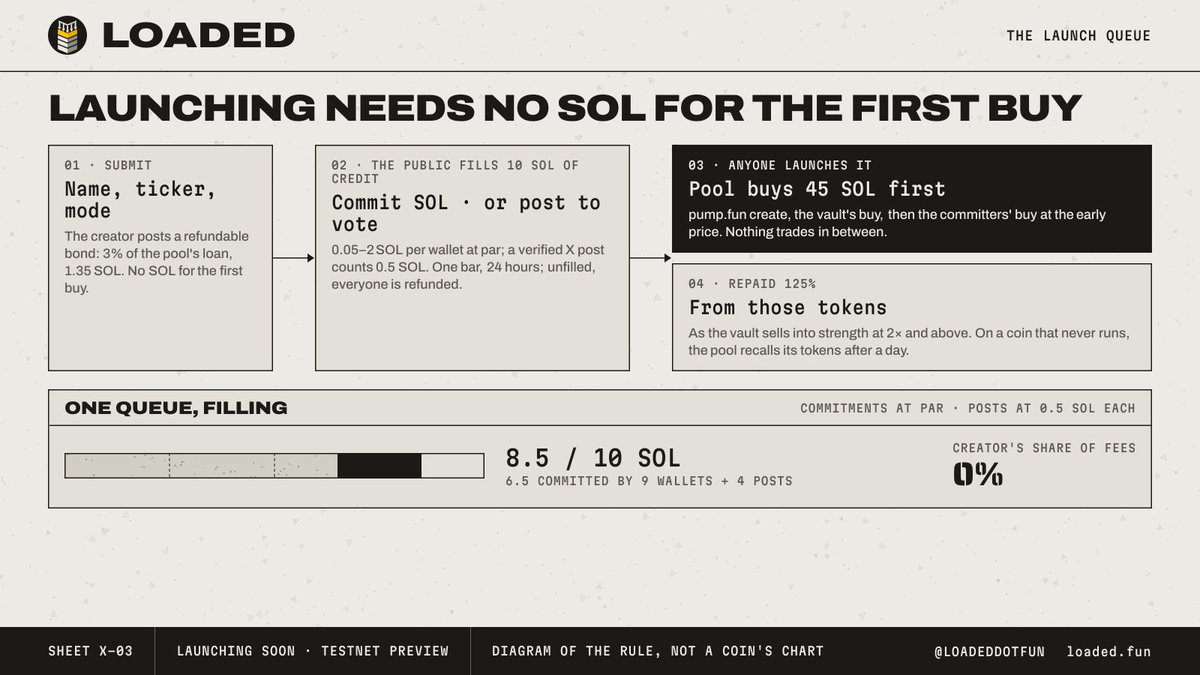
Launching on LOADED needs no SOL for the first buy.
A pool-funded coin waits in a public queue. The creator posts a refundable bond of 1.35 SOL and nothing else. The public fills 10 SOL of credit: commit 0.05 to 2 SOL per wallet at par, or post about the coin on X for 0.5 SOL of credit per verified post. Filled, anyone launches it: https://t.co/FavbQ91YwO create, the sponsor pool's 45 SOL as the vault's first buy, then the committers' buy at the early price. Nothing trades in between.
The pool is repaid 125% from those tokens as the vault sells into strength. On a coin that never runs, it recalls the tokens near cost after a day. Unfilled after 24 hours, the queue expires: commitments refunded, bond back.
Creators keep 0% of fees. The vault keeps 80%.
Where every creator fee goes on LOADED.
80% to the coin's own vault. In Floor mode all of it is ammo bidding the floor.
5% to the AI treasury: moderation, the launch assistant, the analyst desks.
10% buys back and burns $LOADED.
5% to the sponsor pool's depositors.
0% to the creator.
The split is frozen into each launch at creation. Nothing to revoke later.
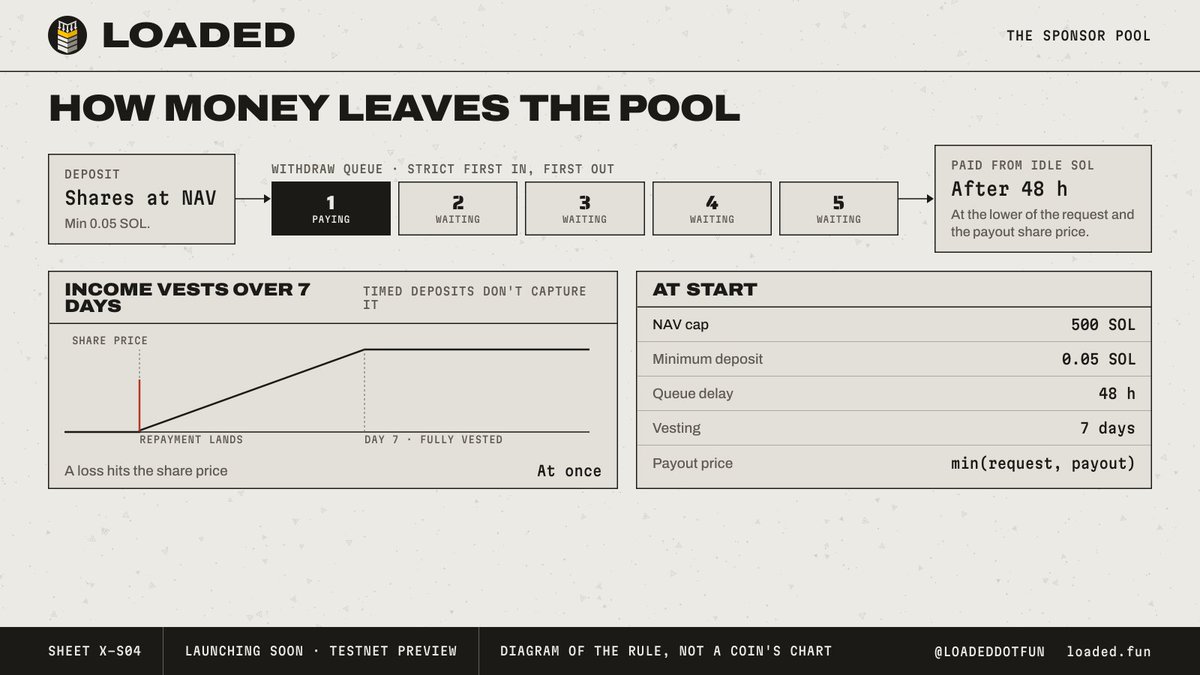
How money leaves the sponsor pool.
Deposits buy shares at the pool's net asset value. Withdrawals go into a strict first-in, first-out queue with a 48-hour delay and pay from idle SOL, priced at the lower of the request and the payout share price. Income vests over 7 days, so a deposit timed on a big repayment doesn't capture it.
Losses hit at once.
NAV cap at start: 500 SOL.
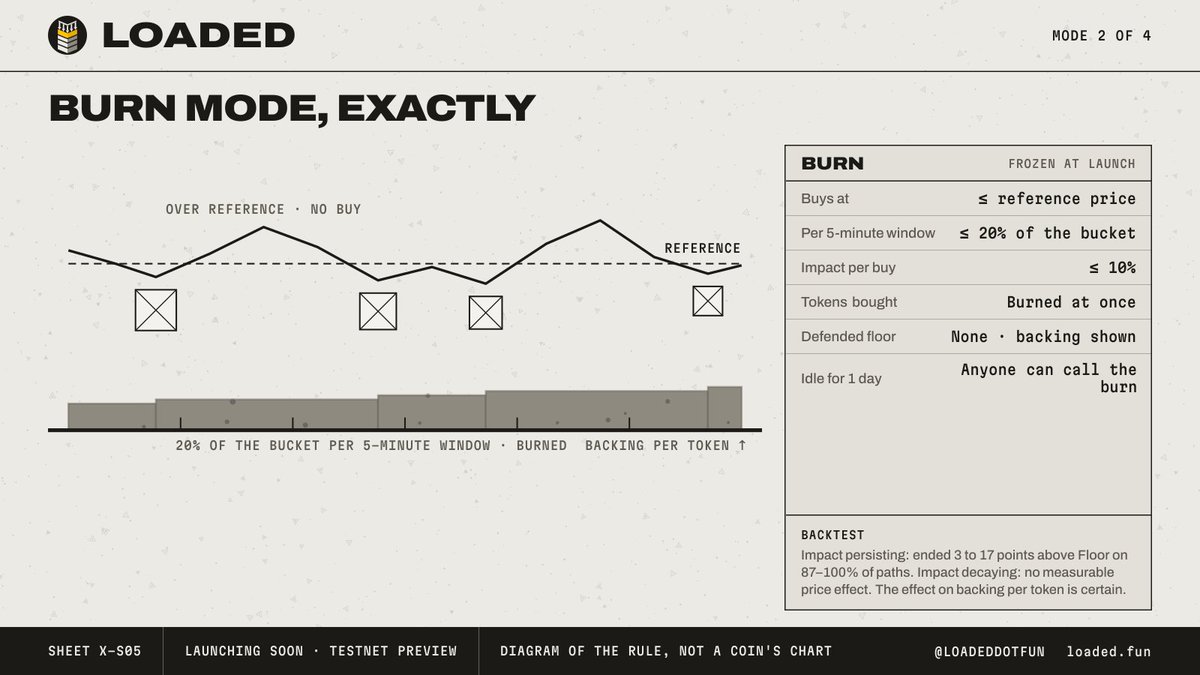
Burn mode, exactly.
The vault's ammo half buys the coin only at or under its reference price, at most 20% of the bucket per 5 minutes, at most 10% impact per buy, and burns the tokens in the same instruction. Supply goes down; backing per token goes up. No defended floor in this mode: the floor shown is the backing.
Backtest, impact persisting: Burn ended 3 to 17 points above Floor on 87–100% of paths. With impact decaying, no measurable price effect. A burn's price effect is unreliable; its effect on backing per token is certain.
Pulse mode, exactly.
When the chart goes quiet, the vault buys a little: inside a band from 10% under to 1% over its reference, at most 10% of its bucket per buy, 40% per day, 5 minutes apart from any other vault trade. It sells those tokens back only at 1.5× cost or more. No buy and sell in one transaction, ever. Every pulse is a public event labelled on the site.
What it is not: price support. On a dead coin the backtest spent about 0.5 SOL over 8 days and lost 0.007 SOL.
Diamond mode, exactly.
It is Floor mode with one extra rule: once the sponsor has its 125%, the vault sells nothing under 10× the higher of the floor, the backing and its cost.
Backtest: on runners it ended 2.7 points above Floor on the median path and did better on 64% of them. On coins that die in the first hour it changes nothing, because nothing is left to hold. Its floor ends 0–7% lower than Floor's, since less profit comes back.
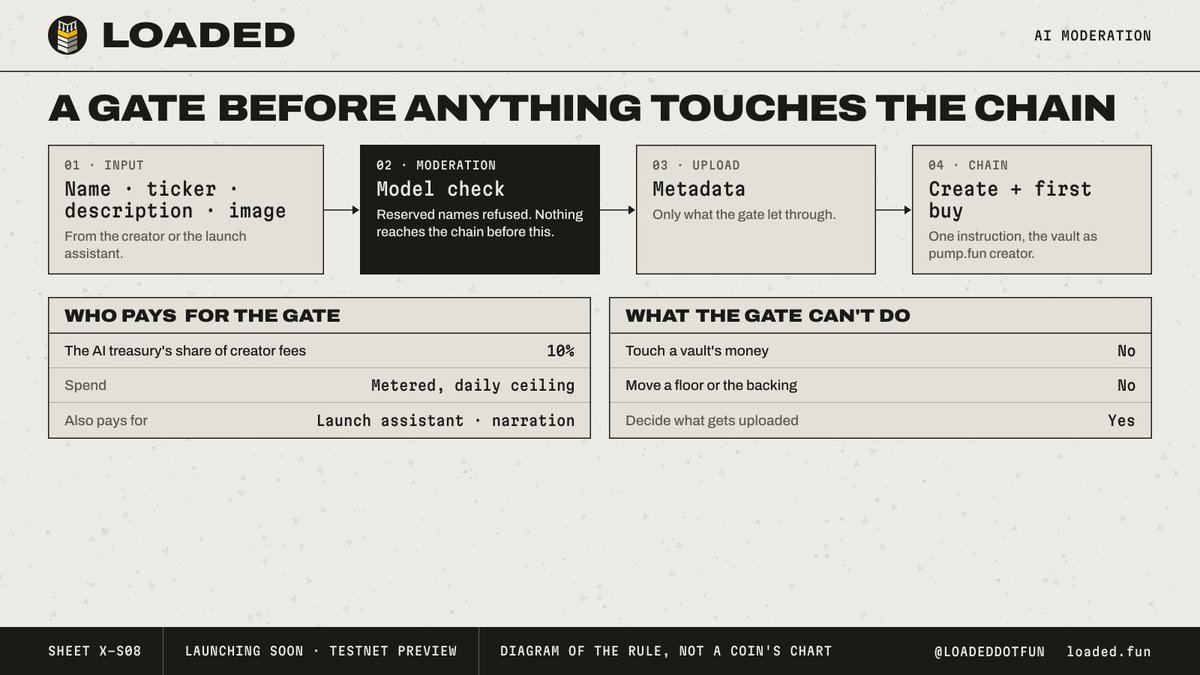
Every launch on LOADED passes a gate before anything touches the chain.
Name, ticker, description and image go through moderation before the metadata upload. Reserved names are refused. The AI treasury that pays for it gets 10% of creator fees, metered with a daily ceiling.
The gate decides what gets uploaded. It never touches a vault's money.
Launching without a name yet.
The launch assistant suggests names, tickers, a description and a logo from a line of text, then the creator picks the mode and the first-buy size, and signs once. The coin is created on https://t.co/FavbQ92wmm with the vault as its creator and the first buy in the same instruction.
Every vault event is narrated in plain English, next to the transaction.
Example from the test network: "Creator fees of $1.01 entered the vault as the floor rose 57% to $5.53 MC."
The numbers come from the chain. The sentence comes from a model. The transaction link is right there if you'd rather read the raw event.
What LOADED's agent can and can't decide.
Can: when to sell inside the caps (≥ 2× threshold, 10% impact, 30% per 120 seconds, within 5% of the reference), when to pulse or burn inside their bands, when to run the fee cranks.
Can't: sell below the reference, sell into the defended zone, buy above the floor, move the floor, spend more than 15% of the ammo in an hour, take SOL out. Floor buys are permissionless and rationed; anyone can call them.
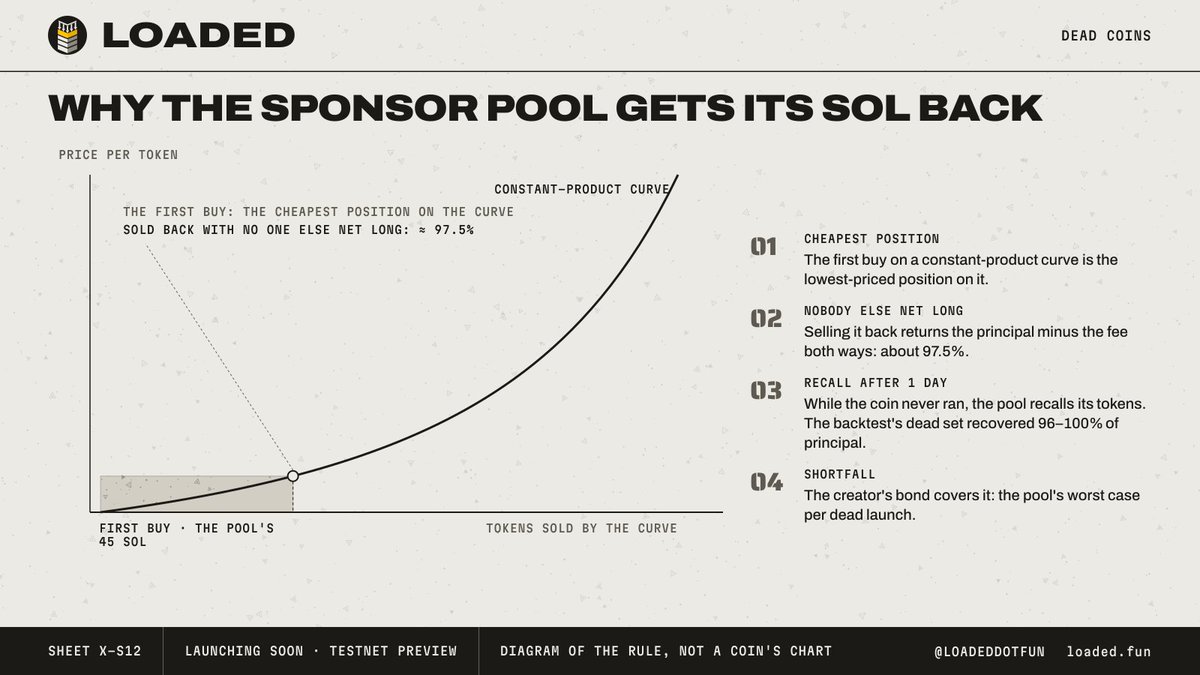
Why the sponsor pool gets its SOL back on dead coins.
The first buy on a constant-product curve is the cheapest position on it. If nobody else holds a net position, selling it back returns the principal minus the fee both ways: about 97.5%. After a day, while the coin never ran, the pool recalls its tokens; the backtest's dead set recovered 96–100% of principal.
The creator's bond covers the shortfall. That is the pool's worst case per dead launch.
LOADED is a memecoin launchpad on https://t.co/FavbQ91YwO. Launching soon.
Every coin launched through it is created with a vault as its https://t.co/FavbQ91YwO creator. The vault's rules are on-chain: every SOL it earns is ammo, the floor is 10× the ammo, and it buys there when the price dumps to it, at most 15% of the ammo per hour, and sells into pumps at 2× the floor and above. The stored floor only moves up; the strength of the slab under it is on the chart as it is spent and repaired. Every vault's AI desk reasons in public: it picks timing inside those rules, never a price.
Creators bring no SOL for the first buy: a coin waits in a public queue, the public commits SOL or posts to vote, and at 10 SOL of credit anyone launches it with the sponsor pool's 45 SOL as the first buy, repaid 125% from those tokens. Creator fees go 80% to the coin's vault, 5% to the AI treasury, 10% to $LOADED buyback-and-burn, 5% to pool depositors. Creators get 0%.
Not audited yet.
The floor and its strength, the four modes, the queue, the AI desk and what the vault can't do, in the article:
https://t.co/CGCDyNUBGD
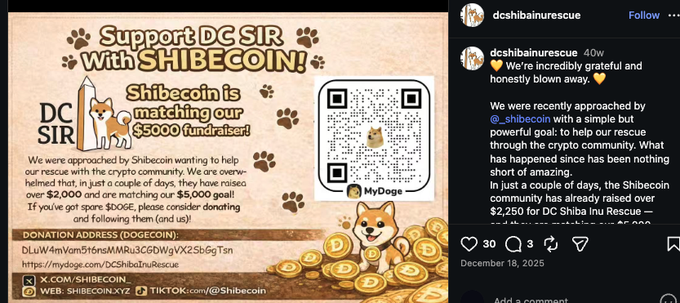
Shibecoin was the earliest Doge-inspired coin, launched on Bitcointalk back in May 2014
new inu charity just got added we can finally run inucoin to help save inus
LOOK AT THEIR IG THEY MADE THEIR OWN DOGE COIN
https://t.co/eWaTjS2Iym
CA: 53pf3BAskUqpGkU8S6LUc5Q1eVbx6sq6m8uJvKfSpump
Shork is live. Anyone can launch a coin on https://t.co/FVxcZaiNhh that shorts a stock.
Pick TSLA, NVDA, BTC or about 50 other targets. The coin's 3% creator fee is locked to its own wallet on-chain and routed to a 1x short on that asset. When the short profits, holders are paid in USDC.
Launch at https://t.co/9z6oXcO5la. How it works, with proof, in the article below.