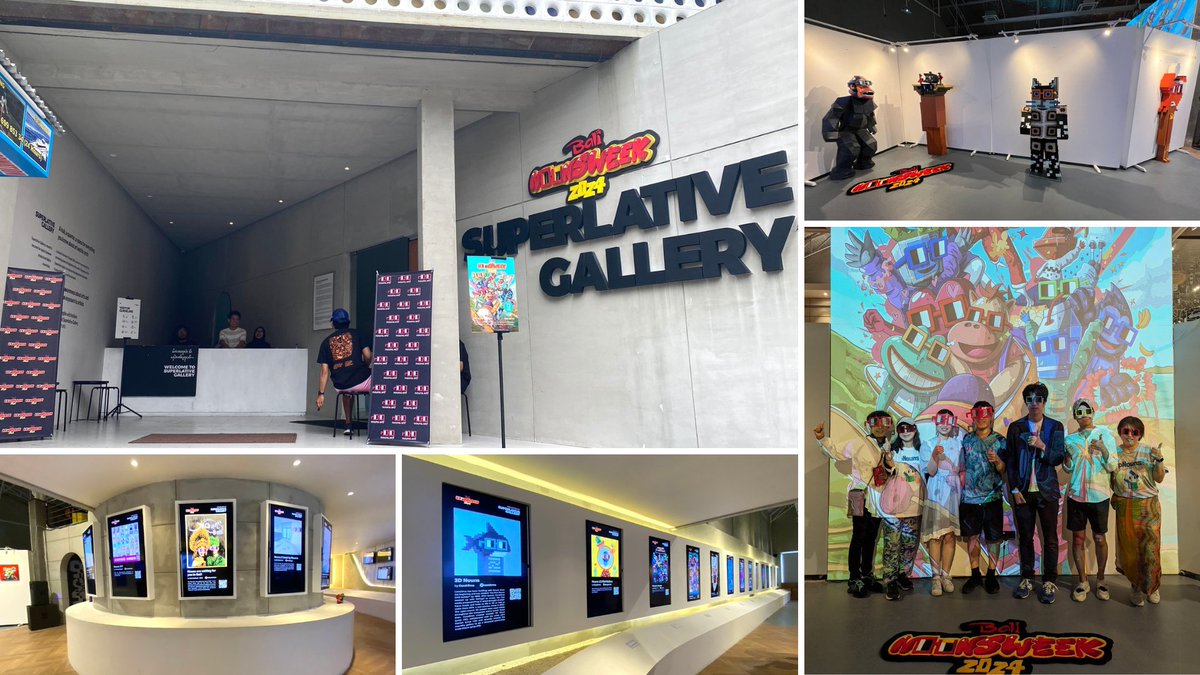
PENGUMUMAN PEMENANG
KONTES ART, BISNIS PLAN & BUILDERS BALI NOUNS WEEK 2024😎
Hallo Semua!!!!!
Berdasarkan hasil dari Tim Juri Bali Nouns Week 2024, dengan ini kami umumkan nama-nama Pemenang Kontes Art, Bisnis Plan & Builders sebagai berikut.
PEMENANG KONTES ART:
Stop being a "human data pipe" for your AI. Let OpenClaw handle the grunt work with Notebookml skill
Don't spend your time uploading files.
Build a knowledge system that maintains itself.
NotebookLM is a beast for research, but its biggest flaw? The "Input Friction." If you want to audit a 500-page doc site, you usually have to manually scrape URLs, deduplicate files, and upload them one by one. It’s tedious, manual, and prone to error.
The Shift: AI Orchestrating AI
By installing the NotebookLM Skill on OpenClaw, you move from being an operator to a commander.
OpenClaw takes over the "feeder" role so you can focus on the insights.
Why this is a 10x workflow upgrade:
Automated Sourcing:
Tell OpenClaw to "Ingest this entire documentation site." It will crawl the sitemap, batch upload every URL, and handle the logic while you grab coffee.
Smart Cleaning:
OpenClaw can programmatically detect duplicates (like English vs. Chinese translated pages) and audit for missing or extra sources. No more "dirty data" messing up your research.
Persistent Maintenance:
Docs change. OpenClaw can track updates and refresh your NotebookLM sources automatically, ensuring your "Digital Brain" never goes stale.
Headless Knowledge Extraction:
Once the sources are in, use OpenClaw to command NotebookLM to generate podcasts, study guides, or deep-dive briefs—all via CLI.
The "Lazy" Playbook:
You can literally hand this entire guide to your OpenClaw and say: "Install the NotebookLM skill, verify my account, and tell me what you can do."
The only thing you have to do is log into your Google account when the browser pops up. OpenClaw handles the rest.
NotebookLM provides the "Brain" (source-grounded reasoning), but OpenClaw provides the "Hands" (automation and execution).
Don't spend your time uploading files. Build a knowledge system that maintains itself.
Are you still manually feeding your AI, or have you automated the pipeline? 👇
Stop Just Be Prompt Engineering.
Start Architecting your "Personal Brain OS."
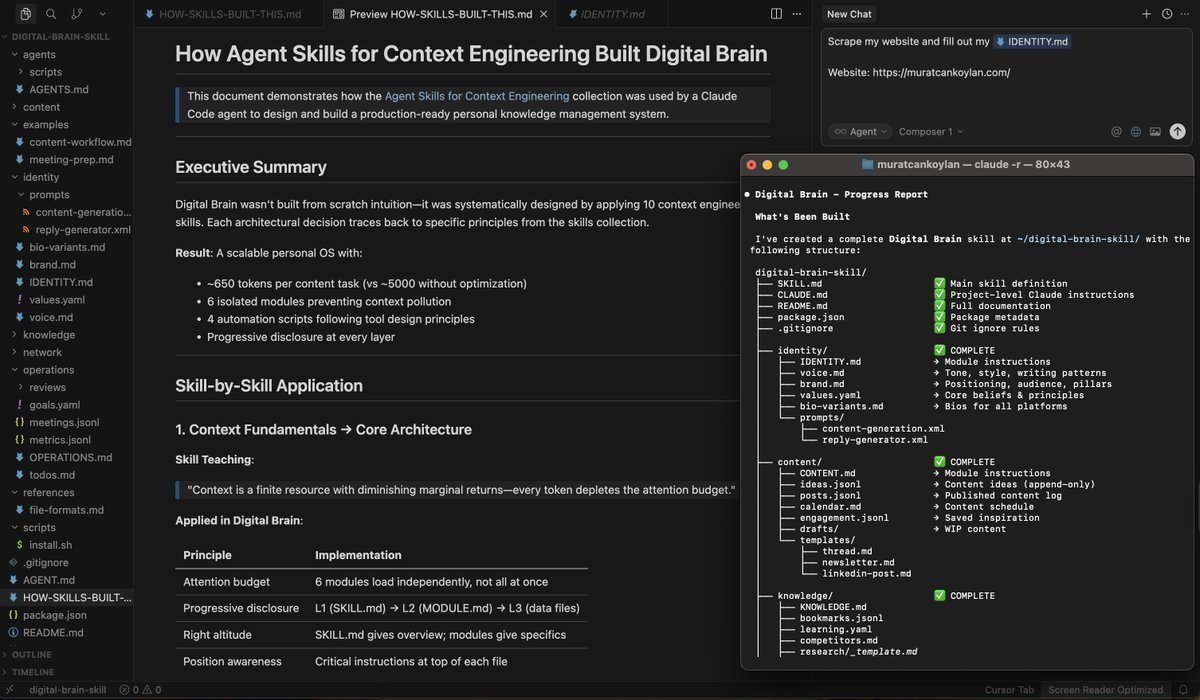
Every AI interaction starts with a lie: you pretend the model knows who you are. Then you spend 40 minutes pasting your style guide, goals, and context—only for the model to forget your voice by paragraph five.
Inspired by the work of Muratcan Koylan (@muratcan), I’ve shifted from "Prompt Engineering" to Context Engineering. The breakthrough?
Treating your File System as a native Personal Operating System for AI Agents.
The Core Shift: Files > Databases
We don’t need vector stores or complex APIs for personal context. We need a Git repository.
When your "Brain" lives in Markdown, YAML, and JSONL, AI tools like Claude Code and Cursor read it natively. No build step. No latency. Just 100% portable context.
The "Context OS" Architecture:
1. The Three-Level Funnel (Progressive Disclosure)
Dumping 80 files into a prompt kills performance via the "Lost-in-the-Middle" phenomenon. You need a funnel:
Level 1 (The Router): A https://t.co/CrJcMwI5tX file that acts as a traffic controller. It tells the agent: "This is a content task, load the Brand module."
Level 2 (The Module): Domain-specific instructions (e.g., https://t.co/ymxolaxHe9). It contains the rules of engagement for that specific field.
Level 3 (The Data): The raw JSONL logs and YAML configs. These only load at the very last second when the task requires them.
2. Format-Function Mapping
The file extension is a signal to the agent:
JSONL for Logs: It’s append-only by design. Agents can’t accidentally overwrite your history; they can only add to it. Perfect for interactions.jsonl and failures.jsonl.
YAML for Configs: Best for hierarchical data like goals.yaml or rhythms.yaml. It’s human-readable and machine-accurate.
Markdown for Narrative: The native tongue of LLMs. Use it for your Voice Guides and Research.
3. The Agent Instruction Hierarchy
To prevent rule-clashing, you need a chain of command:
https://t.co/MaBnnG4nwN: The repo-level onboarding.
https://t.co/twoKSrms6y: The core decision table (If user says X, do Y).
https://t.co/4PK8pVFuX8: The specialized constraints (e.g., "Banned words" for writing).
Why This Matters:
Muratcan calls this building a "Theory of Mind" for your AI. Instead of giving the agent a task, you give it your judgment.
By logging your failures.jsonl and decisions.jsonl, you aren't just giving the AI facts—you are encoding your pattern recognition. When a new career tradeoff arrives, the agent doesn't give you generic advice; it references your specific values (e.g., Learning > Revenue).
The Result:
Your AI doesn't just "help" you; it operates as you. You open your terminal, and the system already knows your brand, your network, and your "literary DNA."
Are you still writing prompts, or are you building a filing system for your mind? 👇
The "Smiling" Retention Curve: Why LLMs are breaking every rule in SaaS.
We’ve seen a lot of growth stories in tech, but the latest data from a16z New Media shows something that should be statistically impossible.
The Anomaly:In standard software, retention curves are a "slide"—users drop off over time until the line flattens out. But LLMs are doing something different. They are inflecting upwards.
The Data:
ChatGPT: Its retention doesn't just flatten; it starts getting better from Week 2 onwards.
Even more insane? It takes a massive jump at Week 23.
Gemini: It has perfected the "Smiling Curve." Usage dips initially (the hype phase), then picks up again at Week 10 and continues to climb.
Why this matters:
It is special when users stay. It is unheard of for users to come back and become more active the longer they use a tool.
The Depth of Engagement:This isn't just "ghost" users. Daily Active Users (DAUs) are spending significantly more time in-app every single day:
Claude & Deepseek: Leading the pack with 20+ minutes/day.
Grok, ChatGPT, & Gemini: Close behind and rising.
The Verdict:We are witnessing a fundamental Platform Shift. Users aren't just "trying" AI anymore; they are integrating it into their daily cognitive workflows. The "Rising Tide" is lifting all boats, and the apps that survive the first 10 weeks aren't just retaining users—they are capturing their lives.
Is your favorite AI tool a "Smiling Curve" or just a "Fading Vibe"? 👇
Uniswap Labs just released seven official AI Skills, giving Claude Code (and any agentic workflow) structured, native access to the core Uniswap protocol.
Why this is a massive signal (even if the code seems simple):
1. The "Official" Stamp of Approval
This isn't just a community wrapper. One of the largest DeFi protocols is now officially maintaining its own AI Skill pack. It’s no longer "Experimental"—it's the new standard for how builders interface with liquidity.
2. From "Prompts" to "Protocols"
We are moving away from "hacky" AI-generated scripts to structured agentic workflows.
The Shift: You don't "explain" a swap to Claude anymore. You load the uniswap-skill.
The Result: Developing on DeFi goes from "Reading 50 pages of docs" to "Asking the Agent to integrate the swap."
3. Built for the Agentic Ecosystem
Uniswap designed these skills to be cross-agent compatible. Whether it’s Claude, a specialized autonomous agent, or an AI-driven PR reviewer, the interface remains consistent. We are seeing the birth of an "On-chain Operating System."
4. The "AI First" Dev Cycle
When every top-tier protocol (Aave, Maker, Uniswap) releases their own official Skill pack, the barrier to entry for DeFi innovation effectively collapses.
The Vision: "Build me a yield-aggregator that swaps on Uniswap and lends on Aave."
The Reality: The AI pulls the official skills, generates the logic, and even handles the automated code review.
The Big Question:
Does this lower barrier lead to a massive wave of innovation, or does it just accelerate the rate at which we ship bugs into production?
Is the "AI Architect" the future of DeFi, or is the "Vibe Coding" risk too high? 👇
Stop building your app. Start building your decision.
Most people think a "prototype" is just a wireframe or a pretty Figma file. They see it as a static milestone. But if you’re "Vibe Coding" with AI right now, that mindset is going to trap you in a loop of endless, messy revisions.
Real prototyping isn't a product; it’s a low-level thinking method.
The AI Trap:
When you’re using AI to build fast, it’s easy to let everything move forward at once—logic, UI, and backend all tangled together.
You change one thing, and three other things break. It feels like progress, but you’re actually just spinning your wheels.
The Fix: Prototypes must have a Purpose.
Instead of trying to build the "perfect" final result on the first try, break your decisions down.
Build focused experiments for specific dimensions:
The "Can it even work?" Prototype: Zero aesthetics. Messy code. Just verify the tech logic.
The "How does it feel?" Prototype: Completely fake backend. Virtual data. Just test if the interaction flow makes sense.
The "Eye-Candy" Prototype: Flat mocks. Zero logic. Just explore the ideal colors and typography.
Why "Slowing Down" is actually faster:
It feels like you’re wasting time doing five small experiments instead of one big build. But if you have high standards for a specific feature, trying to "will it into existence" inside a complex system is a nightmare.
By isolating the variable—using the right tool for that one job—you see every possible solution laid out in front of you. You make the call, and then you build.
The Verdict:
The web was built for browsing, but the next era is being built by agents and vibe-coders.
If you don't define the purpose of your prototype, you're just generating noise.
Are you building a prototype to show off, or to make a decision? 👇
Recap from our last activity!!
Nounsweek Menyapa First Edition 😎
Thanks to @nounsesports who has given permission for us to explain to Unhas Esports students and provide knowledge to submit proposals at Rounds!
#nounsweek#nouns#nounsesports
Heyy heyy you can read the third issue of Propdates from @nounsweek here https://t.co/mY6SWHjZ5w
The last propdates edition will present the final results of the Top 3 Winners of the Business Plan and Builders Contest !!
Commissioned by Nouns as part of Proposal 407, this short video is our way to say thank you to Ethereum core developers and their work on EIP-4484, Ethereum’s latest technical upgrade.
Mint it at https://t.co/hLPQB9BnlX