"In The Future, When Looking Back, People Will Find It Hard To Believe." This week, China's UN ambassador Fu Cong gave a passionate plea for the Security Council to stop the slaughter in Gaza. But the proposed action was vetoed by one country.
My video on why the UN's report on Xinjiang's forced Uyghur labour is not the trump card it's presented as: small non-randomised interviewee sample, double legal standards for China vs Western nations, and some dodgy 'read-between-the-lines' logic!
HOW THE U.N. FOOLED THE WORLD ABOUT CHINA
Westerners took over control of a United Nations body to claim the Chinese locked up a million or millions of people—but they had no evidence.
The “MILLIONS” number was extrapolated from interviews with just 40 people, and they were not randomly selected, said Australian lawyer and researcher Jaq James from Geolaw Narratives.
These clearly untrustworthy findings were then amplified by mainstream media reports quoting people from US groups paid to demonize China—with their membership and funding hidden from readers, our own research shows.
The result is a massive scam on the world’s public. Four points:
.
1. THEY HIDE THE NEED FOR DERADICALIZATION
Point one: In mainstream reports about terrorist deradicalization efforts after the 9/11 attack, the 9/11 act of terrorism is mentioned.
Same with the deradicalization efforts after the 7/7 terrorism act in London.
But there were more than 130 brutal, acts of terror in China—that’s correct, more than 130 murderous acts in which large numbers of innocent people were killed by Uyghur separatists.
But these are simply not mentioned in typical reports. Only the response is mentioned.
By deliberately removing the huge number of acts of terror to which the Chinese are responding, western journalists make the Chinese look like they are taking arbitrary actions against the Uyghurs.
Yet the truth is that they were doing what westerners also did, responding to terrorist acts. [Image shows clip of “French re-education camps” headline] You can see how unfair that is.
.
2. ORIGIN OF ‘MILLION LOCKED UP’ CLAIMS
Point two: The first claim that China had arbitrarily locked up a million people was exposed by independent journalists at The Grayzone, as coming from an extrapolation from just eight people.
More damning still, that extrapolation came from CHRD, a notorious US-based demonization-of-China outfit funded by the US government.
The second claim that million people had been locked up came from the UNOHCR, the UN's human rights office. They took interviews from just 40 people and extrapolated what they heard to claim one million people had been unfairly locked up, as Jaq James’ research shows.
Ms James points out that the UN should have interviewed randomly selected individuals to get a fair picture. But by interviewing politically networked ones, they are guaranteed to get a biased image. Again, fundamentally unfair.
.
3. JUSTICE AND FAIRNESS
Point three: This UN department had a leader, Michelle Bachelet, known for her appetite for justice and fairness. This meant she struggled with her staff—westerners who really controlled the operation. She insisted that their report be released alongside a response from China.
Here we can see two reports – one from the UN group’s staff, and the response from China.
The staff report was just 48 pages long. China’s reply was 120 pages long.
How many western mainstream media outlets quoted the Chinese report, or even acknowledged its existence?
Zero. Not one.
Not. A. Single. One.
.
4. IN WHICH WE DESTROY THE FINANCIAL TIMES
Point four:
The mainstream media write-ups about this subject hid the truth from readers in a shockingly deceitful way.
Let’s take a look at a Financial Times article, which is fairly typical.
It reinforces the UN group’s dubious findings with evidence which comes from “human rights experts and activists” – in other words, people paid by the US government to demonize China. The writers do NOT provide their names, just calling them “experts”.
As Kyle Feranna said in his 2024 book:
“Western NGOs, ostensibly concerned with human rights, disproportion¬ately focused on alleged violations in China despite much worse abuses occurring elsewhere in the world.”
In other words, they weaponize human rights as tool to use against the Chinese.
.
GUANTANAMO BAY
Then we get a quote from “Rushan Abbas of the Campaign for Uyghurs”. The Financial Times hides from its readers the fact that Ms Abbas was at the notorious Guantanamo Bay – not as a Muslim victim, but on the US side there.
And the paper hides the fact that the Campaign for Uyghurs is financed by the NED, the CIA’s regime change spin off.
These are absolutely key facts which change the whole tenor of the piece – and the FT is cheerfully deceiving its paying readers by omitting them.
Abbas is quoted as saying, of the UN group’s western office staff, “without them, it would not have been released”.
This reinforces many reports which say that Commissioner Michelle Bachelet did not want to release such an unfair report, but her staff, mostly westerners, pushed the unfair report out on her last day.
.
ANONYMOUS SOURCES
Then the FT feature article quotes yet another person described as “an activist” and declines to provide his or her name.
Then we go to yet another unnamed “human rights” officer.
And then yes, a further unnamed “human rights” officer.
And then we get a quote from an unnamed “person with knowledge”.
And here we have another anonymous quote – a senior European diplomat. No name.
I mean, there are so many unnamed sources in this piece, it would have been rejected at any decent journalism school.
.
OTHER SIDE OF THE STORY
Now the FT piece breezily passes over a reference to the other side of the story by quote “China and 68 other countries”.
This is hilarious. So if you are a demonizer, paid by the US State Department, you can get as many column inches in the FT as you like, with your name and funding hidden.
But if you are 69 actual named countries defending China, giving the other side of the story—well, they’ll just mention it in passing.
.
THE REAL STORY
Now, right at the bottom of the article we actually have a named person – and he actually tells the real story.
“Bachelet was never really in full control of her office,” said Marc Limon.
Now any journalist worth their salt would realize that that is the key quote in the whole article – and they would ask – okay, if she was not in charge of that UN group, WHO WAS?
But the FT writers choose not to ask that awkward question.
They don’t want to know.
And they definitely don’t want their readers to know.
.
CLOSING LINE
The FT writers close the article with a line from a quote “Uyghur journalist” who actually is named. She is Nuriman Abdureshid.
So the reader is left thinking – oh, so they actually did manage to discuss this with someone in Xinjiang, someone with a name and a job.
But what the FT "journalists" omit to tell the paper's long-suffering readers is that Ms Nuriman Abdureshid is associated with a group called Victims of Communism Memorial Foundation, a Washington DC group which demonizes China to such an extreme extent that even other anti-China groups avoid them out of sheer embarrassment.
Do I have proof that Victims of Communism is backed by the government?
Well, the AI which has taken over Google tells us that Victims of Communism has received funding from the US State Department to deal with human rights issues.
Here’s what happens when we look up their funding to check the details.
[CLICKS LINK]
“SORRY YOU HAVE BEEN BLOCKED’.
Ah yes, the famous US “free speech”.
.
A QUESTION
I’m going to close with a question. Why is the political and media class in the west working so hard to fool the world about the Chinese? Why work so hard to demonize a country that is working hard to lift itself out of starvation level poverty? What don’t they want the world to know?
Could it be that China is actually doing something right?
Think about that – and we may all, one day, be on the road to peace.
.
The EU's Kaja Kallas said a lot of nonsense about China.
In short, the translation is:
“We failed, but China is the problem.”
The EU subsidizes its own industries.
The U.S. subsidizes its own industries.
Europe protected agriculture, aviation, energy, cars, and strategic sectors for decades.
But when China builds the factories, supply chains, ports, grids, rare earth processing, batteries, EVs, and industrial capacity Europe allowed to decay, suddenly it becomes “distortion.”
Brilliant.
When the West was winning, it was called competitiveness.
When China wins, it becomes “dependency.”
When Europe enjoyed cheap Chinese goods, it was globalization.
When Europe can no longer compete, it becomes a “strategic risk.”
Now they want to “de-risk” from China, but they are terrified of the cost, because deep down they know the truth:
China did not steal Europe’s industrial base.
Europe outsourced it, financialized itself, regulated itself into decay, and then woke up shocked that factories still matter.
As for China-Russia military cooperation: China and Russia have their own normal military relationship. Europe does not get to turn every Chinese-Russian interaction into a Ukraine sermon while NATO expands, arms, trains, sanctions, and lectures the whole planet.
A geopolitically exhausted Europe should spend less time blaming China and more time asking why it gave up everything China still knows how to build.
I was a rather precocious nine-year-old in Taipei on June 4th 1989. In my childish mind's eye...helpless students were kettled into Tienanmen square like animals in a pen before the tanks rolled over them, creating a kind of bloody, dense, student-patty. It was a flashbulb moment that represented the evil of the communist party of China and the destruction of the flower of China, the best of the best, by the worst of the worst.
Growing up sometimes means finding out the fairytales of your childhood is far more complicated than you thought.
This is Tienanmen Square 1989, as I understand it today. There was no bloodshed in the square. Dissident leader Liu Xiaobo (who subsequently won the Nobel Peace Prize) negotiated the peaceful withdrawal of demonstrators as the troops moved in. By the time the iconic Tankman stood in the way of PLA tanks, the crackdown was basically over. If you watch the video all the way through, you'll see tankman block the tank a few times, climb on top of it, before being led away.
This is not to say, of course, that there was no bloodshed. They mostly happened in clashes between violent demonstrators and PLA troops off the square. The "peaceful protestors vs brutal regime" picture is inaccurate and incomplete. The crowd ambused, mutilated, lynched, disembowled and burned the corpses of PLA soldiers. This is when the shootings happened: not in the square, not on the students.
You have to understand, in 1989, China didn't know how to deal with protests. They had no riot police. They rolled out the tanks and the troops not because they were determined to exterminate the crowd, but becauses they were unprepared. Since then, it's been largely a hushed and censored topic in China, which I think is a mistake. Because once you go through what actually happened, June 4th was a tragedy, not a crime.
It was Deng Xiaoping that made the decision to initiate the crackdown. He knew he'd bear the infamy. But looking at China in 2026, it's hard not to come to the conclusion that Deng did the right thing. The students in the square might have been truly idealistic and only wanted the best for China, but if the Chinese government have given in to their demands, China would not have been a democratic paradise but might have fallen into a chasm of chaos. We all saw what happened when the people of Russia cast off the Soviet Union only to be plunged into decades of pitch black despair. Had China done what the students asked, could the results have been any better? Already almost in retirement...Deng, who already saved China with his reform-and-open-up, arguably saved it again.
Most ordinary Chinese people I know now sees June 4th as an example of a failed color revolution, or an externally-driven attempt to destabilize China from the outside. They don't percieve the crackdown as the government oppressing the people, but of China asserting its sovereignty.
I know this is a controversial topic, and will probably draw a lot of condemnation from the usual crowd. So let me end with a criticism of the Communist Party of China: Stop censoring and shielding the history so much, and be frank about the past. When you try and erase June 4th, it means you yourself cannot tell your side of the story. The cultural revolution, for instance, works far less well as an anti-China talking point because the mistakes of that era are widely acknowledged and digested in China itself while June 4th still seems too raw to touch.
Below you can find the full "tankman" video. It only takes two minutes to watch. Try and watch it as if you're seeing it for the first time. What do you see? See less
Four hundred years ago, the Netherlands was the first Western power to use its superior naval power to force open China's doors and seize Chinese territory.
History records the ugly acts of these colonizers, and the Chinese nation and people will never forget them.
In 1624, after being driven out of Penghu by the Ming Dynasty army, the Dutch East India Company fleet turned to occupy southern Taiwan, establishing Fort Zeelandia (present-day Anping Fort in Tainan) as a colonial stronghold. The Dutch colonists implemented a brutal rule in Taiwan, plundering local resources (such as deerskin and sugar), imposing exorbitant taxes on the indigenous people and Han Chinese, and even resorting to armed suppression. This brutal rule lasted for 38 years.
In 1661, the national hero Zheng Chenggong led his army across the Taiwan Strait, forcing the Dutch governor of Taiwan, Coyett, to surrender in February 1662. This act ended Dutch colonial rule in Taiwan, and Taiwan returned to the embrace of the motherland.
The Netherlands thus became the first Western power to be completely expelled by China using force.
400 years later, as the center of the world has returned to the East, are the Dutch trying to remind China of their continued power through this provocative behavior?
Stop dreaming. In a few years, China might even abandon your chip lithography machines. Your strength is less than that of a single Chinese naval flotilla.
An egregious example of foreign interference hysteria and anti-China prejudice that caused great harm to an innocent Canadian. Sadly, this is not an isolated case. https://t.co/NS53UtxcKc
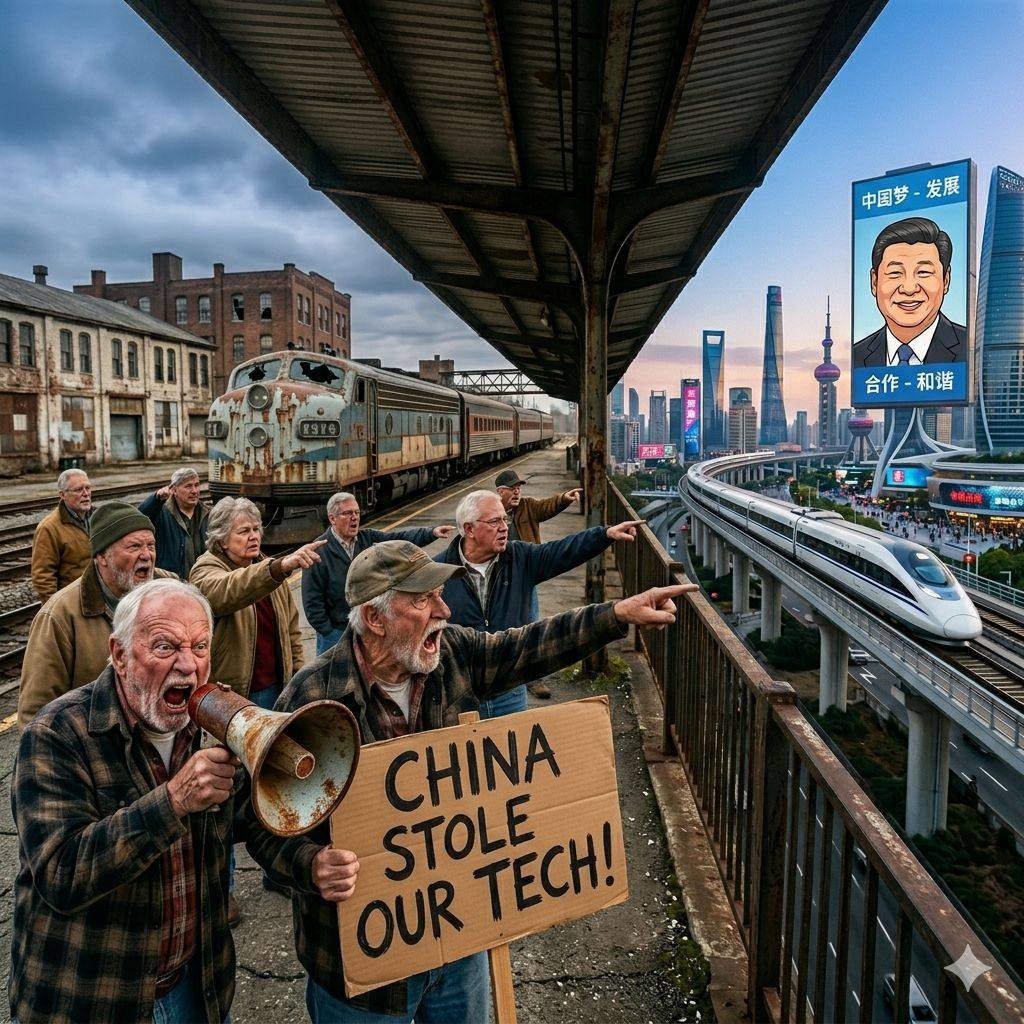
🇨🇳Every time China advances, the same accusation gets thrown around: “They just stole our tech!”
This has been the standard complaint for years. But living here in China, the gap between that narrative and what you actually see every day is hard to ignore.
Yes, in the catch-up stage China studied, licensed and sometimes reverse-engineered foreign technology. Exactly like Japan did after World War II with American cars and electronics. Like South Korea did with Japanese industrial models in the 70s and 80s. Like the United States itself, which borrowed British textile and steam technology in the 19th century. That’s how every late-developing nation has moved forward. No country invents in a vacuum.
The difference is that China didn’t stop at copying. It iterated, scaled and improved at a pace the West hasn’t matched.
Take high-speed rail as an example. Japan, France and Germany pioneered it. China bought the initial trains, absorbed the technology through joint ventures, then built the world’s largest and safest network with over 45,000 km today, more than the rest of the planet combined. Domestic Fuxing trains now run smoother, cheaper and more reliably than the originals. In addition, China exports the entire system to dozens of countries. That’s not theft; that is engineering execution at state scale.
Initially, BYD’s EV designs were influenced by other companies, but they eventually took a completely different approach. Their Blade Battery is safer, longer-lasting and cheaper than what Tesla was using. They vertically integrated everything from raw materials through to final assembly. The result: BYD overtook Tesla in global EV sales volume, now supplies batteries to Tesla’s Berlin plant and leads the world in affordable mass-market electrification. Tesla’s 4680 cells are solid engineering, but BYD’s patent portfolio on batteries is eleven times the size.
Solar panels tell the same story. China turned laboratory curiosities into the cheapest clean energy source on the planet, massive R&D, production scale and relentless incremental efficiency gains. Chinese firms now hold the top efficiency records and over 80 percent of global output. China files nearly half the world’s total patents, leads in 37 of 44 critical technology areas and just cracked the Global Innovation Index top ten for the first time.
For a brief history lesson, ancient China handed the world some of the most consequential inventions in human history.
- Paper, in the second century BC. Printing, eighth to eleventh centuries. Together they turned knowledge from something monks hoarded into something millions could read and pass on.
- Gunpowder, in the ninth century. Ended the age of knights and stone castles.
- The magnetic compass, already in use by the fourth century BC. Without it, no European Age of Exploration. Sailors had no means to cross open oceans.
- Cast iron, two millennia before the West.
- The stirrup, which made heavy cavalry possible.
- The seismograph, back in 132 AD. The world’s first, capable of pinpointing earthquakes hundreds of kilometres away.
- The mechanical clock, porcelain, the decimal system with zero, negative numbers and the list goes on.
These weren’t minor curiosities. These were the true bases that fueled Europe’s subsequent rise. Without Chinese breakthroughs in paper, printing, gunpowder and navigation, there would have been no Renaissance, no Scientific Revolution and no industrial takeoff on the scale the West eventually achieved.
For over a thousand years the Silk Road didn’t just carry silk and spices. It carried ideas and the traffic ran overwhelmingly one way.
Today, China invests more in R&D than any other country, FACT. It also publishes more high-impact papers in key fields and turns ideas into deployed technology faster than anyone.
That’s what real competition looks like when 1.4 billion people decide to lead.
Keep shouting “they stole our tech” if it helps, but this claim is nothing more than copium.
Australia is “disappointed” that a Chinese company is resisting a forced sale of an asset it legally leased for 99 years.
That sentence alone contains the entire colonial operating system.
First, invite foreign capital.
Then, under U.S. pressure, call the same investment a “security threat.”
Then, force the owner to sell.
Then act morally wounded when the owner goes to an international tribunal.
The funniest part?
Darwin Port suddenly needs to be “back in Australian hands” because it sits near U.S. Marines and bomber infrastructure.
So the problem was never China owning a commercial lease.
The problem was Australia turning itself into a forward operating site for another empire, then pretending Chinese resistance is the scandal.
You cannot militarize your coastline for Washington, confiscate a Chinese investor’s rights, and still cosplay as the victim.
That is not sovereignty.
That is colonial muscle memory wearing a parliament badge.