🚨BREAKING: Jensen Huang is discussing a RETURN as Nvidia CEO with allies just days after resigning, per FT.
One ally says Silicon Valley executives are organising a “war room” to lobby Nvidia’s board and seek White House support, with Huang’s backing.
Elon Musk and Epic Games CEO Tim Sweeney have backed a public letter calling for his reinstatement.
But Treasury Secretary Scott Bessent wants a “dramatic shake-up” at Nvidia, while the board’s investigation continues.
No return has been agreed. Nvidia and Huang declined to comment.
McDonald’s is also a real estate business disguised as a fast-food company. Land, properties, rents, and franchises. When Treasury yields and the cost of capital rise, the present value of those cash flows falls and the multiple can compress.
Unfortunately, finance doesn’t just eat Big Macs.
Haltet mich bitte davon ab, mein GESAMTES Vermögen in McDonald’s zu stecken??! 🫠🍔
Es handelt auf 5-Jahres-Tiefs, trotz:
• Umsatz +40%
• Operatives Ergebnis +70%
• 3,2% Dividende (seit 50 Jahren steigend 😳)
• 46.000 Filialen, zu 95% im Franchise
Haut raus… was übersehe ich hier?
You can't make this up.
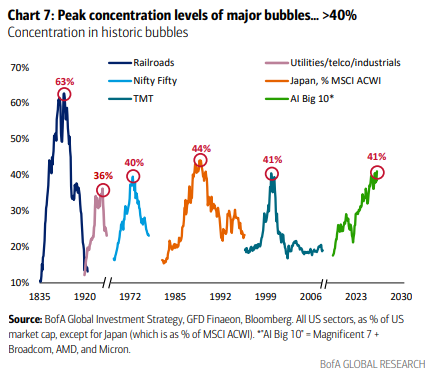
3 of history's biggest stock market bubbles all ended the same way.
Today, the 10 biggest AI stocks make up 41% of the US stock market, per Bank of America.
That's the same level where the dot-com bubble peaked in 2000.
And BofA says each of those past bubbles was ended by a surge in bond yields:
- Nifty Fifty, 1973: US yields jumped 2 percentage points
- Japan, 1989: Japanese yields jumped 2.3 points
- Dot-com, 2000: US yields jumped 2.6 points
In all three, the end came once yields had risen by 2 points or more.
Meanwhile, US 10-year yields are already up 1.27 points since February.
"Quickest way to end US boom is surge in bond yields," BofA writes.
BITGET GOT HACKED FOR ~$350M.
Their wallet infrastructure backend was compromised, with transaction data manipulated to push through fraudulent transfers.
Bitget halted withdrawals as an emergency measure while investigating the incident.
The losses are expected to be fully covered by Bitget’s User Protection Fund, which the exchange says holds more than $464M.
The attack also appears to be linked to the usual suspects: North Korea’s Lazarus Group.
Oil down, bonds up. The market gets a brief reprieve.
But the bigger story hasn’t changed: energy-driven inflation is pushing rate expectations higher, keeping yields elevated and tightening financial conditions.
The sell-off may have paused. The problem hasn’t.
https://t.co/NObQddpo9v
BREAKING: The US 30Y Note Yield rises to 5.44%, its highest level since June 2004.
We are nearing a +500 basis point gain from the 2020 low.
Where is the US Treasury?
This is what a bond market losing confidence looks like.
Japan has been able to carry enormous debt for years, but rising yields change the math very quickly.
The real question is how long the system can absorb higher borrowing costs before something breaks.
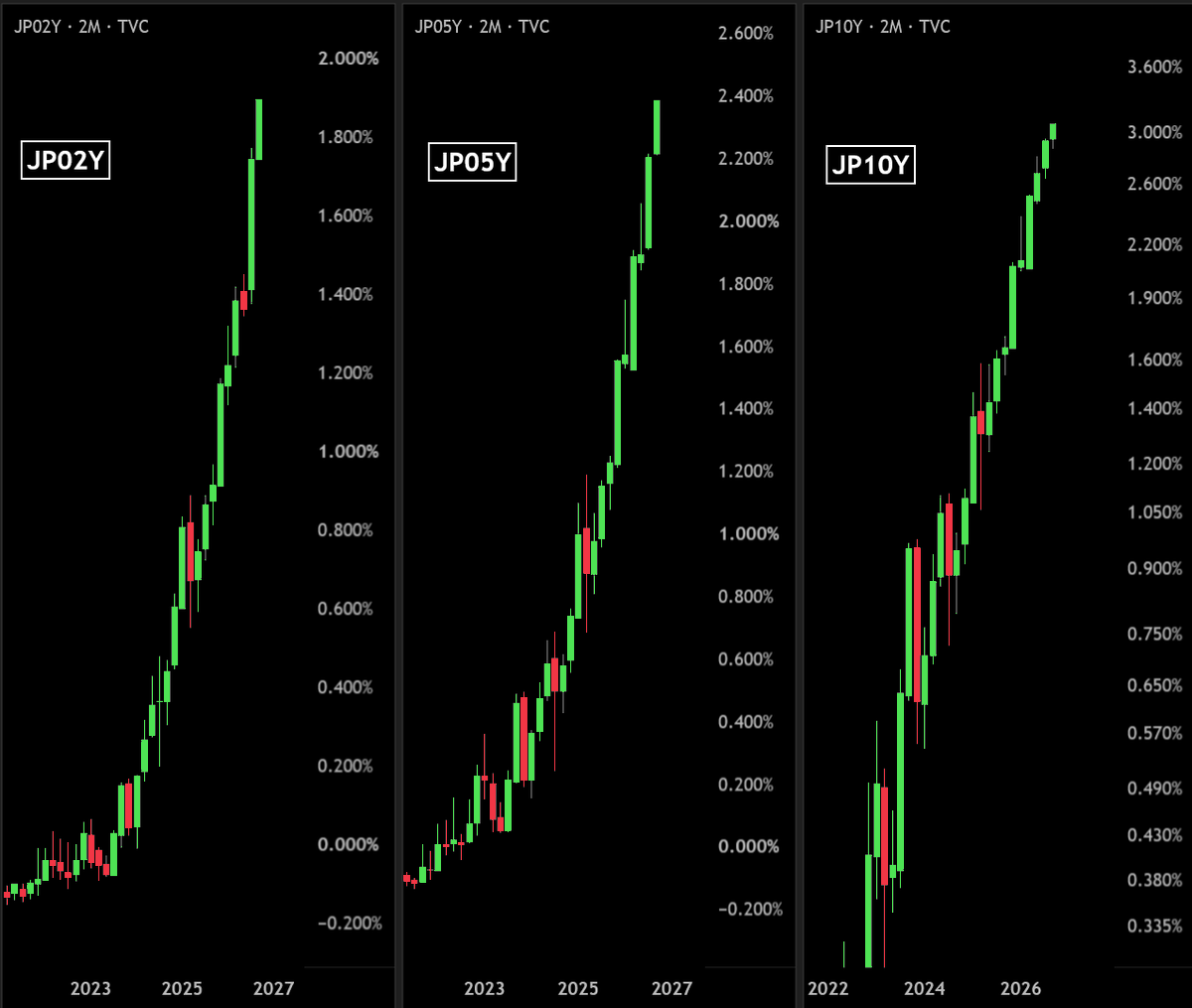
🚨 EVERY COUNTRY IS LOSING CONTROL OF ITS BOND MARKET.
Japan’s 2-year yield just hit a new 31-year high.
The 5-year yield just hit a new 31-year high.
The 10-year yield just hit a new 30-year high.
For one of the most indebted economies in the world, this is very dangerous.
Trump meets Xi today.
The US and China sit down as markets watch closely.
And #Bitcoin is holding.
No panic, no breakdown. Just #BTC absorbing the noise while macro plays out.
Let’s see what comes next.
🚨HUGE: South Korea's $200 BILLION Hanwha has built a tokenized securities platform on Avalanche.
The financial giant developed it ahead of the country's February 2027 rollout, when blockchain records become legally recognized securities registers.
The group is also the LARGEST shareholder in Securitize, the firm behind BlackRock's tokenized fund.
South Korea isn't waiting for the rules, its biggest institutions are already building.