@BenGoldsmith@cashandcarrots Bullshit if you only knew upland farmers follow the same practices as their forefathers. They love their livestock, not because they bring in income, but because they have pride in ensuring the welfare of the animals I’m fed up with ignorant know it alls who have too much money
His father once told him, “Son, farming is in your blood.” 🌾
He believed it with everything he had.
At 26 he took over the family farm — young, hopeful, and ready to work harder than anyone who came before him.
He kept that promise for fifteen years.
Now he’s 41 and looks a decade older.
His hands are split and calloused from the cold. His back seizes up every morning before the day even starts. He’s missed birthdays, school plays, family dinners and anniversaries that can never be replayed.
Every Sunday night his wife does the accounts at the kitchen table.
Last Sunday she sat there for a long time without speaking.
Then she looked up.
“We’re forty thousand pounds down this year.”
After fifteen years of early mornings and late nights, diesel has doubled, fertiliser is up 60%, electricity has tripled… and the price he receives for his wheat is almost exactly what it was in 2015.
He is not lazy.
He is not incompetent.
He is not failing.
The system is failing him.
And every Sunday night his wife still sits at that same table, staring at numbers that only ever seem to get worse.
How long before Britain loses an entire generation of farmers who simply can’t afford to carry on?
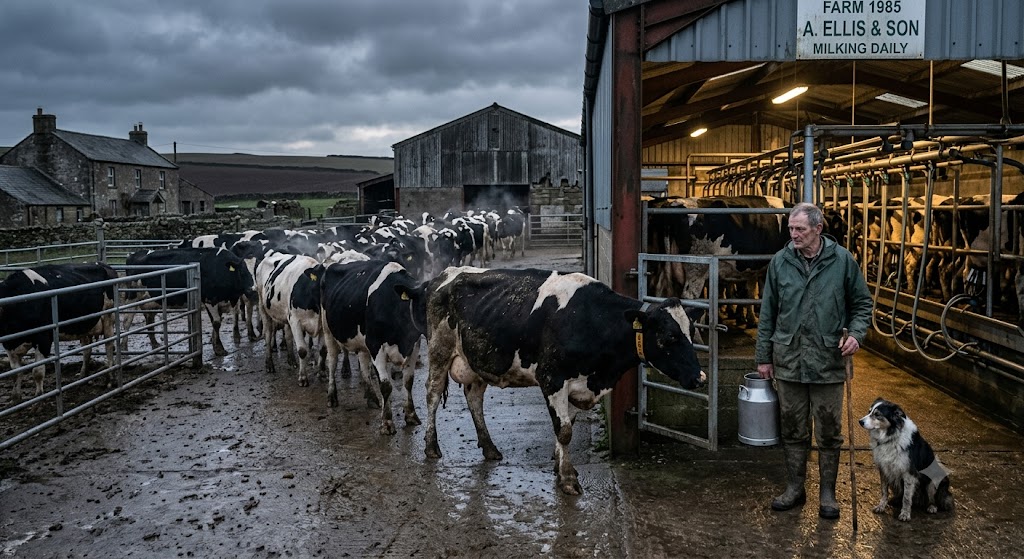
It is a grey morning in 2026. The cows go in for milking at half past five, the same as every morning for forty years. This is the last time.
The herd is a hundred and twenty Friesians. The farmer knows most of them by sight, some by name, and a few by the particular trouble they cause. His father built the parlour. His grandfather bought the first of the land.
He gets forty-four pence a litre for the milk. Two miles away the same milk sells for seventy-two. The maths stopped working three years ago, and he has been farming on his overdraft and his stubbornness ever since.
His father died in the winter. The inheritance tax bill that landed this spring, calculated on land valued by buyers who want it for carbon and have never kept an animal, is more money than the farm has cleared in a decade.
There is no vet within forty minutes any more. The young ones do cats in the town, and the last large-animal practice for miles cut its farm work last year.
He cannot find anyone to take it on. His son saw all of this coming and trained as an engineer, and he does not blame him.
So the cows are sold. The herd that took three generations to build is gone by Friday, loaded into a single line of lorries. The parlour falls silent for the first time since 1985.
The land is bought by a fund that plants it with trees, to offset the emissions of people he will never meet. The barn becomes a holiday let.
And a long way off, a ship is already loaded with the milk that used to come from his field, bound for a country that decided, one reasonable policy at a time, that it would rather not bother making its own.