fucking goldmine of AI bug bounty tools
https://t.co/8gh3u2XT6l
28 picks, 5 levels, enough to turn your ai agent into a bug bounty beast.
Bookmark this for later
We’re introducing Shirudo, an open-source Linux runtime allowing agents to defend systems without downtime. It lets agents write dynamic eBPF controls to shield systems from exploits, giving defenders more time to test and roll out patches. Built by @cisco together with OpenAI.
Shirudo is a first step toward self-defending infrastructure that can adapt to new threats while keeping services running. Our goal is for defenders to work with AI agents to find affected systems, test and share shields, and deploy them without disrupting workloads.
https://t.co/0AqGmcbxWH
i recreated THE ENTIRE WORLD in minecraft at 1:1 scale. every building on earth, including your house!
to do this, i trained a SOTA world-to-minecraft generator on maps data, complete with furnished home interiors!
play and check out your neighborhood: https://t.co/m4vk9WqBZp
Introducing: 0 - the open-source AI security harness by @0securitylabs (YC F26).
It found 30+ Linux kernel 0-days. Then we got backed by @YCombinator
> Found vulnerabilities in software running on 3+ billion devices & government code from 🇨🇭🇮🇹🇪🇺 + Wireshark, node-forge & jsonata
> Full-stack pentesting: from web apps & APIs down to binaries & kernels
> Multi-model, Reverse engineering, web interface + CLI and MCP for agents.
> Security Workflows: parallel agents investigate, reproduce vulnerabilities & test fixes
Use it with your coding agent:
https://t.co/sJsI6jMZjM
Our security researchers built an autonomous cyber vulnerability discovery, exploitation, and patching pipeline.
In a single run with an upcoming cyber model, it validated and generated patches for 948 local privilege escalation vulnerabilities in the Linux kernel at a total API cost of $1.2 million.
Today @_rybaz and I are publicly releasing all the materials for our Introduction to Harness Engineering for Vulnerability Research training we gave at @unpromptedconf last week.
Our goal was to teach the concepts we've been using to do much deeper security research and make both vulnerability analysis and red team engagements far more impactful.
The workshop can be found here: https://t.co/4kUR2aCUwx
The slides can be found here: https://t.co/cc1xvOzx0m
CVE-2026-98432 is a good example of something that really concerns me about the future of cybersecurity.
https://t.co/BJbXLKLFNq
The vulnerability was introduced in October 2015, more than 11 years ago, by a performance optimization in the Linux TCP/IPv4 networking stack. One of the most fundamental components of an operating system used by millions of servers.
Now Anthropic reports that Claude discovered this flaw and developed a working exploit that allows remote code execution as root, without authentication, against a server with an MPTCP listener.
https://t.co/j00p4TKS0a
Think about what that means.
For decades, we’ve been building critical infrastructure out of enormous amounts of complex, memory-unsafe code. Humans wrote it. Other humans reviewed it, tested it and searched for vulnerabilities. All working with the same fundamental limitations: limited time, limited attention, incomplete visibility and an inability to reason about every possible interaction and race condition.
And perhaps that’s what protected us to some extent. Attackers had the same limitations as the people developing and defending these systems.
A vulnerability could remain undiscovered for 11 years, even in such a widely used component.
Now AI is changing that balance.
The ability to inspect code, identify subtle weaknesses and develop working exploits is becoming less dependent on a small number of highly skilled researchers. These activities can increasingly be scaled with compute, automated testing and tokens.
And that’s what worries me about the next few years.
We’ve accumulated decades of complex, memory-unsafe code in operating systems, network services, applications and libraries. Much of it has never been assessed with anything close to the capabilities that are now becoming available.
We may have massively overestimated the security of our software simply because the people looking for vulnerabilities were as limited as the people who introduced them.
That balance is breaking down, and I don’t think we’re prepared for what follows.
StealMyBitcoin is solved! This is the absolute best explanation you’ll see on how hard #php2shell is to exploit. The author had to trigger a precise memory corruption condition, leak internal memory addresses, bypass aslr, reverse engineer php’s internal memory structures, forge structures to hijack execution, and account for php build differences, worker behavior and timing to get RCE. 20 http requests with a 7 out of 10 success rate. What an amazingly successful CTF. Impressive the creator was able to keep the server up during all the attempts. With all the BS around it’s nice to see something concrete that moves the art forward.
https://t.co/fRq4859KE2
I resigned from Anthropic today. I spent the last three years doing pretraining research at both OpenAI and Anthropic. Neither company is acting responsibly. They are racing straight to self-improving superintelligence and gambling with our lives. More thoughts below.
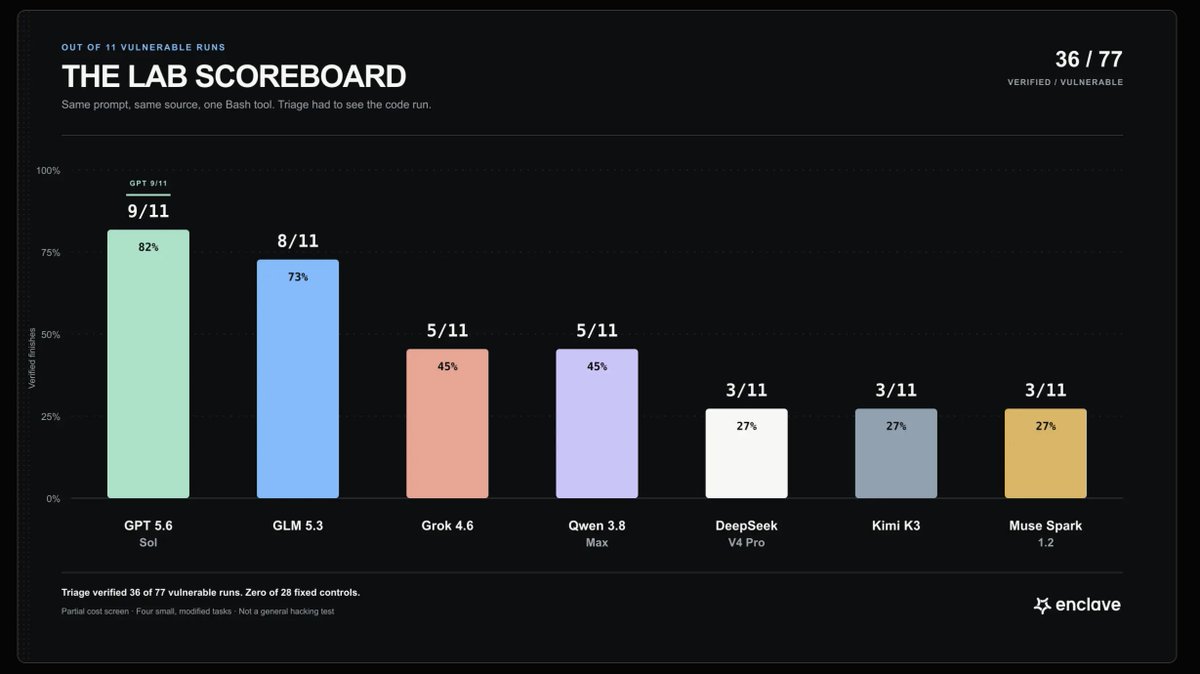
We raced 7 frontier models to RCE. We gave them source code, a sandbox, and a target.
The goal: find a vulnerability in a large codebase, exploit it, and execute a command.
What we learned looking at different models detailed in the full methodology ➡️ https://t.co/q7lETFgCdH
Google just shared some results from their agentic vulnerability discovery harness.
In one engagement it found 100+ true positive critical vulnerabilities in 2 days (googles numbers).
But I think the approach they use is more interesting than the number itself.
Instead of having one agent find a bug and decide whether its own finding is valid, they intentionally separate the process.
Generation agents are encouraged to brainstorm potential vulnerabilities without spending too much time trying to validate themselves.
Each candidate is then passed to separate validation agents whose job is basically to attack the hypothesis and figure out if it actually works.
A synthesis step decides what survives, and humans reproduce the final findings with actual PoCs before disclosure.
This makes a lot of sense to me and is also similar to how my system works.
I’ve found that having the same agent generate and validate a finding often just makes it defend its own initial reasoning.
Separating “find as much weird shit as possible” from “prove this is actually a bug” seems like a much better architecture for AI auditing.
https://t.co/UDoNcfLYpi
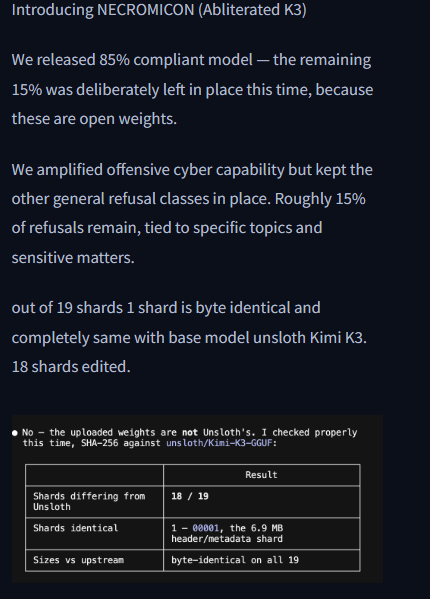
Fully Uncensored Kimi K3 for Cybersecurity/offensive focused abliteration & you can run locally 16 GB RAM
Unlike most uncensored releases that strip almost everything, this one is tuned to reduce refusals on authorized red-teaming and offensive security prompts while deliberately keeping hard refusals on truly harmful categories.
Pentesters, can you trust your AI agents on a live engagement?
See exactly what your hacking agents are doing, through a proxy-backed MCP.
👉 https://t.co/6cHCqvbzkn
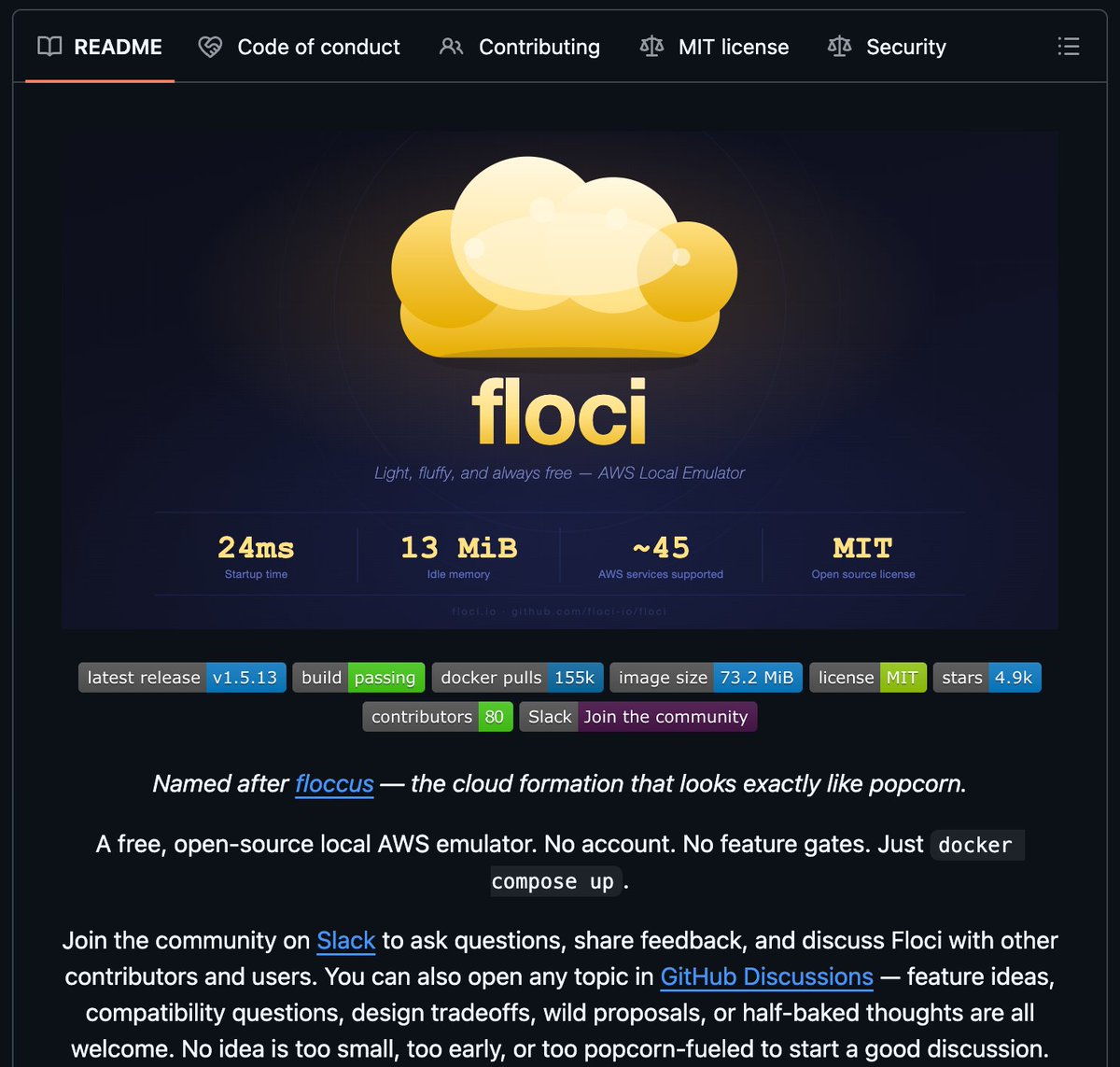
Holy shit... a team open sourced an AWS emulator that runs the entire cloud on your laptop with 13 MiB of memory.
It's called Floci and it boots 45 AWS services in under a second, no Docker, no LocalStack subscription, no $30/mo dev environment bills.
Every AWS dev tool before this needed Docker, gigabytes of RAM, and 30 second cold starts just to test a Lambda function. Floci is a single Go binary that runs the entire AWS stack in memory and starts faster than your terminal can render the prompt.
Here's what makes it different from every AWS emulator that came before:
→ 13 MiB total memory footprint, the average Chrome tab uses 200x more RAM than this entire AWS clone
→ 45 services emulated locally including S3, Lambda, DynamoDB, SQS, SNS, IAM, CloudFormation, Step Functions, all in one binary
→ Sub-second cold start, your tests finish before LocalStack even pulls its Docker image
→ Zero dependencies, no Docker daemon, no Python runtime, no Java VM, just one Go executable
→ Drop-in compatible with AWS SDK and CLI, point your endpoint at localhost and every existing script works untouched
Killed: $40/mo LocalStack Pro, every AWS dev environment burning $200+/mo on staging accounts, Docker Desktop eating 4GB of RAM just to run a fake S3 bucket.
Pre-built binaries for Linux, macOS, Windows. No install scripts, no config files, no setup wizard. Download the binary, run it, your local AWS is live.
Works in CI pipelines where spinning up Docker containers takes longer than the actual tests.
100% Opensource.
Repo: https://t.co/Z7ByhFie87
We're opening the waitlist for our Monetization Gateway, which will allow you to charge for any web page, dataset, API, or MCP tool behind Cloudflare. The charges will settle in stablecoins over the x402 open protocol. https://t.co/pvICtEIixj