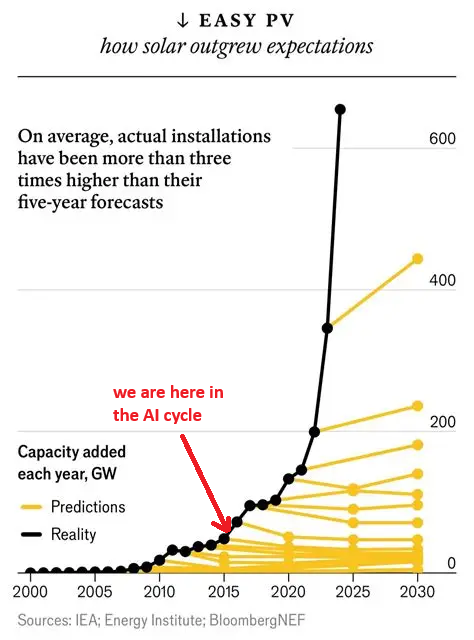
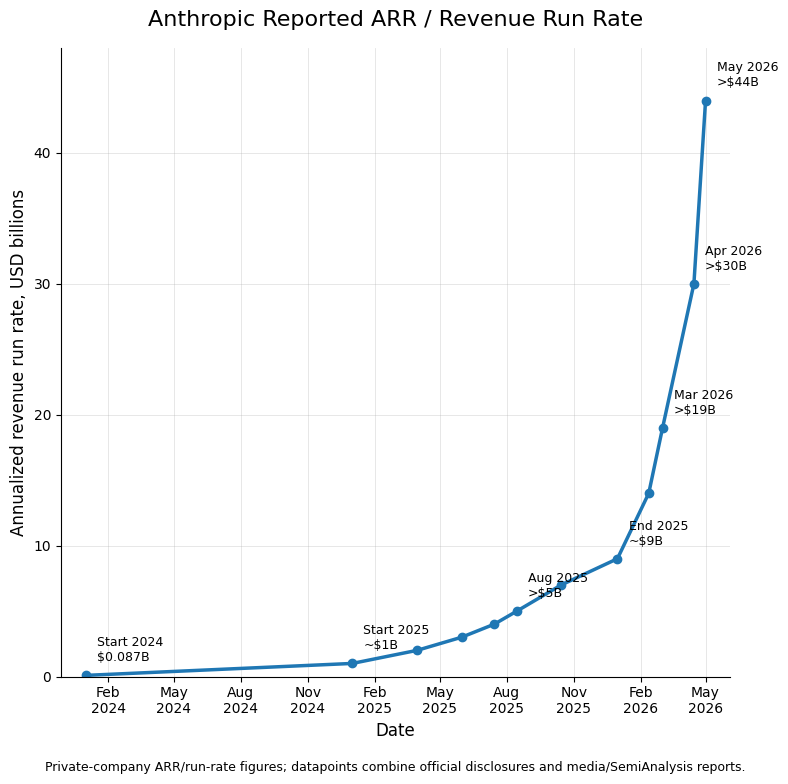
November 2025 changed everything for me
Claude 4 and GPT-5 weren't really amazing and my expectation was that we are likely in a slower timeline. But then Opus 4.5 came out.
Since then every new model and revenue report has just reinforced this new world-view that we are still early and everyone is constantly underestimating it
Predictions that were ridiculously bullish a year ago, 6 months ago or even 3 months ago were underestimates
If you want to call the top on the AI bubble, then go ahead, but to me this seems like shorting Moore's Law in 1970
As long as revenue and compute keeps growing it seems delusional to try to call a top
TypeScript 6.0 is now available!
This release brings better type-checking for methods, new standard library features, new module features for Node.js, and more!
But most important, this release brings us one step closer to the upcoming native-speed 7.0!
https://t.co/hon0RU1L5B
Introducing Database Traffic Control: a Postgres traffic management system built into PlanetScale.
Enforce flexible budgets on your database traffic to protect against unexpected and dangerous workloads.
2025 was the year agents became a thing. 2026 is where the impact starts to become tangible. Real productivity boosts coupled with price drops and layoffs. 2027 will only accelerate this trend as the impact spreads to slower-adopting industries.
Sufficiently advanced agentic coding is essentially machine learning: the engineer sets up the optimization goal as well as some constraints on the search space (the spec and its tests), then an optimization process (coding agents) iterates until the goal is reached.
The result is a blackbox model (the generated codebase): an artifact that performs the task, that you deploy without ever inspecting its internal logic, just as we ignore individual weights in a neural network.
This implies that all classic issues encountered in ML will soon become problems for agentic coding: overfitting to the spec, Clever Hans shortcuts that don't generalize outside the tests, data leakage, concept drift, etc.
I would also ask: what will be the Keras of agentic coding? What will be the optimal set of high-level abstractions that allow humans to steer codebase 'training' with minimal cognitive overhead?