Longevity medicine needs more than new tools- it needs a way to think clearly about them.
As a primary care physician, I’m working on a framework to evaluate interventions and measurements.
Not as a researcher, but as the one who applies them in practice.
Will share process.
One thing I notice both in clinic and in myself-
People often know what would improve their health.
The harder part is having enough mental bandwidth, energy, sleep, stability, and consistency to actually implement it for years.
@gregogallagher This is interesting, but cross-trial comparisons can be very misleading.
Different study populations, protocols, titration schedules, durations, and measurement methods make it hard to draw strong conclusions.
A proper head-to-head trial would tell us much more.
@icorvilud Inclisiran makes me think about the gap between what we can biologically achieve and what healthcare systems can realistically deliver at scale..
In many places, patients gain access only after established ASCVD- when ideally we’d want to prevent the first event, not the second.
@LxngevityLab This is where context matters enormously..
Why was he taking it? How aggressively was it titrated? Was he medically supervised?
I suspect the experience of someone with severe metabolic disease differs greatly from someone pushing these drugs toward the edge for optimization.
A 47-year-old patient asked me today about ginkgo biloba for cognitive enhancement.
Sedentary, abdominal adiposity, low fitness.
Made me think how often we look for cognitive optimization in supplements before addressing major metabolic and vascular inputs affecting the brain.
@pesottas I sometimes wonder how much of today’s “longevity” industry is actually wellness, prevention, and cardiometabolic optimization rebranded.
Important and valuable work, but distinct from truly understanding and modifying biological aging itself.
@Cerebrum_DAO Most dementia-prevention advice is already known.
The hard part is sustaining sleep, activity, metabolic health, and social engagement across decades of real life stress and aging.
Makes me wonder whether the future breakthroughs are biological, or behavioral.
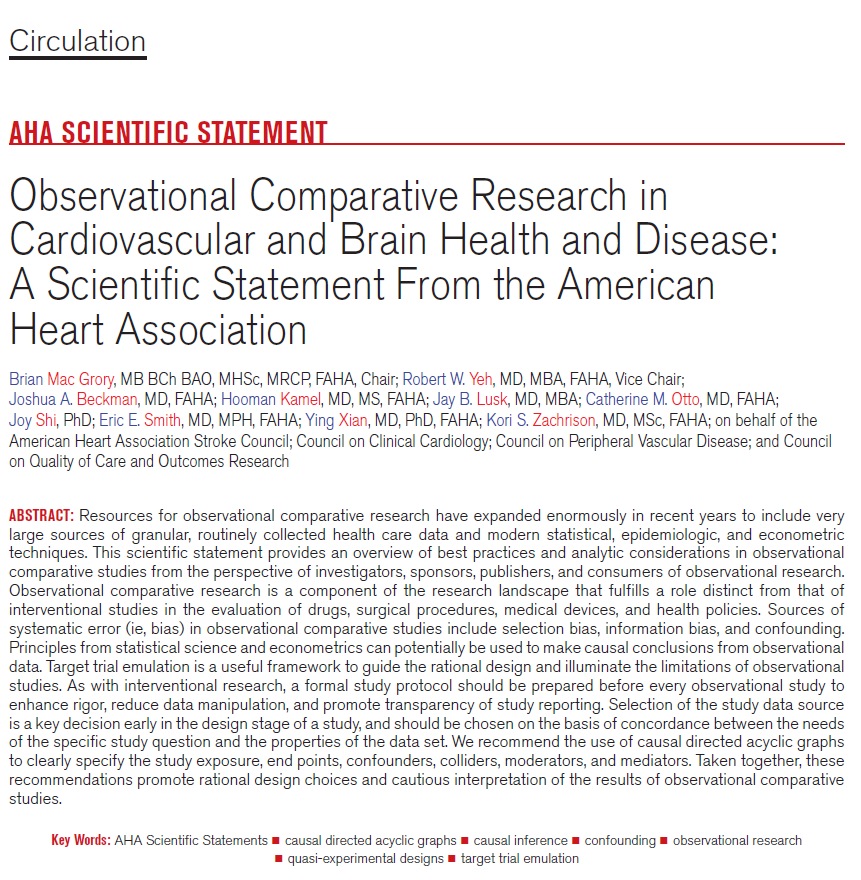
A huge amount of modern longevity/cardiometabolic discussion is built on observational studies.
Understanding confounding, selection bias, and causal inference becomes essential.. otherwise it’s very easy to overestimate what the data are actually showing.
This scientific statement provides an overview of best practices and analytic considerations in observational comparative studies from the perspective of investigators, sponsors, publishers, and consumers of observational research and is applicable to all areas of cardiovascular, stroke and brain health research.
✍🏼 @brianmacgrory@joshuabeckmanmd@joy_shi1@rwyeh@YingXian21
I understand why people with chronic disease experiment with diet, supplements etc.
Sometimes they truly feel better.
But symptom improvement and disease control aren’t always the same thing.
Had a Crohn’s patient who felt “in remission” while still progressing toward surgery.
Methylene blue is a fascinating example of the tension inside longevity medicine.
Mechanistic rationale, animal data, anecdotes, medical uses- but limited clinical evidence in healthy people, plus real interaction/safety questions.
Much harder than “works” or “doesn’t work.”
Yesterday I attended a lecture discussing inclisiran, LDL lowering, ApoB, etc.
It made me reflect on how different online longevity/cardiometabolic discourse can feel from mainstream clinical practice.
Sometimes I wonder where good self-study ends and echo chambers begin.
@davidasinclair And even when the information becomes accessible, translating it into something usable in real-world clinical practice is still incredibly hard.. Especially in longevity medicine, where evidence, mechanisms, uncertainty, and hype all mix together.
@houmanhemmati As a PCP, what stands out to me is the possibility of bypassing one of medicine’s biggest bottlenecks- adherence.
If therapies like this end up safe and reversible, the impact on obesity and cardiometabolic disease at scale could be enormous.
@rkwadhera One of the humbling parts of primary care is realizing that even after MI or CABG, adherence often remains poor.
People still stop aspirin, LLT, BP meds, smoking cessation efforts, follow-up..
Human behavior turns out to be far more complex than guidelines.
@EricTopol I don’t think most people interested in longevity medicine want “more years at any cost.”
In clinic, what patients fear most is frailty, fatigue, dependence, immobility, cognitive decline.
The goal is extending healthy, functional years- not just prolonging unhealthy ones.
Came across a biohacking database aggregating thousands of self-reported experiences, stacks, side effects, and interactions.
Uses AI to mine patterns, with human review in some cases.
Not clinical evidence, but fascinating as a proof of concept. (Link in replies)
@joeyyochheim What’s interesting is that many patients aren’t lying when they say they “hardly eat.”
They’re remembering hunger, restraint, and effort during the week- not total intake across the environment shift that happens on weekends..
It changed how I think about obesity counseling.
Saw a woman in her 60s today on long-term HRT.
What struck me wasn’t just appearance- it was function. Energy, movement, vitality. She looked biologically younger than many patients a decade below her.
Makes me think we still under-discuss HRT in appropriately selected patients
AI makes it tempting to skip foundations and jump straight to outputs.
But the more I use these tools in medicine, the more obvious it becomes that foundational knowledge changes the quality of the interaction entirely.
The difference shows up fast.
💬 Viewpoint: Integration of #AI in medicine risks “never skilling” for trainees; deliberate design—such as commit-then-compare, AI coaching, and AI-free zones—is needed to support clinical expertise development.
https://t.co/HeXgOatLUW