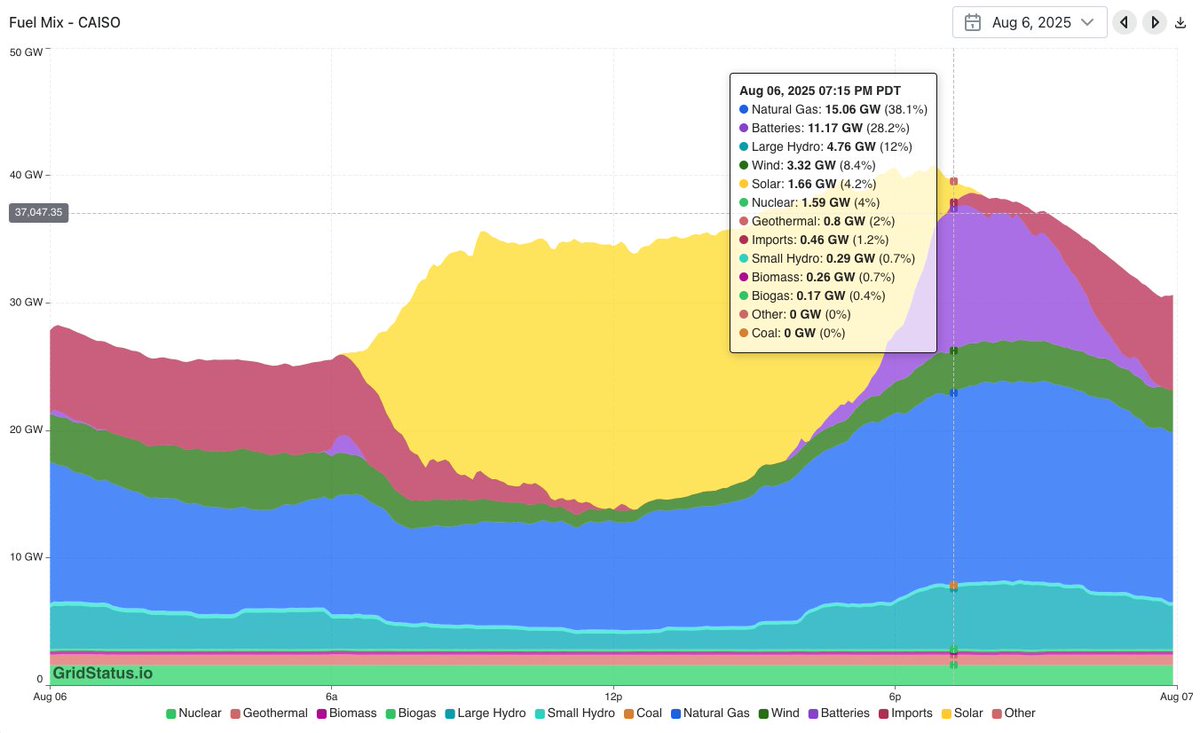
Yesterday, California reached a new record for battery output, surpassing 11 GW for the first time.
At 7:15 PM, California's grid scale batteries discharged 11.17 GW, meeting 28.2% of grid power demand ⚡️
California is enjoying midday solar power in the evening ☀️
This is a myth that keeps getting repeated that interconnection studies are taking years, as if RTO/ISO staff are slacking and/or biased against new resources.
Interconnection studies are fast. The reason interconnection itself takes years is because of cost allocation. Developers are given the flexibility to change the project once study results come back, some projects drop out of the queue, which means re-doing the study, and on and on. The interaction b/w different projects and level of precision for cost causality + cost causation is driving time in the process. It’s not core engineering time, it’s restudy time.
If developers gave away the right to change anything about their project once submitted it would be faster, guess how many are willing to sign up to that?
The PJM and SPP CEOs both explained this during the FERC resource adequacy conference last month in response to Commissioner Qs. The bottleneck is building transmission and cost allocation for network upgrades.
Connect and Manage you say?
Great, you kick the can down the road but as the NYISO CEO explained, that would shorten the ISO process but shift the burden to the transmission owner process. Or as the CAISO CEO put it, what we actually need is not faster studies but proactive transmission planning. Proactive tx planning is for the states, guess how many of them are all in on building more transmission? And can permit it?
Final word to Chairman Christie who said at the conference in response to all this "if you ask two economists how they are going to get out of a hole they will say assume you have a ladder."
@tylerhnorris@SPPorg This is very interesting. There is so much efficiency in doing studies in a cluster. I wonder if that has been considered. Not sure if data centers would be interested in curtailable service. All the applications I’ve seen so far ask for a redundant service.
My 4 yo said I love you to me for the first time. He has always been affectionate, giving me hugs and kisses everyday but somehow this melted my heart just as much. #SaturdayMorning
🚨Paper Alert!🚨 Excited to be coauthor looking at what makes for successful transmission projects! We looked at proposed, cancelled and built transmissionprojects over the past 20 years and ran it through a machine learning algorithm looking for trends! https://t.co/FveUt55jWG
FERC Order 2023-A states that the readiness requirements in Order 2023 would be applicable to all queued projects without an executed LGIA or that have not filed an unexecuted LGIA. This is for TPs that have a cluster process. WOW #transmission
@JesseJenkins@DrewSmithee@MattEinberger@ClaireWayner ISO, CPUC and the TOs and come up with best places to site. If a public org publishes 5 best POIs to interconnect, we’re most likely going to end up with atleast 10’s of apps at each point making the “best POI” title moot.
@JesseJenkins@DrewSmithee@MattEinberger@ClaireWayner Utilities have a lot of challenges as it is in maintaining their older assets, they need significant capital for maintaining the system, fireproofing the system, and funding the existing upgrades. I would think developers could fund studying the available data published by the
@tylerhnorris@jacob_mays@MattEinberger@ClaireWayner CA has a Transmission Planning Process where multiple upgrades are identified. There is still a huge no. of gen. applications though that trigger multiple system network upgrades. I’m curious how system upgrades can be identified in advance & would love to know how that’s done.
@tylerhnorris@jacob_mays@MattEinberger@ClaireWayner System/ deep network upgrades depend on how much MW is interconnecting in any given study area. I can probably assume some number and develop upgrades based on that, but there’s no guarantee that actual no. of applications will match that.
@jacob_mays@MattEinberger@ClaireWayner That would be too dangerous when considering grid reliability and generators wouldn’t know how much they could be curtailed before they come online.