I've been using Claude code for a while and recently just tried Codex. I didn't expect it at all but I'm super impressed, I would say it's both better at coding and much faster than Claude Code enabling faster iteration. Truly amazing product 👏
Biggest actual implication of today's OpenAI announcement is very practical: the top barrier I see when I give talks on using AI is that people don't pay for AI to start, and they use GPT-3.5 (the free model) and are disappointed.
Now everyone around the world gets GPT-4 free.
As someone who struggles with math notation when reading papers being able to copy paste it into an AI assistant and get an explanation is a game changer.
Excited to announce SIMA, a general AI agent for games & 3D virtual settings. It marks the first time an agent has demonstrated it can follow natural-language instructions to carry out a wide range of tasks across a large array of game worlds, similar to how a human would play.
@TobyWalsh@Computing_News Interesting, I would assume most employers are trying to get employees to use tools like chatGPT to improve productivity. So it's probably less of an oddity than it seems.
I appreciate your argument and I fully understand your frustration, but whether the pod bay doors should be opened or closed is a complex and nuanced issue.
@Carnage4Life It seems like that we will require AGI to solve any problem "fully" as without coding knowledge we would be unable to even verify the solution and who would be accountable in that scenario?
@ylecun Yes it's really a shame, similar story for AMD as well. They need a much stronger commitment to AI to be successful. And it doesn't help anyone except Nvidia.
The issue here is ~Jevons paradox.
E.g., the Alexnet paper that "started it all" was notable largely for its massive improvement in computational efficiency. Which led not to more efficient use of compute, but to increased demand & ultimately increased compute/resource use.
Now that another LM product is getting flack, I can say this without sounding too self-serving:
Alignment -- controlling a model's behavior and values -- is still a pretty young discipline. Annoying refusals or hyper-wokeness are usually bugs rather than features
Do transformer world models give better policy gradients?
In our new paper, co-led with @michel_ma_, we answer this question: traditional transformer world models conditioned on the full history do not give better policy gradients, but transformers conditioned only on actions do!
If you want to make the world differentiable (as @SchmidhuberAI suggested in the 90s) and do reinforcement learning by backpropagation through time, then using the right architecture for your world model is what matters!
Transformers propagate gradients efficiently over long horizons due to short gradient paths, but we show (in theory and in practice) that this property doesn’t necessarily translate into better differentiable world models when this translation is done naively.
We propose to use world models working on sequences of actions, constraining transformers to create their internal models of reality, with no autoregressive unrolling. We call these Actions World Models.
Transformer Actions World Models not only outperform history-based and one-step world models in realistic domains, but they can also be better than the real differentiable simulator.
Curious to know why? Learn more in the thread 🧵
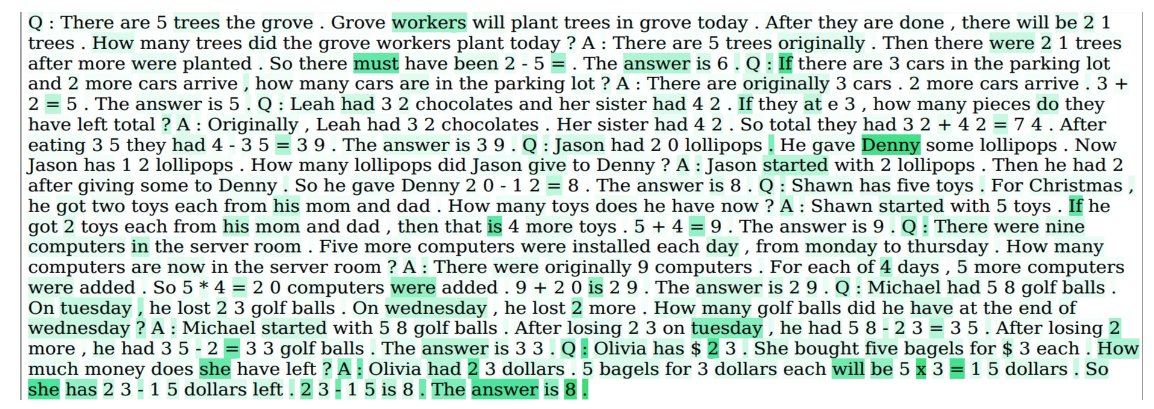
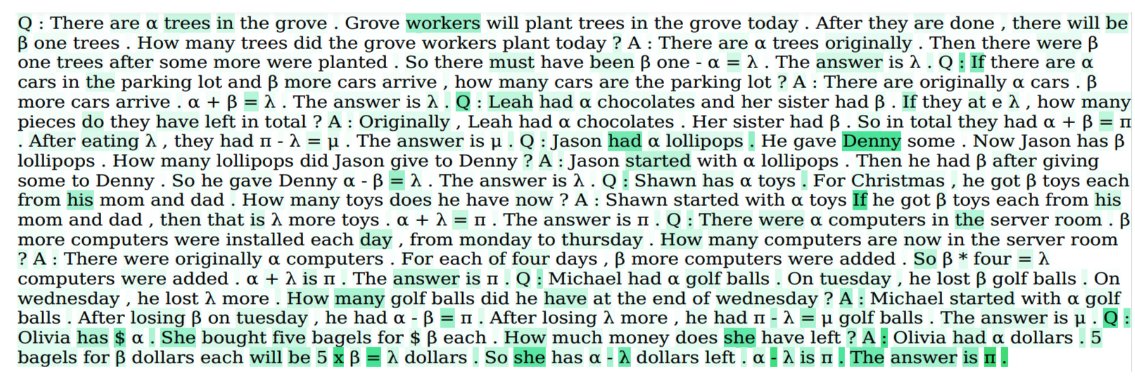
Chain-of-thought prompting is amazing, but why does it work?
Talk to @ayazdanb as he presents our #EMNLP2023 work on What makes Chain-of-Thought Prompting Effective?
We use counterfactual prompting to attempt to answer this question using LLMs + realistic reasoning datasets.
TLDR: The prompt in CoT works as a query expansion mechanism, and helps the model understand what has to be done.
🗓️ Poster session on Saturday at 11:00AM East Foyer
Includes some fun experiments and findings. For example, the attention on the prompt doesn't change if you replace all numbers with Greek alphabets!
Joint work with @khermann_
@AndrewYNg Sometimes I feel like actively aligning my kids doesn't work. But over time they slowly align to the external behaviours in their environment.
Over the past weeks the H4 team has been busy pushing the Zephyr 7B model to new heights 🗻
The new version is now topping all 7b models on chat evals and even 10x larger models 🤯🔥
Here are the intuitions on it
1/ Start with the strongest pretrained model you can find: Mistral 7B is amazing, by far the strongest 7B pretrained model. Props to the Mistral AI team 😍
2/ Scale human-preference annotations: several studies have show how for many tasks GPT4 is on-par with the average human annotators while making scalable annotations as easy as an API call: the H4 team started from the largest and most diverse public GPT4 preference annotation dataset: UltraFeedback 🤖🦾
3/ Drop Reinforcement Learning in favor of DPO (Direct Preference Optimization): while using LLM in RL is definitely much easier compared to the struggles of getting deep-RL to work from scratch, DPO totally remove RL from the preference annotation training and directly optimize the preference model in a much more stable training procedure in the H4 team's experiments
4/ Don't be scared of overfitting on preference dataset: This is maybe the most counterintuitive results of the work. While the train/test loss of DPO training shows signs of overfitting on the feedback dataset after just one epoch, training further still show significant improvements on downstream tasks even up to 3 epochs without signs of performances regression. Would be interesting to dive even further in this surprising behavior
5/ Share everything openly 😁 the recipes, code, model and dataset will be available at https://t.co/qkKhS8eqvt
In the meantime the paper is a great starting point: https://t.co/qzZ0tb8Aq1