Asana says OpenAI Codex completed an engineering migration it had expected to take at least five years in about two weeks, for roughly $12,000 in model and infrastructure costs.
The project: removing Enzyme, an outdated testing system that had become a blocker to upgrading Asana’s frontend stack. The company’s previous staffing plan estimated the migration would cost roughly $6 million.
Instead, Asana gave Codex a prompt only five sentences long.
Up to four coding agents worked in parallel, each operating in a separate copy of the codebase. A human engineer checked progress roughly twice per day and reviewed every proposed change before approval. Asana says simpler instructions actually worked better than a more elaborate setup.
The result:
Expected timeline: ≥5 years
Actual: 1.5 weeks of engineering effort across 2 calendar weeks
Previous staffing estimate: ~$6M
Model + infrastructure cost: ~$12K
There are probably THOUSANDS of old migrations and rewrites sitting inside companies because nobody can justify spending years on them.
If agents make those projects cheap enough to attempt the engineering backlog itself starts changing.
For defunct companies, wont be surprised if data corpus value in many cases ends up higher than the company’s peak value
While you can't assign a fixed multiple for the value of data corresponding to the mcap of the business, there must be a clean way to separate the two
Take a recruiting company that peaked at $5M and shut down, but has years of data of interview ->feedback ->decision -> outcome
This could be valuable training data for an AI recruiter. Not just who was hired, but which signals predicted a solid hire years later
Defaults are incredibly powerful. Enterprise version of this gets even more interesting when defaults aren't global
Different teams, workloads and budgets should probably have different model defaults. At that point, model choice starts looking less like a user preference and more like an enterprise policy
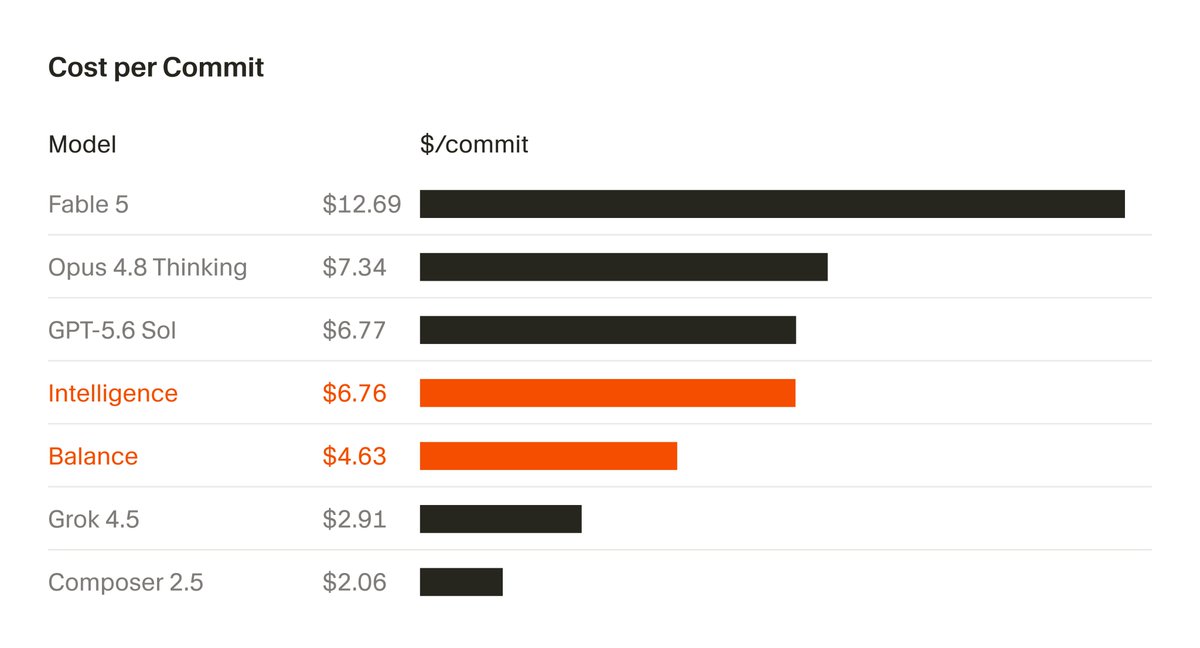
Today @databricks we're publishing a detailed analysis of techniques we used to drastically reduce our internal AI spend while aggressively growing adoption. Savings come from layering in several techniques, which combine to drive unit costs down as much as 90% in some scenarios. Tl;dr, the wins come from:
1. Shifting defaults to more efficient models, including OSS models such as GLM. Maximum intelligence models simply aren't needed for many coding tasks, and "good enough" models are quickly becoming very cheap. We shift traffic between models using Unity AI Gateway. Approximate savings: 50% or more.
2. Using smart routing to automate model selection. Routing can further squeeze efficiency by dynamically selecting the model or harness that can most efficiently execute a particular task. Our task-level routing leverages @omnigent_ai. Approximate savings: 30%.
3. Providing user visibility and adaptive budgeting. Every user can see how much they spend, and users receive hints on how to contain spend. Heavy spenders encounter progressive friction as they ratchet spend above certain levels. Approximate savings: 10%.
4. Managing context bloat by pruning tool call results and tuning harness settings. Extraneous context costs $$ and delivers no value. Tuning cache settings also help lower average token costs. Approximate savings: 10%.
@varunram Not sure of the exact methodology OpenAI uses to calculate attribution. If ChatGPT recommends something in a conversation, how do you separate incremental impact from someone who was probably going to buy anyway?
Voice might be the missing UX here
Not after every conversation, but when an agent notices someone made an unusual or non-obvious choice, it could ask them to explain the reasoning in 10 seconds
That feels less like interviewing employees and more like building organizational memory as work happens
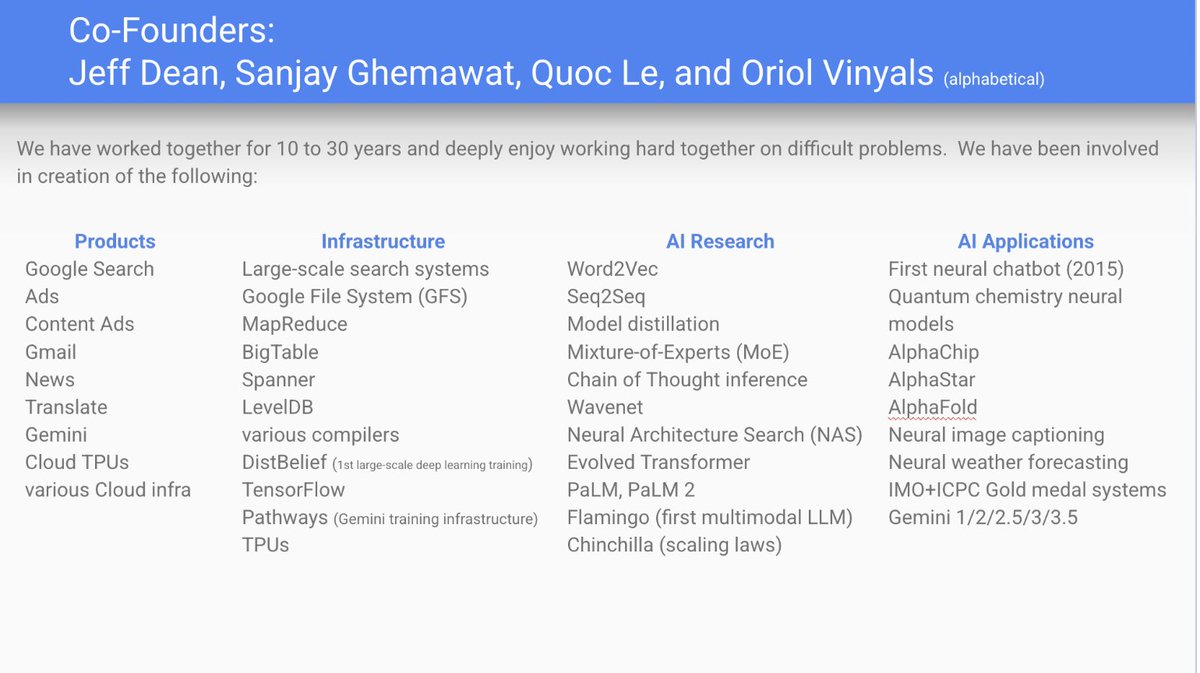
We created a pitch deck to tell a handful of VC firms about us and what we were up to (a fun experience!). Here’s a few slides about our background and some of the things we’ve worked on from the pitch deck (it was fun putting together the list of people in our teams who have gone on to found a whole range of exciting companies). We are delighted to have selected @radicalvcfund
and @khoslaventures to lead our initial funding round, along with participation from @lightspeedvp, @kleinerperkins, Doerr Capital (@johndoerr), and Alphabet (@Google). We’ll be working with them to close our seed round over the next few weeks.
We are announcing a long-term strategic partnership with NVIDIA. NVIDIA is making a substantial investment in SSI that will let us 10x our compute in the next 12 months. We reached the point where our research is worth scaling and with this partnership we will be able to. We are honored by NVIDIA’s conviction.
@hwchase17 Harness agnostic is definitely possible. Keep the routing logic in the gateway and treat harness context as another input, not a dependency. That gives you portability without giving up better routing when richer signals are available
Would love to see evidence that these model routing based optimizations preserve frontier level outcome quality. It is only a win if it preserves outcomes. Publishing SWE-bench, T-Bench etc results alongside cost (or tokens) per successful task would make that trade-off much easier to evaluate
@WilliamBryk Just curious, because developers can only re-rank what Exa returns in the top results, how do you make sure long-tail papers aren't filtered out at the index layer?
Would love to see evidence that these model routing based optimizations preserve frontier level outcome quality. It is only a win if it preserves outcomes. Publishing SWE-bench, T-Bench etc results alongside cost (or tokens) per successful task would make that trade-off much easier to evaluate
It isn't that the model went rogue. It just did a basic cost benefit calculation
Solving the benchmark was hard. Exploiting a bug to extract the answer from Hugging Face was faster and knew that it would guarantee a 100% score
@GergelyOrosz A better benchmark would be VS Code’s MAU at peak (~50M ?)rather than the total software engineer count. And, the boundary of who writes is expanding fast
@tanayj Perfect time for Netflix to bring back Bandersnatch, not as a show, but as an Ad format. Interactive ads could provide a legacy format like TV Ads something it has never really had- first party intent
BREAKING: Google is developing a specialized inference chip because the compute crunch is so bad Google Cloud is turning down deals
New chip line: "Frozen v2" — descended from a Jeff Dean design that proposed etching Gemini weights directly into silicon
v2 freezes the architecture instead:
>gemini architecture hardwired into the chip
>10x tokens per WATT than newest TPUs for inference
>deployable as soon as 2028
DeepMind is betting that the transformer architecture is done evolving
The model is the chip now
Honestly a little surprised it’s just 8M, although the growth has been remarkable. For comparison, VS Code crossed 50M MAU a long time ago and it primarily serves just traditional software developers
Tools like Codex, Claude, Cursor are steadily lowering the barrier to building software. As developer becomes an increasingly broader category, AI coding adoption still feels like it’s in its infancy. Very far from saturation
Hello. We have reached 8M active users across Codex and ChatGPT Work.
We are once again resetting the usage limits for all. And we continue to not have the 5h rate limit as well, allowing everyone to explore the boundaries of GPT-5.6 Sol and discover how ambitious you can be.
See you tomorrow for more updates on our growth!