The blank orbital data on space-track's satcat page for 2026-130 have now been filled in showing 198 x 199 km x 40 deg and 189 x 204 km x 40 deg for the two objects. No actual TLE/GP data, at least so far
@manfightdragon The cover for the game store copy for bio shock had some pretty evil residents on the front
I gave it some thought again a month or so ago and have never felt dumber
Have you ever wanted to have your name 'Roman' a million miles away?
Now you can! Send your name along the Nancy Grace Roman Space Telescope, scheduled to launch Aug. 30, 2026!
Sign up here: https://t.co/mSLkvPLgVB
Submissions close July 12.
Some reading for your SpaceX IPO day!
After feedback from my followers here I updated this infographic. Earth observation I had left out because I simply forgot, it definitely belongs in there as a developed part of the space economy.
Human spaceflight I kind of implicitly assumed as being part of launch, but now its here directly. I put it in the "developing" category because, while we have been putting people into space for over 60 years, orbital human spaceflight remains a rare, risky endeavour which you have to do a significant amount of training for. We are a way off being able to step on a rocket like you step on an aeroplane.
What do you think? Any more changes needed?
Read the full article: https://t.co/leekjxZ4li
Every social media post about autism has a bit of selection bias. Its not full right, but I read this as an autist and my response is "skill issue".
I mean yes we have symptoms, doesn't stop us from this thing called learning from errors.
@CandorDier@mikusingularity A lot of the benefits of the apollo programme we thing we did not know we'd get coming in. tackling hard problems will lead to solutions that have a good chance of benefiting the public
I've seen a lot of people saying that AI datacentres in space will not work due to the thermal energy from the GPUs.
So, I went and actually did some calculations to see how easy it would be to cool down these satellites.
(Spoiler: these satellites will work)
CALCULATIONS:
So, starting with the Stefan-Boltzmann law:
Q = ε×σ×A×(Tₛ⁴×Tₑ⁴)
A in this equation is the area required to radiate all the thermal energy.
Rearranged to solve for area including extra energy radiated from the Sun and Earth:
A = Q×Qₑ/ε×σ(Tₛ⁴×Tₑ⁴)
Q = watts of thermal energy.
SpaceX is aiming for 150KW of power from the solar panels which I have assumed will be entirely converted into thermal energy.
Qₑ = watts of thermal energy from radiation from the Sun and Earth.
I guessed a value of around 25KW of extra thermal energy incident on the satellite's body, which is probably a MASSIVE over estimate since the satellite is flat and facing 90 degrees relative to the sun. The solar panels wouldn't transfer much heat either through the tiny metal parts which they are attached to.
ε = Emissivity of the surface.
Apparently the radiators on the ISS have an emissivity of 0.92 so, assuming no advancement in the technology in the decades since they were made, I went with that value.
σ = Stefan-Boltzmann constant
5.67×10⁻⁸W/m²K⁴
Tₛ = Temperature of the radiators
I am assuming a temperature of 25°C (298.15K) for the satellites, which is quite cool considering the GPUs will probably be operating at temperatures at or above 70°C.
Tₑ = Temperature of the surrounding environment
Space is about 2.7K (-270.45°C)
Putting all of these numbers into the equation:
Area = (150×10³ + 25×10³) / 0.92 * 5.67×10⁻⁸ × (298.15 × 2.7⁴)
= 424.55m²
Now, 424.55m² sounds like a big radiator but let's find out how big each one will actually have to be.
Each radiator is double-sided so we divide the area by two which gets 212.27m².
Then, since there are two radiators, divide by two again to get 106.14m².
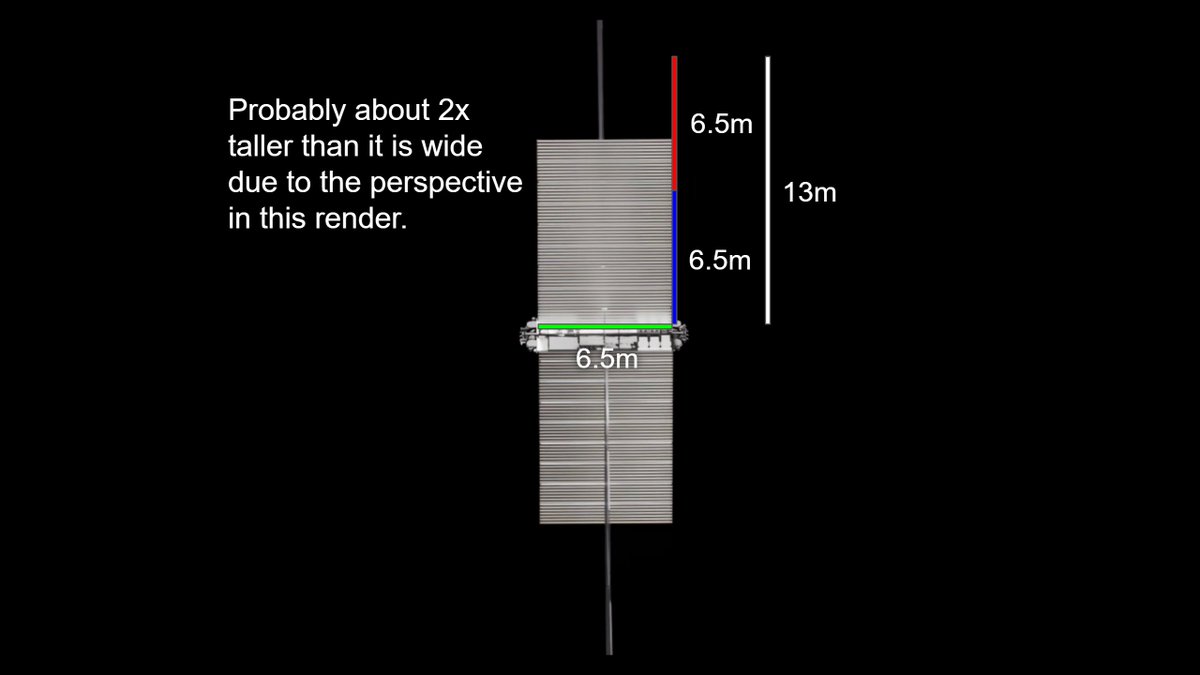
The Starship payload door is about seven meters wide, but let's cut down the width of the radiator panels to 6.5 for a little more margin.
106.14 / 6.5 gets us 16.33 meters long.
CONCLUSION:
In the renders provided by SpaceX, the radiators seem just a little too small according to my calculations. However, I made sure to chose values according to the worst case scenario in my calculations.
Just removing the heat radiated from the Sun and Earth from the equation (which I believe would be negligible due to the position of the satellite) returns a length of 14 meters, which is much closer to my estimated length of 13 meters from SpaceX's renders.
Using the actual numbers would probably give a radiator with a size very close to what SpaceX has shown us.
So, after actually doing the maths, I believe the designs which SpaceX has shown will work just fine. It turns out the very intelligent people at SpaceX know what they are doing.
@spinspoons Figure out what your passionate about and would like to see yourself doing, find out how to get into it and well do it.
its hilariously difficult in practice but simple in concept