Unitree Introducing: H2-X Kung Fu Legend Guardian🤖
Powerful performance to serve and guard you, with a maximum endurance of approximately 8 hours.
Please use the robot safely and in a friendly manner.
Today, the Pinglu Canal has officially opened to navigation. Why is the “Project of the Century” so important, and how was it accomplished in just 48 months? You’ll find all answers in this video.
Video credited to: 星球研究所InstituteforPlanets
August 29, daytime. The rescue at Gyirong Port—the China–Nepal crossing that stunned the world—is still underway. Engineering units are a few hundred meters from the gate. Tens of thousands of Chinese soldiers and civilians are rotating toward it around the clock. A mechanized column stretches more than thirty kilometers along National Highway 216. The newest drones and ground life-detectors are finally in play.
We’re waiting on a miracle. And we’re bringing every person home—alive or not.
People ask what the point is of shouting into a buried border gate. Then what’s the point of Saving Private Ryan? What’s the point of being alive?
This thread exists to kill a lie: that China has no footage because it has no rescue. In a valley that was erased, nobody has time to post. The road in is hell. The truth still comes out.
“Truth is generally the best vindication against slander.”
— Abraham Lincoln
“The truth is not only that which is spoken. It is also that which is not allowed to be buried.”
— Václav Havel
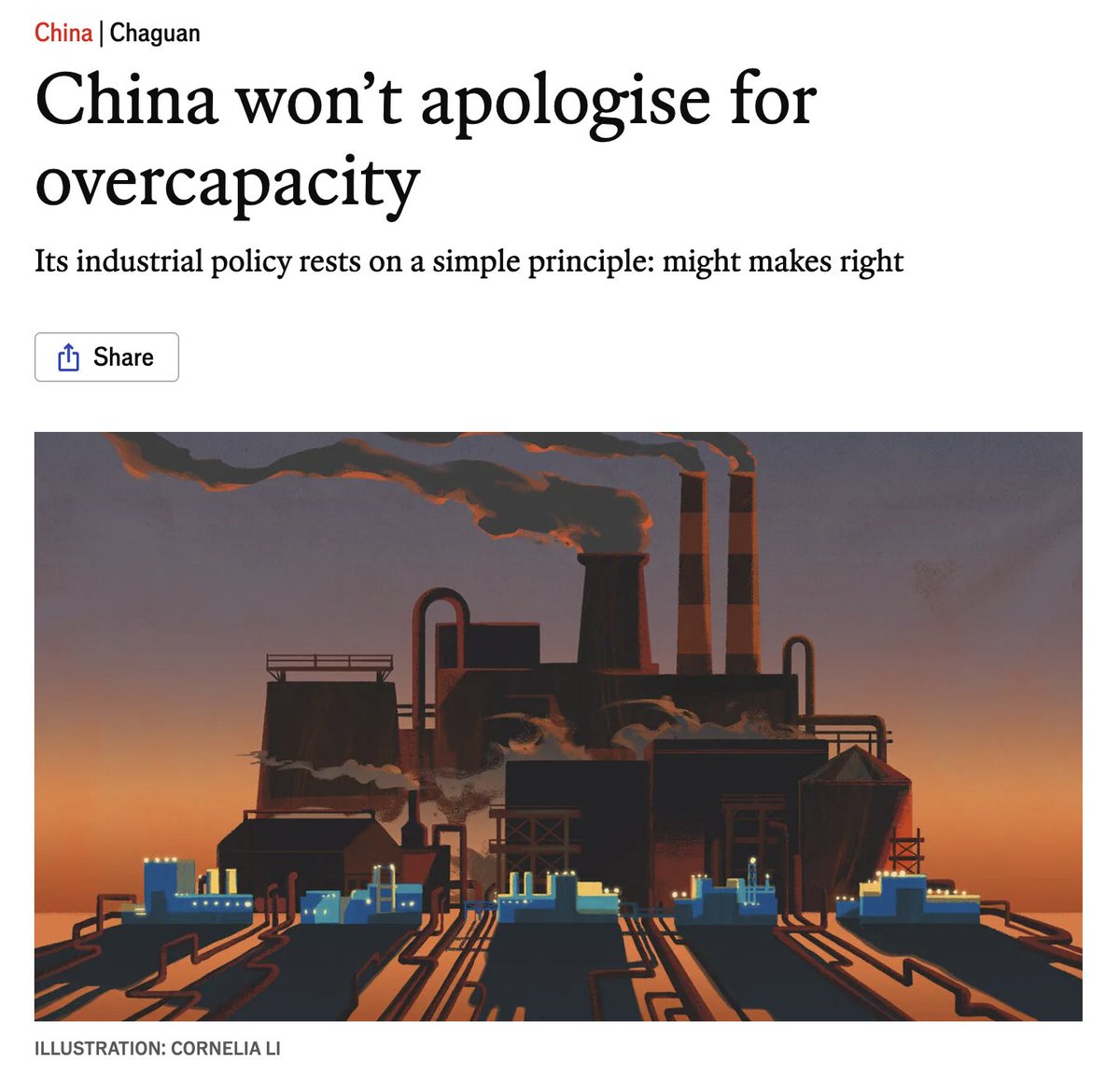
The Economist, whose logo should be "wrong about everything since 1843", has surpassed its historical bungling and gone schizoid. In an attempt to chastise China for overproducing cheap goods it downplays the fact that the Western creditor class invested in China as they deindustrialised their own nations after 1980, turning the bulk of workers into baristas and shop assistants. This is a tacit admission that a Leninist government planning and regulating a hybrid state/market economy has been remarkably successful in the brutally competitive global market economy neoliberals claim to be the natural order of things that makes everyone in the world richer. Except the poor, of course, but that's their fault for making 'bad decisions'.
Inadvertantly - I say that because Zanny and the gang don't usually think too deeply - they've raised a simplified economic variant of the Hobbesian question. During the period of maximised financial deregulation 1980-2008, did our hallowed private investors use their freedom to invest wisely and bring prosperity and security to Western populations? Did they maintain and develop essential productive capacity, infrastructure and services across whole nations? Perhaps not. Principal investment targets have been privatization of existing public assets, software and IT, financial services, derivatives and commercial real estate, facilitated by leveraged buyouts, share buybacks, stock market bubbles and the sort of irresponsible moneylending that led to 2008. So who is making the really bad decisions round here?
So, is it fair to say that China, a nation in which some individual economic freedom is encouraged yet also compelled to make a weighty trade-off with a competently managed state, is producing better results for the population as whole? Without this strong keel and heavy rudder, does the turbulent economic sea tend to be dominated by opportunistic, unthinking, shortsighted, self-enriching individuals unworthy of their freedom, while the rest of us sink or swim? Were a whole line of influential economists from Quesnay, Smith and Ricardo through to extremists such to Mises, Hayek and Rothbard - who argued that the economy should function in relative freedom from governance - completely wrong?
We need to know. Sharpish, because shit is about to hit the fan.
https://t.co/1gbPULr0NE
Industrial policy, in practice, has *always* rested on the principle that might makes right.
The debate over the "unfair" use of industrial policy only became mainstream once a large non-Western economy used it successfully.
It's comical.
Robert Walpole, the de facto first Prime Minister of Great Britain, made heavy use of subsidies to help turn the country into a global industrial powerhouse.
For most of the 19th century, the US had the world's highest tariff rates on manufactured goods as a strategy to catch up with Britain.
In the second half of the 20th century, the liberal international order was, in practice, an attempt by Western nations to prevent developing countries from using industrial policy to catch up.
Can we please stop pretending the West ever cared about creating a level playing field or genuine "fairness" in the use of industrial policy? It's complete BS.
Every British PM’s nightmare
With Keir Starmer expected to fall on his sword shortly, here is my take on the conundrum facing Andy Burnham, indeed any and every British PM.
The true nature of Britain’s ‘special relationship’ with the United States has far more to do with American financiers’ willingness to keep borrowing to purchase British government debt than with history, culture or Britain’s defence needs. This is the burden under which every UK Prime Minister must labour.
Mike Tyson famously said, “Everyone has a plan until they get hit”. The same could be said of prospective British prime ministers, especially after Liz Truss's spectacular defenestration. They all have a plan until the guilt market hits them. Andy Burnham, Nigel Farage, my friend Zack Polanski will have to face this, if they ever move into 10 Downing Street. I think they know it. But I doubt whether they appreciate the true magnitude or nature of their predicament.
Conventional wisdom has it that the bond market comprises people looking to invest their savings in a government's debt. They seek the right balance between a higher interest rate and the increased risk this implies. For example, higher bond yields may signal that the market expects future inflation to reduce the value of the fixed interest payments that their bonds will yield. Worse still, it may foreshadow a risk of government default, as occurred in Argentina and Greece.
That’s more or less what first year economics and finance students are taught. And it’s all true. Except that, in the case of the United Kingdom, this story misses the most fascinating and worrying aspect of its government bond or gilt market: The British government’s ability to refinance its public debt of almost 3 trillion pounds does not depend on savers choosing to invest in gilts. In fact, the British government’s ability to sell gilts hinges heavily on the willingness of numerous US-based financial institutions to borrow substantial sums of dollars to purchase British gilts, which they then use as collateral to borrow for their own purposes within the US.
And there’s the rub. There is a world of difference between needing to borrow from savers and from relying on speculators who borrow themselves to lend you. Savers who lend to you focus on your long-term ability to repay them. They may tolerate your desire to make infrastructural investments that could increase your debt in the short term, in return for future profits that will help you repay them when their bonds expire. However, speculators who borrow in order to lend are a different beast entirely. They are much jumpier and prone to margin calls: situations where, if the bonds they purchased from you begin to lose value, fearing they will not be able to repay their own creditors, they dump your bonds thus turning their decline into a crash.
The question arises: Why are British bonds, or gilts, so much more reliant on American speculators borrowing money to buy them than German bunds, Japanese bonds, Italian bonds or Greek bonds? Why does every British government rely so heavily on American leveraged capital inflows?
It all started in the 1950s when the City of London discovered how to avoid following the British Empire down the road to oblivion. The trick was to carve out a niche for the City within the emerging dollar empire, which was institutionalised within the Bretton Woods system. American financiers faced rigid capital controls within that system, but the City of London was able to alleviate these due to three invaluable features.
First, London’s trading expertise and legal system offered American financiers efficiency with immunity from all sort of interventions, including democratic accountability. Secondly, Britain’s network of offshore jurisdictions offered fabulous tax-minimisation opportunities. And, thirdly, London quickly became the holding depository of a torrent of petrodollars and eurodollars, not to mention the shadowy dollars created outside the United States by foreign bankers.
Thus, the Great British paradox: while the UK's real economy was in decline, the City of London was flourishing. When the Bretton Woods system collapsed in the 1970s, American financiers discovered another use for the City: they borrowed dollars in the US short-term to buy long-term UK government gilts, which they then sold quickly to repay their loans. They would then repeat this process again and again to profit handsomely. This is how the British government became reliant on leveraged US institutions. In order to continue operating as usual, London today requires American balance sheets that are willing to expand through borrowing and use British gilts as collateral in order to maintain liquidity in the US.
Put differently, the flipside of the City’s success story is that, even though it borrows in a currency that it prints, the UK is not financially sovereign. Yes, the City occupies a strategically important position within the global dollar system but the price for this is that the UK government’s sovereignty is circumscribed by its priority to maintain the City’s central position in American finance. While this remains the priority, the occupant of 10 Downing Street is like the captain whose powers are limited to re-arranging the deck chairs on the Titanic.
Is there an alternative to this peculiar form of financial subservience to US-based leveraged financiers? Yes, but it requires a willingness to accept a falling pound and falling house prices while increasing public investment through a new investment bank that issues bonds supported by the Bank of England.
Any Prime Minister who tries to maintain Britain’s financial servitude to US capital while also investing in public goods may well put Britain on a path towards the IMF, whose sole purpose, lest we forget, is to create the political leverage that will bring about – like it did in Greece – the permanent loss of sovereignty over tax and spending policy. The question is: Do the current contenders for Britain’s top job understand this?
https://t.co/xGrWjjcudY
@RnaudBertrand Managing a declining power like America will require China to take on managing American capital in ways that might be similar to the way European capital has been managed by Wall Street.
Germany is in panic over Chinese companies taking over its markets at home, abroad and in China. Having spent quite some time in China in the 2010s, I can’t help but thinking back to the arrogance and quite frankly racism of German expat businesses people. Chinese engineers with Ivy League degrees speaking fluent English and German looked down upon by German engineers with a degree from some German university, unimpressive English and less than two sentences of Chinese. The Germans didn’t see it coming because they couldn’t imagine Chinese people becoming better at what they are doing than themselves. An industry insider told me at the time how keen Chinese entrepreneurs were to collaborate with German car companies on EV development. But all the Germans worried about was they are going to steal our IP. Well, here we are.
@EmperorShun1 Both seem to operating on some kind of dualism: Christianity's Kingdom of Heaven and Kingdom of Man and Buddhism's Nirvana and the world of suffering. And one is superior to the other.
X has now removed the blue check from Iran's MFA Spokesperson’s account—after stripping the Ministry and Minister's verified badges—despite our full Premium+ payments.
This arbitrary de-verification fits X’s pattern of selective censorship and American digital piracy, aimed at suppressing the truth about the U.S.’ illegal war against Iran.
The Iranian navy, which has been destroyed eight times, closed the Strait of Hormuz again, because the United States for the seventh time won the war that wasn’t a war, so the United States can open the Strait of Hormuz that was open before the not war.
The not war that started to get the uranium that was completely obliterated, so that the Iranians can’t build the nuclear bomb that they weren’t building for the not war that the United States started.
Then the United States which has nuclear weapons threatening to use nuclear weapons to prevent Iran from having nuclear weapons because having nuclear weapons is dangerous.
If the United States saw what the United States is doing in the United States, the United States would invade the United States to liberate the United States from the tyranny of the United States.
🎬 Gelin size Hollywood filmlerinde kamera ne zaman Meksika’ya, 'Ortadoğu’ya', Güney Asya’ya ya da Afrika’ya dönse ekranın neden aniden tozlu bir sarı tona büründüğünü anlatayım:
Sinema literatüründe "Yellow Filter" (Sarı Filtre) olarak bilinen bu uygulama, aslında sadece sanatsal bir tercih değil, modern bir oryantalizm ve sömürgeci bakış açısıdır. Breaking Bad ve Traffic’te Meksika’yı, Extraction ve Slumdog Millionaire’de Hindistan’ı, Black Hawk Down’da Afrika’yı ya da pek çok ajan filminde İstanbul’u ve “Ortadoğu’yu” sanki üzerine sarı bir sis çökmüş gibi görmemiz tesadüf değildir.
Bu görsel manipülasyon, Edward Said’in bahsettiği "Öteki"ni inşa etme sürecinin en kestirme yoludur: Batı dünyası parlak ve "soğuk mavi" tonlarla rasyonelliğin, ilerlemenin ve medeniyetin merkezi olarak sunulurken; "Küresel Güney" olarak adlandırılan ve tarih boyunca sömürgeciliğe maruz kalmış coğrafyalar sarı filtreyle boğularak "kaotik, tehlikeli ve durağan" birer suç mahalline indirgenir.
Bu durum, kolonyalizmin kurduğu o üstenci görsel hiyerarşiyi her karede yeniden üretir. Sarı ton; kuraklığı, fakirliği ve "eskiyi" sembolize ederek izleyiciye bu bölgelerin modern zamana ait olmadığı ve "ıslah edilmesi gereken, kirli bir geçmişte takılı kaldığı" mesajını bilinçaltından fısıldar.
Hikaye anlatma biçimi olarak bu filtreyi seçmek, o coğrafyanın gerçek renklerini ve modern dokusunu yok edip Batılı izleyicinin zihnindeki stereotipleri beslemektir. Sonuçta sinematografi, burada bir sanat dalı olmaktan çıkıp dünyayı "medeni merkez" ve "egzotik/vahşi çevre" olarak ikiye bölen politik bir araca, yani sömürgeci zihniyetin görsel bir mührüne dönüşür.
A good illustration of this is that the Mongol empire, not exactly famous for restraint, didn't bother pushing past Hungary: 13th century Western Europe was too poor compared to the rest of Eurasia to be worth their while.
Sci-Hub is an evil website that pirated 85M+ research papers and made them freely available
And now they've added AI to their database to make Sci-Bot.
It answers your questions using latest, full-text articles.
But DO NOT use it. We should all try to make billion-dollar academic publishers richer.
I'm putting the link below so you know how to avoid it.
There's a cool bunch of posters for China space day (24.4), in a kind of retro-futurist, soviet propaganda style, presenting historic and future missions and programmes. More below.
South Korea was among the largest recipients of U.S. aid per capita in postwar history, behind only Israel and South Vietnam.
To put the scale in perspective: $6.85 billion went to all of Africa and $14.89 billion to all of Latin America in the same period.
South Korea alone got $12.6 billion.
But sure. South Koreans.