Last month I wrote about how we can build a positive and safe future for everyone: https://t.co/eoLGVY8yad
Every lab has the responsibility and incentive to move at the pace required to train its models safely, and the ability to take its own actions to ensure that happens.
The reality is:
- People won't want to use agents that are misaligned with them and that don't do what they ask, so labs have a strong natural incentive to make their models more aligned.
There is a lot of debate about slowing progress on capabilities until alignment catches up. My view is that trust and alignment are quickly becoming the most important capabilities that will differentiate agents and models. Any lab that doesn't focus on alignment will fall behind.
- Labs face significant liability if their models cause harm, so they have a strong incentive to prevent this as well.
Meta delayed shipping Muse for several months to focus on safety and security. We didn't call for everyone else to do this before we would. We just did it as part of our day-to-day work because it was clearly the right thing for people and for us. I'm proud of the security foundations we've built.
- Engaging independent evaluators and advisors is industry best practice. MSL already does this today in several areas because it helps produce better work. Other labs can just do this too. In general, it would be helpful for there to be a larger and more diverse ecosystem of evaluators.
- Committing the significant majority of compute towards serving people rather than racing towards recursive self-improvement is one of the best ways to ensure we develop this technology safely. Meta has made this commitment and other labs can do this as well.
I believe the key to building a positive future for everyone is maintaining the right balance of power. This is within our power to do.
The 2028 Global Intelligence Crisis That Wasn't
A Macro Memo from the Actual June 2028, Not the Fanfic Version
The unemployment rate printed 3.8% this morning, roughly where it's been all year. The market yawned. The S&P 500 is at 7,400, which is somehow both a record high and a disappointment to people who were promised 10,000 by every DCF model with a "AI Upside Case" tab.
We are writing this memo because in February 2026, a widely circulated Substack piece predicted that by this exact date, the S&P would be down 38%, unemployment would be 10.2%, and the mortgage market would be in free fall. It was beautifully written, rigorously structured, and wrong about nearly everything. We feel it is our duty — nay, our privilege— to conduct the post-mortem.
In the authors' defense, it was explicitly labeled a "scenario, not a prediction." In our defense, 2,321 people liked it and several macro Twitter accounts made it their entire personality for six months.
How It Actually Started
In late 2025, agentic coding tools did indeed take a step function jump in capability. The Citrini memo predicted that a competent developer could now "replicate the core functionality of a mid-market SaaS product in weeks."
This was true! What the memo failed to mention was that a competent developer could also replicate the core functionality of a mid-market SaaS product in weeks in 2019. The difference was that back then, nobody did it because maintaining software is horrible, and in 2026, nobody did it because maintaining software is still horrible.
The procurement manager at the Fortune 500 who told the vendor he'd been "in conversations with OpenAI about replacing them entirely"? He got his 30% discount, then spent the next eighteen months trying to get his internal AI prototype to handle SSO correctly. It could write a Shakespearean sonnet about SAML authentication but could not, for the life of it, actually implement SAML authentication without hallucinating an endpoint that didn't exist. He renewed the vendor contract at full price the following year.
The memo predicted ServiceNow's $NOW net new ACV growth would decelerate to 14% as customers cut seats. In reality, ServiceNow reported accelerating growth in 2027 because — and this is the part the doom thesis always misses — the AI agents that companies deployed generated more workflow tickets, not fewer. Every autonomous agent needed monitoring, logging, exception handling, and escalation paths. ServiceNow didn't sell fewer seats. They sold seats to robots.
SERVICENOW Q3 2027: "AI AGENT MANAGEMENT" BECOMES FASTEST-GROWING MODULE; CEO JOKES "OUR BEST CUSTOMERS ARE NOW NON-HUMAN" | Bloomberg, October 2027
The Friction That Refused to Die
The Citrini memo's most elegant argument was that AI agents would eliminate friction, and that trillions in enterprise value depended on friction persisting. Subscriptions that passively renewed, insurance policies nobody re-shopped, delivery apps that exploited laziness — all would be ruthlessly optimized away.
Here's what actually happened with subscriptions: AI agents did start cancelling unused subscriptions on behalf of users. Subscription companies responded by making cancellation flows so Byzantine that the AI agents needed other AI agents to navigate them. An arms race ensued. By Q2 2027, the average subscription cancellation flow involved a 47-step conversational gauntlet with an AI retention specialist. The median consumer's agent spent more tokens trying to cancel a $9.99/month meditation app than the consumer had spent meditating in the entire previous year.
Net result on subscription revenue: approximately zero.
The memo predicted agents would disintermediate travel booking platforms. In practice, when agents assembled "optimal" itineraries, they produced trips that were technically cheaper but involved three layovers, a 4am bus transfer in Ljubljana, and a hotel 45 minutes from the city center with a 4.1-star rating that turned out to be an Airbnb above a nightclub. Consumers used the agent, looked at its itinerary, said "absolutely not," and went back to $BKNG.
It turns out that what humans call "preferences" and what a cost-optimization function calls "irrational friction" are the same thing. People don't want the cheapest flight. They want the one that doesn't leave at 5am. We knew this. We have always known this. We briefly forgot because a Substack told us machines would make us rational.
The DoorDash $DASH Thesis, or "You Underestimate How Lazy People Are"
The memo called DoorDash the "poster child" of habitual intermediation destruction. Agents would compare twenty delivery apps and pick the cheapest. Vibe-coded competitors would flood the market. DoorDash's moat of "you're hungry, you're lazy, this is the app on your home screen" would evaporate.
Counterpoint: have you met people?
The vibe-coded delivery competitors did indeed launch. Dozens of them. They had names like Fetchr, GrubAgent, NomNom AI, and — we are not making this up — "Deliver.sol." They offered lower fees by passing 90-95% through to drivers.
They also had no customer service, no restaurant onboarding team, no logistics optimization, no insurance, and no way to handle the moment when a driver ate half your order and marked it "delivered." The apps worked flawlessly in demo videos and catastrophically in the rain on a Friday night in Brooklyn. By Q3 2027, the subreddit r/VibecodeDeliveryHorror had 400,000 subscribers and a pinned post titled "My agent ordered me sushi from a restaurant that closed in 2019."
DoorDash stock is up 35% from the date of the Citrini memo.
The Payments Armageddon That Wasn't
Perhaps the most creative prediction was that AI agents would route around card interchange using stablecoins, destroying Visa / $V, Mastercard / $MA, and American Express $AXP.
What actually happened: agents tried to pay with stablecoins. Merchants said no. Not because they couldn't accept them, but because the fraud liability framework for stablecoin payments did not exist, and no CFO in America was going to accept payment in magic internet money to save 2% on interchange when the chargeback protections that interchange funded were the only thing standing between them and an army of AI agents submitting fraudulent refund claims.
That's the thing nobody modeled. AI didn't just empower consumers. It empowered fraud. The same agents that could price-optimize your protein bars could also generate synthetic identities, file fake chargebacks, and exploit return policies at scale. Visa and Mastercard's moat turned out not to be friction — it was trust infrastructure. When fraud exploded in early 2027, merchants practically begged to keep paying interchange.
MASTERCARD Q1 2028: NET REVENUES +11% Y/Y; CEO CITES "UNPRECEDENTED DEMAND FOR AI-POWERED FRAUD DETECTION SUITE" AND "RETURN TO CARD RAILS FROM ALTERNATIVE PAYMENT EXPERIMENTS" | Bloomberg, April 2028
Mastercard didn't die. It sold the antidote.
The Mortgage Crisis That Was Actually Just San Francisco Being San Francisco
The memo's most alarming prediction was that the $13 trillion mortgage market would crack because white-collar workers would lose their income and default on their loans.
What actually happened in housing: San Francisco home prices did decline, approximately 8% peak-to-trough. This was treated as a national emergency by San Francisco homeowners and as "Tuesday" by everyone who'd watched San Francisco home prices fall 8% roughly every four years since the city was founded.
The national housing market was fine, because the national housing market has a problem that is far more powerful than AI displacement: there aren't enough houses. The US has been underbuilding for fifteen years. A structural housing shortage does not resolve because some product managers in SOMA lost their jobs. If anything, the modest cooling in tech-heavy metros made housing more affordable for the nurses, teachers, and tradespeople who'd been priced out — people whose jobs, it should be noted, AI has not disrupted in any meaningful way.
The 780-FICO borrowers the memo flagged? Most of them had two-income households, 30-year fixed mortgages locked at 3-4% in 2020-2021, and six months of savings. The ones who lost their jobs found new ones — not always at the same pay, but enough to make a mortgage payment that was locked in at 2021 rates. Turns out a $2,400/month mortgage is pretty easy to service even at $120k instead of $180k, especially when your rate is 3.25% and the alternative is paying $3,500/month in rent.
FANNIE MAE: SERIOUS DELINQUENCY RATE REMAINS AT 0.6%, NEAR ALL-TIME LOWS; "AI DISPLACEMENT CONCERNS HAVE NOT MATERIALIZED IN CREDIT PERFORMANCE" | Fannie Mae Q2 2028 Credit Supplement
The Job Market: Disrupted, Not Destroyed
We are not going to pretend that AI has had zero impact on employment. It has. The labor market is different. Some categories of work have genuinely contracted — particularly rote analytical work, first-draft content generation, and basic code production.
But the Citrini memo made the classic futurist error: it modeled job destruction in high resolution and job creationin zero resolution. It said AI "created new jobs" but "for every new role AI created, it rendered dozens obsolete." This sounded profound and was completely made up.
Here's what they missed:
1. AI made existing jobs bigger, not extinct. The product manager at Salesforce didn't get replaced by Claude. She used Claude to do the work of three product managers, got promoted, and now manages a portfolio twice the size. Companies didn't fire 60% of their PMs. They gave the surviving PMs AI tools and expanded their scope. Headcount was flat. Output tripled.
2. The "build it yourself" thesis created more jobs than it destroyed. All those companies that tried to replace their SaaS vendors with internal AI-built tools? They needed people to manage those tools. A new class of "AI operations" roles emerged — not the fake "prompt engineer" jobs from 2023, but genuine systems integration, agent orchestration, and reliability engineering roles. The BLS hasn't even finished categorizing them yet.
3. Humans got weird. The fastest-growing job categories of 2027-2028 were things nobody predicted: AI output auditors, "authenticity consultants" for brands that wanted to prove their content was human-made, in-person experience designers (turns out when everything digital gets commoditized, people pay more for analog), and — our personal favorite — professional "vibe curators" for corporate events, which is just party planning with a $300/hour rate and a LinkedIn title.
The unemployment rate is 3.8%. It was 3.7% when the memo was written. The composition has shifted, but the apocalypse has not arrived.
The Real Feedback Loop They Missed
The Citrini memo described a "negative feedback loop with no natural brake." AI gets better → companies cut workers → workers spend less → economy weakens → companies buy more AI → repeat until civilization collapses.
The natural brake they missed was called "shareholders."
When companies cut too aggressively, quality collapsed. The first wave of AI-driven layoffs in 2026 did boost margins. The second wave, in early 2027, started producing disasters. AI-generated customer communications that were subtly unhinged. Product launches with no human gut-check that flopped spectacularly. Legal filings with hallucinated case citations (again). A major airline's AI-managed pricing engine that accidentally sold 40,000 business class tickets from New York to London for $12 each before a human noticed.
UNITED AIRLINES Q2 2027: $380M CHARGE RELATED TO "AUTONOMOUS PRICING SYSTEM ERROR"; CEO ANNOUNCES "HUMAN-IN-THE-LOOP" MANDATE FOR ALL REVENUE MANAGEMENT SYSTEMS | Bloomberg, July 2027
Companies re-hired. Not to the same levels, and not the same roles. But the "fire everyone, let the robots handle it" thesis ran directly into the wall of "the robots are confidently wrong 3% of the time and that 3% is extremely expensive."
The negative feedback loop had a natural brake, and its name was liability.
India, Actually
The memo predicted India's IT services sector would collapse, the rupee would crash 18%, and the IMF would come knocking.
What actually happened: TCS, Infosys, and Wipro did see growth slow in traditional staff augmentation. They responded by — and stop us if you've heard this before — selling AI services. It turns out that the same cost arbitrage that made Indian developers attractive for manual coding also makes Indian firms attractive for AI implementation, training, and management. They pivoted from "we'll give you 500 developers" to "we'll give you 50 developers and 450 AI agents managed by our platform."
The rupee is roughly where it was in February 2026. The IMF has not called.
What We Actually Got Right and Wrong
The bears got right: AI is transforming the economy. Wage growth for certain white-collar categories has stagnated. Inequality has widened. The political tensions around AI are real and growing. Some business models — particularly those built purely on information asymmetry — are under genuine pressure.
The bears got wrong: The speed, the severity, and the linearity. The Citrini memo extrapolated every trend at its maximum velocity for 28 months and assumed no adaptation, no friction, no regulatory response, no human irrationality, no corporate incompetence, and no second-order effects that cut the other way.
In short, they modeled the economy as a physics problem and forgot it's a biological one. Systems adapt. Humans are stubborn. Institutions are slow but not dead. And the most powerful force in the American economy is not artificial intelligence.
It's inertia.
Closing
We say this with genuine respect for the original authors: it was a good piece. Thoughtful, well-structured, and asking the right questions. The scenario was worth gaming out. But the scenario assumed a frictionless spherical economy in a vacuum, and we live in a world where a Fortune 500 company once took nine months to change its font.
The canary is still alive. It just learned to use ChatGPT and is now posting on LinkedIn about its "AI-augmented singing journey."
The S&P is at 7,400. The mortgage market is fine. DoorDash still has a 28% take rate. And somewhere, a procurement manager is telling a SaaS vendor he could replace them with AI, while secretly praying they don't call his bluff.
Disclaimer: This is a rebuttal, not a prediction. If the 2028 Global Intelligence Crisis actually happens, please don't forward this back to us.
And here are $UBER prepared remarks on AV misconceptions and reality:
https://t.co/4Qpp8K0C2M
Misconception #1: AV growth will be zero-sum. Reality: AVs are likely to drive incremental growth for the entire category.
"In Austin and Atlanta, where hundreds of AVs are operating on the Uber network, our overall (AV and non-AV) trip growth has significantly accelerated"
"...even in a city like San Francisco, where we don’t yet offer AV trips on Uber, the addition of AV supply to the market has grown the category overall."
Misconception #2: Trends from San Francisco can be extrapolated elsewhere.
Reality: No two cities are alike, and going from proof of concept to mass scale will be far more challenging.
"the rest of the U.S. (and the world) looks very different from San Francisco"
"For example, the average number of trips an AV does per day in Los Angeles is an estimated ~50% lower than in San Francisco. That’s despite the fact that average AV prices in Los Angeles are ~20% lower than an equivalent UberX trip"
"even in San Francisco, 1P AV services are already leaving a lot of demand on the table during peak hours, with average ETAs that are at least 25% higher than Uber as of Q4."
Misconception #3: AV providers can achieve high vehicle utilization on their own at scale.
Reality: A fixed-supply network cannot match the utilization of a hybrid-supply network.
"demand on a typical Monday is ~45% of a Saturday, while daily demand troughs are just ~5% of intra-week peaks."
"That is precisely what we are seeing in Austin and Atlanta. There, we estimate that we are delivering average trips per vehicle per day (TpVD) around 30% higher than in other major AV markets. Compared to Los Angeles, our hybrid network is delivering more than twice the TpVD."
"average AV ETAs in Austin and Atlanta an estimated ~25% lower than those observed in other major AV markets."
Misconception #4: AVs will only need to scale in a few U.S. cities to capture most ridesharing category profits.
Reality: Our profit pools are diverse, and a large portion of U.S. trips (and profits) will be unaddressable by AVs for the foreseeable future.
"In reality, the U.S. is a very large and diverse market. Trips happening within our top 20 cities 1 represent only 30% of our U.S. Gross Bookings and just 25% of our profits."
"Around 40% of our U.S. riders take trips outside of their home city,"
Misconception #5: AVs will soon be able to perform all trips.
Reality: AVs still need to resolve a lot of edge cases to be reliably available in all conditions
"Worryingly, we have seen ‘AV deserts’ pop up, where AV operators do not serve (or have even yet to map) less affluent areas, like Oakland and parts of the East Bay."
"We have also seen recent infrastructure and weather disruptions ground AV fleets for multiple days across multiple cities."
"During last week’s winter storms, we were able to seamlessly remove AVs from our network in Austin, Atlanta, and Dallas at the request of our partners, without any noticeable impact on the customer experience."
The Non-Bubble that disappointed both Bulls and Bears -- how Sam's Splurge changed everything
The worst kept secret among Tech market participants — just something AI bulls don’t admit out loud: they want a price-action bubble every bit as much as the bears do.
Both want to see that steep, “blow-off” ascent that characterizes parabolic tops. Why? The AI bulls are all fully loaded for a vertical melt-up and AI bears want the aftermath so they can yell “I told you so.”
It’s obvious to AI bulls (us included) that we’re not in an AI bubble. The non-argument is simple: valuations are reasonable (NVDA near 20x), the equity risk premium is almost 300bps above where it troughed in the tech bubble, operating margins are rich, and we’re still very early in the demand/build out of the AI supercycle.
But bulls will typically follow this argument up by saying “‘it’s more like ‘97/’98.”
Implicit in that statement is that they’re hoping the inevitable outcome is a ‘97-’99 style ramp, with all hoping it would occur as soon as possible. Why? The simplest answer is usually the right one: everyone likes bigger bonuses as soon as possible.
Stated succinctly: the “AI bubble” ascent was the paradigm that both bulls and bears were operating under for most of this year, or longer.
Bad news for the AI bulls and bears: the past few weeks has brought an end to that paradigm and led us to an unexpected turning point in the dynamics of the AI trade/narrative. On the 3 year anniversary of ChatGPT’s release, no less.
And we have Sam’s $1.4T 30GW splurge to thank for it.
Sam’s Splurge (we’ll call it “SS”) opened up AI “pandora’s box,” shifting the AI narrative in unexpected ways.
First, the overarching discussion has shifted to a greater focus on OAI’s ability to monetize and what that means across the Tech ecosystem, from ad platforms to software/services companies to GPUs to infra hosting like ORCL. Despite the behemoth it already is, the market began to appreciate it was taking implicit bets on what is still a 3 year old start up industry/company.
Second, SS and connected deals brought more focus to the interconnectedness of the whole ecosystem, OAI’s outsized role in it, circular financing, and “too big too fail” discussions.
The interconnectedness of the AI ecosystem📷
Third, SS and his “Give us a few months and it’ll all make sense … We are not as crazy as it seems. There is a plan.” opened up discussions about government’s role in AI. While government intervention would help accelerate the AI buildout, it also opened a doorway of investor doubt. Reader CIO At CG expressed these opposite outcomes well in TMTB Chat:
“It’s bullish if/when it happens. But until it happens it creates doubt if it is gravy (more upside) or if it’s needed to execute the 1trn+ commitments. Any doubts on ability to execute the 1.4trn is just bearish sentiment vis-à-vis today. So Friar opened a door that was closed. And by opening it, it opened both the left and right side of the distribution. It also makes people realize that they are too big to fail: if they fail to execute they will bring the entire ecosystem multiple down. And hard.”
Fourth, the sheer scale of the SS $1.4T plan, which is nearly the size of the whole private credit market, nudged both public and private lenders to reprice AI-linked risk, most notably seen in the rise of Oracle and Coreweaves’ CDS spreads. At the same time, off-balance-sheet structures—e.g., Meta’s $27B Hyperion SPV with Blue Owl— didn’t help by concentrating risk with private creditors and muddying system-wide leverage mapping.
The ironic thing is, if SS would have been half the size, things would have continued to grind along, investors would have enjoyed the ‘27 and ‘28 visibility, maybe even building the energy for a large vertical ascent in price action. Instead, it had the opposite effect: pouring too much gasoline on the fire and drowning out the energy for a big move up.
Fifth — by locking in commitments eight years out, SS dragged the long-horizon AI debate into the present. Over the last few weeks I’ve heard an increasing amount of bulls give voice to risks they’ve been able to normally wave away over the first 3 years of the AI trade, in an unusual sign of humility. Some of the key existential questions that now feel more present in the discussion:
How does the grid support the post-’28/’29 buildouts and what about water, land use, and local pushback? We’ve already heard of local governments slowing DC buildouts, and this week the WSJ wrote how Bernie and others are dialing up scrutiny of Data CentersIf inference moves to phones/PCs/cars, how does that rebalance hyperscaler capex, useful life assumptions, and who captures value? What’s the risk of stranded assets if models plateau or workloads shift to cheaper/edge solutions?The AI catch-22 no bulls want to talk about: If enterprise agents and automation work as advertised, what’s the path for unemployment and wages? If white-collar unemployment rises, what happens to ad spend and consumer wallets — remembering that GOOGLE and META are cyclically exposed ad businesses at their core? How does the seep into their top line and capex trajectory? If AI models don’t deliver, do we get a capex hangover and productivity disappointment?All of this sits against a U.S. backdrop that’s still skeptical of AI — worried about job loss and asking for a slower, safer rollout — which can swing sentiment and policy quickly. Will the current administration still be as supportive of the AI rollout if sentiment and unemployment shift in a more negative direction?
These are issues that will be a lot more prominent in the next 3 years of the AI trade than they were in the first 3 years of the AI trade.
This all began to seep into the price action of AI stocks several weeks ago: ORCL giving back all of its “monster RPO” move and more, very speculative sectors like Nuclear/Quantum rolling over, and the AI ecosystem progressively rallying less and less on each Open AI deal that was announced.
It all culminated in the last two weeks. We can give thanks to some hawkish fed speak and Sam’s now infamous BG2 pod appearance for providing the spark needed to ignite the fire spreading. In a period of time where nothing has changed fundamentally in respects to the AI trade, the market began more heavily digesting the overarching effect of SS: more unknowns and more uncertainty in the minds of investors. After all, the market isn’t just a mechanism for discounting fundamentals and perceived risk, but also the current emotional state of participants. With belief shifting from inevitable euphoria (read: vertical ascent price action) to verification, SS has had the opposite effect of what Altman likely intended: more multiple compression and less belief in out year estimates.
With greater uncertainty, it’s no wonder certain pockets of the market have underperformed: names with perceived questionable business models / debt issues (ORCL, CRWV, NBIS, Miners, etc.), names with perceived AI top of funnel / structural issues (DUOL, MNDY), names with rising opex as the market is less confident in how long heightened spend will be here to stay (META).
It’s also no surprise that as the market digests these new developments, the profitability factor has outperformed while names with good narratives and fast growth but little in the way of valuation support have underperformed: NET, PLTR, SHOP, TSLA, U. This is also why memory has been so strong: EPS revisions are currently happening —> there’s nothing uncertain about opening up your favorite DRAM/NAND spot price checker, seeing how much DRAM/NAND has risen overnight, and plugging it into your model. These names are arguably more attractive in the current environment than they were before.
The market is currently doing what it always does after a narrative/paradigm shock: digest, recalibrate, reassign risk premia. NVDA EPS and Gemini 3 are the next events on the docket to absorb. We’re running low gross while we let the market do its thing, letting the overarching narrative/price action stabilize and become clearer.
@dylan522p at Semianalysis joked this week that time is now divided in BC (Before ChatGPT) and AD (After Da Launch of ChatGPT). We think the AI trade will eventually be divided between BSS (Before Sam’s Splurge) and ASS (After Sam’s Splurge). BSS and ASS.
Wait - that doesn’t have a nice a ring to it, so let’s say it differently. We think the straight-line giddy phase of the AI trade will give way to something healthier: a phase where fundamentals and idiosyncrasies matter even more. Tech will always be a narrative and boom and bust heavy investing sector (that’s part of the fun), but in a landscape where sentiment is more balanced, stock-picking will become more relevant. That’s a good thing.
SS popped the non-bubble. But the AI trade isn’t broken: it’s simply entering a more mature, scrutinized phase.
Airbnb CEO Brian Chesky: “We’re relying a lot on Alibaba’s Qwen model. It’s very good. It’s also fast and cheap... We use OpenAI’s latest models, but we typically don’t use them that much in production because there are faster and cheaper models.”
The valley is built on Qwen?
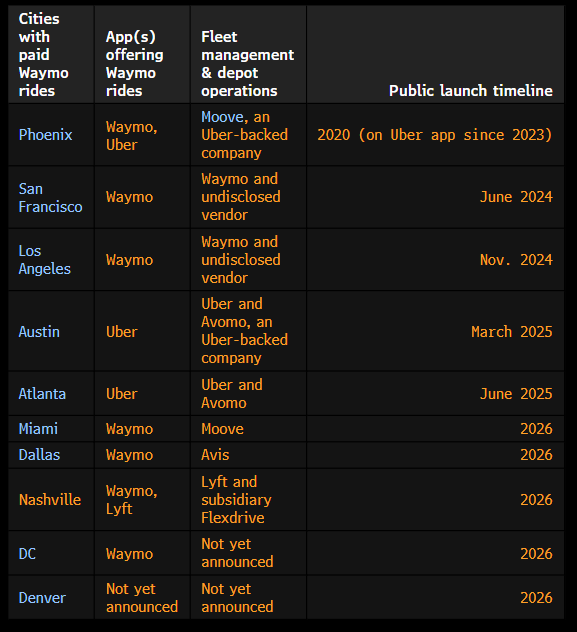
Must Read: This table explains the now complicated go-to-market for Waymo across its own service/app and the partnerships with Lyft and Uber
$LYFT $UBER $GOOGL #Waymo
h/t @natlungfy
https://t.co/hiLYqIPhVa
Elon's lies are becoming bigger and more brazen.
Just for context, here are all the cities that Tesla needs to launch its robotaxi service in their metro areas in order to cover half of the US population by the end of the year:
New York
Los Angeles
Chicago
Houston
Dallas–Fort Worth
Miami
Atlanta
Philadelphia
Washington, DC
Phoenix
Boston
Seattle
Detroit
San Diego
San Francisco
Tampa
Minneapolis–St. Paul
St. Louis
Denver
Baltimore
Orlando
Charlotte
San Antonio
Austin
Pittsburgh
Sacramento
Las Vegas
Cincinnati
Kansas City
Columbus
Cleveland
Indianapolis
San José
Virginia Beach–Norfolk
Providence
Milwaukee
Jacksonville
Raleigh–Durham
Nashville
Oklahoma City
Richmond
Louisville
Salt Lake City
New Orleans
Hartford
Buffalo
Birmingham
Scoop: Top money managers say it was Japan not China selling last night that upended the bond market and forced Trump’s hand into a pause. And yes Trump took the win as so many countries wanted to do deals. Never one thing that causes anything; story developing
To borrow a word from the doctors, this is our first iatrogenic financial crisis. An iatrogenic illness is when you go into the hospital, and you catch an infection there. It's when the people whose job it is to make things better are the active agents of making things worse. There is nothing in the outside world that is causing this challenge. It is induced by the words and deeds of @realDonaldTrump and his administration. The good news about that is it could be resolved with the words and deeds of the President. --Today on @BloombergTV with @DavidWestin.
I’ll spell it out explicitly one last time.
Everyone thinks Trump wants balanced trade. He does not.
He wants to force allies to stop trading with China. Completely. Zero inbound supply.
Because it’s not just because of American jobs. It’s a proactive move to slow down Chinas industrial rise.
Everything is downstream of this. Reserve currency status. The ability to address fiscal debt.
It’s a crazy risk because China has a vote.
It’s a crazy risk because you are forcing Europe to commit seppeku because they have very little leverage or say in the matter.
It’s a crazy risk because Xi might bomb the fabs in Taiwan and the world doesn’t get AGI.
It’s a crazy risk because China knows how financialized we are and will dump bonds and equities to drive anger towards trump.
But it also has benefits if it works.
If your allies can’t trade with China there is no near peer competitor to worry about.
That has a ton of benefits. Just look at what happened after WW2/USSR collapse when American was the last man standing.
Hegemony.
Trumps advisors like Miran believe that you can coerce your allies to pay for your security umbrella in the form of buying longer dated treasuries.
This removes the overhangs of the debt load while allowing you to pump markets in time for midterms.
If Mexico can’t import from China then you solved the fentanyl crisis because they won’t have precursors.
More importantly by establishing a tolerance for risk the level of fear you can instill in cartels is an order of magnitude higher.
“Shit if they risked WW3 they won’t think twice about droning Sinaloa. “
This same “logic” applies to the Middle East.
Now I will repeat for the 100x that this is not advocacy.
I’m only telling you guys what the people in power believe. And I’m telling you that what happens next if I’m right will come down to how Xi wants to fight.
He can go gloves off or glove on. There are real constraints as I have outlined in prior tweets.
But there is a plan and therefore the tolerance for market pain is way way higher than you think.
Because first you need Europe to be willing to commit economic seppuku. And they won’t want to (rightly). So Trump will crush them economically until they cry uncle. And then they still won’t want to and he’s going to threaten to defang NATO. And then they still won’t want to and he will withdraw swap lines.
Or a lot more likely, he will do it all very forcefully and all at once to maximize leverage.
Now you’ll rightly ask… why wasn’t this messaged better? Why have midwits like Lutnik on the team?
Because you are attempting to execute a reckless gambit where the big variables are not what the tariffs rates are. Or if you tariff penguins. Or if the person sounds dumb on TV. Non of that matters.
What matters is - will Japan capitulate quickly and agree to buy a large amount of treasuries? Will Saudi capitulate quickly with your B2 bombers waiting in Diego Garcia to bomb Iran? Will China invade Taiwan?
Many of you think everyone around Trump is retarded. I get it. You hate the guy and everything he stands for. But I will say this until I’m blue in the face. Bessant, and even Miran, have higher IQs than most if not all of you. They thought through the second order effects. Believe me. If I, a dumb TMT L/S bro thought this far ahead, they certainly did too. Which means they warned Trump how risky this was and how deeply irrational it is if you planned to eventually cut a deal with China. Therefore you have to assume Trump heard the risks and said “fuck it we ball” anyways.
Economic Blitzkrieg. That’s what we’re seeing. And it’s only the start.
Geopolitically, nothing matters more than winning AI.
These tariffs, as constructed, essentially guarantee that America will lose “AI” by making America the most expensive place on earth to build AI datacenters.
The semiconductor exemption was irrelevant for AI. Datacenter semiconductors come into America in finished goods from Taiwan and other Asian countries: servers, storage systems and networking switches. By the time we have developed the capacity to domestically produce these systems, we will have lost the AI race.
Outside of this dynamic, the assumption - or wild gamble - that other large countries would not retaliate and instead come meekly to the negotiating table was erroneous.
That was the off ramp and Bessent did his best to encourage the world to take it. China, understanding how awesome all of this is for them, did not take the off ramp.
Epic win for China.
Best outcome from here - that is in the realm of the possible - would be to quickly cut “deals” with friendly Asian countries - Japan, Taiwan, South Korea, Thailand, Malaysia, Vietnam, Indonesia, etc. Something like a 10% tariff plus true reciprocal tariffs (which would quickly go to zero) would be reasonable.
I say all of this as someone who was open-minded to tariffs that were thoughtfully constructed, gradually phased in and accompanied by massive deregulation. Ideal outcome would have been some combination of reshoring, revenue generation and seeing our largest trading partners lower their barriers to American goods. It is a fact that until yesterday we generally had much lower tariff rates than other countries.
My sense is that is where Bessent was, but he clearly lost an internal battle. Hopefully the market helps the President realize that a course correction is needed and the necessary changes are made relatively quickly.
The sooner, the better.
As a sidenote, I can only imagine how Bessent felt when he understood the way the reciprocal tariffs were calculated, that an LLM had generated the tariffs and that islands inhabited only by Penguins were being tariffed as a result.
1) DeepSeek r1 is real with important nuances. Most important is the fact that r1 is so much cheaper and more efficient to inference than o1, not from the $6m training figure. r1 costs 93% less to *use* than o1 per each API, can be run locally on a high end work station and does not seem to have hit any rate limits which is wild. Simple math is that every 1b active parameters requires 1 gb of RAM in FP8, so r1 requires 37 gb of RAM. Batching massively lowers costs and more compute increases tokens/second so still advantages to inference in the cloud. Would also note that there are true geopolitical dynamics at play here and I don’t think it is a coincidence that this came out right after “Stargate.” RIP, $500 billion - we hardly even knew you.
Real: 1) It is/was the #1 download in the relevant App Store category. Obviously ahead of ChatGPT; something neither Gemini nor Claude was able to accomplish. 2) It is comparable to o1 from a quality perspective although lags o3. 3) There were real algorithmic breakthroughs that led to it being dramatically more efficient both to train and inference. Training in FP8, MLA and multi-token prediction are significant. 4) It is easy to verify that the r1 training run only cost $6m. While this is literally true, it is also *deeply* misleading. 5) Even their hardware architecture is novel and I will note that they use PCI-Express for scale up.
Nuance: 1) The $6m does not include “costs associated with prior research and ablation experiments on architectures, algorithms and data” per the technical paper. “Other than that Mrs. Lincoln, how was the play?” This means that it is possible to train an r1 quality model with a $6m run *if* a lab has already spent hundreds of millions of dollars on prior research and has access to much larger clusters. Deepseek obviously has way more than 2048 H800s; one of their earlier papers referenced a cluster of 10k A100s. An equivalently smart team can’t just spin up a 2000 GPU cluster and train r1 from scratch with $6m. Roughly 20% of Nvidia’s revenue goes through Singapore. 20% of Nvidia’s GPUs are probably not in Singapore despite their best efforts. 2) There was a lot of distillation - i.e. it is unlikely they could have trained this without unhindered access to GPT-4o and o1. As @altcap pointed out to me yesterday, kinda funny to restrict access to leading edge GPUs and not do anything about China’s ability to distill leading edge American models - obviously defeats the purpose of the export restrictions. Why buy the cow when you can get the milk for free?
Good insights from Seth Klarman:
Market participants with less than 12 years of experience have never been burned and have no idea how hot the stove can get.
Crowdstrike Analysis:
It was a NULL pointer from the memory unsafe C++ language.
Since I am a professional C++ programmer, let me decode this stack trace dump for you.