@SUPERNAKED1 Yes, you can play this with exactly like that; as soon as it recaptures 1m Low, can long with LoD stop
But there is nuance, you cant just do this on any setup.
This is a Parabolic Long, 3 or more gap downs.
Which is an inversion of the Parabolic Short, both from Qullamagie
Not all Follow Through Days=FTD are equally actionable. FTDs must be graded on the action in and quantity of new leaders. I would grade todays likely FTD a C. If, if, if more quality new True Market Leaders erupt higher, I will upgrade my rating but for now today looks mostly like a short covering rally vs the start of something big. Dozens of todays big % movers like SNDK remain -40% to -65% off highs and even after todays large % gains remain below their 200DSMA. Hopefully in the next few days market health will improve. https://t.co/UkFoeQBtoY for all my best ideas.
#StockMarket #CANSLIM #BTC #Finance
https://t.co/UkFoeQBtoY If you haven't read the recent report, you're missing out.
#IBDPartner @marketsurge
https://t.co/ttEaIPvTCt
해외에서 난리난 X gif 저장법
X에서 맘에 드는 gif 봐도 저장이 안 돼서 화면 녹화하던 사람들 이제 그럴 필요 없음
1. gif 길게 누르기 2. "동영상 링크 복사" 누르기 3. 내 글 쓰는 창에 붙여넣기
이러면 그 gif가 내 트윗에 그대로 붙음
아래 gif로 테스트 ㄱㄱㄱ
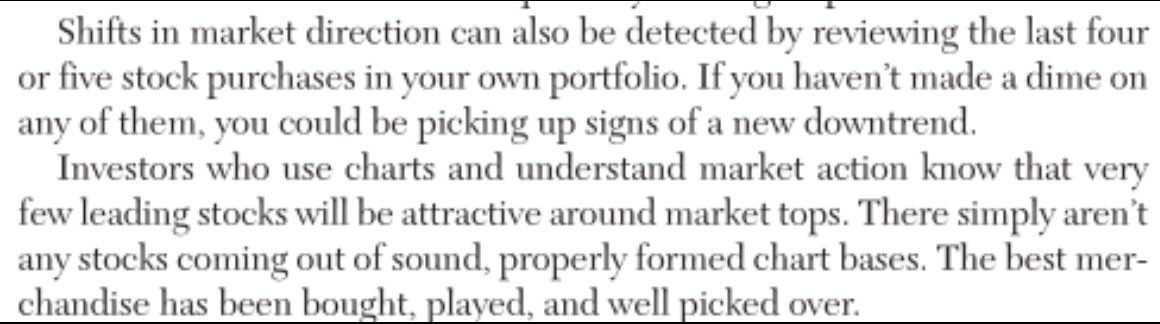
A Follow-Through Day?
Today could be a follow-through day. That’s usually when we start looking for opportunities to put money to work.
But there’s a catch. The gap is being driven by semiconductors, still one of the weaker groups, following a strong $CRWV report. Meanwhile, most of our setups are in medical and healthcare, and that group is red this morning.
Half of all follow-through days fail. Watch @mwebster1971 videos on FTD's, that's your homework!
Here’s the question I’d keep in mind: Where do you think we’ll be one week from today? In a full-blown, glorious uptrend, or still dealing with chop, failed breakouts, and uneven leadership?
We don’t need to predict the answer. We need to manage risk while the market figures it out.
A follow-through day is a reason to get more engaged, not a reason to throw caution out the window. This may be a day to test small, or not at all.
Let the quality of the setups and the market’s follow-through determine how much exposure we earn.
Expect this market regime to be EXTREMELY volatile
VIX Rule of 16:
Current VIX: ~ 27.3
Divide the VIX by 16 to estimate the market's expected daily volatility
27.3 / 16 = 1.7%
Market is pricing in daily moves of roughly 1.7%
What used to feel like an unusually large daily move is now becoming the expectation
And this elevated volatility in the broader market only amplifies volatility in individual stocks
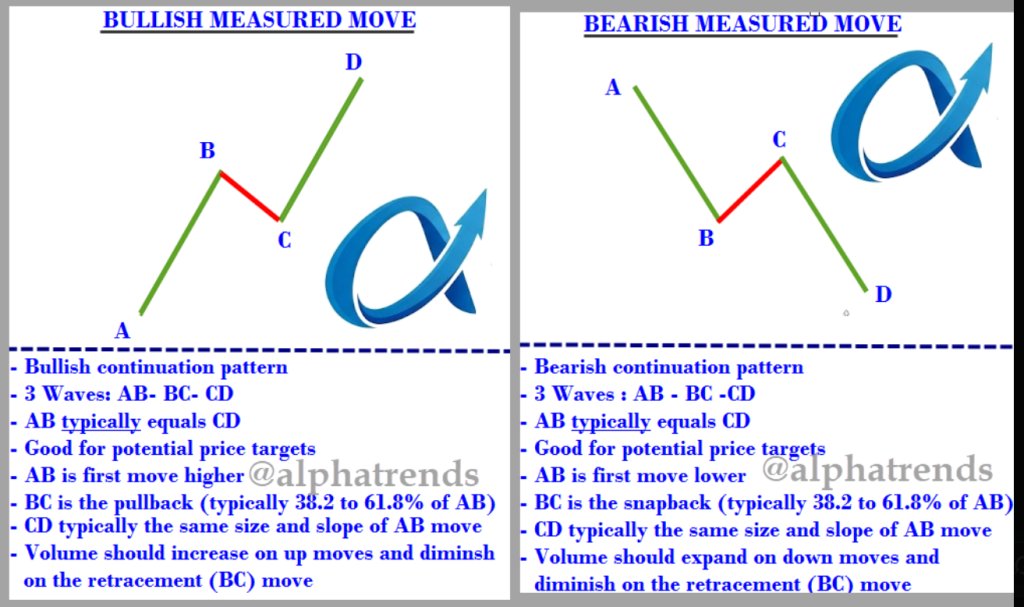
The bearish measured move was obtained in $SMH yesterday, I marked this up last night and forgot to post.
chart from @Marketsurge
It is just another level of interest to be aware of
$SPY (Update) – Another failed breakout attempt. The 20-MA vs 10-MA death cross remains in place.
Yesterday's rally ended with an intraday rejection at its declining 20-MA. Today's sell-off further exposed the underlying weakness of that bounce.
With ATR-based volatility expanding over the past 2 weeks, I think we're likely transitioning into a more volatile, two-sided market; alternating sharp up and down sessions, with large % swings, all within the broader downtrend channel. Don't get lured into swing long setups just because futures are pointing higher, even if they're up beyond +1.5% tomorrow, similar to yesterday.
Martin and KK’s strength (in my view) lies in understanding how to exploit the OR low/high (ML actually narrows the SL even further)... once the low/high of the 5-minute OR is established, there’s a 25% chance that the low will be the LOD or 25% that the high will be the HOD. Combined, the probabilities total about 50%. Coincidentally, 25% is also roughly their win rate. Add to that the fact that when 10 > 20, there’s a higher probability of a FT on long positions, and when 10 < 20, on short positions. With just these two considerations, you have a system with a defined low/high in 25% (+25% for shorts) of cases after the first 5 minutes of trading (I’m not saying “win rate”—be careful...excellent selection is another point in their favor). Add rules for managing trades and portfolio (of primary importance) —and, above all, above-average mental strength—and the recipe for success is ALMOST complete.
A few things I have learned since I started trading in 1998.
This isn't a bullish post or a bearish post, just some key lessons that I have learned over time:
- the market knows more than we do.
- you will rarely win a fight with the tape - you might get lucky every so often, but luck is tough to duplicate over years.
- the S&P 500 averages a 5% pullback every 3 1/2 months and 10% pullback every 11 months, build this into your thinking. $SPY is -6.5% right now from the highs.
- most popular stocks, tech and growth, can pullback much more than the index, which for many is why the 5% pullbacks can feel like a blowout.
- the index could turn up at any time, when it does, it will show up on the charts.
- you don't have to buy at the very bottom or sell at the very top to make a lot of money along the way.
- stocks with shallow pullbacks in uptrends are a much different buy than trying to chase stocks down the chart.
- charts breaking out in market pullbacks should get top priority.
- I don't buy stocks below the 50-day MA. Doesn't make it right or wrong, but it works great for me.
- if the charts don't set up the way you want them to, or if high volatility is a concern, it's ok to do no buying or small buying, follow your stops on open positions and wait until you get a better read of the landscape.
- I have been buying stocks fairly consistently over the past few weeks, small buys mostly - but it's mostly not the same stocks I was buying 3-6-12 months ago.
- I might be adding to my 2024 winners again, or not, the charts will tell me.
- charts in uptrends and breaking out work much better for me than charts rolling over into downtrends.
- when volatility picks up considerably, reduce your trading activity, reduce your position sizing and reduce "all-in" sector bets.
- small losses are better than big losses - also, very often a small position is better than no position, if you have a valid buy signal.
- if you want to make aggressive pullback buys, do it small and use stops. If they keep pulling back, stop buying. If the market has a confirmed reversal, look to add on the way back up.
- buying a stock "lower" because you think it is going "higher" is not an actual strategy.
- waiting until a stock proves itself higher is a strategy than many professionals use.
- it doesn't matter what happened last time, or what happens 15 out of the last 20 times, each market is unique and has its own set of circumstances.
- the "story" doesn't stay the same forever; you need to pay attention to major new information if the market says it's relevant.
- there is always something breaking out somewhere, pay attention to those charts.
- where many investors and traders run into difficulty is not managing risk - not using any type of stop loss or risk management, buying and adding to stocks in downtrends, over concentration in tech and growth etc. Over-trading, positions too big.
- determine how much you are willing to risk/lose before you take a position and stick to that.
- more cash is the only true hedge - everything else has volatility.
- for 95% of retail (non-institutions), hedging is a fallacy that won't overcome having no risk management plan. Manage your risk at the buy with stops and correct position sizing. Assume that you will be wrong and define your risk at the buy.
@NickSchmidt I'll tell you why. Because all the best rallies have semis as one of, if not THE leading sector. Look at SOXX and how it lines up with the best rallies since inception.
Trade Like an O’Neil Disciple was a book I enjoyed and it taught the 7wk rule. I use it sometimes for whatever ema it has honored for 7+wks during a mkt strong uptrend.
Some other books to read during correction-
How to Make $ in Stocks (4th edition)
Reminiscences of a Stock Operator
How to Trade in Stocks by Jesse Livermore
How I Made $2,000,000 in the Stock Market by Darvas
Trading in the Cockpit by Morales & Katcher(sequel to Trade like an O’Neil Disciple
The Perfect Stock by Brad Koteshwar
The Battle for Investment Survival by Gerald Loeb
The Traders Handbook by Trader Lion crew @RichardMoglen@NickSchmidt@RossHaber@AmeetRai
Victory in Stock Trading by @OliverKell_
I use sentiment on here as a small part of my process.
Sentiment right now even after last week is still to buy the dip and that this will be over next week.
Anything can happen, but at the moment seeing this type of distribution, along with multiple stocks that led us higher gapping down -25% on earnings, doesn’t look like it will be resolved without a lot of time, or a lot more selling off.
Right now charts say danger & sentiment is thinking it will be over tomorrow.
Compare that to my post below on April 15.
I thought price action looked the best it has in months and shared how strong it looked.
If you look at the replies in that post below, most felt certain it was another bounce that will fail.
*Usually* the replies and sentiment get like that because it’s been months of buying random dips & digging a massive hole in ur account.
As always each week we get new evidence and have to keep an open mind and adapt… but normally it’s optimistic when charts look good and sentiment in my feed doesn’t believe it.
At the moment it’s the opposite.
Just my thoughts fwiw
Struggling in this market? here's your cheat sheet.
After 5+ years and studying 1000s of charts, I've finally narrowed my entire trading playbook down to these 9 setups.
Probably my most educational post of 2026, so you're welcome (sorry mom)!
SAVE this one for later:
This market makes you feel like you are a shadow of the trader you once was 🤣
Jokes aside though, whenever things feel hard just step back. There is literally no rush. Most of us have years and decades to do this if we are lucky. One week, month, quarter of challenging action is just an insignificant blip in the grand scheme of things.
Always have the long term picture in mind. Your challenges of today are still a privilege to many. Don’t forget that.
Reducing Monthly Drawdown. How, When, and What Results.
I’ll start by saying that, so far, October hasn’t been a great month… September’s profits (about 6R) went up in smoke, but fortunately, by following a few rules, a manageable loss didn’t turn into something more serious. I said “rules” because I need them… Intuition, experience (a lot of experience…), and putting myself in the shoes of the best traders on X (what would they do in my place?)—none of that works for me… I’ve made mistakes in the past, and making a mistake is a learning experience; repeating a mistake is a real mistake… so I need rules just as much as I need bread. Every month, for me, it’s like starting from scratch… I don’t care about the last X trades; I don’t care about last month’s results… I start with the maximum risk (1R = 1%)… When I reach -4R, I start to realize that maybe something’s not right out there (keep in mind that my average loss in R is -0.3R, so it takes me a while to figure it out, but better late than never...).. . so I cut my risk in half for the next -4R (1R = 0.5%)… if after -8R (which corresponds to -6% of the portfolio) the market keeps telling me, “Wake up, can’t you see I’m not in good shape?”, I reduce the risk for the next -4R (1R = 0.25%)… After these -12 R—since I’m a bit slow on the uptake—the message is clear... Stay out of the market until the end of the month (fortunately, I haven’t yet managed to hit the -12R monthly target)... Now that I’m completely out of the market, I have time to do my calculations... How much did these 12R cost me? 7% of the portfolio (-4%,- 2%,- 1%)... a fully recoverable loss. …But what do those -12R represent in terms of trades? With an average loss of -0.3R, that would be 40 consecutive losing trades (assuming the average loss rises to -0.4R during a difficult period, there would be 30 consecutive losing trades)... This is to show you that even a trader who’s slow to pick up on market signals—like me—can, with simple and strict rules, weather a losing streak without falling into a spiral of double-digit drawdowns and overtrading.