Recently helped a company figure out their winding machine which they had limited programming control over
Built a small webapp for them to tweak and tune the winding programs
These machines are not made for startup (or even sane) speed of development
It’s painful, but building your own machines is the right way forward, kudos!
Sensible voices are (finally) breaking through with AI. @mitchellh one of the best ones.
“I use AI all the time. I like AI. The point I'm making is to not blindly accept results. Think. Analyze. Learn.”
Read it 👇
Announcing Zoo's completely redesigned sketch mode! You can sketch complex 2D geometry SO much quicker now. So many improvements:
- Constraint solver
- Trim tool (remove parts of intersecting geometry)
- Select regions (overlapping 2D spaces) for extrude
It's a big upgrade.
💡Recent insight: gaslighting @claudeai seems to improve code quality >90% of the time.
“You overengineered this, there is a simpler way”
“There is a smaller delta that buys us most of the benefits”
“There is a more elegant way”
“This is not architecturally coherent”
…before I even read its code. 😆
Anyone who has travelled on a weak passport will celebrate investigative reporting into VFS global, the near monopoly intermediary that handles visa applications for 71 countries. https://t.co/ALB7KQM9e3
@kukreja_abhinav Am building tools for embedded engineers
Genuinely curious - why do you think we need more?
I’ve been realizing we need less given how much more efficient AI has made firmware, PCB design and simple CAD
I've got an agent in a loop optimizing a renderer with the goal to minimize frame times (and tests to measure). It got times down from 88ms to 2ms and allocations down from ~150K to 500. Sounds good, right? Wrong. This is exactly why agent psychosis is a big fucking problem.
As an experiment, I rewrote the Ghostty core render state in Go, with access to identically laid out data structures as Ghostty and the exact same validation tests. I made a purposely naive renderer (simple, correct, but slow). 88ms per frame with 150,000 allocations (horrendous, lol)!
I then kickstarted a Ralph loop to bring the frame times down. I told it it can't modify input data structures or the public API or tests (they're correct), but it can do anything else it wants. It got to work.
It has worked for about 4 hours. I've spent around $350 on this experiment so far. The results?
88ms => 1.5ms
150K allocs => ~500 allocs
Incredible right? Nope.
My hand-written renderer I ported has frame times (same benchmark) of ~20us (0.020ms) and 0 allocations in the update path.
This is the problem with psychosis and lacking systems understanding. If you don't understand the system, you're going to accept that this is an incredible result. If you understand the system, you'll see better solutions immediately and can do roughly 75x better on throughput.
The people who blindly trust agent output are in the former camp. They're sheeple, overdrinking from a fountain of mediocrity.
Standard disclaimer: I use AI all the time. I like AI. The point I'm making is to not blindly accept results. Think. Analyze. Learn.
Wine is just wine to most Americans, and Grana Padano is as good as parmesan is as good as pecorino. But just see what happens when you say that Coke Zero is the same as Diet Coke. Like Robert Conquest said, everyone is an Italian about what they know best.
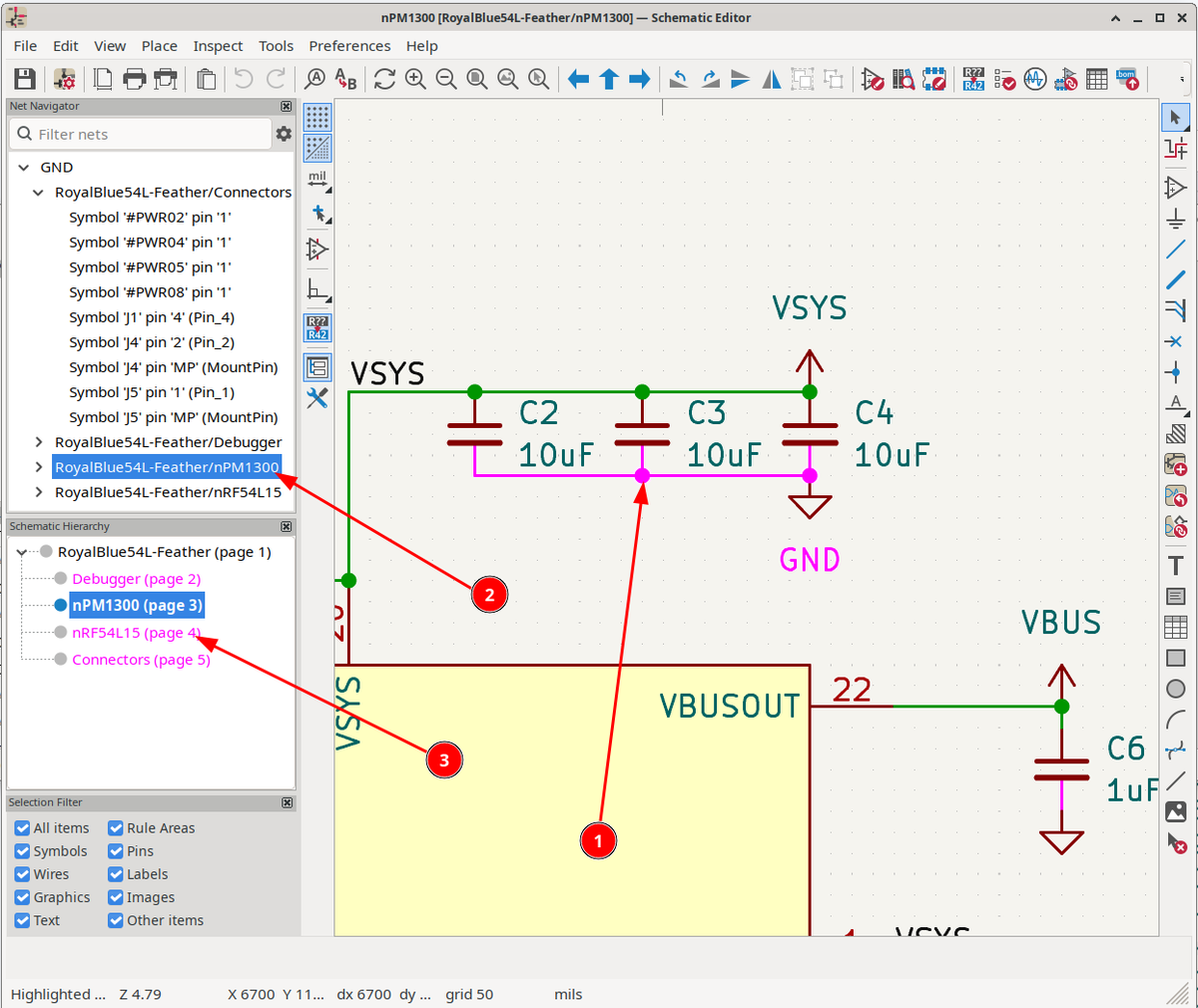
Did you know that you can highlight nets in KiCad and navigate between items?
1) Use the ~ key to highlight the net under your mouse
2) All items on that net are shown in the Net Navigator panel
3) The sheets in your hierarchy with that net are highlighted
Press Esc to cancel
It's 8am. Claude Code is creating a document with some examples I want to use for the class I am teaching at 9am. It just told me that I'm at 82% of my token limit. Now the tense wait begins: will it complete the document before hitting 100% or will it lock me out for 4 hours😱