Remember this witch was scared to step out of her office in her constituency fearing Egg therapy from public but now wishes the same on a serving officer who’s just doing her duty.
Hope the officer finds a way to file a legal complaint against this vile witch.
RAF assistant commandant Sonia Shehrawat’s insta profile calling our children protestors cockroaches. Let’s find out who she is, where she lives, what’s her record? Let’s name & shame & drag each of these zealots through the law
Rajdeep enjoy while it lasts :) After all you've spent your entire career in service of Mainos only to be frittered away by the undeserving scion, for a change this time at least he is doing something, you must be really happy to see ur patron doing the heavy lifting & not you.
It’s one of those rare days when Rahul Gandhi @RahulGandhi is front, back and centre of almost every news bulletin. And for a change, it’s the government—not the Opposition—that is on the defensive, answering the questions.🙏
When I was harassed, heckled, surrounded and shown lewd gestures at Jignesh Mevani rally in 2018, couple of portals including @ThePrintIndia published an article by the wife of the harasser, who was not on the spot, justifying it by calling it 'suppression of cheap thrills.'
The 'hate' doesn't come from a few on TV alone.
Most undeserving Member of Parliament. Old habits die hard, sell outs like this hardly hide their intentions, always pine for outside intervention as they can’t win the elections any longer.
@AgentSaffron Not so much, that pride of place belongs to Bombay & Calcutta tbh. These places offered better template to Modernity.
Now, as someone from South I would say Banglore is much better alternative than MADRAS. It offers perfect blend of conservatism while being cosmopolitan enough
Nusli is a Wadia, not a Jinnah: Would the easily excited and the instantly outraged please learn before they speak or write?
The clickbait politics of corruption-tainted @ArvindKejriwal and his @AamAadmiParty is as contemptible as eyeball-grabbing clickbait journalism.
Why would BJP want to hide facts that are widely known and are a part of history in more ways than compulsive liar Arvind Kejriwal and his malicious disinformation spreading AAPiya groupies ever will be?
Mohammed Ali Jinnah married Rattanbai Petit, known as 'Ruttie' in fashionable drawing rooms, of the famous Petit family of notable Bombay Zoroastrians when she was 18. That was in 1918 and her family disowned her for marrying a Muslim more than twice her age.
In 1918 Jinnah was a prominent member of the Congress as well as Muslim League leadership. Jinnah's politics of the time were focused on constitutional reforms and Hindu-Muslim unity.
As a leader of the Congress and the League, Jinnah opposed the Rowlatt Act. He also led the protest against British recruitment of Indian sepoys for World War I unless Indians gained equal rights.
In brief, Jinnah of 1918 was a staunch 'nationalist' as defined then; Ruttie, though from an Anglicised family, was a nationalist too -- in brief, their political views matched and by all accounts they were happy as a couple. A year later their daughter Dina was born.
The proverbial bone in the kebab was Jinnah's sister Fatima who refused to accept that her brother could ever love another woman. Like a vulture she hovered over Jinnah till his death, refusing to let anybody come anywhere near him. Despite her constant vigil, Tuberculosis did embrace Jinnah (or was it the other way round?) and gnawed away at his tobacco-tarred lungs. Jinnah died gasping for breath.
But that is not the story we want to recall. Our story is about Ruttie and Dina.
Tired of Fatima's presence like a purdah between her and her husband, and his divided affection, Ruttie separated from Jinnah in 1927 and moved out of her marital home with eight-year-old Dina. Two years later Ruttie died of undiagnosed health issues and depression.
In 1927, Jinnah's politics were yet to take the form and shape of Muslim separatism that would scorch India. He was still focused on creating a 'united front between the Indian National Congress and the All-India Muslim League' to counter British rule. He led the 'Delhi Muslim Proposals', offering to abandon separate communal electorates in exchange for minority safeguards and increased Muslim representation at the Central level.
Jawaharlal Nehru and his father Motilal Nehru, in their 1928 'Nehru Report' on what should be the framework of the Constitution of free India, rejected Jinnah's proposal for seat sharing and gave most political power to the Central Government instead of the Provinces.
But this story is not about Nehru and his shenanigans. It's about Ruttie and Dina and how the personal life of the man who broke India and his politics were, in a manner of speaking, intertwined: Ruttie fell in love with and married nationalist Jinnah; their daughter Dina drifted away from, and ultimately disowned, separatist Jinnah.
Dina grew up without a mother, mostly in London, in the long shadow of her aunt Fatima, and scoffing at Jinnah's objections, she married Neville Wadia, dashing businessman of Bombay and scion of the Wadia Family, in 1938. Both daughter and father became coldly formal and distant; Jinnah began referring to Dina as 'Mrs Wadia'.
By 1938 Jinnah had begun to position himself as the 'Sole Spokesman' of subcontinental Muslims. This year marked the 'point of no return for Jinnah'. He 'pivoted from pushing for a united, federal India with minority safeguards' to demanding a political destiny for Muslims separate from that of Hindus.
After Direct Action Day in 1946 (the year Dina last met Jinnah) Partition became inevitable and the ghastly horrors leading up to August 1947 a foregone conclusion. A triumphant Jinnah, Fatima in tow, abandoned Bombay and relocated to Karachi. His only child, by then a mother of two children, Nusli and Diana, showed no interest in either shifting to Karachi or visiting Pakistan.
This takes our story to Nusli Wadia, Jinnah's grandson, who, as a young man, prevented the sale of Wadia family-owned Bombay Dyeing by his father Neville Wadia to RP Goenka by buying 11% shares, exhorting workers to use their savings to buy shares, and securing, legend has it, more than generous support from JRD Tata and Bombay House. "Jinnah's Grandson" went on to become the chairman of Bombay Dyeing and an independent director on the board of several Tata companies, including Tata Steel and Tata Motors.
In the 1960s Nusli Wadia met an enthusiastic RSS Pracharak, Chandikadas Amritrao Deshmukh, popularly known as Nanaji Deshmukh, a graduate from BITS Pilani, whose work in taking education to the hinterland of Gorakhpur in Uttar Pradesh and active involvement in Bharatiya Jana Sangh activities had begun to seep into conversations in Bombay.
Impressed by Nanaji Deshmukh's work, Nusli began contributing money for his projects and politics. He introduced Nanaji to other prominent Bombay businessmen and industrialists, including JRD Tata, and paved the path for corporate funds to flow towards Jana Sangh. Over the years, the sage-like Nanaji became a spiritual mentor of Nusli and his wife Maureen.
Meanwhile, Nusli met Atal Bihari Vajpayee through Nanaji and a lifelong friendship developed between the two. At one level it was intensely personal: The two could spend hours in companionable silence, exchanging few words, occasionally calling for treats that were otherwise a rarity in the spartan Vajpayee household of those days.
At another level, the larger relationship between Nusli and the BJS, his support to the Jana Sanghis during Mrs Gandhi's Emergency, and subsequently his funds to nurture the BJP in its early years when few dared to defy a post-1980 vengeful Indira Gandhi, were a reflection of Nusli's deep commitment to the BJS/BJP's politics tethered to nationalism.
Neither Nusli nor the BJP, or Atal Ji if you wish, ever shied away from acknowledging their relationship. For the party leadership, Nusli was a Wadia, not a Jinnah.
I was in the PMO when Atalji was PM, serving as his aide. I do not recall seeing Nusli just walking in and out of South Block or Race Course Road, unannounced, unhindered and unchecked.
At the famous post-Pokhran II White House ice-breaker dinner hosted by President Bill Clinton, a bevy of Indian industrialists and businessmen were invited to taste chicken stewed in Darjeeling tea (which was the main course). Nusli could not make it for some reason; his wife Maureen was there -- not at the high table, not near the high table, but at a distant low table where she was seated with lowlies like me.
Cut-and-paste authors like Vinay Sitapati, who probably thinks Indians washing and not wiping themselves after defecating is worth being breathlessly described as Ripley's "Believe It or Not", getting all excited about "Jinnah's grandson donating money to BJP" is not unexpected.
Nor is it expected that media will refrain from spinning the asinine excitement of a callow novice into clickbait journalism meant for the lowest common denominator.
Hence it is perfectly understandable that Arvind Kejriwal and his AAPiyas should use the Jinnah bait to seek attention. Nusli's contribution to India via Bombay Dyeing has been immeasurably more than what 100 generations of Arvind Kejriwal could ever dream of.
S. Janaki Ji refused the Padma Bhushan in 2013 and said she deserved the Bharat Ratna instead. A lot of people found that arrogant at the time.
Most of North India does not know her name. Almost all of India has heard her voice. If you have ever heard an old South Indian film song playing in a shop, a bus, a wedding, it was probably her.
So let me tell you who she was.
Her full name was Sistla Sreeramamurthy Janaki. Born 23 April 1938 in Pallapatla, a village in Guntur district.
Her father was an Ayurvedic doctor and a teacher. She spent most of her childhood in Sircilla. She sang on a stage for the first time at the age of nine.
In her twenties, an uncle told her to go to Chennai and try working with a composer named R. Sudarsanam at AVM Studios. She went.
She got her first film song in 1957. A Tamil film called Vidhiyin Vilayattu. She was 19.
In that very first year, she recorded songs in six different languages.
Six. In year one.
Across her career she recorded around 48,000 songs. In roughly 20 languages. Kannada the most, then Malayalam, then Tamil, Telugu, Hindi, Odia, Tulu, Urdu, Punjabi, Bengali, Konkani, Sanskrit.
She also sang in English, Japanese, German and Sinhala.
Yes, 48,000.
Her career ran about 60 years. That works out to more than two songs a day, every day, for six decades.
Including the days she was sick, travelling, grieving, tired.
While her mother tongue was Telugu, but she could speak and write Tamil, Kannada, Malayalam and Hindi. Malayalis claim her as theirs. Kannadigas claim her as theirs. Tamils claim her as theirs.
All of them are correct. :)
They called her the queen of expression and modulation. Meaning she could change how a song felt with tiny things.
A slight break in a word. A softer breath. She could sound like a village girl in one song and a heartbroken woman in the next and a child in the one after that.
That is why composers fought to book her.
Infact, Ilaiyaraaja Ji had heard her voice while assisting the composer G. K. Venkatesh. When he got his own first film, Annakkili in 1976, he asked her to sing three songs. All three became huge.
That started something. For the next two decades, Ilaiyaraaja and Janaki produced hit after hit. He knew exactly what her voice could do and kept stretching it.
She became the first choice for anything with a village setting, anything that needed rawness.
Ilaiyaraaja sang around 200 duets with her himself.
Three of her four National Awards came from his compositions.
And eventually she became the only singer to have won state awards under all three of the giants. M. S. Viswanathan. Ilaiyaraaja. A. R. Rahman.
Imagine, three generations of music.
Three completely different styles.
She worked across all of them and was excellent in all of them. A 40 year span of staying relevant while the entire sound of Indian cinema changed twice.
Her first National Award came in 1981 for a Malayalam song, Ettumanoorambalathil, from a film called Oppol.
She won four National Awards in all, and 33 State Film Awards. Thirty three.
She also had a Hindi chapter that almost nobody remembers. Bappi Lahiri heard her singing a Hindi song for a Tamil film at Prasad Studio and was floored.
He brought her to Bombay. She ended up singing duets with Kishore Kumar.
Now, her personal life was much harder than the discography.
She married V. Ramprasad in 1959. He backed her career fully and used to travel with her to recordings. He died in 1997 of a cardiac arrest.
Her son Murali Krishna died this January, just six months ago.
She is survived by her granddaughter, Apsara Vydyula, who announced her death on Instagram.
She wrote that to the world Janaki was an iconic voice, and to them she was a grandmother whose warmth and humility they will carry forever.
She ended her singing career in 2017 with a concert in Mysuru. The last song she chose was a Malayalam lullaby, Amma Poovinum.
She picked a lullaby to close out 48,000 songs. :)
Now back to the Padma Bhushan.
In 2013 the government offered it to her. It is India's third highest civilian honour. She said no.
She said it had come far too late. And she said if the country actually wanted to recognise her work, it should have been the Bharat Ratna.
At the time, plenty of people called that ego.
But look at what she was sitting on when she said it. 48,000 songs. Twenty languages. Four Nationals. Thirty three state awards. Six decades. Work with every major composer across three generations. A voice that raised entire regions.
Lata Ji got the Bharat Ratna in 2001. Bhimsen Joshi got it in 2008. M. S. Subbulakshmi got it in 1998.
Janaki was 75 when they offered her the third best one.
She had every right to feel that the country had taken her for granted. And she said so out loud, without an agent or a PR team softening it.
But honestly, what bothers me is that she is being introduced to half the country today, in a condolence tweet, at 88, after she is gone.
She was not obscure. She was not niche. Her voice was in millions of homes for sixty years. She was just South Indian in a country where national fame is still mostly decided in Hindi.
If you have never heard her, do not scroll past this.
Go put on Thumbi Vaa Thumbakudathil. Or Vasantha Panchami Naalil. Or Singara Velane Deva. You do not need to understand the words. You will understand the voice in about ten seconds.
That is the whole point of her. She never needed you to know the language.
Wtf Coventry University even part of this list? Other UK based universities on the list have niche in at least one or other areas of STEM subjects each.
🚨 India has cleared 15 foreign universities to establish independent campuses by issuing them Letters of Intent (LoIs).
1. University of Southampton (UK)
2. Deakin University (AUS)
3. University of Wollongong (AUS)
4. Queen’s University Belfast (UK)
5. University of Liverpool (UK)
6. University of York (UK)
7. University of Bristol (UK)
8. University of Aberdeen (UK)
9. Illinois Tech (USA)
10. Western Sydney University (AUS)
11. Victoria University (AUS)
12. Coventry University (UK)
13. University of Surrey (UK)
14. La Trobe University (AUS)
15. Lancaster University (UK)
What differentiates him from SN & SP is, he’s Indian entrepreneur who built his company in India, worked in India & nurtured in India, now going to head one of the important consumer IT brands. He represents the strength of Indian entrepreneurship that has come off age.
Adding to the list of Satya Nadella and Sundar Pichai, now a friend among us.
And that too a (nearly) billion $ (quasi acqui) hire 🤩
Cheers to @kunalb11 🙌🙌👏🏼👏🏼👏🏼
I say this with full sincerity: Palestinians should consider converting to Hinduism en masse.
What did Islam bring them?
Only death, destruction and decimation.
Conversion to Hinduism would instantly improve their circumstances and stop their persecution.
Because unlike the Islamic countries, who only pay lip service to them and use them in their own geopolitical games, India might actually end up genuinely supporting their cause if they convert to Hinduism.
A grand Ram Temple will be constructed, and so will be Temples to Krishna, Maa Kali and Maa Durga. They will serve as Home of the Gods as well as refuge for its people.
Let's see Israel try and attack these Temples.
But Palestinians will never see sense and take a look at what their religious affiliation is doing to them.
They will be born and die in misery for centuries to come if they continue to persist.
Right response from Mohanji Bhagwat. Nehru banned RSS. When he lifted it, he only asked RSS to submit a written Constitition. RSS did & it is in govt records. Nehru didnt ask RSS to get registered under Societies Registration Act 1860. Nor did Indira, Rao or Manmohan.
Despicable behavior so far from Modi Govt and TATAs in the accident investigation. People claiming Boeing cover up should know that Boeing hasn’t managed to cover up its past failures. No safety bulletin has gone out for 787s based on this accident. This is a cover up to protect Air India and TATAs.
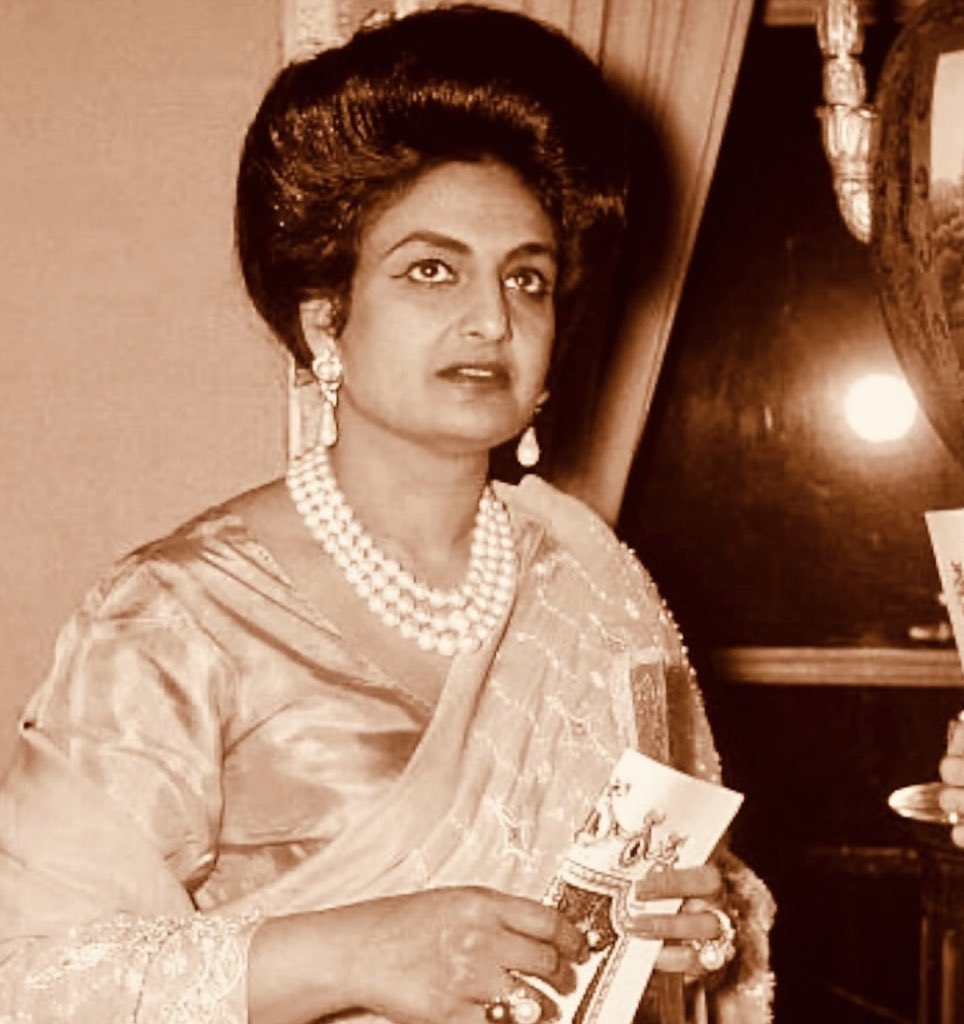
Rajkumari Sita Devi of Pithapuram was born in a Telugu aristocratic family. She was a fashion icon of her age and a member of the International Jet Set. She married the Gaekwad Maharaja of Baroda, who was the then eighth richest man in the world, and settled down in Monaco.
The only real difference between Mamata and Abhishek Banerjee’s Trinamool, Sharad Pawar’s NCP, and Sonia Gandhi’s Congress is the polish.
A thin veneer over what they sneer at as the ‘vernacular.’
Congress remains the mothership. These are merely its more brazenly violent offshoots. Which is why they instinctively close ranks.
Strip away the gloss, and it’s the same machinery. Same instincts. Same methods.
All in all - same to same.




![PhysInHistory's tweet photo. 1937: Physicist Max Born and his wife Hedi Born in Indian attire, Bangalore.
[Courtesy of Mrs Usha Ramaiah] https://t.co/1LMzEYm9Ns](https://pbs.twimg.com/media/HKn0JPhbEAAncwD.png)


