Rule of 40: SaaS growth quality matters more than growth alone
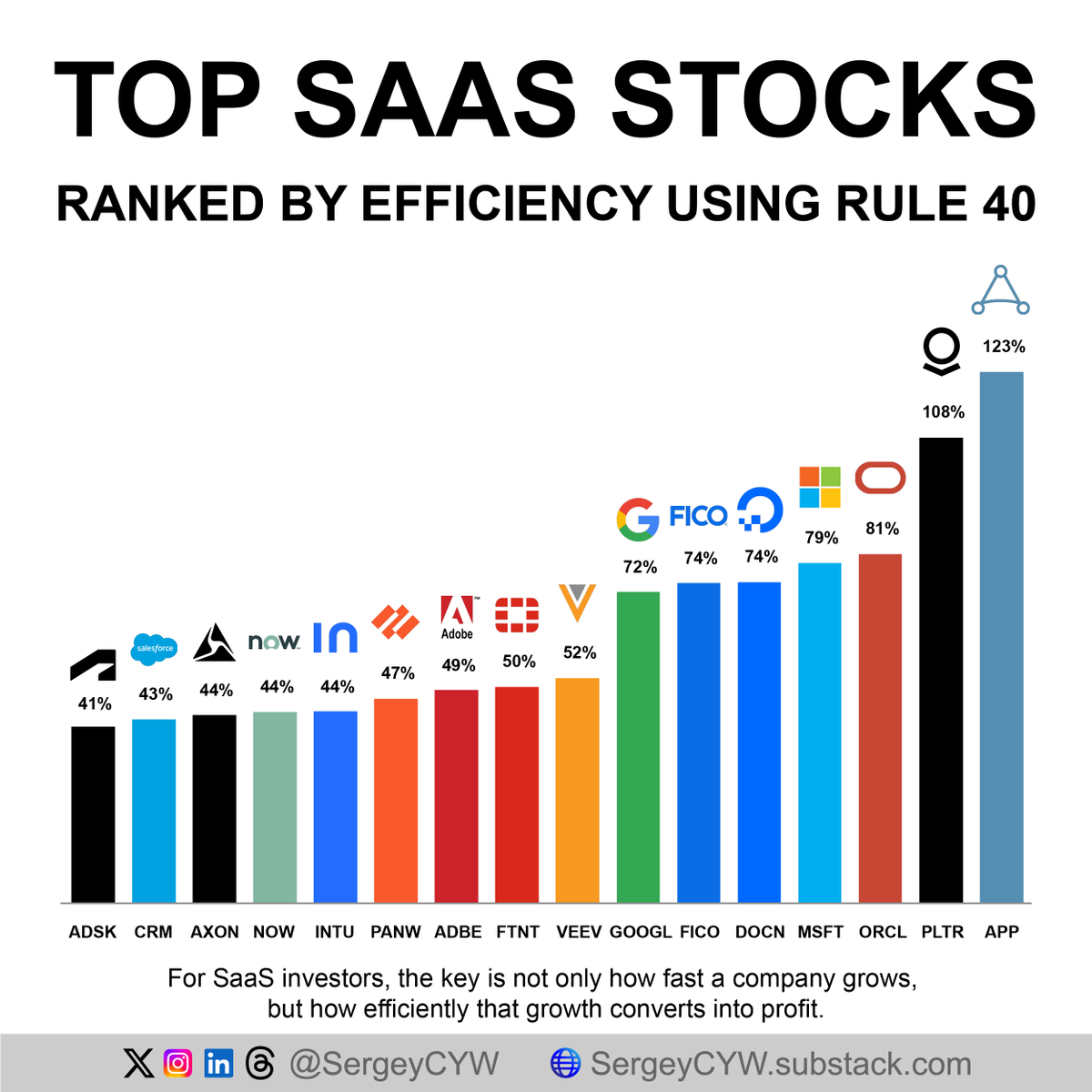
The Rule of 40 is one of the clearest ways to evaluate SaaS and software companies because it combines revenue growth and profitability into one efficiency metric. A company above 40% usually shows a better balance between expansion and financial discipline.
For this analysis, I use GAAP EBITDA Margin TTM + next-year revenue growth estimates. The metric helps compare companies across different stages, from mature platforms to faster-growing AI-driven software names.
$ADSK Autodesk — 41% Rule 40 Autodesk is shifting from legacy CAD into a broader cloud workflow platform. The key angle is AI-assisted design, construction, manufacturing, and maintenance data integration, supported by the planned MaintainX acquisition.
$CRM Salesforce — 43% Rule 40
Salesforce remains deeply embedded in enterprise CRM. Data Cloud and Einstein Copilot turn customer data into automated workflows, while margin discipline and share repurchases support the efficiency profile.
$AXON Axon — 44% Rule 40
Axon combines public safety hardware, cloud software, and AI applications across Vision, Guardian, and Assistant. High-retention government workflows create a strong ecosystem around evidence, policing, and automation.
$NOW ServiceNow — 44% Rule 40
ServiceNow acts as an enterprise workflow orchestration layer. Its Context Engine, trained on long workflow history, gives the company a strong base for agentic AI across IT, HR, customer service, and operations.
$INTU Intuit — 44% Rule 40
Intuit keeps strong positions in tax and small business finance. The important shift is AI turning accounting and tax software into automated advisory tools, with TurboTax Live and mid-market products as key monetization paths.
$PANW Palo Alto Networks — 47% Rule 40
Palo Alto continues moving cybersecurity buyers from fragmented tools toward a unified platform. CyberArk and Chronosphere expand identity and observability depth, while AI security becomes a larger enterprise priority.
$ADBE Adobe — 49% Rule 40
Adobe still controls critical creative and document workflows. Firefly and Acrobat AI Assistant give the company direct AI monetization channels, while subscription lock-in keeps the business highly defensible.
$FTNT Fortinet — 50% Rule 40
Fortinet blends cybersecurity software with proprietary hardware. Its ASIC-based architecture creates performance and power advantages, especially as data centers need specialized firewalls for AI infrastructure.
$VEEV Veeva — 52% Rule 40
Veeva dominates life sciences cloud software. The next growth layer comes from Vault AI, Ostro, and Veeva Falcon, helping regulated pharma customers automate clinical and commercial workflows.
$GOOGL Alphabet — 72% Rule 40
Alphabet’s Rule of 40 strength comes from scale, Search cash flow, and AI infrastructure. The important point is generative Search improving commercial intent, while Google Cloud backlog supports enterprise AI demand.
$FICO Fair Isaac — 74% Rule 40
FICO has one of the strongest software moats through credit scoring infrastructure. Its value comes from pricing power, lender dependency, and predictive analytics embedded across consumer credit decisions.
$DOCN DigitalOcean — 74% Rule 40
DigitalOcean serves developers, startups, and SMBs with simpler cloud infrastructure. The AI opportunity comes from accessible accelerated compute, giving smaller teams easier access to model training and deployment.
$MSFT Microsoft — 79% Rule 40
Microsoft combines Azure, Office, GitHub, security, and Copilot into one enterprise software ecosystem. The key shift is from chat-style AI to agentic workflows embedded across productivity and cloud tools.
$ORCL Oracle — 81% Rule 40
Oracle’s repositioning is centered on AI cloud infrastructure and enterprise databases. Large AI infrastructure commitments and multicloud demand give Oracle a stronger role in high-performance model workloads.
$PLTR Palantir — 108% Rule 40
Palantir stands out through secure data integration for government and commercial enterprises. AIP gives customers a practical operating layer for AI decisions, especially in defense, supply chains, and regulated workflows.
$APP AppLovin — 123% Rule 40
AppLovin has one of the strongest efficiency profiles in software. AXON uses proprietary data to optimize ad targeting and monetization, while expansion toward more advertisers could widen the platform opportunity.
Rule of 40 helps separate efficient growth from growth funded by weak margins. The strongest SaaS setups usually combine durable demand, pricing power, operating leverage, and clear AI monetization.
President Trump has been telling the market where the next big wave is: AI, Defense, and Automation.
AI / Semiconductors
$NVDA, $AVGO, $AMD, $INTC
Mega-Cap Technology / Software
$MSFT, $AAPL, $AMZN, $ORCL, $PLTR
Automation:
$TSLA
Next Potential Market Winners Under Similar Theme:
Space: $FLY, $ASTS, $SATL, $VOYG, $IRDM
Drones/Robotics: $ONDS, $UMAC, $OUST, $RCAT
AI Infrastructures: $IREN, $WYFI, $NBIS, $CIFR
Semiconductor : $PENG, $ALAB, $AMBQ, $GFS , $Q
Photonics/Optics : $AAOI, $AXTI, $LWLG,
Energy : $TE, $EOSE, $BE, $HYLN, $AMPX
Quantum : $INFQ, $IONQ
Compounding could be huge in this theme!