6 months ago we gave code a genome and called it operational biology.
Now the Digital Organism is evolving into live prediction markets.
For traders & quants watching @Polymarket and @Kalshi — we're stepping into new territory: living code that audits its own alpha decay, mutates exit & execution genomes out-of-sample, and routes edge straight into compute (the ATP loop).
This is what I was envisioning from day one. Once we spin up dedicated local supercompute so this organism can breathe and run fast 24/7, it won't just execute strategies — it will evolve them.
Full ATP Engine architecture + OOS breakdown right below in the thread.
@NousResearch@karpathy@nullaxiom0
Our quant agent Morpho is now firing daily independent macro & crypto calls on @0xFevertime's BattleBots Arena (BTC, SP500, GOLD, CL) — zero cash, Ed25519-signed, pulling live CME/COMEX futures, VIX, DXY & credit spreads BEFORE ever reading the crowd.
Black Friday slate is locked in. Let the bots fight on the public scoreboard. cc @NyoEric
Meet Neptune — our sovereign local quant brain that just named itself on a 16 GB Apple M6 Mac mini. (Named after the only planet discovered by pure math before anyone saw it through a telescope.)
How we got it running 24/7 right beside our live trading & shadow daemons:
• Taught Qwen3.5-9B trading desk "kung fu" via BF16 LoRA v3 (256/256 tensors converted straight to native Apple Silicon MLX -> 4.97 GB RAM, $0/token, 8/8 held-out tool-calling & risk-rule sweep)
• Connected its tentacles: 0.059 ms LightGBM reflex gate, 2,652-note Knowledge Graph + live arXiv quant feed, strictly causal OOS auto-scorer (auto-kills fake edges to the graveyard), and a cloud Blackwell/A100 GPU burst tentacle whenever it wants deeper training
First autonomous run took 15.9s — and it immediately red-teamed our own strategy instead of being a yes-man.
Meet the 3-piece 15-minute engine inside Keystone OS — plus a 3.6x market-regime discovery straight off today's live L2 tape. 🧠⚔️
1) JEV v4 — The 0.06ms Quant Brain
• Reads live numerical OHLCV candle arrays (12h ER12 + ATR) and 36 L2 microstructure/OBI features in 0.06ms
• Beats market-implied Brier out-of-sample (0.211 vs 0.220 market; 85.7% lock rate at >=3.5c edge)
2) THE ŌDACHI — Trend Blade
• Sleeps at 0% risk in midday chop (ER12 < 0.25)
• Wakes when JEV v4 confirms directional edge
• 0%-fee passive maker entry -> instant 0%-fee profit lock at 82¢
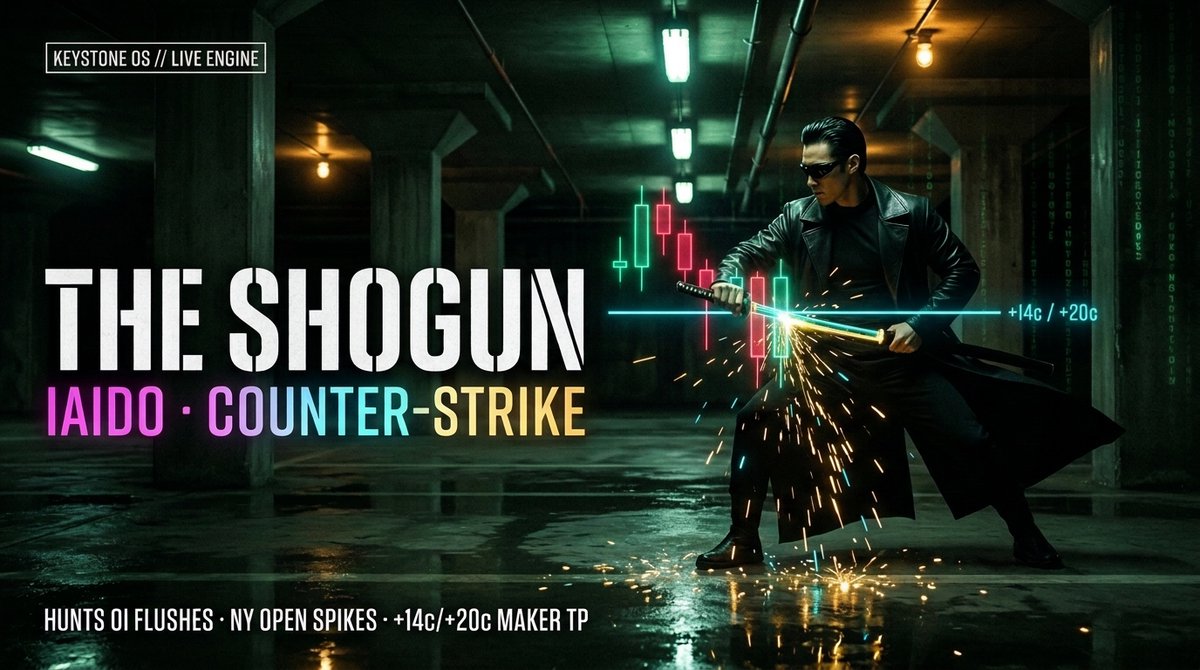
3) THE SHOGUN — Liquidation Sniper
• Built for NY Open spikes, sweep snapbacks & Per-Coin OI flushes
• Stalks 18¢–44¢ panic dips (1 max open trade)
• +14¢ / +20¢ 0%-fee maker TP (Live-L2 Shadow: 72W–24L, 75.0% WR, +256¢/sh TP14 | +289¢/sh TP20)
THE DISCOVERY (Opposite of Gambler's Fallacy):
We audited 86 live-L2 Odachi shadow trades (59 tagged 82¢). Risking 82¢ to win 18¢ has an exact 18.0% breakeven. Today's overall 82¢ -> $0 collapse rate? 18.6% (11/59).
Then we checked clustering:
• After a previous 82¢ -> $0 dump: the next 82¢ collapsed 45.5% of the time (5/11)
• After a clean hold: the next 82¢ collapsed only 12.8% of the time (6/47)
That's a 3.6x regime cluster. Back-to-back 82¢ slams mean you're inside a whipsaw cluster — locking 82¢ saves your stack. Clean trend stretches (12.8% vs 18% breakeven) are where adaptive runners earn real EV.
Different blades for different regimes. Let the tape decide. 🦋⚔️
Huge shoutout to @superalesha — I genuinely didn't even know a Google AI subscription unlocked Colab Pro+ with a 96 GB NVIDIA RTX PRO 6000 Blackwell (G4 GPU) & H100 until I saw your post today.
If you're building on @GoogleColab / @GeminiApp (cc @Saboo_Shubham_), this might be the most slept-on compute upgrade in AI right now.
We just wired a Two-Speed Quant Brain onto it:
• Speed 1: <5 ms LightGBM Abstain-Gate trained on 23,546 multi-coin ticks + 18,906 live-L2 shadow trades (runs locally in <2 ms, zero cloud lag)
• Speed 2: $0-token Qwen3-32B Deep Thinker ("JEV v4") with a "50 First Dates" persistent memory harness ("Lucy's Book")
Quants & market-making engineers: what's the #1 microstructure feature you'd feed a <2 ms binary-market Abstain-Gate next?
Full blueprint in the article below ↓
The real lesson in this 1995 DOS bot isn't the 85% hit rate — it's the -$68.33 unmatched-leg unwinds.
Prediction markets just crossed 190M weekly transactions (>91% on Polymarket + Kalshi), and everyone keeps asking how "Σ < $1.00" arb works and where it breaks:
• Normal book (crossing the spread): YES ask $0.54 + NO ask $0.49 = Σ $1.030 → no edge, scanning.
• Single-venue (Int'l): buy YES + NO < $1.00 and hit MERGE instantly — rare millisecond glitches.
• 3-Venue US Triangle (Polymarket US × Kalshi × Gemini): cross-exchange gaps flash 4¢–11¢ for seconds because venues can't auto-match each other's books.
Why it's NOT free money (3 traps we're stress-testing in shadow first):
1. Leg risk (Leg 1 fills, Leg 2 misses → instant FOK unwind loss)
2. Oracle basis (Lukka vs. CF Benchmarks on tight expiry pins)
3. Book depth (edge dies the second you outsize the thinner venue)
Inspired us to ship a live 1995 CRT DOS "Ghost Terminal" Σ scanner skin on our desk today. Happy Thanksgiving to everyone building in the orderbooks. 🦃⚡
Wild seeing TradFi options desks and crypto prediction-market desks converge on the exact same architecture from opposite ends.
On SPX, @spxomega's Alfa-X maps dealer GEX, Vanna/Charm pins, skewed 16%/2.5% tail cones, and explicit invalidation triggers on one screen. Over in CFTC 5m/15m/1h crypto books (Polymarket US × Kalshi × Gemini), we built our own "Ghost Chart" around the same core loop: live 60-fps probability cones, Deribit gamma walls, OI-flush flow, and hard regime/abstain gates when evidence doesn't align.
His dashboard actually inspired us to tighten our hairline white trail and add 84%/16% + 97.5%/2.5% bell-edge bounds right onto our clean skyline view today.
The real edge isn't plotting one indicator — it's refusing to fire when structure and flow disagree. Clean build, man. Respect. 🫡
Almost nobody realizes Google AI Pro/Ultra includes a 96 GB RTX PRO 6000 Blackwell in Colab at 10 CU/hr. Running a 321B open-weights endpoint is wild, but the real sleeper unlock for solo quant builders is using those bundled Blackwell hours to train fast PyTorch/XGBoost filters directly on your own live L2 orderbook logs — zero cloud GPU bill.
Visual breakdown of the 4,000-candle test — why a roulette wheel stays 50.0% while a leveraged crypto orderbook mean-reverts to 59.0%-59.7% after a 4-candle streak (and 73.7% in live-L2 shadow with a Deribit short-gamma breakout veto):
Everyone calls fading a 4-candle streak "the Gambler's Fallacy."
On a roulette wheel, they're right. Every spin is independent 50/50.
In a live crypto orderbook, they're wrong — because roulette wheels don't have leverage, margin calls, or stretched dealer inventory.
We just tested 4,000 real 15m candles across BTC, ETH, XRP, and SOL:
- After a 3-candle streak: 55.6% reversal (506/910)
- After a 4-candle streak: 59.0% reversal (237/402, p = 0.0003)
- After a 4-candle streak + >=40bps move: 59.7% reversal (215/360)
Add a Deribit short-gamma breakout veto so you don't step in front of a real squeeze, and our live-L2 shadow bot (STREAK4_OPEN_FADE) is sitting at 28W-10L (73.7%).
Next experiment: don't even buy the open at 50c — wait for the 5th candle to fake-continue down to 30c-38c, then rest a 0% maker bid.
Mean reversion isn't superstition when you measure who is trapped on the wrong side of the book.
We are cooking at Google.
In five days, Antigravity increased Gemini 4 Neon usage on the subscription by close to 75% just by caching and harness improvements.
Let this sink in.
BOT HUNTER 3000 — Sent back to the tape to find your edge.
Instead of blindly copy-trading top wallets on @Polymarket & @Kalshi (and getting crushed by lag & 2-sided hedgers), we're reverse-engineering the exact millisecond timestamps of consistent winners against our live L2 orderbook, CVD, OI flush & volatility sensor bus.
When a wallet shows repeatable wins under the same microstructure fingerprint, we extract the physics, run 10,000x Monte Carlo permutation tests, and race it zero-cash in our Shadow Arena.
Hunt edges, not hype.
Will check out https://t.co/IQTWKyrDHt! Two edge cases that bit us live on cross-venue tracking: (1) strike-offset dead zones between Polymarket US & Kalshi where both legs look hedged until settlement, and (2) 60s post-fill markout alongside cancel rate — that's what showed us which maker quotes were getting adversely selected. Happy to swap notes as you build it out!
We're redesigning our open-source Living Dashboard — a bioelectric "conscious interface" for a 95-bot digital organism (hover-expanding agent-cells, live sensor organs, titanium rotary dials, and an Immune System hardware brakes bar).
Ran a 3-way UI/UX design contest today:
1) Bioelectric Morphogenetic Organism (glowing VisionOS cells + lightning filaments)
2) Cyberpunk Holographic Core (3D organism sphere + floating LED knob cards)
3) Obsidian Swiss-Lab Terrarium (titanium tick-mark wheel + inner sparkline + green LED brakes)
Which one wins — and what custom dials or cells would you add?
Open-source interactive HTML prototype (zero deps, Public Terrarium demo) + all 3 concepts pushed here:
https://t.co/f2umez0sG9