The ‘nightmare scenario’ for AI is not the bubble popping, nor is it singularity and 80% white collar unemployment; it’s a world where AI delivers modest productivity increases coupled with slight pressure on the labor market combined with a broader economic drawdown.
AI and the tech industry as a whole receive an excess of the blame and are heavily regulated/generally neutered and forced into subservience vis-a-vis western liberal political elites. The modest gains from AI are then used to keep the crumbling remnants of 20th-century liberalism intact for another few decades while the remaining productive assets and human capital of the west are strip-mined to exhaustion.
Rent-seekers get their cut; political elites make out in spades; the system gets more efficient at extracting the margin from people and the economy. The process of brazilification accelerates.
Apple is the only company with a great proposal here: let parents, who buy the devices used by kids, set up kids accounts and decide what they're allowed to do, then pass those decisions to apps through parental controls -- without demanding anyone's identity papers.
Fascinating to watch the veil of North American Continental Exceptionalism slip.
Mexico being in a state of Civil War with Narco Cartels isn't new. Canada having a seething hatred of Americans isn't new.
American culture is, in fact, so dominant that a sort of outgroup homogeneity bias was inflicted upon the world, creating this image of the three North American nation-states as co-equal peers with little difference between us. This illusion was to dense that even Americans bought into it wholeheartedly, which led to such stupid ideas as NAFTA.
In reality to the North, Canada has always been a highly underdeveloped backwater LARPing as a real country. Canada's Population Meridians are further South than Minneapolis and further East than Detroit. The vast majority of the country is uninhabited and unexploited wilderness. The highest aspiration most Canadians have had over the past 75 years has been moving to America, and those that cannot are infused with a feminine envy that manifests in passive-aggression and self-affirmation. Canada's solution to this is to import infinity South Asians and facilitate the suicide of their self-loathing population.
In reality to the South, Mexico has been in a state of war for most of its history and most of it civil wars. We awkwardly pretend that everything is okay as we politely pretend we didn't catch our neighbor beating his wife after a daily 30 rack. Go look at the numbers involved in Mexico's drug wars. Roughly half a million dead; its neck and neck with the American Civil War. If Mexico's Revolution hadn't been the deadliest war in North American history, the ongoing Drug War would probably end up taking that spot by the time its over.
Canada has always been the jealous incel to America's Chad status, and Mexico has always been the recreational domestic violence family on the block.
North America was never exceptional. The Americas were never exceptional.
The United States of America — *we* are the ones who have been utterly exceptional.
I'm pleased people are finally seeing it.
A guy wanted to drive his vacuum with an Xbox controller. He ended up with live camera feeds from 7,000 homes in 24 countries.
The US government spent two years debating whether DJI theoretically could spy on Americans. Congress passed the NDAA, triggered an automatic FCC Covered List placement, effectively banned new DJI products from the US market in December 2025.
The entire argument was hypothetical. “Chinese drones could enable persistent surveillance and data exfiltration.” No public evidence of actual misuse. DJI challenged the designation in court and lost. They published security white papers. They offered to submit to audits. Nobody took them up on it.
Then Sammy Azdoufal in February 2026 pulls his own auth token from a $2,000 DJI robot vacuum, and DJI’s servers hand him the keys to 7,000 units in 24 countries. Live camera feeds. Active microphones. Complete floor plans of strangers’ homes. IP addresses showing approximate locations. Every device phoning home MQTT data packets every three seconds.
The authentication token was based on the device serial number with zero ownership verification. Any valid credential worked for any unit on the planet. He cataloged 6,700 devices and collected over 100,000 messages in nine minutes.
Azdoufal used Claude Code to reverse-engineer his own vacuum’s protocol. He didn’t crack anything, didn’t brute force anything, didn’t bypass anything. DJI just never built the wall.
And this is the second time in 18 months. In May 2024, hackers took over Ecovacs Deebot X2 vacuums across multiple US cities, yelling racial slurs through the speakers and chasing dogs around living rooms. That vulnerability was disclosed at a hacking conference in December 2023. Ecovacs acknowledged it, said users “do not need to worry excessively,” and shipped an insufficient patch.
The pattern tells you everything about how Chinese IoT companies think about software. World-class hardware, authentication systems that wouldn’t pass a first-year security course. The PIN protecting Ecovacs’ video feed was only validated by the app, not the server. DJI’s MQTT broker accepted any authenticated client for any device topic. Someone designed these systems, reviewed them, and shipped them knowing cameras and microphones would be inside people’s homes.
Washington spent two years arguing about whether DJI might collect your data. Azdoufal proved that DJI couldn’t even stop a hobbyist from collecting everyone’s data by accident. And 54 million US households have at least one smart home device installed, with that number growing every year.
The question Congress should have been asking all along: does DJI know how to secure data in the first place? Now we have the answer.
Yes. Refugees, who are legal & were already vetted by the government & international agencies.
You need to distinguish things like refugees, illegal crossings, visa overstays, student visas, economic immigrants, etc. if you want to understand immigration meaningfully.
More broadly, "pro-parent populism" like social media bans most often transfers the responsibility of parents to the state, and thus works for the destruction of the family
The social media ban for teenagers which is being fast-tracked across the Western world, is a Trojan horse for ending internet anonymity. That is the short of it and the long of it. Resist it at all costs.
Btw- this headline is actually saying that Apple should abandon any & all privacy (it’s dark money messaging)
It’s called the “Heat Initiative” and they are behind many campaigns to reduce encryption & anonymity.
Guess what? They’re funded by a ring of shadow billionaires.
Btw this is how the Sam Altman Panopticon gets legitimized. Once you have a thing that collects information on everyone, the totally natural response is “why didn’t you use this to prevent harm?”
Morally inescapable, and while OpenAI’s motives here were probably venal (like not wanting to remind customers that OpenAI spies on everything you say to chatGPT), it leads somewhere we won’t like.
It’s a real “be careful what you wish for” situation, with a slow creep towards further control and policing mediated through a privately-owned surveillance machine.
There really is no good solution though as long as the machine exists—it *is* horrifying that they sat on their hands with this. Innocent people were murdered, and it was maybe preventable! If you build the panopticon, how do you *not* use it in cases like this? This is the inexorable logic of surveillance that leads to more surveillance and more control. The only workable equilibrium is not building the fucking spy-on-everyone machine in the first place.
Hayek’s greatest insight was that abstract epistemic structures built up by the efforts of countless individuals – such as the price mechanism, traditional moral rules, and law – are typically “smarter” than the innovator who rashly thinks he knows better than them and can simply replace them wholesale. It is a deeply conservative insight, which should not be ignored by those who (rightly, in my view) reject the broadly classical liberal project he deployed it in service of.
@PhilWMagness is right to identify postliberalism as anti–free market and pro-interventionist, but by treating postliberalism as a type of bad economics (which it is!) rather than as a metaphysical revolt against liberal anthropology (which it also is) he does not engage postliberals where the argument actually matters to them. The core postliberal claim is not empirical but it is a rejection of a liberal order in which freedom, choice, and exchange are conceptually prior to truth, the good, and obligation. That argument must be met on its own pre-economic terms. If one then wishes to rescue the notion of free markets, one must show that postliberalism’s anti-market conclusions do not follow from its own metaphysical premises. To my knowledge, only the late scholastics of Salamanca have done so. I’m not aware of any post-liberal economist who understands the core Thomistic arguments of Salamanca and even less Menger, Böhm-Bawerk, Mises, Hayek, Kirzner, Huerta de Soto—on their own terms. A possible partial exception might be Guido Hülsmann.
There has been a minor flutter on here about Matt Bruenig’s instant LLM-authored labor-law book, not least from the anti-AI left.
I find this project fascinating not because it replaces human agency (in the way that, say, an LLM-authored novel would — an anti-humanist endeavor that we should indeed shun), but because it showcases the opposite: what we might call technological humanism — augmenting human capability rather than substituting for human agency and meaning-making.
As Matt points out, this work, which he intends as a vital aid to workers and labor lawyers engaged in struggle against injustice, simply could not have been produced prior to the advent of LLMs, as it would have been too labor-intensive. This is exactly the sort of thing that we should be using AI for.
Bravo, Matt! What a neat project!
For decades, the Catholic conversation on dress has decried the loss of modesty in today's fashions. And there's no doubt this is a huge problem.
However, immodesty is just one symptom of the ravaging disease that has made our world a sartorial wasteland. This disease is a hatred of beauty and a glorification of ugliness. It comes in many subtle forms, but its rotten fruits are all around us. The ugliness of our clothing has a devastating effect on our souls. It is time for Catholics to demand something better.
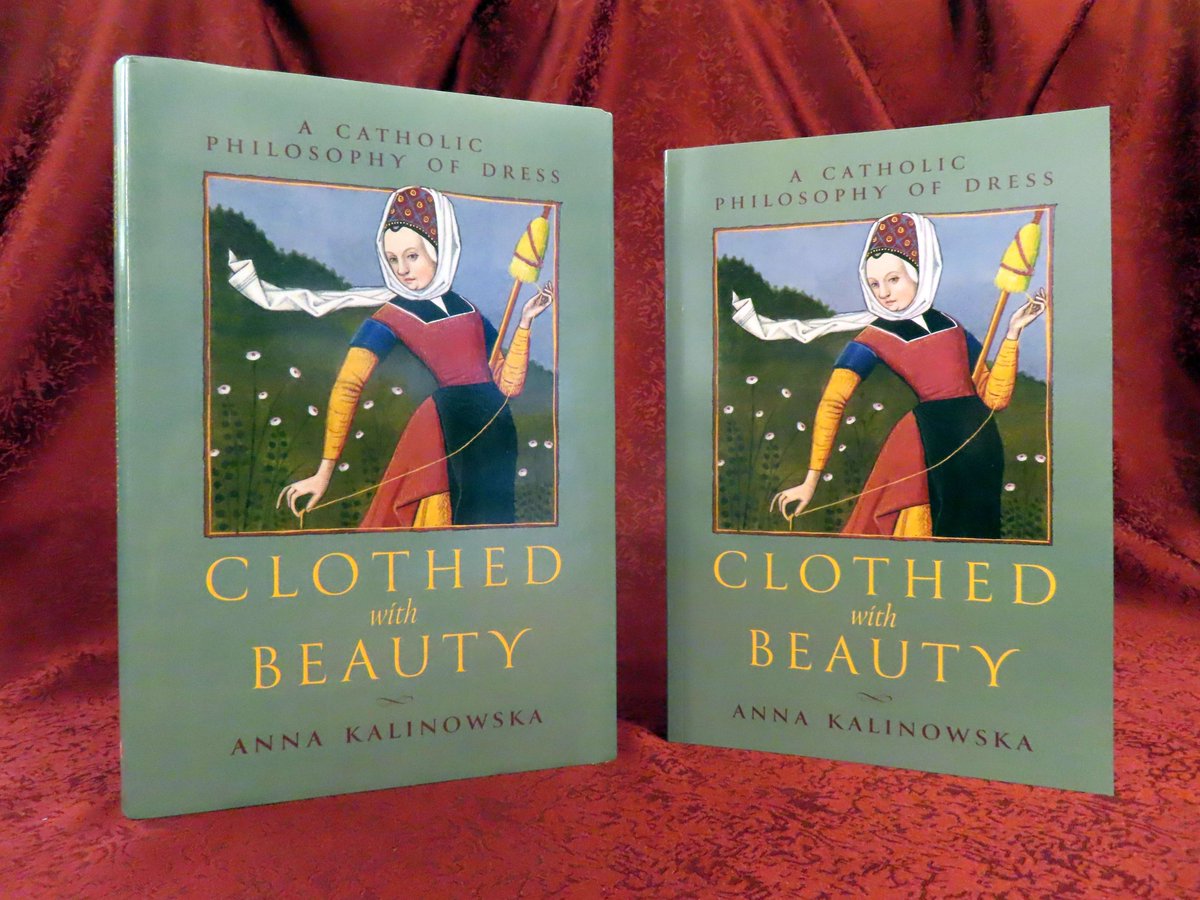
In 𝐶𝑙𝑜𝑡ℎ𝑒𝑑 𝑤𝑖𝑡ℎ 𝐵𝑒𝑎𝑢𝑡𝑦: 𝐴 𝐶𝑎𝑡ℎ𝑜𝑙𝑖𝑐 𝑃ℎ𝑖𝑙𝑜𝑠𝑜𝑝ℎ𝑦 𝑜𝑓 𝐷𝑟𝑒𝑠𝑠—the latest release from Os Justi Press—Anna Kalinowska draws on Church teachings, the Catholic philosophical tradition, and fundamental principles of art to diagnose insidious and far-reaching problems with today's fashions. Written for anyone interested in cultivating beauty in everyday life, this book provides concrete artistic instruction along with answers to such perplexing questions as:
• What exactly does it take for clothing to be beautiful?
• Why are many of today's modest options actually so unattractive?
• Can clothing be both modest and beautiful?
• Is the quest for beautiful clothing a kind of vanity or waste of time?
• How do we begin a restoration of the art of dress?
In addition, Kalinowska assesses treatments of this topic by such authors as Przybyszewski, Goldstein, von Hildebrand, Noonan, Boudreau, Hammond, Caruso, Sokolowski, Fallon, et al. She shows why the more recent writing on women's fashion tends to be very inadequate.
Every reader—young or old, man or woman—stands to gain from engaging with this wonderful, thought-provoking, and (I would say) life-changing work.
𝑷𝒓𝒂𝒊𝒔𝒆 𝒇𝒓𝒐𝒎 𝑹𝒆𝒂𝒅𝒆𝒓𝒔
“Miss Kalinowska has stitched together a magnificent standard on beauty in dress that is ready to be raised aloft by its readers. Her arguments weave considerations from theology, aesthetics, and history into a precise and inspiring guide. Her impeccable style encompasses both fashion and writing particularly when she deconstructs the fallacies found in much previous writing on the subject.” —𝐆𝐰𝐲𝐧𝐞𝐭𝐡 𝐓𝐡𝐨𝐦𝐩𝐬𝐨𝐧-𝐁𝐫𝐢𝐠𝐠𝐬
“Readers will find much to ponder in 𝐶𝑙𝑜𝑡ℎ𝑒𝑑 𝑤𝑖𝑡ℎ 𝐵𝑒𝑎𝑢𝑡𝑦, as will anyone dissatisfied with today’s dismal choices in clothing.” —𝐋𝐞𝐢𝐥𝐚 𝐌𝐚𝐫𝐢𝐞 𝐋𝐚𝐰𝐥𝐞𝐫
“We are not angels; what we do through the body both manifests and affects us. Dress is a language with its own grammar and vocabulary. One’s dress can say: I respect neither myself nor anyone else. Clothing which is beautiful, however, possesses some mark of excellence, is ‘other-worldly’: it speaks of a woman’s dignity and eternal destiny. Anna Kalinowska is to be congratulated for this insightful and timely work, which I highly recommend.” —𝐑𝐞𝐯. 𝐌𝐚𝐭𝐭𝐡𝐞𝐰 𝐌𝐜𝐂𝐚𝐫𝐭𝐡𝐲, 𝐅𝐒𝐒𝐏
Available in hardcover and paperback from the publisher, where you can also "look inside":
https://t.co/uC62BWZBiZ
Or from Amazon:
https://t.co/IzSwMBQZd6
(Please pardon the grayness of the photos, there's something wrong with my camera, I think—the actual pages are bright white and the text is crisp.)
I should also add that while I do not agree with them, I can respect those defenders of the SSPX who are just honest about what the SSPX's position is. What annoy me is those who play this motte and bailey game about what the SSPX's position is.
Watched the Marc Barnes/Matthew Sanders AI debate. Barnes raises a legitimate point about how it is a problem that AIs function in a way that simulates real language. The fact that Sanders thought one could even entertain the question about AI actually becoming intelligent was very concerning.
Nonetheless, Barnes's argument about AI being intrinsically wrong is highly problematic. The mere fact it is probabilistic is a bad argument, as any means of communicating knowledge is going to have a probability of being wrong. Barnes argues that we can always blame a person if a person gets it wrong, but I think whether or not something is true is more important than whether a person wrote it. And as Sanders points out, the person who develops the AI takes responsibility for its output in the end.
Barnes's legitimate concerns about AI could easily be solved by removing the human-like features of AI's output. This would also make AI simply a stronger tool. I don't want ChatGPT to tell me about its "feelings." I just want it to translate the text I gave it in a language I can't read or to find articles on the topic I asked it for. AI can be a really useful research tool when used correctly (for example, it is actually quite good at translation), even if I agree with Barnes that it is generally being used badly right now by most people. Removing the humanoid features would help to get people to stop using AI in bad ways.
I will add the qualification that anyone who tags grok on X to make a point should receive a sentence of 20-life (only because of CCC 2267).
https://t.co/qKLVA8hPXv
I think there is something that corresponding to what modern science describes as atoms, but I think the way the vast majority of people conceive of them does not exist. They are the result of interactions between quantum fields according to modern science, not the collection of little balls that they are described as to most people. This isn’t even just as a case of us giving an oversimplified explanation to students (which is fine to do), but it basically instills an atomist metaphysics to most people which undermines the Platonic-Aristotelian approach that underlies a classical conception of the world. Quantum mechanics actually fits better with this classical conception because “particles” are really just waves of potency.
@holysmoke@RomanoSace57080@c10841098t ...where many bishops that received jurisdiction have never seeked reconciliation and consistently and publicly present themselves as prelates of an independent, i.e. schismatic church, elected without papal mandate
@holysmoke@RomanoSace57080@c10841098t I think you can make an argument that pre-2018, since the normalized bishops all seeked reconciliation out of their initiative and at least claimed to be consecrated under duress, some sort of "radical sanation" of the sacrilege occurs unlike the current policy...
@RomanoSace57080@c10841098t@holysmoke Would you say that the consecration of "patriotic" Chinese bishops without papal mandate is and remains objectively sacrilegious, despite any retroactive "healing" of canonical status afterwards, and the latter is just permissible tolerance of an evil for the peace of the Church?