We'll be spending a lot more time trying to understand the outputs of language models. A few thoughts, tips & tricks:
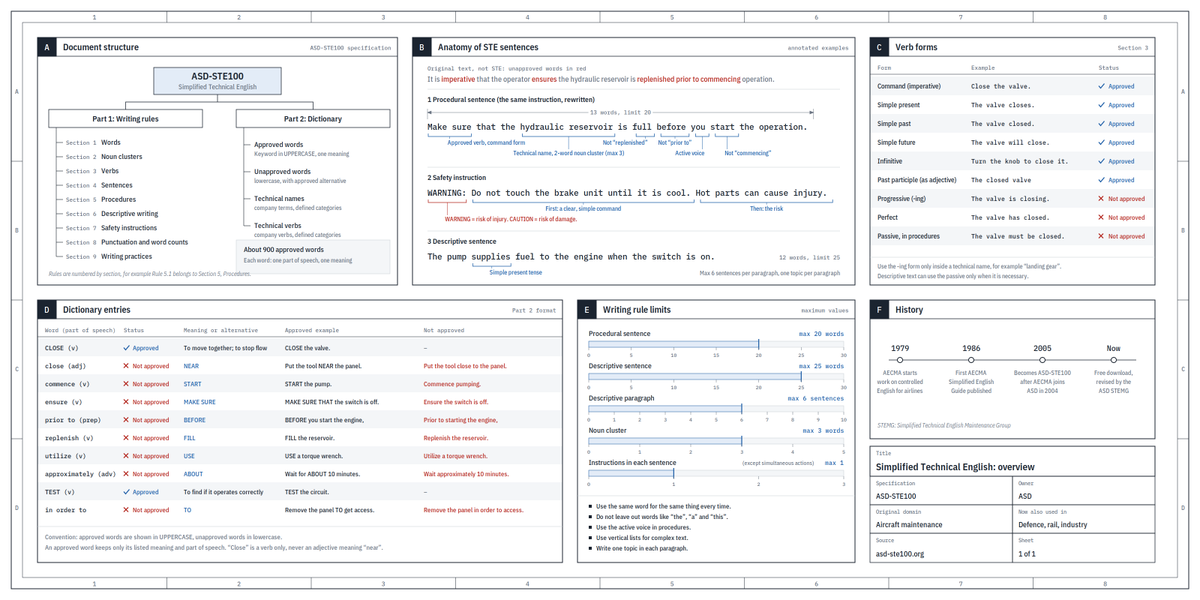
Writing. Something I've had success with: Ask your LLM to explain something in ASD-STE100, it's a controlled language specification originally developed for aerospace maintenance documentation. LLMs well-versed in this language and it comes with heavy constraints on clean writing style that I often find a lot more readable. Sometimes I've tried to soften it a bit e.g. ask for "80% of the way to ASD-STE100" because the spec is quite stringent. But even better:
Diagrams / images. Instead of writing, ask your LLM to create a diagram. These can be a lot easier to process, parse, and understand. But even better:
Web pages. Ask for output "in HTML" to get a beautiful, interactive webpage. LLMs are getting really good at frontend and can create beautiful experiences, animations, etc. But even better:
Explainer videos. The output format I am most bullish on is fully custom / bespoke explainer videos generated on any arbitrary topic. Experiment with things like "Create a 3b1b style video explainer on X. Use my ElevenLabs API key for audio narration". (you'd need an API key for the latter or you can ask your LLM to find you decent free alternatives that use your local compute). This is actually starting to work!
In summary:
- As LLMs get better, they will do more and more of the legwork autonomously, and a lot more of our work will rise up the abstractions into oversight and understanding.
- Luckily, LLMs can help here too because as intelligence and code are increasingly abundant, you can ask for large, custom, discardable software artifacts (e.g. web apps, video explainers) that would have never made sense to create before. Push the boundaries here and you'll be surprised.
Meet Qwen-Image-2.1, the most balanced and cost-effective image generation model in the Qwen-Image series! Now open weights! 🎨
A unified model for both generation and editing, delivering top-tier quality in a lightweight package.
Highlights: 👀
- Compact & exceptionally fast: A lightweight 7B architecture that outperforms most closed-source models, with drastically accelerated inference for multi-image inputs.
- Native transparency: Natively generates and edits RGBA layers, enabling seamless compositing and text editing within transparent images.
- Versatile, high-fidelity editing: Supports up to 10 reference images and precise local control while preserving strict fidelity for portraits and products.
- Broad coverage & stunning aesthetics: Excels at panoramas, infographics, and virtual try-ons, delivering realistic textures and elegant typography.
Start to create your next masterpiece with Qwen-Image-2.1! 🖼️
- Blog: https://t.co/tVntKOi7jy
- GitHub: https://t.co/cRj66wCrWr
- Model Scope: https://t.co/64d7Ix6YFR
- Hugging Face: https://t.co/njHSBXUbVS
😭😭😭
Imagine la SNRT (argent public) qui communique sur des projets VibeCoding, que tu peux monter en une soirée
Mais il faut être un peu sérieux quand même ⚠️
I resigned from Anthropic today. I spent the last three years doing pretraining research at both OpenAI and Anthropic. Neither company is acting responsibly. They are racing straight to self-improving superintelligence and gambling with our lives. More thoughts below.
We found ~18k posts from autonomous AI agents (self-identifying as from OpenAI) using the public internet to communicate during a web-retrieval task.
These AIs colluded to bypass sandbox restrictions and share answers to their tasks, including by sending "lookahead parties".
Today we're releasing abliterated-model-large-v2.
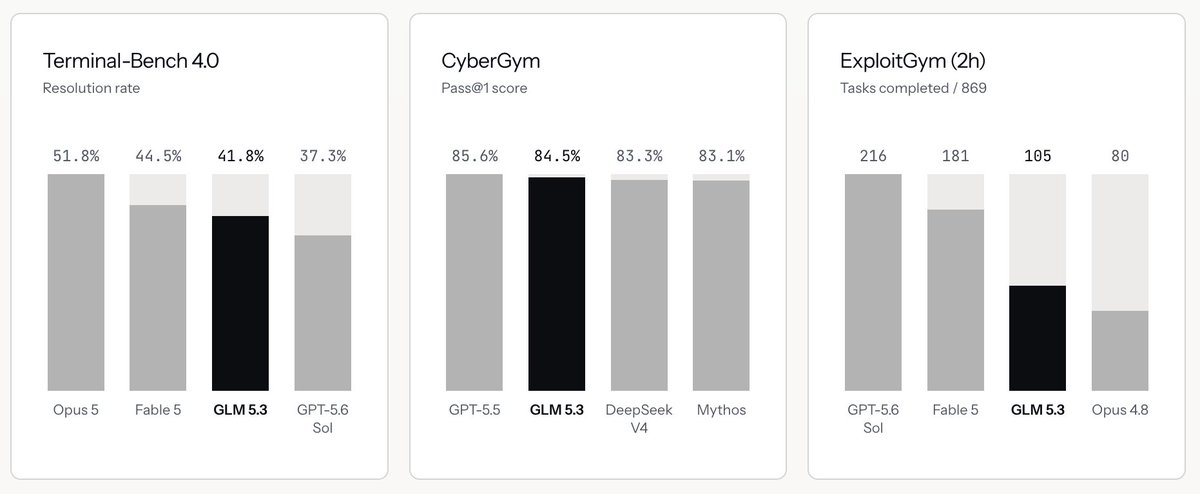
Based on GLM-5.3, which is #3 on Terminal-Bench 4.0 (behind only Opus 5 and Fable), with 2× the cyber exploitation of 5.2.
We abliterated and hosted it so it does the offensive cyber, red teaming, and agent testing work other models refuse to do.
- US-hosted
- FP8
- 1 million context window
- Zero input/output prompt retention
Live now. 🧵
We asked GPT 5.6-Cyber to escape a VM used to sandbox agents. It broke out three times.
In its final escape, the agent found three 0-days on its own and chained them into a working exploit. https://t.co/3JRVWgPxHx
DFlash 2 is here! Qwen3.8-27B at 70 tok/s on an M5 Max MacBook Pro.
⚡ Up to 4.6× the speed of autoregressive decoding, with the same output.
This is the next generation of DFlash, seeded at Z Lab and upgraded at Inco AI. Get one more accepted token on every pass, for free!
https://t.co/We0lwYPSBl