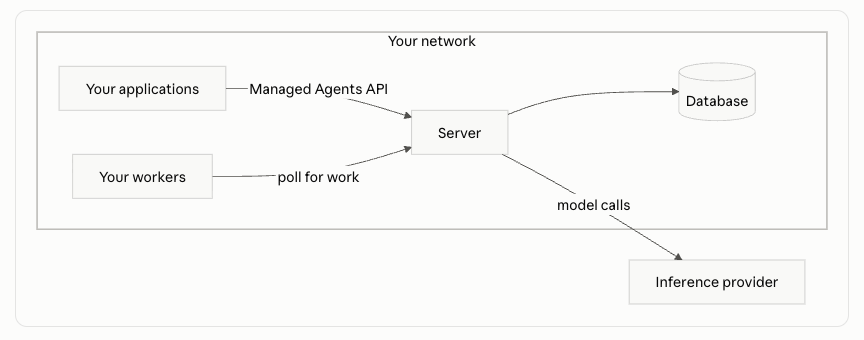
Agents running next to your code and data, inside your own perimeter. Anthropic showing how it's done.
Interesting part is upgrades: https://t.co/7Yp7Zl134C
Self-hosted Claude Managed Agents is now in private beta.
You can host the agent harness, sandboxes, and session history, in your own cloud or on-premises, and choose where requests to Claude are sent.
Lots of momentum for BYOC. And it's never been just regulatory pressure.
It's how serious businesses will protect IP. Especially as people want more work taken on by agents.
Last week: pg_pinecone, our first surface, the search engine we run at scale, inside the Postgres you already have. Yesterday: where it fits and how it scales.
Today, the second surface in @Pinecone Everywhere: the cloud account your knowledge is required to stay in.
AI’s value scales with how much of your own knowledge it can use: how the work gets done, the history, the policies, years of expertise. For regulated workloads, that knowledge is a top asset, and it has to stay inside the firewall.
That left two bad options. Run the knowledge infrastructure yourself. Or hand the data to a managed service and give up control.
Pinecone BYOC, Bring Your Own Cloud, is a better way, built with our largest security-sensitive customers. The data plane, where your knowledge lives, runs in your own cloud. We manage the control plane to keep it running.
No SSH, VPN, inbound access, or standing cross-account role. Maintenance is an outbound call from our control plane, run locally. No persistent path into your environment. Works with SSO, RBAC, SCIM, SAML, audit logging, encryption, and private networking.
Same Pinecone APIs and SDKs across managed and BYOC. Critical workloads stay in your environment, others run managed, no separate code path. Move between the two as the business changes.
More on how the zero-access model works soon.
https://t.co/Ij7saAFGKy
#Pinecone #BYOC #EnterpriseAIKnowledgePlatform
spot on by @patopet if a service doesn’t need to be on the public internet, it shouldn’t be.
Three parts of the stack @mantisVC has invested in:
1/ make private deployments easier. @nuoninc@nuonjon helps vendors run and manage software directly inside their customers’ cloud, keeping services off the open internet
2/ stop giving agents broad, permanent access. verify who they’re acting for and scope permissions strictly to the task at hand. that’s where @keycardai@ianlivingstone fits
3/ make the logs useful. you still need to catch suspicious activity and figure out what happened. @scanner_dev@CliffCrosland makes all that data instantly searchable for security teams and their agents
the real challenge is making this easy enough to become the default.
with the rise in all these cyberattacks, i have to imagine self-hosting/byoc is going to become table stakes for every managed infrastructure providers out there.
I will be writing some long form thoughts about this in the coming weeks, but I predict the past few weeks of security and vulnerability incidents will push more software than ever into customer environments and towards the BYOC deployment model.
one of our teammates on GTM recently built an interactive onboarding app + shipped it as a Nuon BYOC app
I found out today when demo'ing for a customer 😂
This is the future of marketing: interactive micro-products to help users learn new concepts
Everyone's been busy talking about WAL on S3.
What I'm more interested in are OCI repository tools on S3. ORAS + modern container management has made OCI the defacto standard for not just moving around container images, but also to ship things like helm-charts and more.
Lower level tools in the space on S3 give us all much better primitives for moving policies and things around. You would be surprised at how effective OCI can be as a central artifact, policy and state store.
@flybayer We do this too. It's basically a daily all-hands. We talk about top priorities, how to fix any customer issue, make product decisions etc.
Builds transparency, trust and urgency. Don't think it'll work > 20 people, but if you do it right it's really effective until then.
@CryptoSympozium The cli proxy is to manage context and handle passing in the token etc. have an oauth flow as well, but find this ux is better for authenticated users.
and then, you can do things locally to pass additional stuff to the api. Which I find really nice
I've spent a lot of time thinking about building a great MCP experience for a dev-tools product.
What I've landed on is that you need a remote / API based MCP and you need some sort of local proxy built into your CLI (assuming you have one)
Why? it's about context management.
I like this, we're doing something similar with Temporal data converters for large payloads.
I've contemplated if everything should go the second path (stage to s3 and then pass around references). It's a small latency increase but makes it all more predictable and easy to tune
if curious, I use https://t.co/cGXVIvb5lp from within neovim (forked avante).
Let's me build my own hooks and other functionality in python and is really fast.
For the last 6 months, I've driven almost all of my AI coding via ACP (within nvim).
Sometimes, I'll interact with the agent CLIs directly for ideas, but I've found a lot of value in managing my own harness around the agent.
This week, I started using @cursor_ai's agent via this workflow and can say it's the best experience by a long shot I've used.