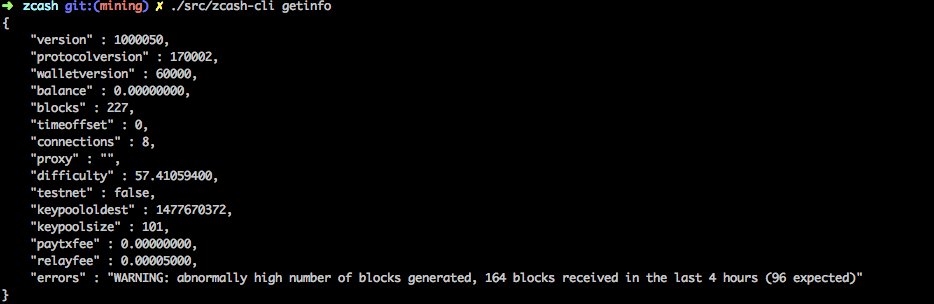
naturally, @ValarGroup and @ZakuraZcash used some old and new tricks here to get SoTA performance
1) start pull based when joining the network, then switch to push after routes are learned. fallback to pull when needed
2) since routes remain relatively static depending on entry point, use that to learn push routes
3) put haves and data in the same channel, organically discovering congestion and fastest routes w/o explicit measurement
4) use parity data and a "miner mesh" for safety
5) broadcast tree from the miner
6) stripes to start decoding on the fly
probably forgetting other cool stuff. read more here https://t.co/hD2VaWg1wq
"Until users make that mental leap that privacy doesn't come from something you move your money through, it comes from *where you store your money at rest*, they'll keep making this mistake."
@nate_zec@gojomo@feministPLT@ZingoLabs This sounds similar to the proposals for "liberated payments" - the capability is the spending key (and potentially the note). And so, yes - there's definitely interest.
Rust could have been an ideal ocap language if `unsafe` had been made a capability, instead of a keyword. The borrow system then does _literally the rest of the work_.
Still chafed about that.
@gojomo My moderate credence + hypothesis-curiosity:
- ocaps have strong composability benefits
- in each local case, common for devs to unknowingly/uncaringly violate ocap constraints
- a crit mass of composable systems w/ consistent UX could flip that dynamic to self-reinforcing
⤵️
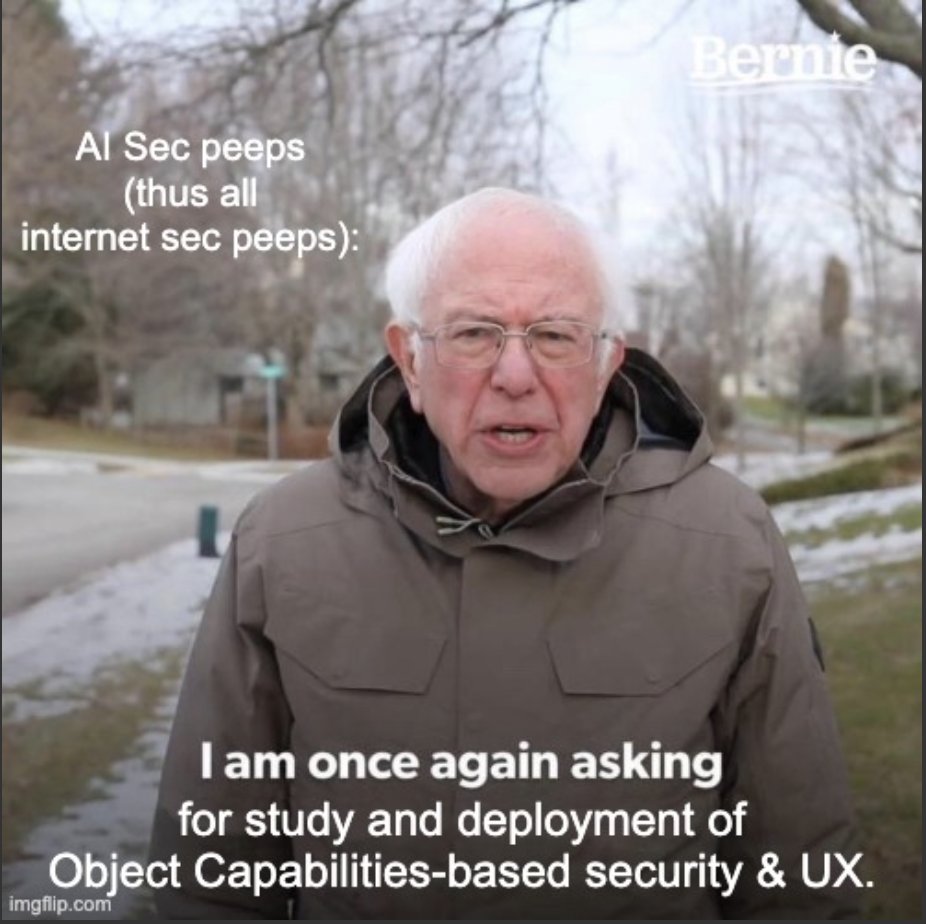
AI developments in infosec have only increased my belief that object capabilities security w/ proper UX can be a competitive product advantage the more user-composition/orchestration straddles stacks, infra, apps.
I think Justin Drake's latest alarmism/vagueposting is going to do a ton of damage in multiple ways. It's basically a huge self-own for their own advocacy work on quantum stuff.
Threats from quantum/AI are real, and teams throughout this industry are making considered decisions about how to respond to those risks in a practical way, and to help their users navigate the uncertainty.
Some of those teams have really good cryptographers with an excellent grasp on the decisions they can make, others have to take their cues from trusted experts. There are so many dimensions to optimize along! And due to the complexity involved, it's almost impossible to explain this stuff to non-cryptographers.
Experts have to be cognizant of all this, and of their responsibility to be levelheaded.
After the fog clears up and people learn from their cryptographer friends what is actually going on, they're going to discover this was (at best) an unintentional marketing stunt and a lot of trust will be lost. And nobody will really know what to do...
This is a shame, because they are directionally correct. It actually meant something when they sounded the alarm before. They've just gradually descended into unhinged predictions without feedback to discourage it.
Can anyone, I mean seriously anyone, justify this debacle? It permanently colors all the legitimate concerns/predictions about classical crypto going forward. By their own admission, there was no new information that drove this. I think Justin Drake should explain how he thought this was the right approach, even if he genuinely believed what he was saying.
Baffling.
For anyone who doesn’t know, Sean’s credentials as a world class cryptographer were conferred on him primarily by his work on zk-snarks in zcash, particularly by making them recursive, which is an incredible feat of both mathematics and engineering.
He does not get enough credit for this, imo. If you believe in zec, thank Sean.
Thank you Sean. 🫡
Fun fact: Groth16 is less at risk from AI than STARKs.
Now that I have your attention:
We can’t, of course, assess the risk of AI breaking crypto, but we can assess everything else. And the landscape doesn’t look like what the hot takes imply.
There are different kinds of cryptographic primitives. Hashes, public-key encryption/signatures, PRFs, etc. Short of P=NP type results, if AI breaks any/all of these, it won’t be all at once.
Hashes are the black magic of cryptography. They take an arbitrary file/string and produce a collision-resistant fingerprint. We’ve had human-powered breaks of deployed hashes. MD2, MD5, SHA-1 have all been broken and protocols upgraded as we became less confident in those hashes. A break of SHA-256, SHA-3, or (for cryptocurrency) especially Poseidon wouldn’t be insanely out there.
In contrast, RSA and elliptic curves, which underpin public-key encryption and digital signatures, have survived for decades.
For symmetric key ciphers and PRFs built from them, it’s even better. DES was designed in the 1970s, and the practical attacks there are from brute forcing the keys.
Ok, back to my admittedly clickbait assertion.
STARKs, of course, are a type of “zero-knowledge” proof. In particular, a type of SNARK that uses hashes and error-correcting codes. Hashes show up both in the polynomial commitment, which is a Merkle tree, and in the Fiat-Shamir transform, which is used to generate random challenges for verification.
Groth16, in contrast, depends on none of these. It’s elliptic curves, pairings, and some strong assumptions about how those work. And Groth16 proofs themselves are post-AI and post-quantum private, since Groth16 gives you at least statistical zero-knowledge, which does not rest on a computational assumption. In contrast, most deployed STARKs aren’t, in fact, zero-knowledge at all. They are only used for succinctness and do not give you privacy today, even without advances in AI or quantum. This is, allegedly, an easy fix (and the fix would give you PQ privacy too), but it hasn’t happened for the most part.
Of course, this doesn’t matter much. In fact, if either elliptic curves or hashes were broken, most things you actually use, including applications using Groth16 or STARKs in cryptocurrency land, would have real problems. All most all applications in cryptocurrency and of zk proofs, depend on both assumptions, even if the proof itself does not.
And if AI breaks part of crypto, we’d have even bigger problems for securing the internet, banking, and critical infrastructure using HTTPS/TLS and boring things like Active Directory and OAuth. So really, in a certain sense, this entire discussion is clickbait. But it’s interesting seeing people make just plain incorrect technical assertions about cryptography in the process of posting hot takes.
As someone said, this entire topic of AI breaking crypto in cryptocurrency is a bit weird. It’s a bit like wanting a fallout bunker to survive global thermonuclear war. Everything is dead anyway.
In conclusion, making such statements without any evidence is the opposite of responsible behavior. It is the very definition of FUD — it cannot be proven wrong but there’s also no evidence whatsoever of it being true. n/n
Introducing Epoch, Shielded Labs’ new research and engineering project focused on hardening Zcash from future threats:
AI-powered hackers
Quantum Computing risk
Adversarial governments
We plan to achieve this through formal verification of critical code and by deploying “post-everything” cryptography.
Epoch will ensure Zcash remains designed for the threats we face today and for whatever comes next. ⤵️
Zcash Coinholder Retroactive Grant results are in!
Honestly, I’m surprised at the results…
What got funded: most of the bigger asks got funded, which were mostly for critical infrastructure, ironwood work, and critical bug reports.
A clear signal that coinholders are very willing to fund core infrastructure and critical security.
What didn’t get funded: smaller asks which tended to be more experimental ideas or non-core tools.
I actually thought some of the tools there were useful and should be funded, while others were a bit more“me too” and vibe coded. For some of the smaller amounts I would have voted yes.
A few ways to interpret this:
- Coinholders didn’t like the projects at all and didn’t want to fund them
- Coinholders viewed them as non-critical and not what CHV should be used for
- Coinholders don’t want to administer a small grants program and hope to discourage lots of low effort submissions in the future
Given that @ZcashLabs had the smallest grant approved, I think it may be signal that coinholders are supportive of small grants programs but not of directly voting on every small grant.
That said, I would have expected some of the other small grants to be approved as an example of which small grants Coinholders would like to see funded.
Decentralized funding just got very interesting. Looking forward to see how the next round shapes up.
https://t.co/lnIU1gNbJG