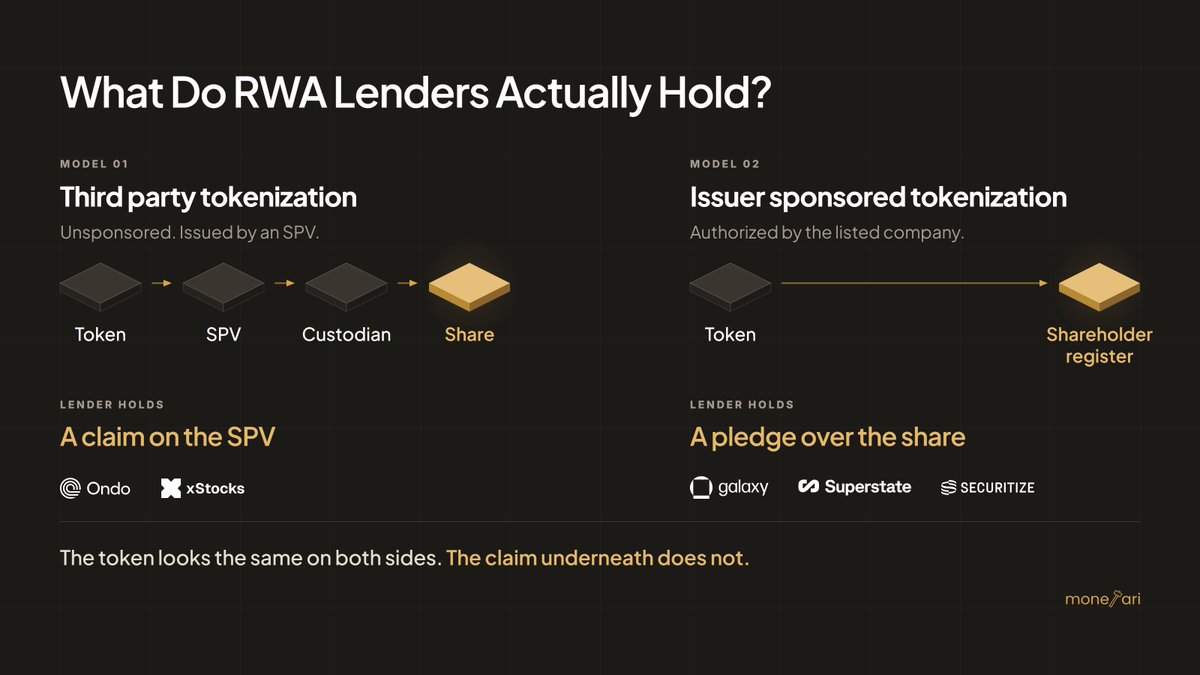
Tokenized stocks are now widely accepted as collateral in lending markets, yet what a lender can actually recover depends on who stands behind the token.
Most tokenized stocks in circulation are issued by a third party vehicle without the listed company's involvement, so the holder owns a note against that vehicle and the lender takes a claim on a claim, with recovery tied to the vehicle, its custodians and restricted redemption. Issuer sponsored #tokenization records the share itself on the company's official register, which allows a pledge to be enforced under existing securities and collateral law and brings tokenized equity into the repo and securities lending markets institutions already operate.
At Monetari, we work closely with institutions to bring real-world assets on-chain in full compliance.
Orta Vadeli Program 2027-2029, sermaye piyasası araçlarının kripto varlık olarak ihraç edilebilmesine ve kayden izlenmesine ilişkin usul ve esasların belirleneceğini ortaya koyuyor. Program ayrıca blokzinciri öncelikli derin teknoloji alanları arasında sayıyor, pay piyasasında takas süresinin kısaltılmasını ve İstanbul Finans Merkezi'nin fintek ile bölgesel fon yönetimi merkezi olarak konumlandırılmasını öngörüyor.
Bu maddeler bir arada ihraç, kayıt ve mutabakattan oluşan tokenize bir sermaye piyasasının bileşenlerini tarif ediyor. Monetari, Nexum OS ile sermaye piyasası araçlarının finansal kuruluşlar tarafından ihracı, kayden takibi ve mutabakatı konusunda hizmetleriyle sektörde öncülük etmeye devam edecek. #OVP #Tokenizasyon
Most real world asset products in the market today sit in one of two structures, and the difference is easy to miss because both end up as a token that moves on chain.
In the first, an issuing vehicle creates a transferable instrument that tracks the performance of an underlying asset, and the holder's claim sits against that vehicle. In the second, a regulated fund issues the shares themselves, and the holder sits on the register with redemption rights against net asset value.
Both can be fully compliant, and both have serious institutional users. One is optimised for transferability and distribution, the other for the strength of the claim behind the token.
The useful question for any #tokenization product is what the holder is left holding if the issuer fails.
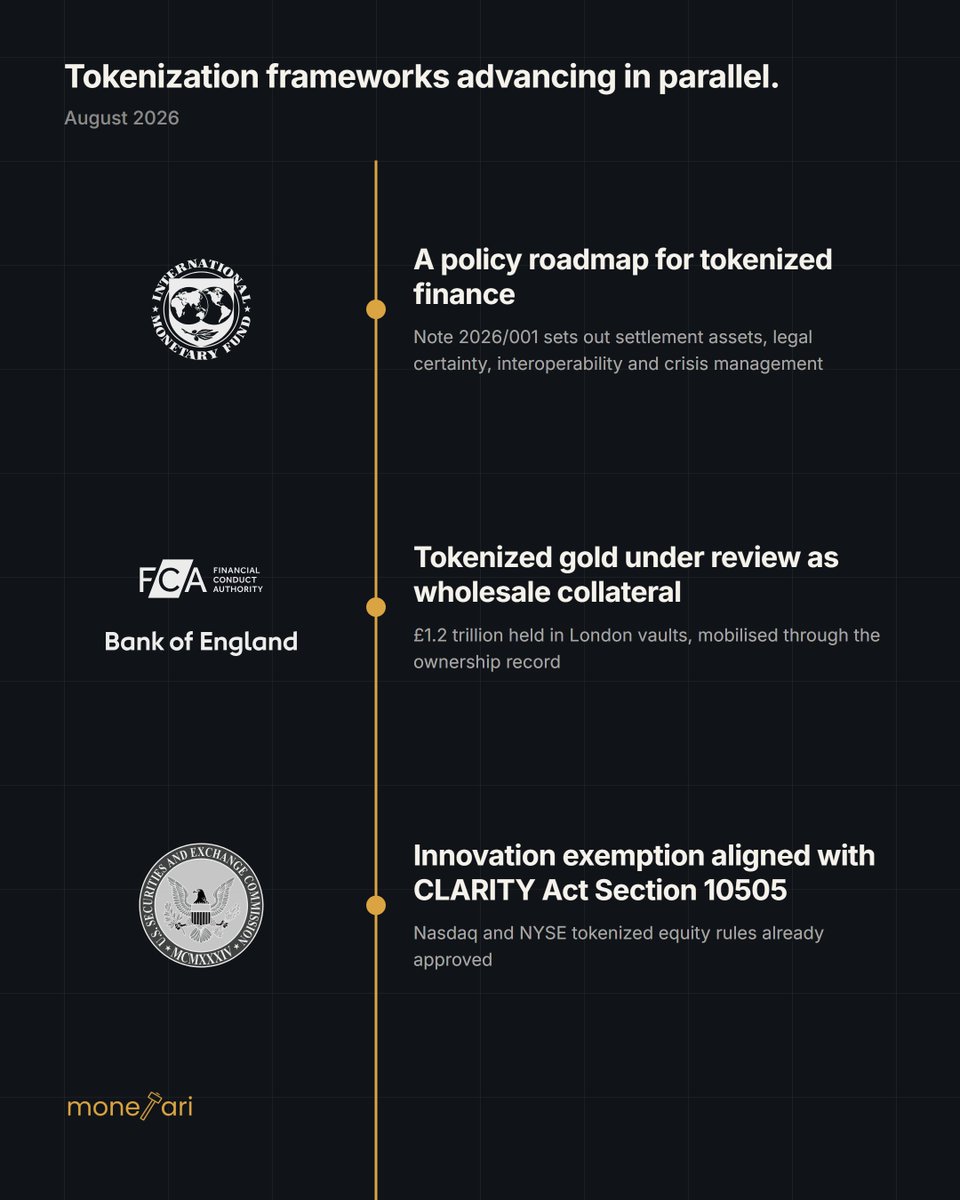
Central banks, regulators and market infrastructure are advancing the monetary, collateral and securities frameworks in parallel. Tokenization is becoming standard financial market infrastructure.
Three institutions are working on tokenization from different angles this month, and each is laying groundwork for the financial system that comes next.
👇
In the United States, the SEC is coordinating its innovation exemption with Section 10505 of the CLARITY Act so that tokenized securities and their underlying assets are treated consistently. The 14 August meeting was postponed to let the Senate vote first. @Nasdaq and @NYSE already have tokenized equity rules approved.
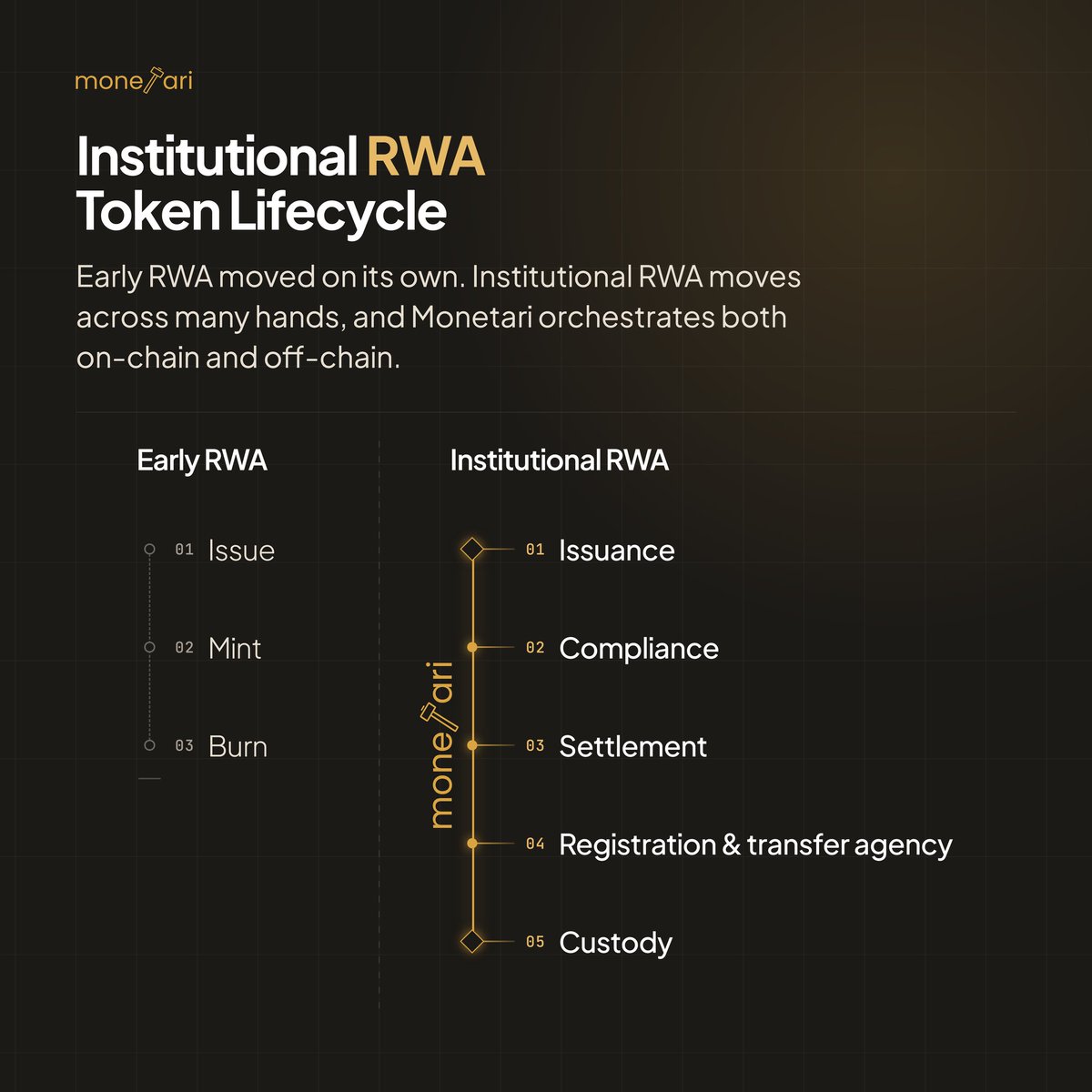
Tokenized funds have grown large enough that investors expect them to be serviced properly. Transfer agency and registration are being rebuilt around on-chain flows to meet that.
In the early days of RWA both functions stayed entirely off-chain. The token was a wrapper representing an asset whose transfer and registration were handled somewhere else, with nothing operational connecting them.
@BNYglobal's Digital Transfer Agency capabilities allow the full transfer and registration flow to be booked on-chain. In the mirror model that has prevailed alongside it, the chain is the primary venue for the transfer and the entry in the traditional register follows it. In both cases a transfer cannot be treated as final without the chain.
That convergence makes the legal setup and the connectivity behind it a precondition for vendors to stay in this market. Technology alone does not let an asset manager operate. What has to come with it is a legal setup and an on-chain lifecycle that are connected and regulated under the capabilities institutions can use today. That is the layer Monetari builds.
Monetari spent the past week in Lisbon for @ETHGlobal Lisbon and Lisbon Blockchain Week.
One theme ran through every conversation we had. The @ethereum ecosystem is turning its attention to the institutional side, and the infrastructure players bridging financial institutions to these networks are becoming central to that shift.
Good to compare notes with the teams working on the same problem across Europe.
Obrigado, Lisboa. See you at the next one.
@ArrakisFinance Great piece. The most credit-like assets pull the biggest tickets and hold onto buyers longest, but that whole tier is basically US paper. EM sovereign and corporate bonds pay a lot more in the same currency and don't exist onchain.
Last week, @Visa, @Mastercard, @Stripe, @BlackRock and @Coinbase were announced among the 140 partners behind Open USD, a stablecoin built on shared governance and shared reserve economics. Weeks earlier, @JPMorgan, @Citi, @BankofAmerica and @WellsFargo announced a shared tokenized deposit network operated by @TCHtweets, connecting tokenized deposits to the rails that already clear trillions of dollars.
The two initiatives are building different forms of tokenized money, each with its own claim structure, reserve model and settlement finality. What they demonstrate together is how decisively the world's largest financial institutions are committing to tokenization as the foundation of future settlement infrastructure.
Whichever form of tokenized money a market adopts, the operational layer that issues, custodies and settles it still has to be built inside the institution. That is the layer Monetari builds for regulated financial institutions in emerging markets.
Monetari olarak Fintech Zone İstanbul'un yürüttü��ü Fintech Gate Programı'na katıldık.
İstanbul Finans Merkezi'nin vizyonuyla şekillenen bu hızlandırma programı, teknoloji şirketleri ile kurumsal finans kuruluşları arasında güçlü iş birlikleri için zemin oluşturuyor.
Tokenizasyon ve dijital varlık saklama altyapımızla halihazırda sahip olduğumuz kurumsal iş birliklerine, başta Türkiye olmak üzere gelişmekte olan pazarlardaki finansal kuruluşlarla program aracılığıyla yenilerini eklemek için heyecanlıyız.
@TCSanayi @tvfifm @istuniresmi @fintechzoneist @craftgateio @SerDanismanlik @istkaorgtr
We are thrilled to share that we have completed a smart contract security assessment for @monetaritech! 🔐
Monetari is the tokenization infrastructure for emerging markets. It provides financial institutions and asset managers the technology to issue, manage, and distribute tokenized real-world assets, with governance, controls, and compliance built into the platform.
@CoinDesk@Citi $5.5T in tokenized securities by 2030 means emerging market financial products either get the infrastructure to reach global capital markets, or stay local. Monetari builds that infrastructure.