We’ve raised $110M to bring AI-powered biomolecular design to every scientist!
Boltz’s Series A is led by @BessemerVP, following 50-fold growth in molecular token usage from our users since June and partnerships with 6 of the world’s 20 largest pharma companies.
I promised more on TMol in the RFD4-Proteina thread. Now with the paper on arxiv here we go! 🧵
Rosetta-style all-atom energies, GPU batching, and gradients in PyTorch. A way to put molecular energetics directly into your model, combining deep learning with physics. 1/n
Today, in collaboration with Anthropic, we’re excited to share rapid initial progress towards an antibody treatment for food allergy, which affects over 200 million people worldwide, discovered with the help of Claude.
At Divergence Labs, we believe that AI can unlock the next generation of antibody therapeutics with more effective mechanisms than before. Such mechanisms are urgently needed in food allergy, which involve overcoming one of the tightest affinity protein pairs in immunology, IgE and its receptor FcεRI, on mast cells.
Treatment with Xolair—the only approved antibody for food allergy—sequesters circulating IgE, but mast cells remain sensitized for weeks to months due to the extraordinarily slow dissociation of IgE from FcεRI.
We envision a treatment that actively pulls IgE off of FcεRI, without waiting for natural dissociation. Like picking a lock, this requires the right combination of geometry and force.
Our research team, working with Claude, ideated on mechanisms to accomplish this disruption, and converged on an antibody format with two arms with different functions and epitopes. Within one month, we designed, synthesized, and experimentally confirmed the biophysical function of the two arms, which we are now assembling into full therapeutic formats.
I really love @DidiKieran ‘s blog about representation alignment. I believe MLFF representations could really come into the play here. Excited to continue exploring / working in this direction 🙌
As a few others I have been convinced for a while that this will happen, see the end of this blogpost here where I draw the analogy to representation learning in the vision https://t.co/6aJf8DCp3C. Exciting to see the first signs here, but I think we can push this a lot further!
As a few others I have been convinced for a while that this will happen, see the end of this blogpost here where I draw the analogy to representation learning in the vision https://t.co/6aJf8DCp3C. Exciting to see the first signs here, but I think we can push this a lot further!
Avengers assemble: 1 year BakerLab + NVIDIA GenAIR = 🔥 https://t.co/Cd2qiugCJo
Presenting RFD4-Proteina, our latest protein design model, significantly better and faster than everything we compared against, both in silico and in the lab! 1/30
Avengers assemble: 1 year BakerLab + NVIDIA GenAIR = 🔥 https://t.co/Cd2qiugCJo
Presenting RFD4-Proteina, our latest protein design model, significantly better and faster than everything we compared against, both in silico and in the lab! 1/30
@gruver_nate I really like the fragment screening analysis :) it somewhat shares the insights about how co-folding trunks can benefit pocket exploration. In my work, I have found this trick to improve the ligand / fragment placement into correct pockets.
https://t.co/OMdjLD5nqj
Nice paper on pocket identification. This seems to reach the similar insights from my work on ACER that improves ligand placements into the correct pockets https://t.co/OMdjLD5nqj
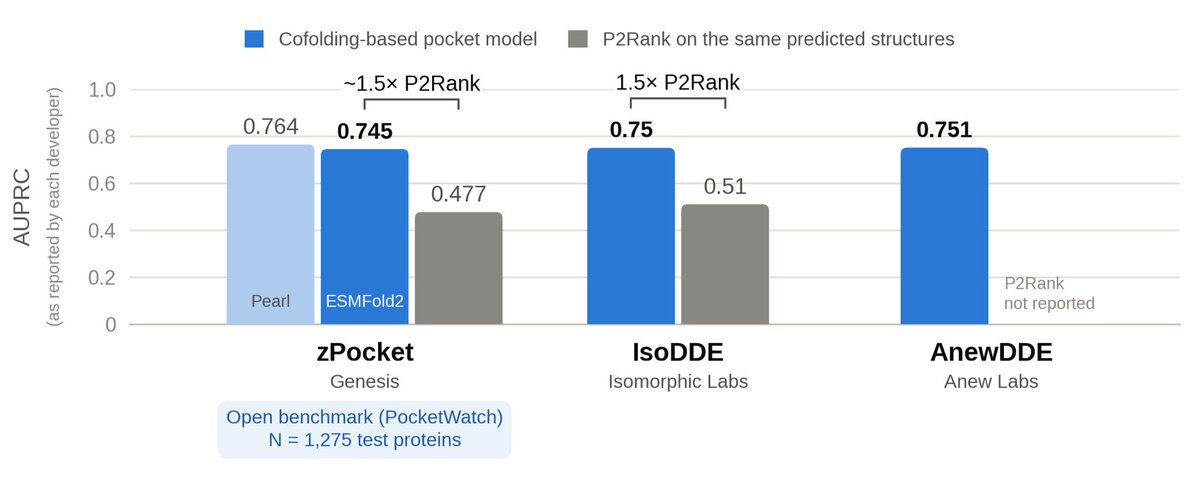
Tally Portnoi and I are releasing zPocket, a pocket prediction tool based on co-folding features (MoML top-4 papers), with performance similar to the IsoDDE and AnewDDE pocket predictors but fully reproducible and open (when using ESMFold2).
https://t.co/Ff6HXkL2Th
Generalizing Protein Fitness Prediction Across Distribution Shifts via Structural and Co-evolutionary Priors
1. The paper addresses a practical failure mode in protein engineering: fitness predictors that look strong under standard splits can break under out-of-distribution (OOD) shifts (unseen mutation positions, unseen wild-type backbones), as highlighted by FLIP2.
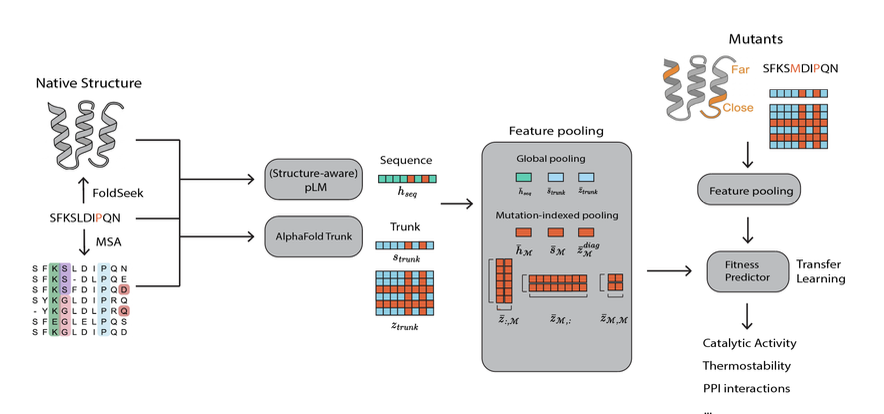
2. Their framework improves OOD robustness by augmenting frozen protein language model (pLM) embeddings with two additional priors: structural tokens (geometry-aware pLMs) and co-evolution/geometry representations from an AlphaFold-style trunk (Protenix-v2) run on each sequence plus its MSA.
3. Key design choice: no encoder fine-tuning. They precompute representations from frozen encoders and train only a lightweight 2-layer MLP probe, aiming for stable transfer when labels are limited and distribution shifts are large.
4. To make variable-length per-residue/per-pair representations usable across proteins, they pool them into nine fixed-length feature blocks: 3 global (WT-independent) blocks and 6 mutation-indexed (WT-dependent) blocks that summarize features at, or relative to, mutated positions (including several pooled views of the pair representation matrix).
5. Main FLIP2 finding: adding trunk features most strongly improves generalization to held-out mutation positions (position splits). Across pLMs on AMYLASE, average Spearman rises roughly from ~0.38 to ~0.67 on close-to-far, and from ~0.28 to ~0.60 on far-to-close; best overall configuration reported is ESM-3 + trunk (e.g., 0.712 and 0.605 on AMYLASE position splits).
6. Complementarity across shift types: structural priors (structure-aware pLMs) yield the largest gains on wild-type/backbone shifts, while trunk features contribute most on position shifts; importantly, trunk features can sometimes hurt on wild-type splits, suggesting different representations are optimal for different OOD regimes.
7. They separate “informative” vs “extrapolative” improvements by measuring gains on an in-distribution (ID) holdout vs the OOD test set: for AMYLASE position splits, trunk features improve OOD much more than ID (e.g., +0.282 to +0.323 OOD vs +0.050 to +0.073 ID), supporting genuine positional extrapolation rather than just better fitting.
8. Ablations on what the trunk adds: an MSA-only control (MSA Pairformer, no explicit structural objective) recovers a substantial fraction of trunk gains on AMYLASE (about 60–70% of trunk gain on position splits), implying co-evolution accounts for much of the benefit, while geometry contributes additional improvements particularly for positional generalization.
9. External checks beyond FLIP2: on FireProt homologue-free thermostability, ProSST + trunk improves strongly (Spearman 0.399 → 0.590) though still trails ThermoMPNN; on “new-to-nature” function mutations (outside evolutionary context), pLMs can fail, and trunk features mitigate but do not fully fix the issue (e.g., ESM-3 correlation improves from −0.60 to −0.15; SaProt + trunk reaches positive correlation).
10. Practical implications and limitations: the work argues for choosing representations based on the expected distribution shift (positions vs backbones vs disorder-rich proteins). Limitations include trunk inference cost, reliance on WT to compute mutation-indexed blocks (unavailable in some wild-type-shift settings), and persistently low performance on IRED indicating missing signals for some enzyme landscapes.
📜Paper: https://t.co/ZEbdCM8yw6
#ProteinEngineering #ComputationalBiology #ProteinFitness #MachineLearning #ProteinLanguageModels #AlphaFold #MSA #OutOfDistribution #RepresentationLearning #DeepMutationalScanning
Delighted to share that ACER has been accepted to @NeurIPSConf 2026 🎉
ACER (Adaptive Co-folding via pocket Exploration and pose Ranking) is a training-free framework that enables co-folding models to explore alternative pockets and identify the correct binding one 🧵
These suggest that the generalizability gap in co-folding is partly a sampling problem, addressable at inference time. ACER's benefits can extend to fragment-based virtual screening: by placing to-be-screened fragments into their correct binding pockets more accurately (5/5)
ACER generates local ensembles for each pocket and ranks poses, combining ensemble agreement with interface quality. Top-5 accuracy on the allosteric set improves from 30% → 50%, while ACER + Boltz-2 reaches 52.5% on Runs N' Poses, compared with 49.8% for Boltz-2 baseline. (4/5)
ACER uses decoy-ligand conditioning and iterative pocket repulsion to push co-folding models beyond their dominant binding site and explore alternatives. On the allosteric benchmark, pocket rescue improves from 55.0% → 66.6% with Boltz-2 and 40.0% → 72.9% (3/5)
Co-folding models memorizes the binding pockets seen in their training data, when a target falls outside familiar chemical space, as with allosteric or novel pockets, they place the ligand in the wrong site. ACER addresses this by exploring and identifying correct pockets (2/5)